
Translated material
Valuable story
People are so successfully looking for goods cheaper that they stopped noticing prices
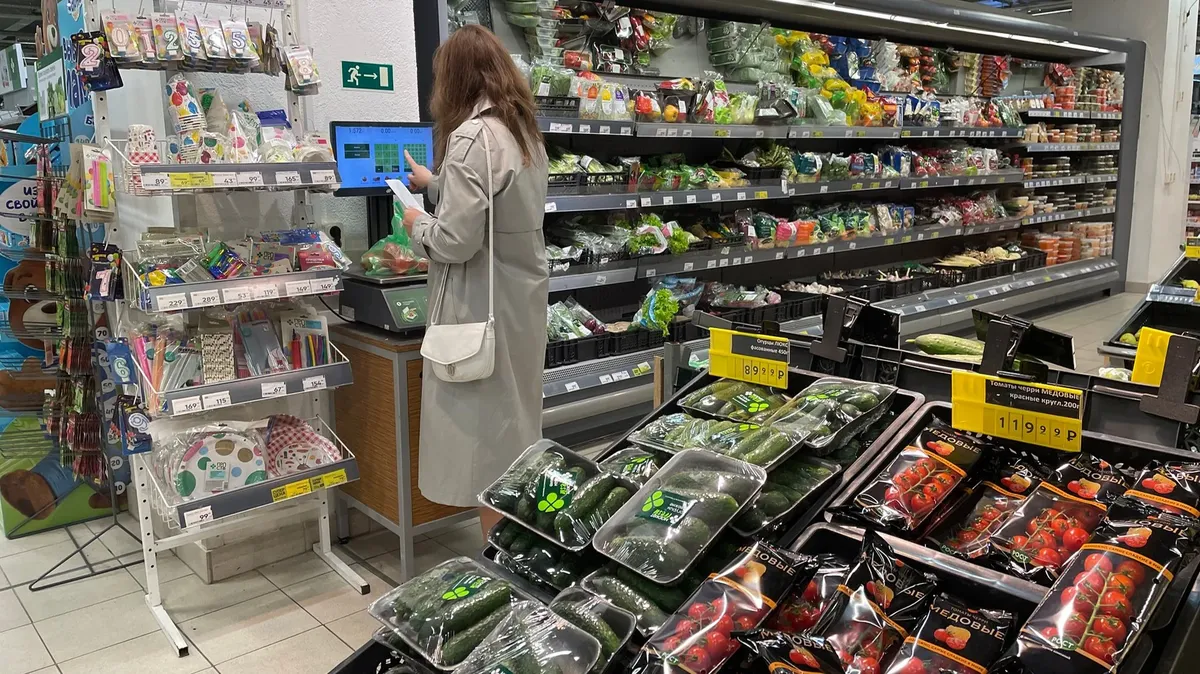
Photo: Alexey Dushutin / "New Gazeta"
Both in 2022 and in 2023, the largest share in the structure of the family or personal budget of Russians is occupied by food expenses. Now such expenses on average amount to 31% of all monthly expenses. True, in 2022, the products “ate” 35% of people's income, which allows you to formally talk about the growth of welfare. But the well -being is quite shameful.
Finally, the so-Yaitsa fell down ... but not everything is so simple
At the end of January, the “chicken eggs” finally became cheaper. According to the latest data from the Federal State Statistics Service , for the period from January 23 to 29, 2024, prices decreased:
chicken (-1.0%) on eggs,
Curric meat (-0.5%),
pork, sunflower oil, tomatoes and buckwheat (-0.3%),
Canned fruit and berry for baby food (-0.1%).
Not to say, however, that consumers have noticed such a decrease - especially against the background of constant price growth in the last two years.
At the same time, the widely advertised import of imported eggs into Russia hardly helped the market, since these eggs did not fall into retail chains, almost without affecting prices. All of them went for processing for different enterprises - mainly those that produce various kinds of confectionery. And the effect of the import of eggs was only informational. According to Rospstitsesuza, 42 billion eggs are consumed in the Russian Federation per year (115 million per day).
Has one of the authorities seriously believed that the fee for a month of daily consumption would somehow affect prices?
But, official statistics report, for the same period, prices rose to everything else:
White cabbage - by 3.3%,
Cucumbers - by 2.6%,
Canteen beets - 2.0%,
Carrots - by 1.4%,
Onions and bananas - by 1.1%,
Potatoes and apples - by 1.0%,
lamb - by 0.9%,
beef, butter, hard, semi -hard and soft cheese - by 0.5%,
vermichel, rice and vodka - by 0.4%,
Sausages, sausages, sausages half-smoked and boiled-fucked, frozen fish, pasta-by 0.3%,
Boiled sausages, margarine, milk, bread, salt, dinners in the dining room, cafe, snack (except the dining room in the organization) - by 0.2%.
With minimal margins
The margin of the largest federal retail chains for “first prices” decreased to 5%, said the head of the Federal Antimonopoly Service (FAS) of Russia Maxim Shaskolsky.
“Thanks to our work, it was possible to reduce the average combined level of margins of 11 largest federal retail chains for“ first prices ”in all 25 categories of socially significant food products by 17%. If at the beginning of August 2021 the margin was 22%, now it is 5%. ”
“It is clear that the faces need to be reported about incessant work. But we note that the margin of “first price” in networks is always minimal. And not even because the networks care about poor citizens, but because if it is high, then these citizens simply will not come to stores. Only a business, nothing personal, ”the independent expert on Retail Mikhail Lachugin comments on this statement.
Help "New"
Products of the “first price” are typical goods from the consumer basket of the average store of the store regularly present in the checks (shopping) of customers. Milk, sour cream, sunflower oil, kefir, flour, cereals, pasta, eggs, as well as household items.
At the same time, as Romir counted in the holding, “... after a slight decrease in the previous period in the fourth week of the year (from January 22 to 28), the amount of average weekly expenses of Russian households again went in growth. For a week, the average family on average spent 6908 rubles on everyday goods, which is 70 rubles more than in the previous seven days. ”
“Against the backdrop of a reduction in the size of the average check, an increase in expenses suggests that, probably, in order to save Russians, Russians visit a larger number of outlets in search of profitable price offers,” Romir’s analysts write.

Economic economy
People generally took up saving seriously - Romir notes such a trend as "the formation of stable patterns of consumer behavior aimed at saving."
“Experts Romir fix the cross-cathegoric migration of buyers, which is most actively manifested where such a choice exists. For example, in the meat category, the buyer refuses more expensive segments, such as beef or fish, in favor of more affordable - chicken or pork.
There are also price switching inside the categories - from more expensive brands to more affordable up to the focus for their own brands (STM).
A wide assortment proposal of STM in different categories has already been formed on the market, corresponding to the request “price - quality”. At the same time, purchasing trust is formed even in fairly sensitive categories, such as alcohol or children's goods, where a high level of distrust of STM was previously noted. In 2023, Romir experts note the destruction of these barriers. ”
In other words, people look more and more at the price tags, and not at brands or composition of products.
Angrily, but is it cheap?
“Another way to save directly with retail is to switch between formats and networks ...
... Networks with low price positioning are also actively growing. These are the same hard quanters through which customers close part of their needs ... ” -says Romir.
The so-called hard discounters occupy about 8% of the modern trade market, but most top managers in the industry evaluate them as the main challenge of the coming years, Nielseniq reports . Both in the monetary and natural terms, sales in this channel grow in a pace, the percentages of which make up two -digit numbers. Their dynamics are inferior only to online market.
But in fairness, we note that the savings of the savings are different. In hard-discouners, people are most (in monetary terms) buy dairy and confectionery products-their share in the revenue of “cheapest stores” is 22%each. It must be understood that in these categories it is possible to reduce prices through the use of various substitutes for natural products.
Many manufacturers have learned to replace milk and dairy products yourself know what. (But such a focus will not pass with eggs - they cannot be imitated and added to them vegetable fat.)
How do people evaluate their prospects?
This is evidenced by analysts of the Central Bank of the Russian Federation in the commentary "Inflationary expectations and consumer moods No. 1 (85) January 2024."
In January 2024, according to the info survey, inflation assessment that citizens expect in a year decreased to 12.7% (from 14.2% a month earlier), but remained at an increased level. Inflational expectations decreased both in respondents who have savings, and those who have no accumulations.
What important is inflationary expectations? Explains the Bank of Russia.
“It depends on the inflationary expectations of economic agents how effectively the monetary policy will control inflation-because enterprises, credit organizations and households make decisions on consumption, savings and investments, set prices for goods and deposits, including based on their expectations regarding future inflation.
In turn, the results of the monetary policy of the Bank of Russia affect inflation expectations.
...
Assessments of inflationary expectations and observed inflation based on the population surveys in Russia and other countries are almost always higher than actual inflation. This discrepancy is associated with the peculiarities of perception: it is common for people to notice prices and actively respond to it, while decreasing or stable prices usually attract less attention. As a result, citizens judge inflation to a greater extent by the most elevated goods. ”
For respondents with savings, median inflation expectations in January amounted to 11.2%. (Half of the respondents is waiting for higher inflation, half - lower.)

Inflation observed by the population in January also decreased. Its median value was 16.3%. The assessments of the observed inflation decreased in both subgroups of respondents - both those who have savings and those who have no savings.
Answering the question about rising prices for individual goods and services, respondents in January noticeably more often than in the previous month, indicated the rise in the cost of eggs, vegetables and fruits, as well as an increase in the cost of housing and communal services. At the same time, less often than last month, respondents began to report an increase in prices for meat and poultry, fish and seafood.
So who is right in the “price assessment” - people or statistics?
The slowdown of inflation [according to Rosstat] is primarily due to the fact that, when calculating it, over the past 12 months, the indexation of communal tariffs that occurred in December 2022 ceased to be taken into account, the Central Bank of the Russian Federation notes in a comment on January 24.
At the same time, the annual increase in prices for most groups of goods has accelerated compared to the previous month. This was facilitated by high demand, which allows sellers to faster raising prices, transferring increased costs to them.
Among food products, more than a month earlier, products of animal origin, especially chicken eggs, as well as confectionery and cereals, have risen in price. Among non -food products are cars and furniture, the financial regulator reports.
That is, the increase in prices did not go away, just people began to choose so skillfully what is cheaper that it begins to seem to them that prices did not rose so much.