
Translated material
Subty Ocean Mimas
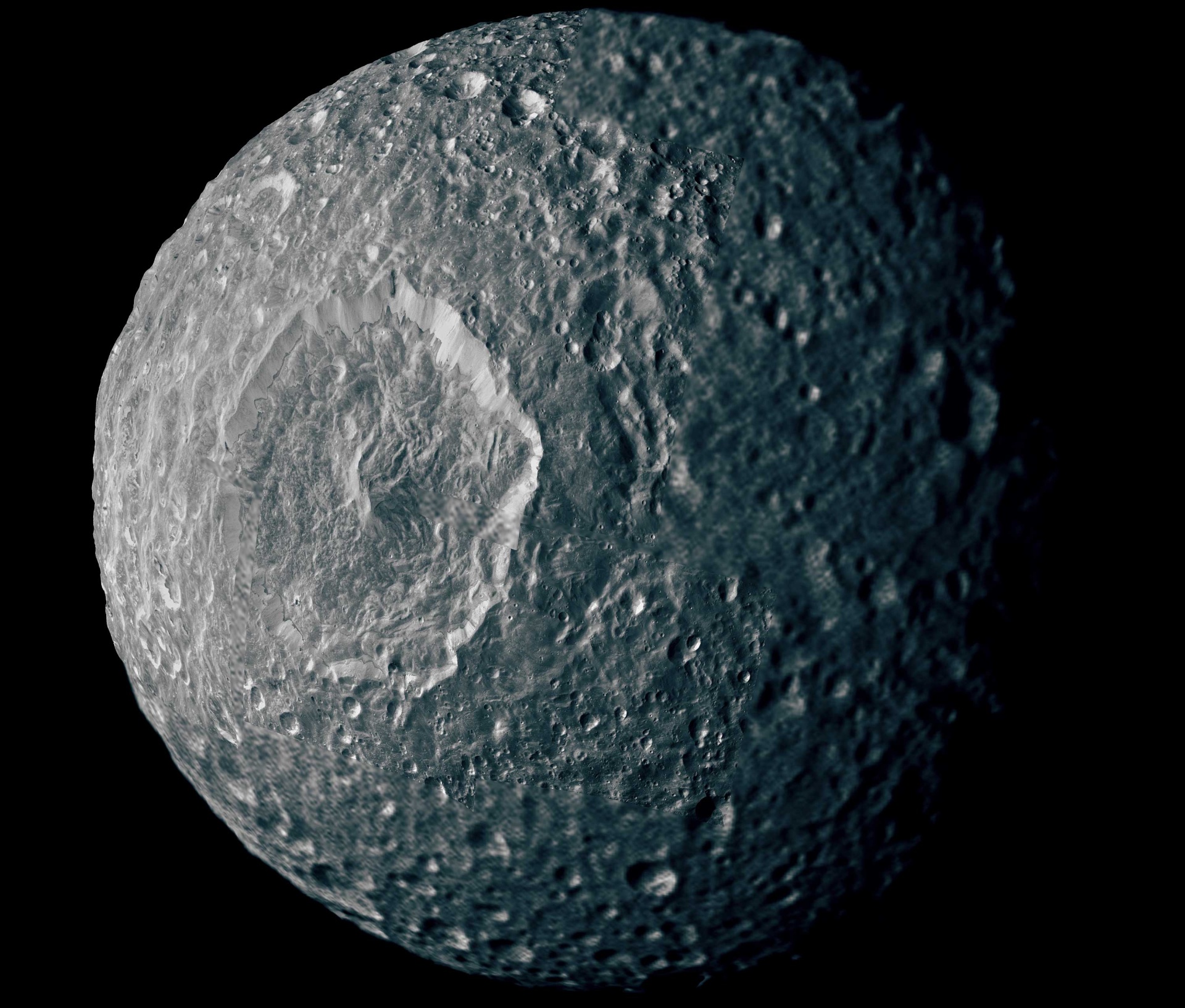
The authors of the new study came to the conclusion that the satellite of Saturn Mimas hides the ocean under his icy shell. The conclusion was made by the planetologists of the Sorbonne, the University of Nantes, the University of the University of Queen Mary, the University of Franch Contain and the University of Jinan on the basis of the data of the Kassini spacecraft about the orbital movement of Mimas. The ocean, according to scientists, was formed relatively recently - less than 2 - 3 million years ago. It is located under an ice layer with a thickness of 20 - 30 kilometers.
Mimas-the most internal and smallest (radius of 198.2 km) regular satellite of Saturn-was considered an unlikely candidate for the presence of an underblying ocean due to the difference between the properties of its surface compared to other ice satellites, such as Entezelad. However, now Valery Laine and his colleagues dispute this opinion. Previous studies showed two possibilities of the internal structure of Mimas: either an elongated rocky nucleus or a global ocean. Now, with these two models, specified data on the movement of the satellite in orbit and its rotation are compared. The use of a solid -state model would require the rocky core to be elongated, almost pancake. The model with the inner liquid ocean better corresponds to the collected Cassini data.
“Mimas is a small satellite, and its very painted surface does not give any hints to the ocean hidden under it,” says Nick Cooper from the University of Queen Maria. “This discovery is added by Mimas to the exclusive club of satellites with internal oceans, including Entezelad and Europe, but with a unique difference: its ocean is amazingly young.”
The study was published in the journal Nature.