
Translated material
"The end of the world comes to your country"
Paul Lynch’s novel “The Song of the Prophet” about the dictatorship and the Civil War in modern Ireland, which received the Buker Prize, is released in Russian
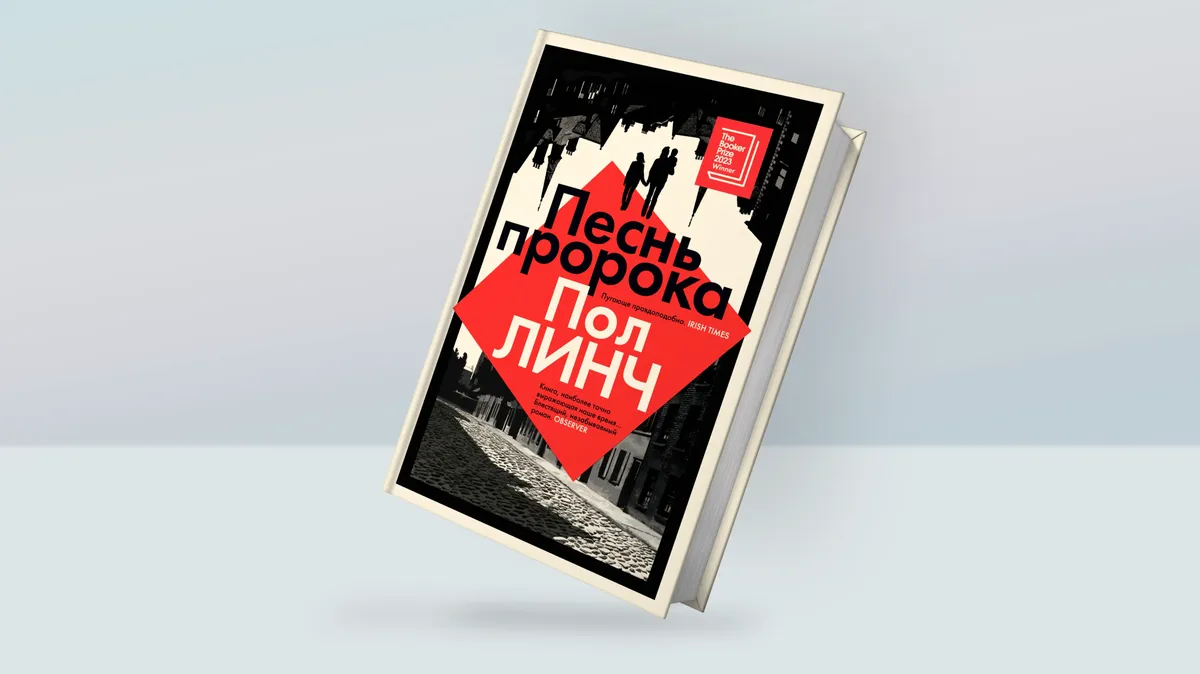
About the "Songs of the Prophet" (Publishing House "Foreigner") speak of a new bright anti -utopia. A sort of "Irish" 1984 "about the vulnerability of democracy in the face of an ever -returning totalitarianism. But in fact, Roman Lynch is not like anti -utopia. Its content is much more interesting and deeper than the declared. And it is sharply echoing with experience that the Russians had to survive over the past two years. “The Song of the Prophet” is an ideal “interlocutor”, capable of understanding both those who left and remain actively resisting the regime and “catacombs”. The answers to the questions posed by the era with Lynch are also in store. Sorin brom talks about the Buker novelty.
Who is Paul Lynch?
Paul Lynch (b. 1977) is considered one of the most gifted modern prose writers of Ireland. Before the beginning of the literary career, he was known as the film critic in The Sunday Tribune. Lynch's debut book “Red Sky in the morning” about Irish emigrants in the United States of the 19th century immediately attracted attention. Since then, the writer has released four more novels and became the finalist and laureate of several international awards. Lives in Dublin.
One evening, on the threshold of the house of Stakov, families from a prosperous suburbs, employees of the newly created public national security service appeared. They are actively interested in the activities of the head of the family. Larry Stack leads the teachers' trade union and is just preparing for a strike. According to the "guests", it contradicts the freshly received law on extraordinary powers. It soon turns out that this law prohibits citizens with about everything, and the authorities, as usual, allows everything about it. The first chapters are the embodiment of amazing and, alas, familiar naivety. Residents of the country still refer to the constitution, believe that the party of national unity will see the outrage of society and give back, and if not, then the intervention of the international community will certainly cool its ardor. But the authorities “have seriously not yet begun” and are determined to fight with society to the last disagreement. Larry is in the camp - it is impossible to visit him or contact him. And the eldest son of Stakov Mark comes the agenda - the fact that he was only sixteen and he did not even have time to finish the school, does not care about anyone.
The main character of the Prophet's Songs Ailish Stack in normal life was a successful microbiologist. But now she is primarily a mother with a special mission. Ailish is trying to protect children (except for Mark, these are adolescents Molly, Bailey and baby Ben) from the nightmare of the dictatorship and looks after his father who has very much surrendered recently. Periodically, a sister from Canada calls her and persistently proposes to take her relatives from the country. Ailish refuses, but with each chapter the idea of the sister looks more convincing. For the reader, the author acts something like Virgil from Dante's poem. “The Song of the Prophet” is a journey through the totalitarian hell, where every new circle is worse.
Rumors reach that Larry is not at all in prison, but has long been executed along with other opposition. Mark is hiding from the call from a friend, but soon, unable to withstand inaction, adjoins the rebels. Ireland is covered by an uprising, and the state army seems to have to sweat to suppress it. The new boss (the loyal servant of the party) cheerfully dealt with the dissenters in the state. Ailish is one of the first candidates for dismissal. Increasingly, she is refused to serve in stores as the mother of the "deviation". And one night, a group of patriotic young people with the silent assistance of the police smashes her cottage and a car. But these are still flowers. Soon, a checkpoint will appear opposite the house of Stakov, and fighting will begin on the street. Around the cottage, rockets will fall. Thirteen -year -old Bailey will be injured, get to the hospital, and from there he will be abducted by special services. Ailish strains the last forces to protect loved ones. But how is it possible in the coming chaos?
A characteristic feature of the “song of the Prophet” is a thick mixture of external events with the thoughts and experiences of Ailish. Lynch writes "without pauses", in a stream. Sometimes it is difficult to distinguish a replica from the dialogue from the heroines. The author is very attentive to the landscape, willingly describes the trees in the garden, the prospect of a suburban street, fields and the sea coast. On the one hand, this is a reliable way to show the reader that the totalitarian government creates special psychological conditions and in many ways holds power due to this. On the other hand, the pictures of nature, which changes in the known rhythm of the seasons, and calm, even majestic species remind that the matter here is not in a particular Ireland. The writer does not offer a political concept at all. Totalitarianism interests him in an existential context - as a property of human nature.
Ailish has the feeling that something frightening and dark (spirit, ghost?) Penetrated into the house from the evening darkness of the garden. Thinking about the virus that the children infected, she calls him "an invisible enemy, penetrating inside during inhalation." Finally, he observes rusty water coming from the tap, and represents how lead “is absorbed by the gastrointestinal tract, accumulates in tissues, bones, aorta and liver, adrenal glands and thyroid gland, poison imperceptibly does its black deed until the traces of its work are detected in blood and urine tests” .
All this, of course, is the metaphors of the action of totalitarianism. He impregnates the structure of reality itself and gradually transforms it. A citizen defending his rights, under a strict dictatorial look, begins to feel like a criminal. Lynch describes the disunity and powerlessness in a world provoked from above, where laws no longer apply. After all, one of the main psychological tasks of totalitarian power is to cloud reality, making the “rules of the game” by blurry and mobile. Without access to information, a person weaves reality from his own fears and hopes. The latter pushing him to wait and inaction, the first - to hide in a hole or join the aggressor. The dictatorship is largely kept on controlled uncertainty. Having established the “order” from above, for the “bottom” the power creates a feeling of chaos. It is no accident that in the middle of the novel, Lynch contrasts the clarifying conversation with the “silence”, into which they “take husbands”.
The exact characteristic of what is happening in the country gives in one of the conversations with Ailish her father:
“Having got institutions, you get power over the facts, you can change the structure of values, change your previous agreements, and yes, they do this ... PNE [Party of National Unity] tries to change what you and I call reality ... If you call black white and do it for a long time, black becomes white ... Of course, sooner or late, you can temporarily appropriate it, you can temporarily assign it to yourself, you can assign it to yourself, But she silently and patiently waits for to set the price and equalize the scales ... ”
In other words, totalitarianism is an attempt to subjugate reality, or even a war declared to the nature of things, world order as such.
Lynch figuratively shows this confrontation: "The birds with singing meet the dawn, then the shooting makes the world subside," or "bruises appear in the sky." However, much worse it looks where it is about people - take at least a gradual, romance, stretched throughout the romance of the stack family.
One of the most piercing scenes is when Ailish, in search of a son in the morgue, unfastens bags with dusty people, endlessly repeating the same phrase. “This is not my son,” it is written. “This is someone’s son”-it seems. Lynch, as it were, returns life and fate to the dead in order to re -crush them in front of the reader. A strong episode is a scene of humiliation of a refugee male soldier. He is placed on his knees, put a muzzle at the temple, step on the neck: “So why are you running, bald, do not want to stay and fight for your country, you are a cowardly geek?” When he finally, “carrying his humiliation on his shoulders,” returns to the bus, Ailish remarks that “something is broken irrevocably in his eyes.” He is another “dead” fragment of reality, another defeated element of nature.
The whole first half of the book it seems that soon Ailish will follow the example of Mark and actively support the rebels. Then it becomes clear - the warring sides in her eyes differ little from each other. And they establish the rules in the subject territories. In the thoughts of Ailish, reality - as, however, she herself, is changeable, subjected to smithereens, vulnerable and constantly eludes from perception and understanding. "The world is not black and white and does not always obey the orders of the commanders." It is as difficult to understand this thought to the rebels as the supporters of the regime. Both of them surrendered to fear of the world full of uncertainty. They decide to fight in order to take reality under control and impose on her own order.
The defeat for Ailish is concluded in the very entering the path of struggle, the willingness to “kill” reality: first in his attitude, then - destroying someone else's life, breaking fate. The eldest son Mark is lost in this sense. His brother Bailey copes with the internal “worm”, which, of course, refers to the biblical snake. Ailish's “Mother's Mission” is to protect children not only from hatred of the parties, but also from “poison” of their own fear, to give them an antidote - love.
“And the world ends again and again in one place, but not in another, and the end of the world is an event of local significance, the end of the world comes to your country, visits your city, knocks on your door ...”
- Such an apocalyptic (hence the name of the book) The image of the Civil War is very important for the selected Ailish paths. In universal reality, woven from many individuals, the Apocalypse occurs at each individual point of space, and the task is to defend its own. Do not allow yourself to fall out of a living, animated world, not to become deadly power. Contrary to all tests, save empathy, trust and learn to accept a natural (albeit not very rainbow) structure of the world. In anti -utopias, it is usually love that is opposed to totalitarianism. But, unlike Orwell and Zamyatin, she wins by Paul Lynch.