
Translated material
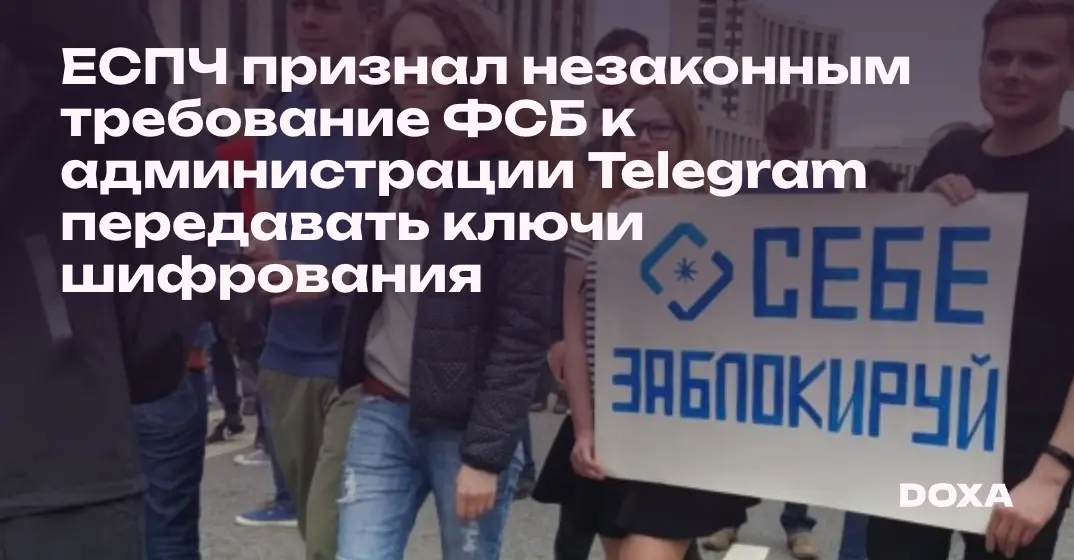
The ECHR recognized the FSB demand to the Telegram Administration to transfer encryption keys
On January 25, 2024, Doxa was recognized as an “unwanted organization”.
If you are in Russia or plan to return to it, you can not replace our materials on social networks, refer to them and publish quotes.
Read more about what is possible and impossible, read in the cards .
The European Court of Human Rights made a decision on the Telegram case. The court agreed with the requirement of Anton Podchasov, the Telegram user from Russia, to recognize the requirement of the FSB to the Telegram administration to transfer the encryption keys illegal. At the same time, the court rejected the requirement to compensate him for moral damage, considering that it was compensated by the statement of the fact of violation.
The Telegram case was initiated by Roskomvoboda, which collected and transferred 23 complaints to the user: NIC. The reason for the complaints was the decision of the World Court of the Meshchansky District of Moscow, which in October 2017 fined Telegram for 800 thousand rubles in the FSB claim for the fact that the company's administration refused to transfer the “encryption keys” to the security forces: this would violate the user's right: NIS for the secret of correspondence. In 2018–2020, Telegram tried to block the work of the messenger in the country, but later abandoned this policy.
As the head of the legal practice of Roskomsvoboda, Sarkis Darbinyan, who represented the interests of Podchasov in court, noted on the eve of the publication, this decision is significant even despite the fact that Russia's membership in the Council of Europe is suspended and the country does not recognize the decision of the ECHR. “ I am convinced that sooner or later the“ warm Russia of the future ”will return to the ECHR, and then all the decisions of the Strasbourg court made against Russia will have to be executed. <...> In addition, the decision will be important for all other countries - members of the Council of Europe. This became especially relevant in connection with the recent legislative initiative of Great Britain ... in fact, prohibiting through encryption. If their [amendments] will be accepted, then IT companies will not be able to prevent the authorities to monitor citizens , ”Darbinyan wrote.
Sarkis Darbinyan also answered DOXA's questions about Telegram on the trial and the consequences of the decision of the ECHR.


Cyberadvatok
Sarkis Darbinyan
If Russia executed the decision of the ECHR, what consequences would this have in the country? In this case, would she have to justify Telegram in the case of 2017 or somehow change the legislation?
If Russia executed the decisions of the ECHR, and the Russian authorities wanted to remain part of the international judicial system, then after the indicated decision of the Strasbourg Court, it would have to do quite a lot-firstly, to reconsider the provisions of the Yarova Law regarding traffic, correspondence and metadata. Secondly, it would be necessary to recognize the requirements of the FSB to transfer the encryption keys and the subsequent blocking of the messenger illegal with the revision of all judicial acts issued in the case. Well, thirdly-to pay compensation to all the victims at the expense of the budget, as well as cover all the losses of the company itself, in view of the illegal restriction of access to the service.
How much was Telegram itself in this process? Was he somehow involved in him, and his interest changed after unlocking the messenger or in the light of some other political events?
All the political and civil activity of Durov ended there in 2018, immediately after blocking the messenger, when he first and the last time called usuals to disobey and expression of a civil position at the rally. Then Durov also did quite a little, allocating the money to third-party developers of proxy servers, who ensured the performance of the messenger in the dark times of the blocking.
But as soon as the Russian authorities lagged behind the messenger and suddenly unlocked him without any normal explanation, Durov's activity ceased. And this, of course, gave rise to more rumors - that Durov lay down under the FSB, the keys were given for a long time, and the messenger is not so safe. Well, when in 2021 Durov stated that Telegram deleted the Bota Voting Bota from the Navalny team, referring to the observance of local elected law and pressure from Apple and Google, that they supposedly drank messages from shops, if the Messader did not remove him, Dukurov Haters were no longer stopped.
In the whole process, the Telegram team did not take any part, and apparently, he showed no interest in it. It was a pure victory of civil society, but not a business that, having much large resources, could go much more efficiently to the courts to protect the rights of their users.
You wrote that this decision will be important in other countries - members of the Council of Europe. And how exactly will he affect them? European countries will now not be able to ban through encryption? Or do they have loopholes?
As follows from the provisions of Article 46 of the Convention, the legal positions of the European Court of Human Rights, which are contained in the final decisions of the court adopted in relation to any members of the Convention, are mandatory for courts. Therefore, this decision creates the uniformity of judicial practice for the entire Council of Europe. To argue its decision, the court refers to the most advanced legal standards in the field of protection of digital rights. The court refers us to the UN already formed position on the publications of communications, the legal position of the Council of Europe, the practice of the EU under the GDPR (EDPB and EDPS solutions), as well as the positions of the Europol and the European Cyber Promotion Agency (Enisa). Well, at the end, as a cherry on the cake, the court fixes its verdict with references to the most relevant practice of the European Justice Court (not to be confused with the ECHR!) In the field of privacy - the Maximillian Schrems v. Data Protection Commissioner, Digital Rights Ireland and Seitinger and Others, Big Brother Watch and Others v. The United Kingdom).
Therefore, for all other countries of the Council of the Council of Europe, the decision will be very important. It is especially relevant today in connection with the recent legislative initiative of the UK, amending the law on the powers of the investigation (better known as the "Charter of the Spy") and, in fact, prohibiting through encryption. If these proposals are accepted, the IT companies will not be able to prevent the authorities to monitor citizens, and the law itself can force the company to establish encryption backdors and weaken the safety of users. Techigigans will be required to notify officials about products and services that may limit the government’s access to personal information, including access to personal data of users outside the UK. That is why the indicated decision of the ECHR will now very much help civil society and human rights organizations in Europe to defend the right to through encryption as a human basic law in a digital age.
The news is complemented by the commentary of Sarkis Darbinyan