
Translated material
Azerbaijan wants to return hundreds of thousands of people in Karabakh
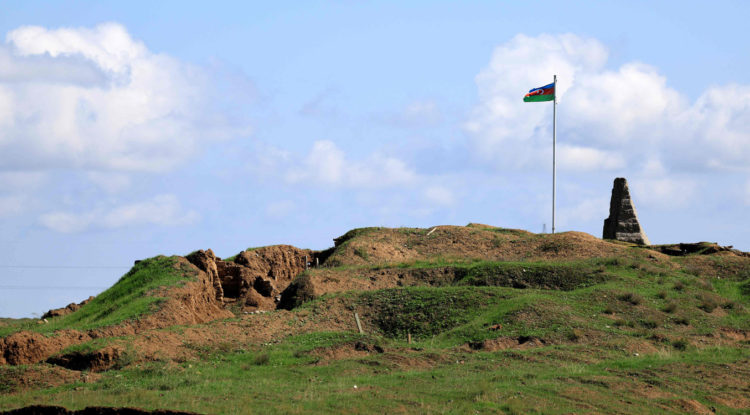
But many are not ready to return and require compensation. What went wrong?
The return of Karabakh sets before Azerbaijan a unique task for recental history - on gigantic territory, the authorities will have to build an economy from scratch, and reconstruct cities and villages. This is necessary that about half a million refugees expelled by Armenians from 1991 to 1994 could return to their native lands. The years of speculation by the political elite raised the bar of expectations so high that the harsh reality does not correspond to them at all. At the same time, the authorities are not ready to listen to the dissatisfaction of citizens, because of what, fearing persecution, residents are forced to hide their faces and names when they criticize the Karabakh policy of the authorities. Especially for the “cold”, Kirill Krivosheev visited the liberated territories and tells how the expectations of the Azerbaijanis diverge from reality.
In order not to miss the main materials of the "cold", subscribe to our Instagram and telegram .
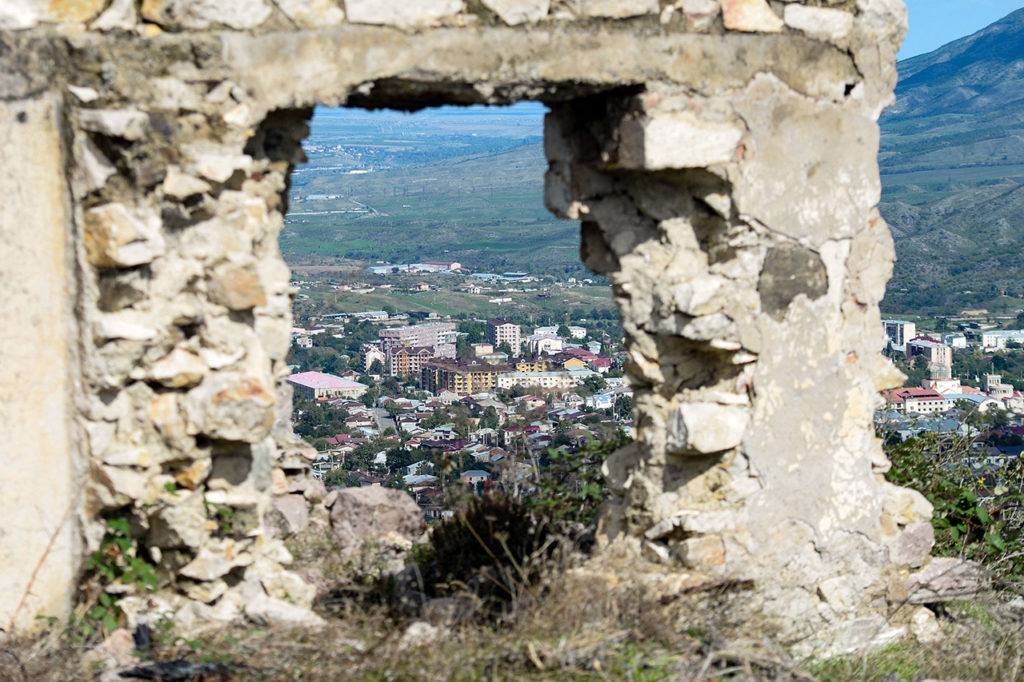
A little more than three years ago, in December 2020, I already walked along Fizuli. The Azerbaijani flag over the city was already fluttering - over the facade of the editorial office of the newspaper Araz . The arch with columns in the style of the Stalinist Empire was preserved and striking on the background of the ruins. The only whole building in the entire district was the military unit in which the Armenian garrison was located. The Armenians, taking possession of the city in 1993, even renamed it in Varanda (in honor of the Armenian principality of the 17th century), but did not plan to live there. Like other cities and villages left by Azerbaijanis, Fizuli simply dismantled the stones to build houses in Stepanakert (Azerbaijani name - Hankendi) and other parts of Karabakh. After a 44-day war, shells and scraps of Armenian military uniforms lay in the road mud.
It is still impossible to come in Karabakh independently-passing there for both Azerbaijanis and foreign guests give out government agencies. In Shushu, which is considered the pearl of the region, there are official tours , but this is more reminiscent of Soviet vouchers abroad - everywhere you need to move in a group and only in “proven” places. Such severity is explained by the presence of mines - the last incident was February 5 near the former front line. Since December 2023, they made a relief: citizens were allowed to drive to Shushu and Sugovushan on personal cars, but without stopping and with mandatory registration on a special site. I am going with a press tour from the Azerbaijani Foreign Ministry-this is an imperfect, but the only possible option.
Fizuli model of 2024 looks like a good area of the Moscow Region. There are still skeletons of old houses with the Araza editorial office, but five or six-story houses with coffee houses and shops on the ground floor, multi-colored playgrounds and a new school for 960 students were built from them-clearly with plans for a great future. Its construction financed Uzbekistan as a sign of Turkic solidarity, and at the opening ceremony there were two presidents - Ilham Aliyev and Shavkat Mirziyoyev. Inside, the school looks very European. The only thing that reminds of the place where we are is the patriotic drawings of the students. They depict the Shushin fortress, the flower of Hara Bulbul , which is considered a symbol of Karabakh, and, of course, Azerbaijani soldiers.
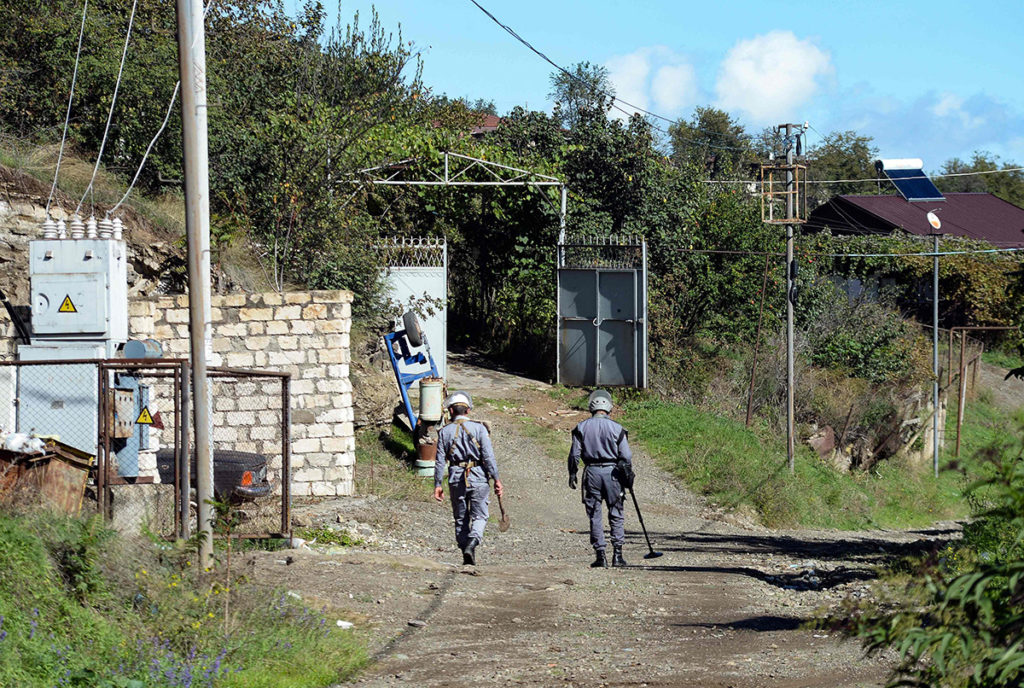
In addition to abouttwo thousand immigrants, there are many builders in Fizuli: new buildings are being built around the new buildings. “We came here to work here, but if we are offered to stay, with pleasure,” says Mubariz. He speaks Russian well, because he was earned in Moscow. “I think our president will quickly build everything here. If the president puts his hand, so it will be. Soon the whole world will see what the Turkish power is capable of! ” - exclaims Mubaris. There is no difference between the concepts of “Turkish” and “Turkic” in the Azerbaijani language, and the red flag of Turkey is almost always hung next to the Azerbaijani tricolor.
"The photo is not necessary, otherwise my children work for the state"
Those who do not only work in Fizuli, but also live, also look at the future with optimism, but mentioning the shortcomings still interrupt the blessed picture. I go up to talk to a group of elderly men sitting near a still -working pharmacy. “There are no pharmacies, there are no hospitals, but there is a school,” says Muzaffar (the name is changed ), twisting in his hands the rosary and a pack of cigarettes. - Only do not show the photo, otherwise my children work for the state. Then they will ask me: “Why did you say so?” The most important thing is that our president is good. The factory will be built, work will be. I used to respected Putin. Now not. "
Visually, it seems that there are more people around the age than young. The apartments are given to the Fizulites for free, but with work it is still bad. In fact, you can be either a teacher at a school, or a driver, or an employee of utilities. Therefore, often men transport their wife with children and elderly parents to a new apartment, and they themselves continue to earn in Baku. It turns out essentially a shift: several days here, several days there, although 325 kilometers between Baku and Fizuli. In Russian, Azerbaijani youth does not always speak, but I understand the main idea: “Burada Iş Yox”-“There is no work here.”
“These young people simply do not think what's what! Those who do not want to return here, I do not know and do not want to know. We fought for the freedom of the people and returned our own. My daughter was given a three -room apartment, a two -room son, ”a man aged at the entrance, who introduced himself as a talekh, emotionally declares to me.
He claims that he participated in both wars (1991–1994 and 2020) and that his pension is $ 800. Of such money in Azerbaijan, only a senior retired officer can receive, but Taleh refuses to tell the details of his biography - “military secret”.
Realizing that I am a journalist and ask people, a guy came up to me and showed a message on the phone in Google Translate: “I am a new resident, I can’t find a job where I’m going, they say to me, and the salary is not good for vacancies, which are not praised because of fear of the authorities” ( punctuation is preserved ). The translator between us is called by 21-year-old Ali. He speaks perfectly in English because he works with tourists in Baku. It turns out that the parents of the unemployed guy have already found a job in Karabakh, and he wants to live in Fizuli and create his family, but so far does not know how to provide it.
Ali himself still lives in Baku, but the family is already here, and he also wants to move "as soon as possible." “I will create my company and work with tourists here,” he says confidently. True, Ali's family, apparently, was more fortunate than others: their apartment in Baku is their own, not state. So, there is no risk of it.
"Open Air Museum"
The Smart village of Agaly in the Zangilalan district, where we were taken after Fizuli, looks beautiful both from the satellite , and close to the central square with a fountain, a restaurant and a bank with rays diverge streets with the same neat houses - one -story or two -story, with a balcony. In the distance, snow caps of mountains are visible - they are already on the territory of neighboring Iran.
If you believethe state media , the “standards of modern urban development will be applied to the agals, such as“ smart ”streets lighting, the construction of ecological houses resistant to heat and cold, household waste management, the construction of hydroelectric power plants, the installation of solar panels and the use of biogas energy”. But here people have complaints - in tiny courtyards they allow the maximum of the bird.
The idea of the authorities looks reasonable - a farm for animalswith Italian and Israeli equipment , gardens and fields should be located far from residential buildings, and only flowers and steam of trees should grow in the personal plot. But the idea to create a beautiful European village is conflict with the habits of Azerbaijani immigrants who want to start their own livestock, and not just work for agricultural holding, opened with the support of Recep Tayyip Erdogan. According to the authoritative publication of Eurasianet, members of the ruling families of Azerbaijan and Turkey were directly involved in agricultural projects in Karabakh.
“It is clear that when the state gives something for free, it establishes the rules of the game. But, as for specifically, Agala, I think that it is just a beautiful, but non -viable project, ”says Natig Jafarli, a member of the Real Opposition Party, a member of the Opposition Party.
He calls the agals an open-air museum, which is shown to all foreign guests, and rejoices that the authorities do not plan to build similar projects somewhere else. “Everything should be thought out more organically, and first of all, it should be done by land reform. After all, when the Armenians seized land, there was no private property yet, ”says Jafarley.
"If they do not pay compensation, I will burn the house"
During 2021, the Azerbaijani authorities conducted a deep survey of internally displaced persons, as well as business representatives about their readiness to move to Karabakh and participate in the restoration of the local economy. “It does not surprise anyone that almost all the families of internally displaced persons expressed a strong interest and joy about the liberation of their native lands, which they have been waiting for for almost 30 years for so long. The percentage of respondents who want to move to their native places reached the absolute majority, ” the article says on the Baku Dialogues website. This is one of the ADA University projects, created on the basis of the Azerbaijan Foreign Ministry, and the author of the text is the vice -rector of the university Fariz Ismailzade.
True, problematic issues are also noted there. According to the author of the article, the family of immigrants “asked serious questions and expressed fears about the safety, housing conditions, work and state of infrastructure on the ground” and made it clear that their readiness to move depends on these factors. Finally, sociologists drew attention to the difference in answers within the framework of one family “depending on the age and gender”, the desire of young people to maintain a city lifestyle, as well as a strict requirement to ensure the move to the village where the family had to escape in the early 1990s.
Another topic that bothers immigrants is benefits. In his New Year's handling, Ilham Aliyev already called refugees “former”, although such a wording still looks hasty. “Those refugees who move to the liberated territories will use the benefits further,” Farid Shafiev, head of the State Center for Analysis of International Relations, said at a press conference on February 6. “And those who prefer to stay in Baku or in other places will lose benefits after three years .”
“Firstly, this is a purely voluntary process,” the deputy of the Nizami Safarov continues after him. - No one is forcibly returning to the liberated territories. It must be taken into account that refugees, I mean 300 thousand resettled from Armenia, and forcedly displaced faces lived out of their native foci for about 30 years. They have a job here, they have family ties here. But the process is carried out in accordance with the Great Return approved by the President of the Strategy, where the program is spelled out to optimize this process. ”
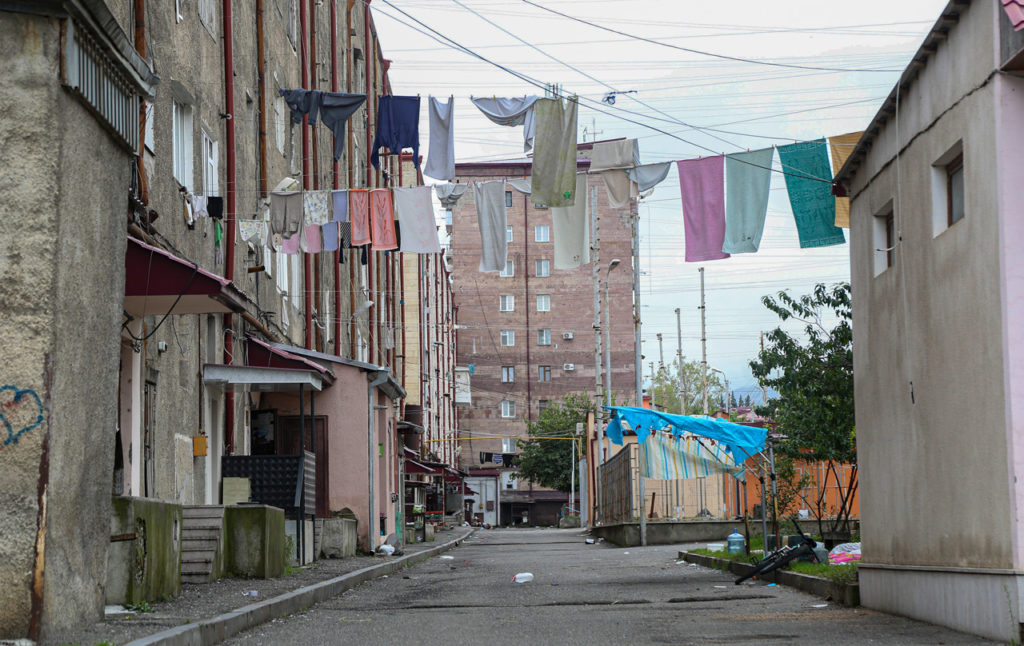
To talk to the immigrants directly, I went to the village of Raman near Baku. Even the local school is still formally referring to the city of Hankendi - here children of forced immigrants study, and their parents with the Karabakh registration voted in the presidential election. True, my first interlocutors - the company of guys relaxing in the street cafe, turn out to be Tereter. This city was never occupied by Armenians, but the war in it was felt in full - in the fall of 2020 there were mortar and missile shelling . While we are drinking tea, guys share problems: it is impossible to find work in Termer, so they are forced to live here. Twice a month they go to elderly parents - this is 330 kilometers. They nod to my story about a trip to Fizuli - if there are no worthy conditions even in the "old" territory of the country, then what can we say about the "new".
After a short walk along the private sector, I find a bakery - near it are the same immigrants from Karabakh: Khojaly, Malybeeli and Agdam. Women working there behave in a Caucasian hospitally-they offer tea and fresh bread from a tandoor with home cheese, but several times ask them not to photograph and mention real names.
The problem that they talk about seems unexpected, but at the same time very typical of post -Soviet realities. “Until 2007, we lived in the rooms of the sanatorium of the village of Buzovna on the Caspian Sea,” says a man from the village of Malybely near Shushoi (in 1992 there was a murder of civilians ). - Then they gave us the house here, but it was terrible: the cracks in the floor, a bad roof. Insects and snakes crawled into the bathroom. I invested 30 thousand manat (17.6 thousand dollars) in repairs, and some even more. Next year, they offer me to move, but without compensation. But I even bought trees for the garden myself. They would have built it right away right away - I would not have to spend money. Or let us live in a sanatorium. ”
“I’d better buy a boots for myself for these 200 manat. In these trips they accompany everywhere, as if we are some kind of sheep, ”the man answers the question of a trip to Karabakh.
About the house in the reeds, where snakes crawled, says a woman who treated me with bread. “When my son grew up, I asked the officials of permission to build a separate house on the ground, which was allocated to us for crops,” she says. - They allowed, and we built. And now they say that when moving, we must leave both at home without compensation. The son never saw Agdam and does not want to go there at all. If they don’t give me compensation, I just burn the house! ”
In the same way, in 2020, the Armenians also burned their homes, leaving the Agdam and Kelbadzharsky districts. In one of them, I then found a service, melted Turku and books that became a handful of ash.
Housing and grief cycle
In the basement, where the office of the human rights center of Azerbaijan is located under the leadership of Eldar Zeynalov, time seemed to have froze in the 1990s. On the shelves are the dusty books and brochures about human rights in Azerbaijan, Turkey, Armenia and Georgia. There are materials about wars in Chechnya and Karabakh: reports on war crimes and proposals of the conditions of a sustainable world. I catch myself thinking that in almost all countries of the region, it is hardly possible to work on something like this for one reason or another.
Back in 1993, Zeynalov published in Baku and Moscow publications (for example, the “ New Daily Newspaper ”, which then became a “new newspaper”) an investigation about the process that Azerbaijan prefer not to mention. Some Azerbaijanis from Karabakh behaved about the same as the Spanish Okupas - they seized someone else's real estate, using the connivance of the authorities. The remaining Armenian and Russian families often became victims.
“Although the courts recognized the right of owners to housing, no one was in a hurry to evict refugees. This process was postponed to the “complete liberation of Karabakh from the Armenian invaders,” Zeynalov tells the “cold”.
At the same time, until 1998, the rule of six months worked - if the invaders managed to hold out this period in the apartment, then the previous tenants lost their residence permit, and the new ones received. Later, this even allowed to privatize such apartments that it was clearly in the interests of the huge apartment mafia. In general, this is a completely vile chain of violence - when the former victim becomes an executioner, Zeynalov says. In his opinion, even now that some of the Karabakhtsev returned to their homeland, it will not be possible to roll back this process in many cases.
In the stories I told from the frame, he also sees victims of state policy. However, in his experience there were less unambiguous stories. “Some immigrants really made repairs at their own expense. And others, on the contrary, brought the received housing into an unsuitable state to get an apartment in a new house. Previously, fires often flashed in the dormitories from Karabakh, and few believed that this was an accident. ”
Migrants, unlike everyone else, were forbidden to privatize housing, in which they sometimes lived for decades. According to Zeynalov, the reason is obvious: the state did not want them to take roots in a new place, because otherwise there would be even more problems with the return. Now the housing that they occupied will be distributed between war veterans and the families of the dead. It will be difficult to object against this to Karabakhans - because it is thanks to these people that they get the opportunity to return.