
Translated material
Stream and plunder
A brief story of the confiscation of property in Rus' - from Ivan the Terrible to Stalin. Why prepare citizens in the era of their
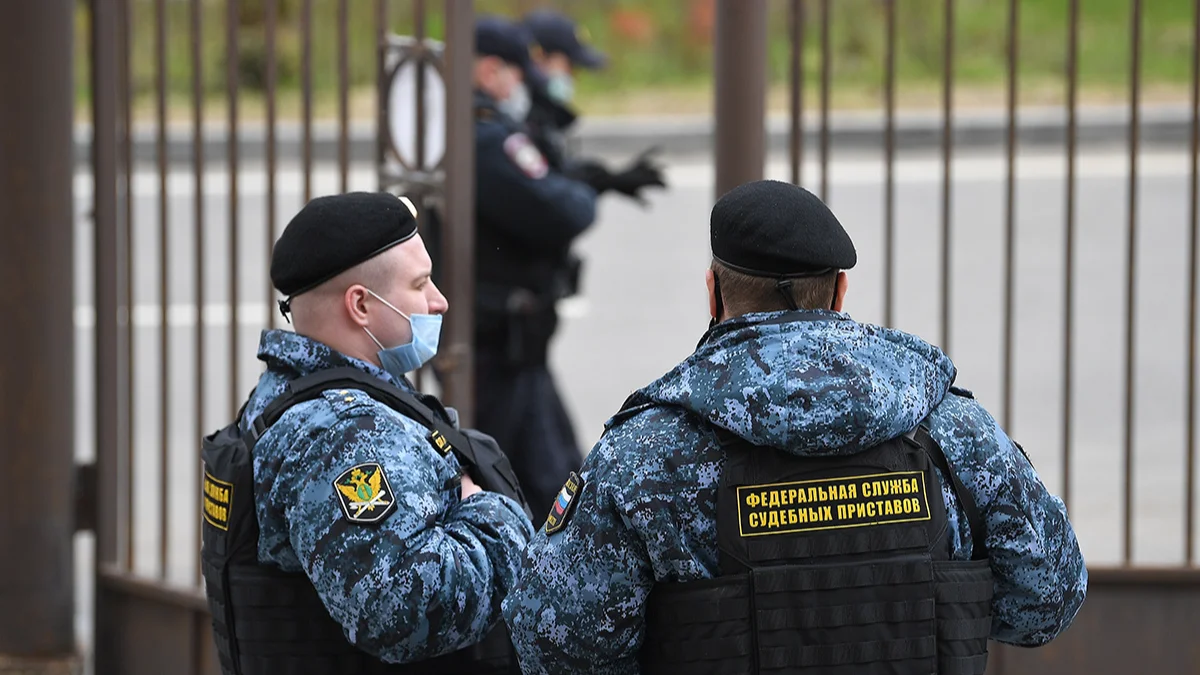
Photo: Alexander Miridonov / Kommersant / Sipa USA / Vida Press
The State Duma adopted a law on confiscation of property among citizens who committed crimes against the state - for example, "discrediting" the Russian army invading Ukraine. Lawyers say that the current legislation still does not allow the authorities to take away any property from the offenders, so you can still focus on the “guns of crime” (will be taken by the laptop) and the property earned by the “criminal way” (the journalist who “discredited the army” bought an apartment in a mortgage). On the eve of the first trials with the confiscation of Novyevropa, the historian Nikita Gusev asked to recall the rich domestic tradition of the seizure of property from “dashing people”-from the era of Ivan the Terrible to the Stalin reign.
I must say right away that we have a long and bright connection of politics and confiscation in Russia. Its brightness is in complete unpredictability: we just lived in the day, and here-and, it turns out, the day is completely different in the yard, and the rules of the game have already changed, from more or less modern turned into medieval ones. The power, which is long provided to itself, uncontrolled, vulgar autocratic, loves to plunge into the past. There is an explanation for this.
Power cannot help but love archaic, it is convenient. Archaic deals with mass instincts, in particular with a tendency to collective reprisals. In conditions of deep social inequality, the mass is always ready to greet anyone's defeat in property rights. If in the old days this punishment accompanied by a public death penalty, the pleasure was double: firstly, the crowd received a spectacle, and secondly, satisfaction from the fact that the confiscation of property left a family of executed in the poor position. And if it was about the execution of a state criminal, and there was, as a rule, a person from the ruling class in the Russian Middle Ages, then a feeling arose: here it is, the triumph of justice.
The concept of a crime threatening the state system appeared at the end of the 15th century in the lawsuit of Ivan III, grandfather Ivan the Terrible. Such a crime was called "dashing business." And any, who did not even do anything, but potentially capable of committing unlawful actions, could be recognized as a “dashing man”. The concept of “lean people” is also introduced - persons who have committed the act intentionally.
Anti -state crimes under different names are reduced to provocation of instability, treason, espionage, attempt to conspiracy or rebellion with the involvement of the people and the murder of a representative of the ruling class. Punishment is death and confiscation.
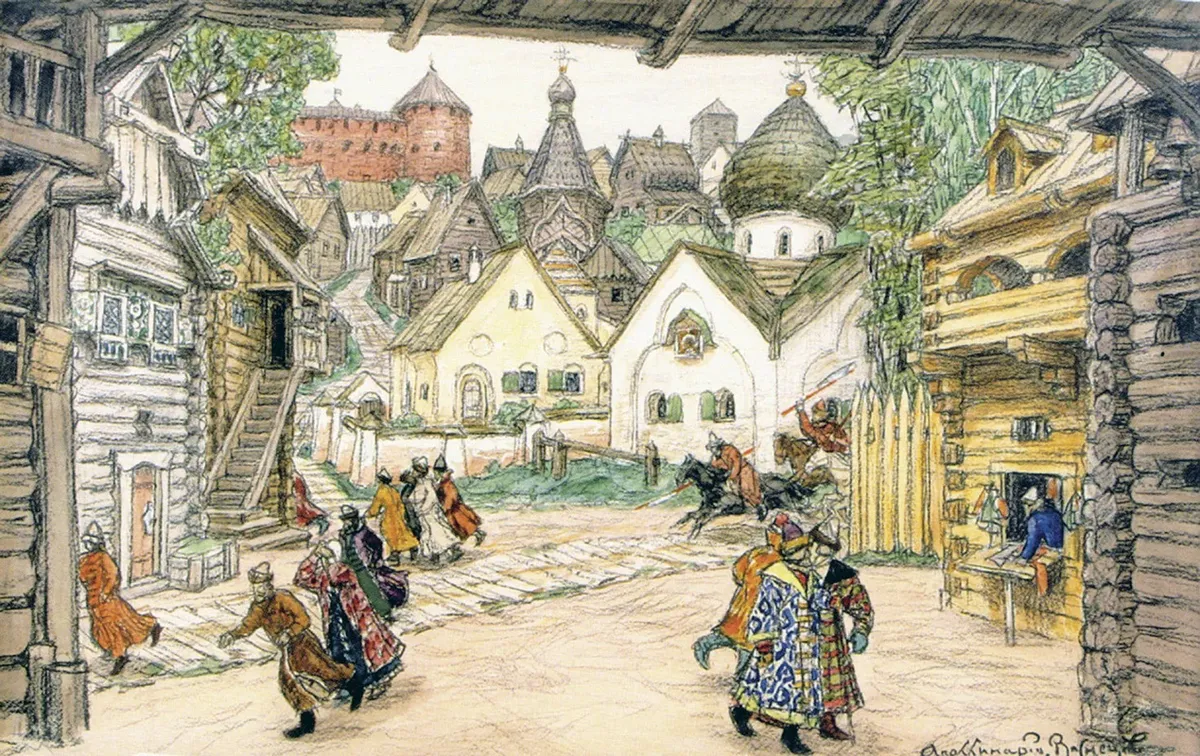
Confiscation under the old mode: from the era of Ivan the Terrible to the reform period
Ivan the Terrible in his userik did not make fundamental changes to the list of political crimes and punishment for them. True, the trial was accepted before the oprichnina, to the mass deadly in Veliky Novgorod, that is, in the “vegetarian” period of the reign of Ivan IV. And then there were no to the written laws, complete arbitrariness, sadism, debauchery, wild suspicion, torture and execution of people of the near and far circle and just rivers of spilled blood went.
Then, under Alexei Mikhailovich, the father of Peter the Great, the Council Code appeared, and in it - a number of innovations in the section of political crimes. This legal document arose after the Time of Troubles, after the impostors claiming the throne, respectively, it already had articles about the crime against the personality of the tsar and his family members, on the preparation for armed rebellion and on the informal authorities of the authorities of anti -state intent.
In connection with the special danger of state crimes, the responsibility for them, in addition to the guilty, was also carried by members of his family (wife, children, parents and even distant relatives). Confiscation was also provided, but with some nuances, sometimes the family could save something.
After the church schism, a new category of persons immediately appeared whose property was subject to confiscation: a well -known character from this category - the boyar Morozov.
By the way, when the picture was exhibited, and this is 1887, the official reviews of Surikov were accused of "promoting a split through an artist's brush." But then the accusations of the propaganda of the anti -state of the Old Believers had no consequences for the artist and did not prevent the acquisition of the picture in the Tretyakov Gallery with its subsequent demonstration.
Peter I also liked the confiscation: the money from it with the adjustment of theft went to the state. Pyotr, with his activity in money, was in dire need of money.
Catherine II ordered a different way and among the rights guaranteed by the nobility banned confiscation even in the event of a “condemnation of an important crime”, that is, a state, political crime: property departed to the heirs.
After reading the Journey from St. Petersburg to Moscow, the Empress was furious, Radishchev was arrested, accused of inciting to the rebellion, sentenced to death, but pardoned and exiled ten years to the prison. Catherine believed that Radishchev shared the ideas of the French Revolution, which was just "anger of the day." At the same time, there was no confiscation of property.
In exile, Radishchev wrote a legal article in which, among other things, he spoke about the ratio of confiscation and private property rights, and after the exile returned to his estate.
Alexander I spread the release from confiscation to the merchant and bourgeois estates. The confiscation did not affect the Decembrists, although in the case there were such aggravating circumstances as the intent on regicide and complicity in conversations about regicide.
Wives, children inherited the estates. The low -income wives of the Decembrists, who, in view of the exiles of her husband, lost the breadwinner, a state pension was assigned.
At the turn of the XIX - XX centuries, complete confiscation was already considered both theoretically and practically insolvent, documents were being prepared to eliminate this punishment measure. Moreover, in relation to the exiles, including political and administratively sent to the public supervision of the police, the state had great economic plans: the authorities wanted as many people as possible to settle in sparsely populated Siberia. Therefore, the exile was given out benefits, money loans, land, it was allowed to hire. Who wanted to engage in agriculture, received 15 acres (and tithes - this is almost a hectare) for a person - the calculation was that people would bring families. Moreover, this was the case during the political reaction after the 1905 revolution.
By the way, at the moment when Lenin was in Shushensky, his mother’s estate was still preserved, the family will sell it a year after the exile.
That is, if you look back, the trend with confiscation in Russia as a whole is positive.
But when Lenin is in power, it turns out that no one in the Russian autocratic past loved confiscation like the Bolsheviks. Ivan the Terrible would have been aligned with a gigantic scale of arbitrariness.
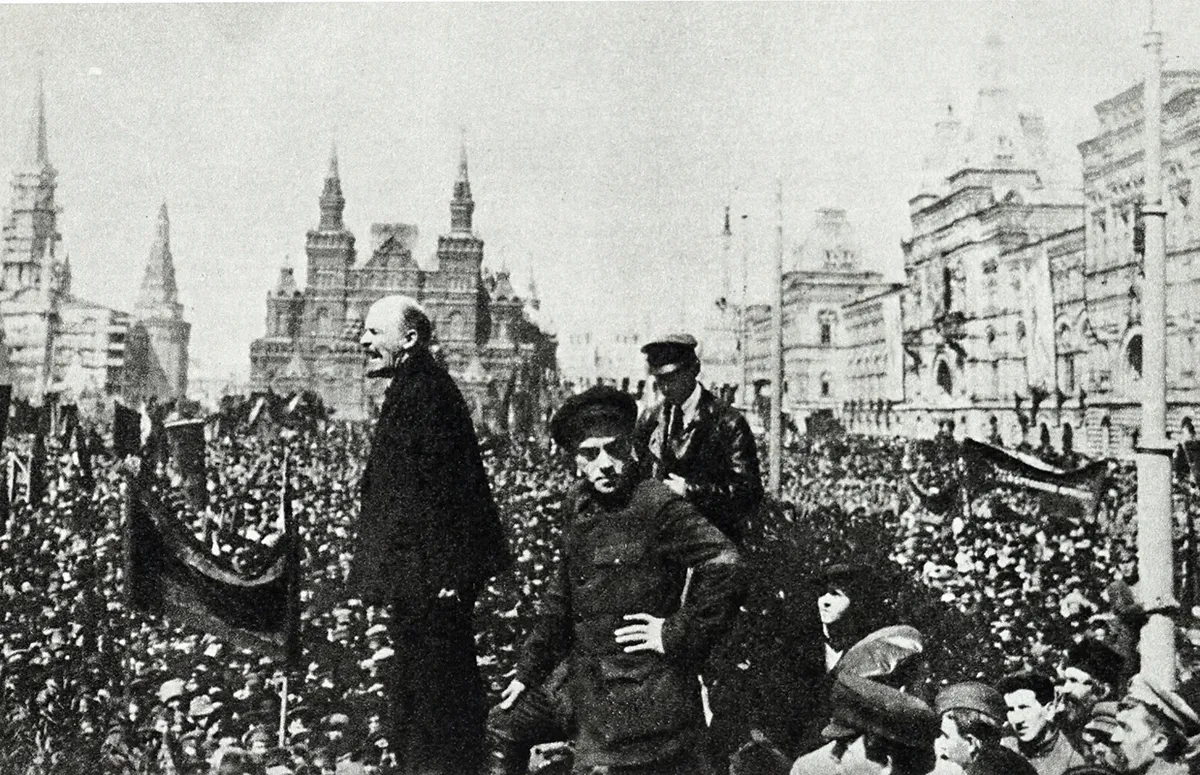
Lenin as aorist and confiscation practitioner
The main trick of the incident was in the moment of collapse from the present in the Middle Ages. None of those who lived then could assume the likelihood of such a sharp departure of an entire country from normality. It was so incredible that did not find a definition daily and everyday. Although it was medieval Russian language that could offer an adequate name for what is happening - “stream and looting”. Moreover, this is a legal term. So in the first ancient code of laws of Kievan Rus, in Russian truth, the punishment with confiscation was called. In accordance with him, the convict was subject to expulsion (stream) outside the territory of residence, his family fell into slavery, and the property was given to the looting. True, in the XI century it was a punishment in court and for the three most difficult crimes at that time, by the way, by the way, and in the 20th century - without trial or with what they passed down as a court.
Lenin solved two problems. Firstly, to realize your own purely theoretical and ideological plans for the quick construction of communism, that is, to conduct an experiment, since such a chance has fallen. Secondly, to keep the power that went unexpectedly. To do this, it was necessary to spread it to the whole country. According to the Lenin plan, this meant to untie the civil war and win it.
Due to the unprecedented ambitious tasks of the defense of property rights, confiscation under the guise of nationalization and simply confiscation of everything in a row meant incomparably more than criminal punishment by the standards of old, now canceled laws.
The main bet was made for confiscation.
So, they confiscated, or rather, selected. Let's start with the moment of the October Revolution.
At the stage of the armed uprising of Lenin, banks were interested in - they had to be captured. According to the Lenin plan of the armed coup, it was necessary to take government buildings, stations, and telegraph. And banks. This is an element of innovation. Lenin said: “Here the Paris commune did not take the banks - and how did it turn out? It turned out to be a defeat of the Paris commune. And we avoided this mistake. ”
Banks were nationalized on the move, including private banking cells. The main task was to enter into money. And she was completed.
Lenin rightly considered banks to be "nervous of all capitalist life." Accordingly, he believed, their nationalization would allow the entire old bourgeois economic system to put on the shoulder blades. It succeeded. Having carried out the nationalization of banks, draining everything from everywhere in one people's bank, broke a complex branched system of financing the economy.
Enterprises were nationalized, that is, they confiscated both large and small business. The owners of the business who were planted, who were killed, many left the country. Their enterprises stopped working, their products have disappeared. All the turnover collapsed. The paralysis of the economy has come.
The industry, which needed the Bolsheviks, was dying before their eyes. Social problems were sharply aggravated. When nationalization of banks, the Bolsheviks promised that small investors would not suffer, their accumulations would not be lost. But in the chaos that arose sharply, inflation went up and ate the accumulation of workers. Thus, the Bolsheviks in the course of the case actually confiscated the accumulation of workers. As for salaries, now they have been paid little and rarely. For a worker’s salary, you could live for three days. In addition, the confiscation of enterprises among the former owners was accompanied by the loss of the most qualified workers who grew up during the period of the Russian economic upsurge of the beginning of the century: they were not used to working in vain and the first left the plants. But the lack of money was not limited. The cities were left without food, because the Bolsheviks banned free trade.
They had a great clear idea of organizing life. Everything is confiscated, everything is in the hands of the state. The entire urban population performs labor service, receives food in accordance with the class status. The government determines who and how much is and whether there are at all. Workers work, produce products, which the state then, at their discretion, gives peasants in exchange for bread. The state shares and distributes this bread to the workers. Those will go, go to work, and so everything will be spinning without any money, the whole farm - on a purely natural calculation. And the Bolsheviks decide to whom to give boots and stockings, to whom nails, to whom pencils.
Of course, if you look from the side, the question creeps up: what, the confiscation of the whole country is necessary so that the Bolsheviks are distributed? The answer is yes.
If they do not take the distribution mechanism into their own hands, if life (or starvation) does not depend on them, why do they need them with their party? Therefore, no matter how Vertya, the confiscation with the distribution is all to the question of the authorities.
Therefore, free trade was banned.
This means that in order to feed workers in cities, the Bolsheviks will go to a new confiscation version called “surplus”, and simply - the power seizure of grain from the peasants. Although the peasants literally, even kill, do not understand why they cannot freely sell bread, and the rest - to buy it freely. And they, peasants, in turn, would buy what they need at their own discretion. Though a chintz, at least saws, at least tractors, at least candies on a stick. And now neither the peasants nor the city life, and the Soviet money is worth nothing. You have to trade without money: for two pounds of millet, one pound of soap can be obtained, give 30 pounds of oats for three pounds, one pound of horseshoes - 27 pounds of 7 pounds of grain, one braid - three pounds of grain.
But the Bolsheviks have their own logic in relation to the peasants.
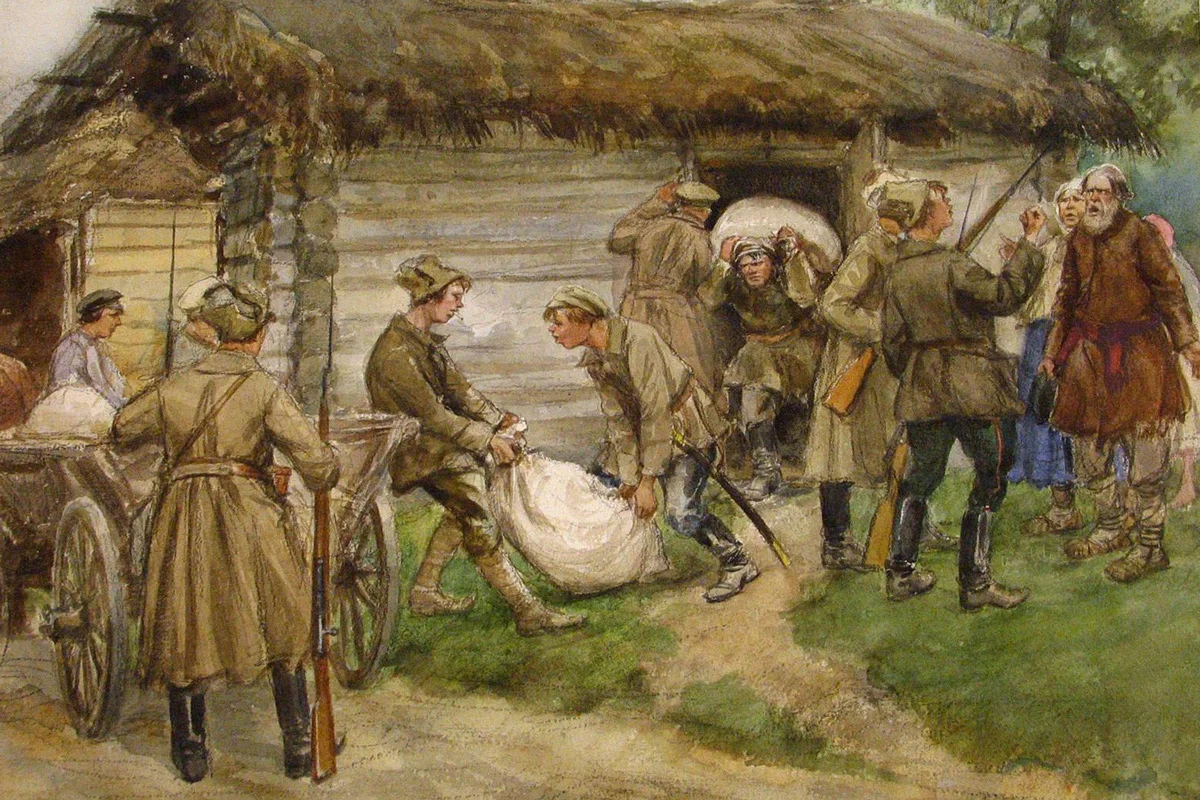
You demanded land - we gave you the land, but we will dispose of the fruits of your labor on this earth, not you. You counted on another, trading, for expanding production, on profit - these are your problems, we did not promise you this. We have our own plans for your grain. We need to somehow feed the army and cities, otherwise we will lose power. Therefore, we will take everything that we need from you by force.
It was a special confiscation: they demanded to give grain more than was available. Any products were selected at all, nothing left for personal consumption. They poured, undressed and left in the cold. This was a common thing. Lenin called for the "terrorist war" against the peasants holding bread. From his point of view, naturally: there will be no bread for cities and the army - everything, the Bolsheviks will swept.
Bread was more important than gold. The Bolsheviks confiscated gold were elementary. At the beginning of the Civil War, they captured half of the Golden treasury. They started to spend almost immediately.
In 1918, for success in the Civil War, the Bolsheviks needed to get out of the world war, that is, to conclude a separate peace with Germany. They bargained with the Germans, giving them significant territories. But not only the territory. The Brest Separate World had an economic component. The Bolsheviks pledged to transfer to Germany 245 tons of gold. Managed to give only 93 and a half tons. They would send everything, but the world war ended, and the Brest world has lost strength. As a result, it turned out that the Bolsheviks paid for the sake of holding power from the treasury of Germany, and Germany a month later lost the world war, and Russian gold went to the winners - France and England.
In addition, the Bolsheviks had an agreement with Germany: to secure the other part of the confiscated gold, send to Swiss banks to accounts, which will be available only to the highest leadership of Germany. The funds were transferred, but the accounts were opened to the leaders of Soviet Russia. In particular, in the name of the head of the Cheka of Dzerzhinsky - 85 million Swiss francs, on Lenin - 75 million.
Plus, they had what they took in commercial banks, especially in gold mining centers. The stock of Russian state awards, as well as the gold supply of Romania, which was evacuated to Russia during the German offensive on Bucharest in 1916, was confiscated and re -melted.
In parallel, confiscation of individuals was underway. First, gold was selected according to the class principle, then from everyone in a row. First, large products were selected, then they reached the ground crosses. The right of implementation was endowed with a wide range of Soviet structures. That is, complete arbitrariness reigned.
In addition, the Bolsheviks still did not leave the thought of the world revolution. She also demanded funds, and the gold reserve went to the maintenance of various communist parties, terrorist organizations and agents. For these purposes, gold was transported through the channels of such an organization as the communist international. About 200 tons of gold were lowered to the world revolution.
Lenin did not hide how he intends to use gold after the victory of the world revolution. In 1921, he wrote:
“When we win a global scale, we, I think, will make public in -late places on the streets of several largest cities in the world.”
That is, when and who first appears a dream of a gold toilet.
It is clear that a separate confiscation article is church property and values. Although the confiscation of the revered remains of the Holy of the Russian Orthodox Church is not a story about money. This was done by the 8th department of the People’s Commissariat of Justice, who did not limit himself to just withdrawal, but accompanied him with opening the relics and their public demonstration, which, in fact, was a violation of the taboo for both believers and for unbelievers: the government disturbed the ashes of the dead. This was a challenge, and with a specific purpose. If Russian society demolishes this insult, it means that it lends itself to corruption and decomposition. Society did not give any mass reaction.
But the story with the relics is an exception: church values for the Bolsheviks are money.
Советская пропаганда объясняла конфискацию церковных ценностей тем соображением, что деньги от их продажи пошли на спасение голодающих (запрет торговли и продразверстка с последующим естественным сокращением посевных площадей привели к страшному голоду 1920–1921 годов, унесшему 5 млн жизней). На самом деле, церковная конфискация должна была прикрыть другую — музейную.
Пропагандистский тезис о спасении голодающих был адресован Западу. Голод для большевиков был отличной отмазкой: у нас гуманитарная катастрофа и Западу неприлично крутить носом и твердить, что он не покупает конфискат. А согласие на покупку церковного конфиската должно было открыть большевикам мировые рынки для сбыта любых видов ценностей. На вырученные деньги советский режим усилил бы армию, то есть упрочил собственное положение. Ленин торопит с продажей отнятого.
Сначала начали сбывать то, что конфисковали у граждан. Для ювелирного конфиската, который вынесли из квартир, сорвали с шей и пальцев, создали специальную структуру — Гохран. По сути, это контора по хранению краденого. Расшифровывается как «государственный фонд ценностей для внешней торговли». В него же со всей страны свозят картины и предметы прикладного искусства, которые были в домах и частных собраниях. Что-то по минимуму оставляют в музеях. Но всё, что можно, пускают на экспорт.
Позже разные советские конторы, торгующие награбленным, находят доступ к аукционам в Германии, вступают в отношения с голландской фирмой по продаже драгоценностей короны, с английской компанией, торгующей антикварным серебром. И речь уже идет не о часах, снятых с рук граждан и гражданок, а, попросту говоря, о распродаже народного достояния. Это новый вид конфискации. На «Сотбис» появится брачная корона Екатерины Второй, потом всплывет инкрустированный бриллиантами меч Павла Первого, а также две тысячи бразильских бриллиантов и индийских изумрудов с платьев Екатерины.
Изъятие имущества по-сталински
Но всё это было только началом, разминкой. Главным торговцем станет Сталин. Списки проданного теперь опубликованы. Эрмитаж, 1931–1932 годы, по месяцам. Вот, скажем, февраль 1931 года. Оцените, какие имена: Хальс, Рембрандт, Рафаэль, Веласкес, Боттичелли, опять Хальс, еще Рембрандт. Апрель 1931 года тоже прекрасен. Рембрандт, Ван Дейк, Перуджино, Рафаэль с «Мадонной Альба», Тициан с «Венерой перед зеркалом». Sold! Причем недорого. И так месяц за месяцем. Сохранились документы, спущенные сверху: «Предлагаю немедленно выдать картину художника Джорджоне «Юдифь»». Содержимое некоторых дворцов продали скопом.
Часто говорят, что на деньги, полученные от распродажи шедевров, спасали людей от голода и провели индустриализацию. This is not true. Полученные деньги были малы, менее одного процента валового продукта. Они ничего не решали и были просто разбазарены. Шедевры, проданные по дешевке, можно увидеть в главных музеях мира.
На индустриализацию пошли деньги от другой конфискации под названием «коллективизация». И индустриализация, и коллективизация — не более чем промежуточные этапы сталинского плана. План такой: конфискуем у крестьян зерно, продаем на Запад за валюту, закупаем там целиком заводы, производим на них вооружение, а дальше переходим к главному — к решению геополитической задачи. Ее цель — победить западный мир и распространить его, Сталина, власть как можно дальше за пределы СССР.
Вот для победы над Западом на начальном этапе надо было упростить отъем зерна у крестьян. Естественно, они так просто не согласятся, особенно те, кто, пережив конфискации зерна периода военного коммунизма, во время НЭПа, несмотря на высокие налоги, сумел подняться, расширить и сделать прибыльным свое хозяйство. К примеру, на Урале в период свободной торговли своим хлебом обычная уральская деревенская семья обеспечивала себя и кормила трех горожан. Те, которые считались кулаками, кормили 15 горожан. Масло и бекон в Англию экспортировали, создали свои кредитные организации, строили элеваторы, маслозаводы. Эти самостоятельные и эффективные люди — главная помеха для сталинского плана. Их объявят врагами и избавятся от них путем так называемого раскулачивания.
Всё будет вроде как по закону. Государство вдруг снизит закупочную цену на хлеб. А доход от продажи хлеба — единственное для крестьян средство содержания и развития хозяйства, госдотаций нет. Крестьяне немедленно массово начинают прятать зерно.
Государство пускает в дело 107-ю статью Уголовного кодекса РСФСР. Это лишение свободы с конфискацией за укрывательство хлеба и неуплату налогов. 107-я статья имеет размытую формулировку, она не адресована именно кулакам, и поэтому ее действие может быть распространено на любого крестьянина, не отдающего хлеб по бросовой цене. Конфискация имущества грозит всем, варьируются сроки лишения свободы.
Раскулачивание — конфискация всего подчистую, разбой. Уполномоченные пьют, насилуют, душат, привязывая к гвоздям шнурки от нательных крестов, выносят всё вплоть до детских пеленок. Это в чистом виде средневековый «поток и разграбление». Раскулаченные целыми семьями высылаются. Их в качестве даровой силы планируется использовать на лесоповале: экспорт леса наряду с зерном будет источником валюты.
После этой кампании устрашения переходят к коллективизации. Всех сгоняют в колхоз и привязывают к земле. Привязывают почти в прямом смысле: людей лишают паспортов, они не могут по собственной воле уехать, сменить работу. Они работают столько, сколько требуется, а то, что они производят, государство конфисковывает. Оплата за трудодни не деньгами, а в натуральном виде. Ставки минимальные, только чтоб не протянули ноги и могли работать. Оставляют в пользование клочок земли для дополнительного подкорма, если найдется в сутках время что-нибудь на нем вырастить.
То есть конфискация закладывается в основу экономики. Выстроенная вскоре откровенно лагерная экономическая система базируется на том же принципе конфискации произведенного продукта. Строго говоря, ГУЛАГ использует труд людей, переведенных по вымышленным обвинениям из свободных в разряд заключенных, чтобы конфисковывать всё, что они произведут. Это в чистом виде каторга, которую ввел в свое время Петр I для удовлетворения потребности в дешевой рабочей силе.
Знаменитая 58-я контрреволюционная статья УК, пополнявшая ряды ГУЛАГа в 30-е годы, во всех своих подпунктах в дополнение к расстрелу или лагерному сроку содержала и конфискацию имущества. В определенных случаях, как при царе Алексее Михайловиче, 58-я статья распространялась и на семью врага народа, включая бывших жен, официальных и неофициальных. В этом случае конфискации подлежали дети, которых отправляли в детприемники, а затем в детдома. Причем часто у детей конфисковывалась и их фамилия.
Из имущества в 30-е годы по большому счету у людей конфисковывать уже было нечего (за исключением высшей номенклатуры). Всё, что можно, уже снесли в Торгсин или спустили на еду во время голода в начале 30-х. Права собственности на жилье не было давно, его большевики отменили сразу. Основным видом проживания были коммуналки, хотя желание вступить в обладание комнатой в коммуналке тоже часто бывало поводом для доноса.
За счет конфискации жилплощади репрессированных удовлетворялись государственные интересы.
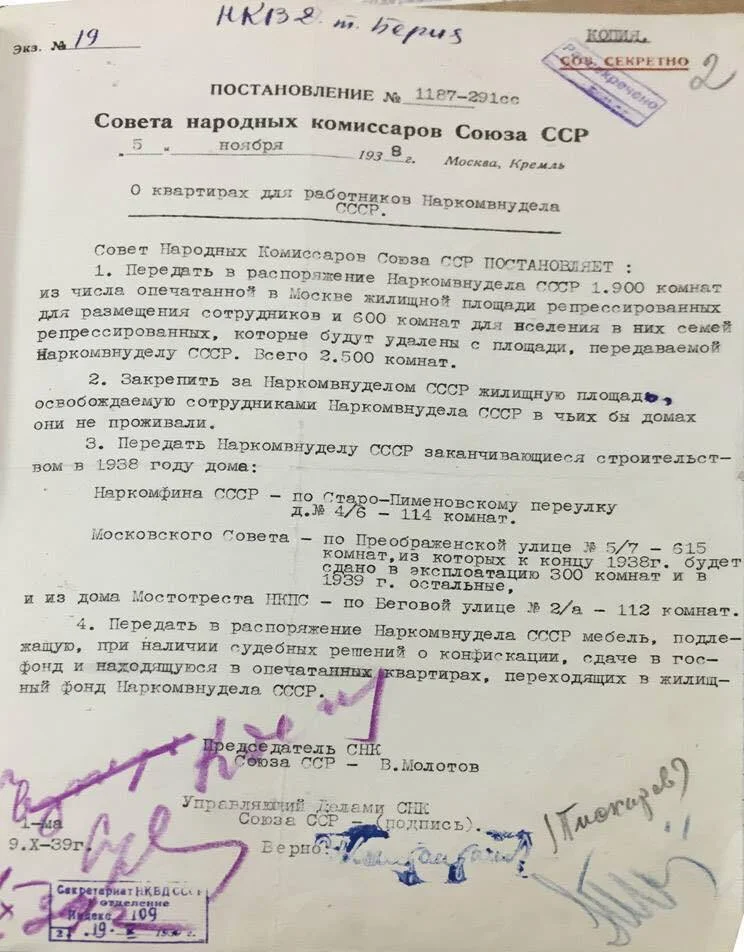
В докладной записке на имя Сталина за подписями наркома внутренних дел Ежова и начальника управления госбезопасности Берии от 19 октября 1938 года читаем: «Чтобы разрядить тяжелое положение с квартирным размещением работников НКВД в Москве, просим:
- Передать в распоряжение НКВД СССР 1900 комнат из числа опечатанной в Москве жилищной площади репрессированных».
«…Сотрудники НКВД, особенно прибывшие и прибывающие для работы в Москве с периферии, в своем подавляющем большинстве не имеют никакой мебели. Поэтому просим передать в распоряжении НКВД мебель, подлежащую … конфискации, сдаче в госфонд и находящуюся в опечатанных квартирах, переходящих в жилищный фонд НКВД».
Надо сказать, НКВД сам приторговывал конфискатом. Недалеко от Лубянки был магазин, можно сказать, секонд-хенд. Покупатели знали о происхождении вещей; никого это не смущало. Иногда даже знали, чью вещь покупают. После ареста очередного высокопоставленного лица записывались в очередь на его имущество. Магазин пополнялся постоянно и приносил стабильный доход.
Отдельные квартиры в номенклатурных домах при аресте одних жильцов просто передавались другим жильцам со всей утварью, часто даже с чашками с чаем, недопитым перед внезапным арестом, с детскими игрушками. Трудно сказать, можно ли это расценивать как конфискацию.
***
После Сталина контрреволюционную 58-ю статью отменили. Появилась 70-я статья «Антисоветская агитация и пропаганда». По ней не было расстрела и не было конфискации. Но это было в «оттепель» с интенсивным антисталинским запросом и снизу, и сверху. Потом запросы стихли, чувство опасности притупилось, потом всё забылось, зажевалось.
Отличный историк Натан Эйдельман считал, что после того, как Екатерина II запретила телесные наказания для дворян, из первого непоротого поколения вышли декабристы. В отношении того поколения Эйдельман прав. Но двести лет спустя постсоветское поколение, не знавшее советской порки, совершенно к ней не испытывает отвращения. Живет, как будто до него ничего не было.