
Translated material
People are burning
In Berlin, they presented the play “Creuncher” based on the novel by Sasha Filipenko. What was the production of the destruction of the "enemies of the people" and the rewriting of history
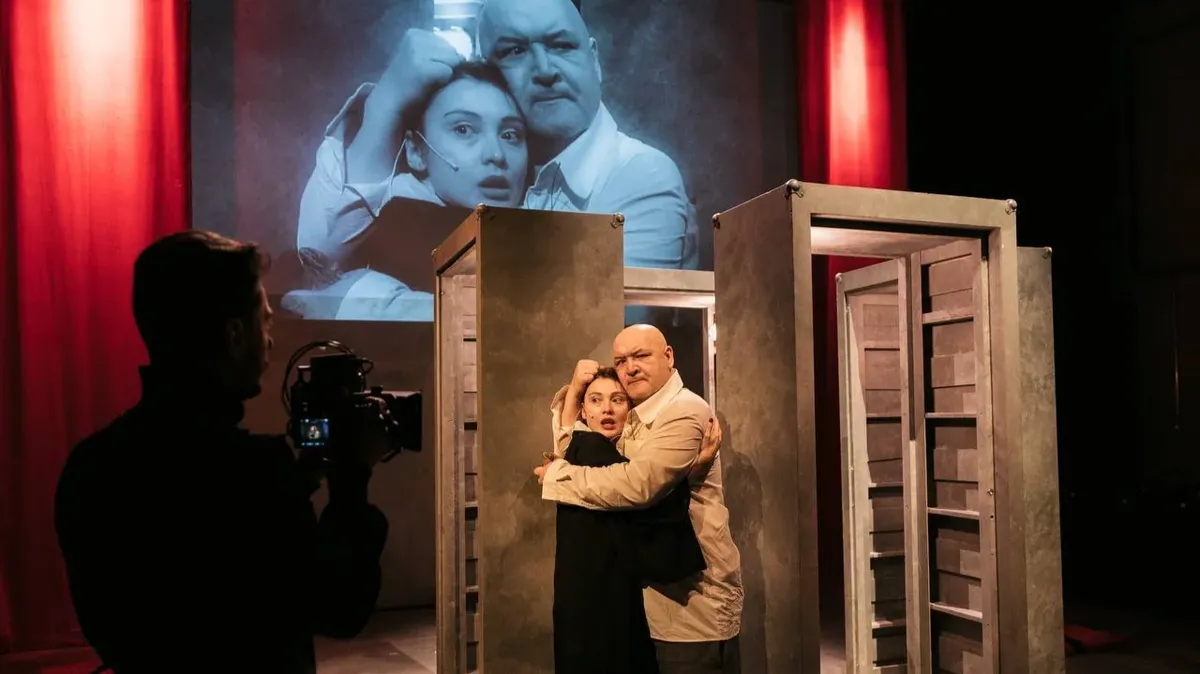
Photo: Victoria Nazarova
In the Berlin Säalchen, a small fashion space near Alexander Platz, played the premiere of the play “Crynether”. Star composition: Maxim Sukhanov in the title role, director Maxim Didenko, composer Sergey Nevsky; Roman Sasha Filipenko as a literary foundation and Sasha himself in the hall - producer Svetlana Daul, who worked without the support of German stationary theaters, managed to release a full -fledged performance, which is interesting to disassemble from different points of view.
Having spent two hours in the feeling that the performance is not in Berlin, but in Moscow, and having observed the audience, Anna Lakhmatova once again convinced: what was happening today with Russia is not a failure of the system, but a logical continuation of what happened to her yesterday and the day before yesterday.
Maxim Sukhanov and his devils
In the 1990s, in the theater of the latest Atlantis, that is, temporarily free Russia, the performances were performed by “J (Enitba)” according to Gogol and “X (Lestakov)” according to his play “The Examiner”. They were placed by Vladimir Mirzoev-who from the late 80s instilled in the Russian theater, then covered with a layer of dust and “pseudo-psychologism”, a love of postmodernism and other “post” things that will fully come into fashion twenty years later. And Mirzoev opened the actor Maxim Sukhanov. Having played the role of Kochkarev’s feature in “Z” and Khlestakov in “X”, he first embodied this nasal, capable of any metamorphoses, a mocking and unhappy monster. Urka, who was leaning back from the zone and doomed to it; Or a demon who received a short -lived dismissal of the underworld.
Freedom in these performances was unheard of. Yesterday's Soviet citizens reacted to her to the best of taste and readiness. Mirzoev hated the postmodernism. For Sukhanov - they hated and were afraid: his characters turned out to be too recognizable. No one got closer to Homo Soveticus. It seems that the best review of “x” and “g” was then written by one novice author, comparing Max Sukhanov with a reckless astronaut behind the helm of the starship.
The wind changed: the author has long been swollen, tied with the theater and now sings Stalin. The Prophet Mirzoev went almost into the schema, but a couple of his performances in Moscow are still going on. Sukhanov, breaking out of his native galaxy, continues to fly.
His new hero's name is Peter Nesterenko. A former white officer who recruited to Soviet agents to return to his homeland, in 1926 he became the director of the first Moscow crematorium, arranged in the church of the new Donskoy cemetery. Since the mid-30s, the crematorium worked in two shifts: in the afternoon Nesterenko was cremated with the bodies of advanced citizens (cremation services were not available to everyone). And at night - the bodies of the executed "enemies of the people."
This documentary story by the Belarusian writer Sasha Filipenko was told by an employee of the Memorial that was not yet liquidated in the Russian Federation. The day after the beginning of the Second World War, Nesterenko was arrested, accused of espionage and executed. Filipenko wrote his history at the first person, alternating Nesterenko’s answers during interrogation with the NKVD investigator with the internal monologues of the hero, who was endlessly talking with faith - his youthful love, after which he returned to the USSR.
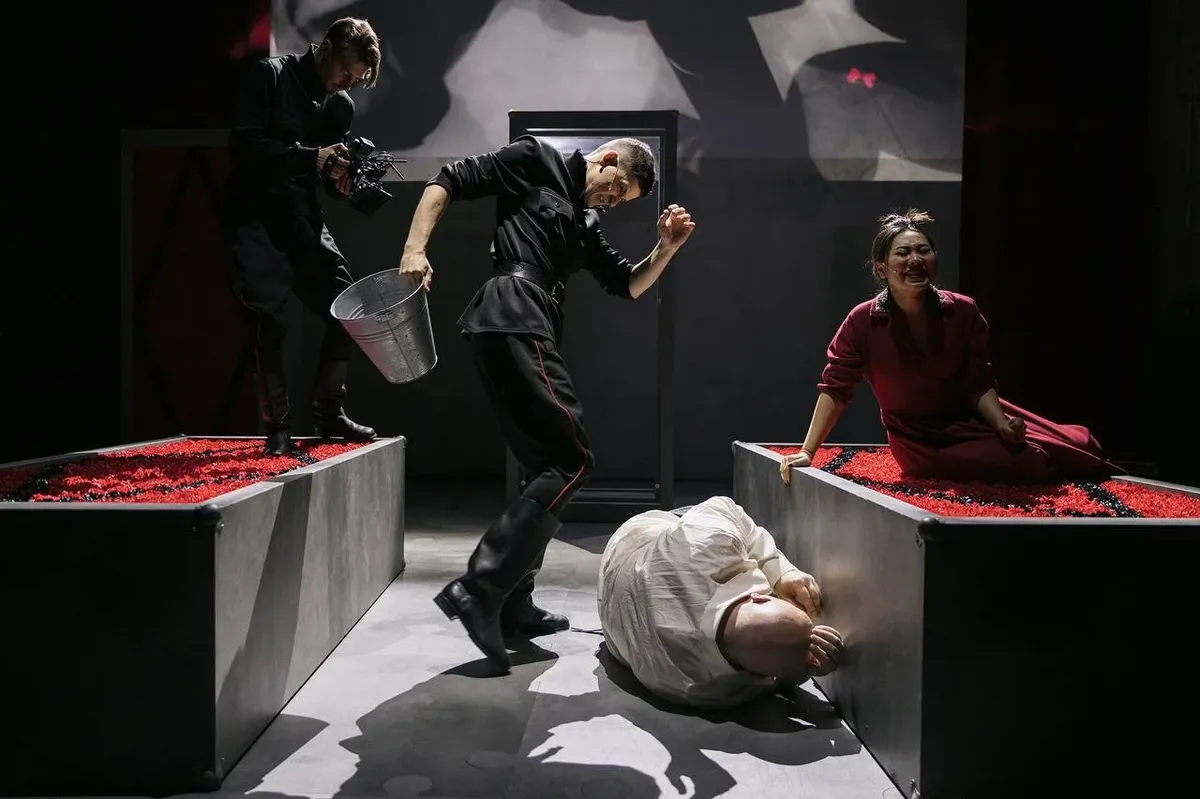
Sukhanov is not like Nesterenko. Unless in the last, prison photo: almost a bald head, sunk eyes and mouth with a bracket down. But Sukhanov is similar to himself - a theater being capable of taking any appearance and making them so reliable that in a couple of minutes the blade cannot be stuck between him and his hero. The Haron of the Soviet spill, which creminated the entire red elite, - both those who died themselves and those whom the famous executioner Blokhin delivered with a hole in the skull - believes in his own immortality: they say, if you carefully imagine his death, then you will not die. And he all his life - on the fronts of the First World War, at the helm of the aircraft to the civilian, as a secret agent of the NKVD, and then in the crematorium - he only did that he rehearsed. All this he floods the young investigator into his ears (the “Brusniknik actor” Igor Titov), realizing that the outcome of the case is a foregone conclusion, but reveling in the chance to stretch agony. He jeopters and fuckers, giving the investigator a reason to knock out a seat from under himself, then hit his stomach with his foot. The investigator’s improvised operator Frol Podlesnaya is dressed up:
His camera projects Sukhanov’s face on the screen, resembling a swollen posthumous mask. And suddenly a muffled eye lights up, then another, a spot of blood appears on the lips ...
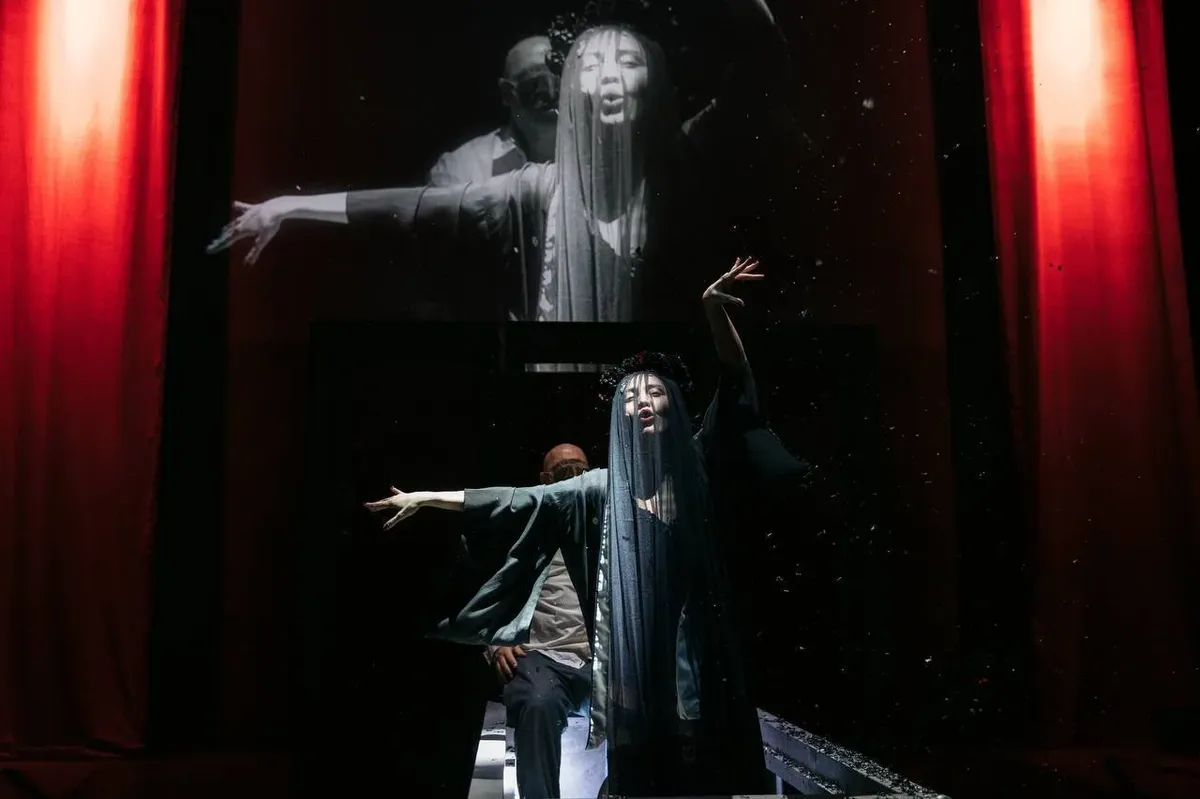
“I know the handwriting of Vasily Mikhailovich and I am extremely appreciated. He loves and respects his work ... ”, Superhentingly mutters Nesterenko about the executioner, explaining that Blokhin shot so that nothing around was getting dirty. Trying death, Nesterenko-Sukhanov fits into mourning pedestals, drowning in nylon colors, scolds the Bolsheviks for the squalor of Soviet funeral; Shamanite, trying throat singing. To match him and beloved. The role is played by two compositions-two actresses of the Gogol Center who moved to Europe: Svetlana Mamrecheva and Jan Ge. And this, as they see both, two different performances. Your correspondent managed to see only Mamrev. Its elegant and crafty faith is in a black cloak with scarlet colors, reveals mourning wings, sings a chapel, listing the contents of the prisoner confiscated from the prisoner: “The blanket is gray - 1 pcs, 2 pcs - 2 pcs ...” and so sweet she sings, so young guys are in black, and they are curled like two, like two, like two, like two. Around the huge Nesterenko. And then they clamp between the walls of the two cabinets: but it is not enough to crush his strength.
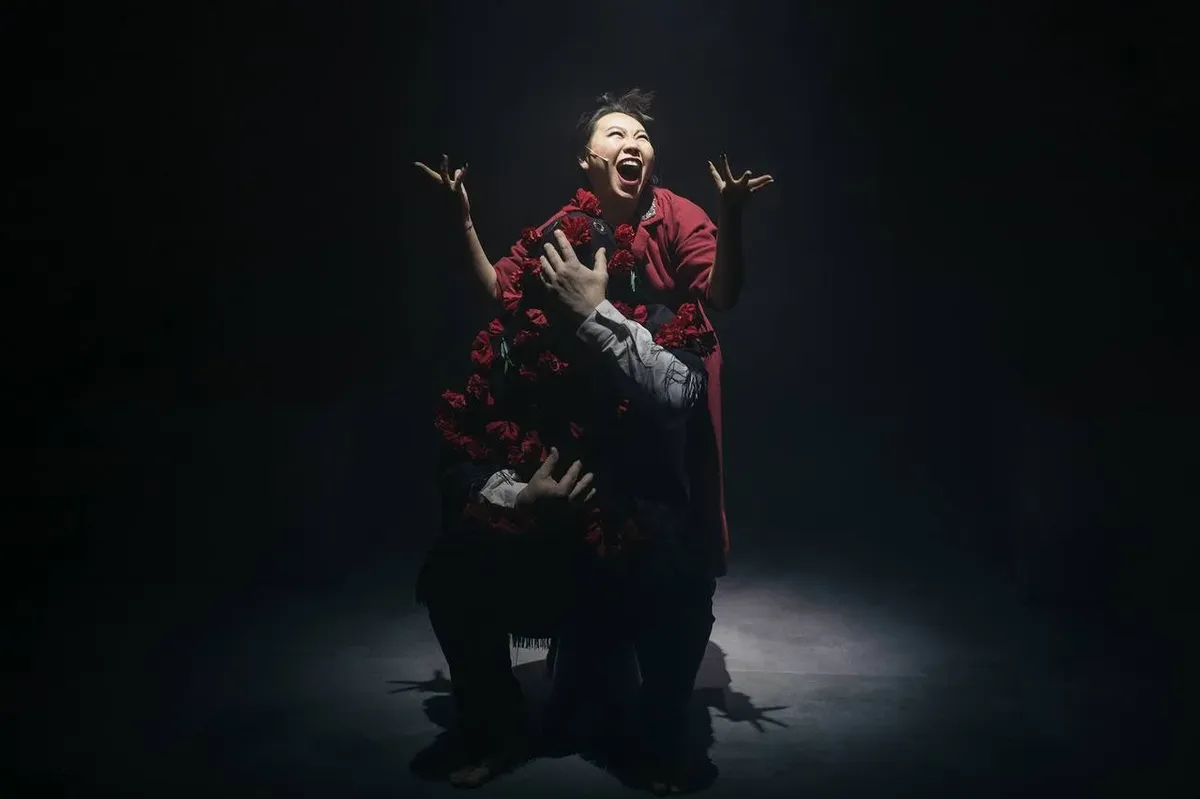
The video projected onto the screen from two cameras is perfectly beautiful (it is worth remembering the video artist Oleg Mikhailov), the movements of the executioners are plastic. As for Sukhanov - you don’t think about his plastic, as you do not think about the movements of the tree in the wind or splashing of the waves. All this is addictive - how the spectacle of burning bodies delayed Soviet citizens (in the early years, with pleasure recalls Nesterenko, the crematorium sold tickets to those who wanted to look at the process in the technical window).
Sukhanov, on the other hand, turns this Guilty Pleasure into a love story. The history of the one who has fallen in love with lovers.
Simple delight flickens on his face every time he looks at Vera, allowing her to deceive herself and slip away.
But he has a moment of insight. Closer to the final Nesterenko once again finds Vera, who no longer wants to know him - the former White Guard. She plays minor roles, but she seems to patronize her herself: choke on happiness, she will make a chatter about the great leader and the future of the country, where, of course, she will become the first actress. “Belief that you are carrying!”, - at once going down to the ground, suddenly says not Nesterenko, but, it seems, Sukhanov himself.
Maxim Didenko. Circus and funeral
Today, the “Kremulator” is the best, or at least the most sincere production of Didenko. A connoisseur of the Council, a lover of avant-garde and early Soviet aesthetics, he once made the play “Earth” according to the film Dovzhenko-a visually bright, but with a blurry message. It seemed to be the same as a witty “circus” by the plot of the film by Alexandrov. Under the dome (that is, under the grates) the theater of nations flew Ingeborg Dapkunaite, it was interfered with the evil German pest. The form was found, the content seemed attracted. Didenko’s most powerful performance - “Norm” according to the novel by Sorokin, was released in the theater on Bronnaya and walked in the pompous hall of the recreation center on Yauz, amazing the acting virtuosity and the imperial scale of this black clowning.
“In exile, I became more tolerant of people,” Didenko admits in a recent interview. And not lying. As a director, he is first so sad and open. His theater does not look like a circus. He does not shake the viewer with clown numbers, although everything is with him-both Physical Theater, and an acute visual form: excellent video and laconic scenography (artist Alexander Barmenkov creates a Soviet totalitarian environment of two elements: artificial carbacons with mourning ribbons and pseudo-borderline cabinets that turn into pedestals for coffins, then Crematic furnaces, then in a narrow prison punishment cell). The emotionality with which Didenko tells the story of a person who went after his lover in Hell, rejected by her, and as a result of her who had not yet cooled the corpse was added to the above. The hero Sukhanova talks with him for a long time and gently - as with a living woman.
Homo combussit / burned man
After combustion from the body, ash remains, the homogeneity of which bones interfere. All this is placed in a creparditant, where they grind to the state of “pleasant in appearance of the mass” - as the Soviet popularizers of a healthy image of death wrote.
The image is clear: the Soviet system turned a person into dust. In some cases, a bullet was also among the ashes. As it becomes clear from the “cremor”, not only the body was destroyed. The soul, conscience and other metaphysical obligations - all this was grinded during his lifetime. Nesterenko reported to his beloved, not taking her betrayal. And then he crescent and buried. She, having appeared in front of him immediately after his execution, says that until her last sigh convinced the investigator: Nesterenko - a spy; Yes, only the executioner Blokhin no longer listened.
Actors play the lyrical and terrible final among the audience: in a small hall, the audience is planted on three sides, the playground in the center. The performance is in Russian, with German subtitles. The text of the novel by Sasha Filipenko for the performance was adapted by Johannes Kirsten-chief dramaturg of the Berlin Theater Gorky. But at the premiere in the hall - mostly Russians. The atmosphere, and the configuration of the hall itself resembles the famous White Workshop at the Moscow Vinzavod (the Platform was once placed there, where the seventh studio Kirill Serebennikov played). And this hall every now and then includes in action.
In one of the scenes, Igor Titov, turning into an Enkewed spying in Paris, throws the audience a replica, literally taken from Filipenko’s text: “What if the people who have remained in Russia actually want to live as they live now?” - The emigrants about the remaining in Soviet Russia argue in the novel. The Russian-Berlin audience who has not read the novel (written before the war) thinks that they ask about today-and accepts to answer. “Let them live as they want, they will only leave us alone,” the lady shouts. And they agree with her. Half of the hall begins to blame what is happening with Russia - the remaining. Other voices offer to simply forget about Russia.
"How many more have they shot today?" - asks Vera. “Yes, here are all these,” shows Nesterenko to the screen where the image of the hall appears.
“And what, all the supposedly German spies?”
- Yeah!
- None ...
And then the grandchildren and great -grandchildren of those who shot, and those who were shot are laughing together.