
Translated material
Fantasies about pleasant
Ivan Kurill - about the book "Russian Moment in World History"
With a 20-year late, a small work of Marshall Poe reached the domestic reader, in which the historian effectively contrasts Russia and Europe. Without entering with the author in the polemic, the acute moments in his reasoning were dismantled by the historian Ivan Kurill.Starting from February 24, 2022, we were all in the face of the advancing barbarism, violence and lies. In this situation, it is extremely important to preserve at least the remnants of culture and support the values of humanism - including for the sake of the future of Russia. Therefore, the editorial office of Gorky will continue to talk about books, reminding our readers that the world remains in the world and fiction.
Marshall T. Po. Russian moment in world history. M.: The whole world, 2023. Translation from English Peter Ilyinsky. Content . Fragment
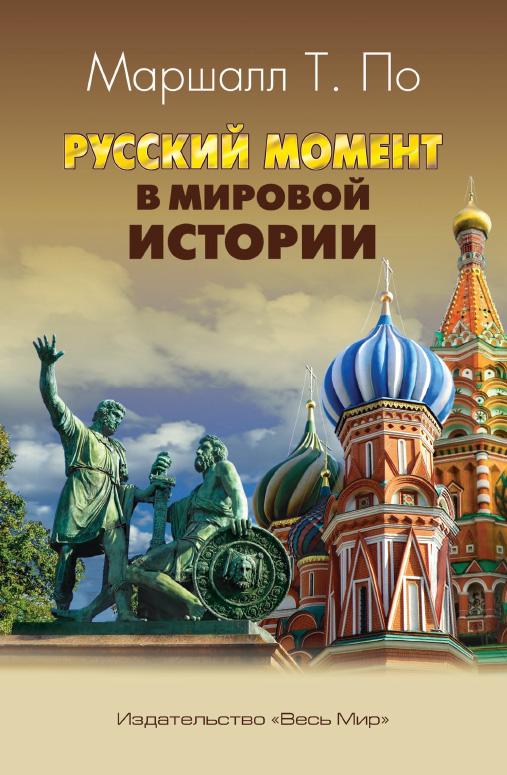 Marshall’s book was waiting for publication in Russian for twenty years (the English original was published in 2003). This very small text, which can be called a detailed essay, clearly does not fall under the definition of a scientific monograph, however, according to the Open Syllabus project, it is recommended in 70 courses taught at English -speaking universities - much more often than many large books.
The point is not only in the bright and witty presentation of Russian history, and not even in the brevity, which allowed, to the joy of bachelor students, to fit a hundred millennia in a hundred pages. According to Marshall, in the preface to the Russian publication, he wrote this book, making a decision to change the direction of his own research and break with Russian history. This decision gave the author freedom, without looking back at colleagues, to make fun of many established ideas about Russian history in the Western (and Russian) historiography and propose their own original development scheme of Russia.
The main idea of the book is that Russia over the past five centuries has been successful in the confrontation of the onslaught of European civilization, remaining the only country that retained independence from empires that somehow conquered the rest of the world. This became possible because the Russian elites, realizing the economic and technical lag from the Western neighbors, managed to completely subordinate the society and direct all its resources to protect their power. It is this long period that Marshall calls the “Russian moment in world history”.
The book is provocative, the author overwhelmed his text with paradoxes and contradictions, often drawing the attention of readers to them. With this temporary coverage, it is not surprising that some statements in the seemingly incorrect, but I will not try to catch all inaccuracies and mistakes in the book - in the end, I am also not a specialist in the history of two thousand years. It seems to me more interesting to pay attention to some acute observations and those statements that seem important, despite my critical attitude to them.
The most common “stupidity, said about the Russians” calls “the judgment that they are in some way predisposed to the authoritarian method of government.” But the liberal reader does not have time to rejoice at this phrase, the author encourages him with the following statement: “Veche’s assemblies of the Middle Ages, Zemstvo Cathedrals, Boyar Duma-all these are continuous fantasies about the pleasant, about what has never happened” (p. 17-18). The point is not that the Russians were natural democrats, but that democracy was a relatively new invention, and authoritarian rule was widespread until recently, so Russia was not at all some exception.
The next misconception is the assertion that "that Russians are supposedly characterized by a natural desire to expand their territory with the help of war." No, the author answers, and here the Russians were no different from other peoples - except that on the eastern border they met sparsely populated lands with peoples leading a traditional lifestyle, and succeeded in conquering Siberian spaces (p. 19).
Finally, the author considers the idea of Russian messianism the result of reading by Russian historiosophies of the late 19th century the works of Hegel and has no real reasons in the past.
The largest error regarding Russia in terms of the idea that it is a European or Asian country. In fact, neither the other nor the other - it is the country "Russian" (p. 24).
Of course, the last statement is not new for the inhabitants of Russia, it often sounds from Russian politicians and media characters. However, there is a doubt of the methodological properties: of course, every country can be tautologically called “its own”: France - French, Germany - German. The attribution of the country and the people to some wider community is the external classification procedure, on the one hand, and internal self-determination-on the other. The statement that Russia is not European, and at the same time not an Asian country, puts it in this classification scheme for one level not with Germany or France, but with all of Europe. At the same time, the identity of Russians - their answer to the question "Who are we?" - Most often makes them Europeans. And the author himself mentions the period two hundred years when Russia was a participant in European politics and it was recognized as such as Europeans themselves. Marshall reasonly and rightly argues how Asia and other continents were designed by European colonialists, but does not affect the question of how Europe itself was designed. It seems that it is here, in the process of the invention of Europe, that one must look for the grounds for creating a European other from Russia. However, this was written about this by Larry Wulf and Iver Neumann . Moreover, Marshall in his “big” monograph spoke of binary schemes (good - evil, freedom - slavery) who dominated the descriptions of Muscovy with European travelers of the early New Age and helped Europeans describe themselves as the opposite of the eastern neighbor.
However, if we do not agree with the postulated with the exception of Russia from Europe, but introduce it to one of the European powers, then the problem is that it was not subordinate to Europe, will not be. She was Europe, and relations between European empires were subordinated to other international laws. But then the whole beautiful construction about the half -thousand -year -old “Russian moment” will be in question. However, in the book and without this there are well -aimed observations.
The author’s observation that many historians describe the Russian history “using the terms denoting shortcomings and failures” seems very important to me. In fact, "the Russians did not have a desire for democracy, openness, a free market, as well as the slightest interest in national self -determination." This follows the conclusion that the Russians “failed,” the author claims that if you look at this not from a European point of view, this is evidence that Russia “successfully reflected European pressure for more than five centuries” (p. 84). I would add that the description of Russia through the absence of important institutions in it, from the point of view of Western authors, often leads them to the conclusion about the immutability of Russia. Indeed, if in the country it was bad with freedom in the XVI, and the XIX, and in the 21st centuries, then Ivan the Terrible with Stalin can be identified, and Togo with Putin and tolerate the “immutability” of Russia, as Richard Pipes did, for example,. According to, however, it shows that the development of the country should not be determined through what is not in it, but through what it managed to create.
In passing, a thought casts in passing, which Yuri Slovkin will develop into his solid work many years: “The Lenin party coincides with its closest modern analogue - a radical religious cult” (p. 92).
Of course, all readers of the Book of Marshall Poe in 2024 will pay attention to his assertion, as if in 1991 "Russian project <...> ceased to exist." The subsequent enumeration causes complex feelings: “The party has lost power without hope to return it, and its place was taken by a new, democratically thinking elite. The Warsaw Agreement lost force, and new agreements on security issues were concluded with NATO. The Russians quickly learned the Western style of behavior, their millions rushed west. The main structures of the Russian path to the present have broken up. Autocracy was replaced by elected democracy. A rigidly controlled social sphere has become open. The command economy was supplanted by a chaotic mixture of banditry and capitalism, and the once powerful armed forces are minimized ” (p. 104). As we know today, the statement of the “ending of the Russian project”, rhyming with the “end of history”, according to Fukuyama, turned out to be premature. It seems that Russia has entered a new circle. The translator and author of the afterword Peter Ilyinsky sees this grounds for pride (p. 135), but I would still think.