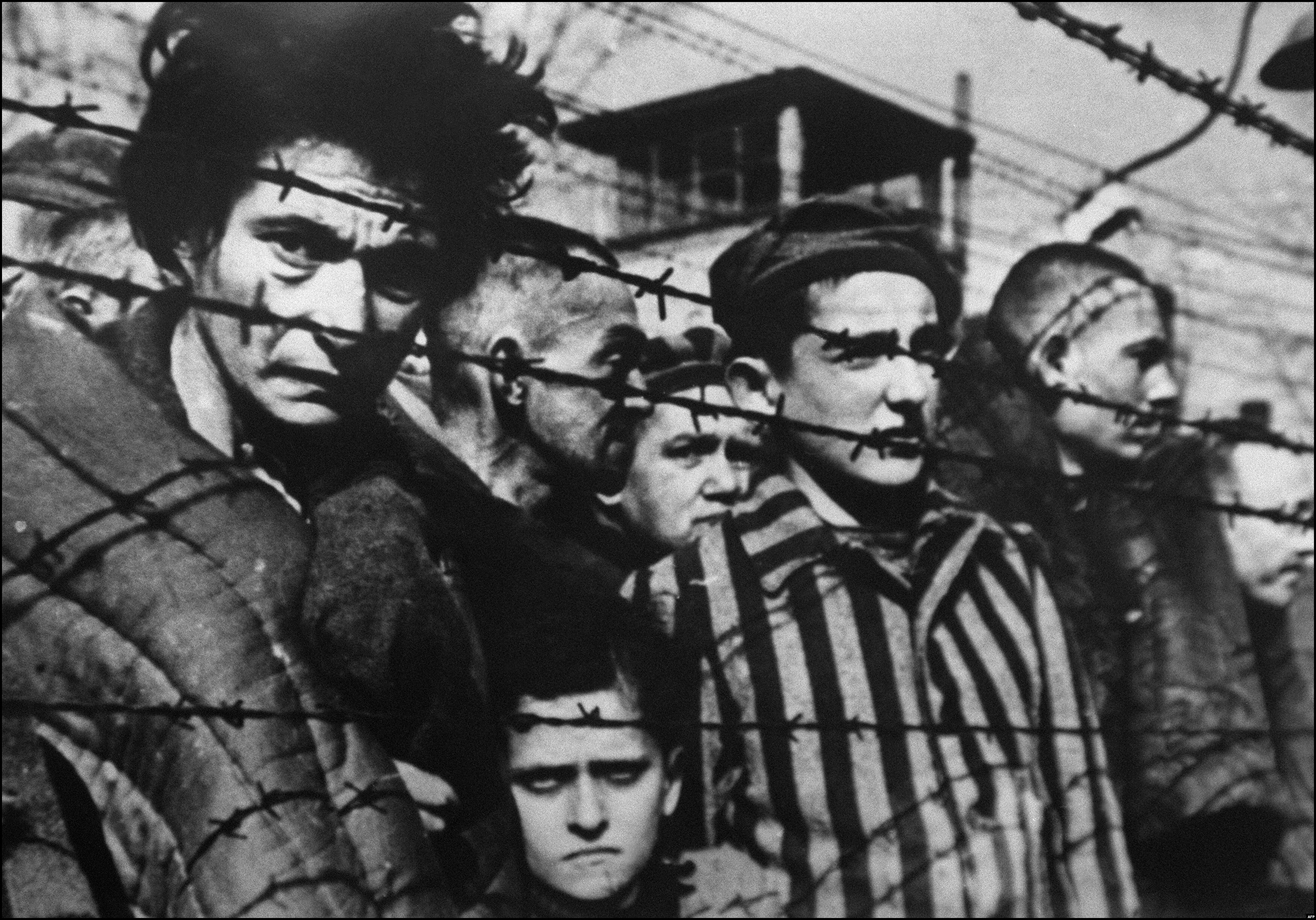
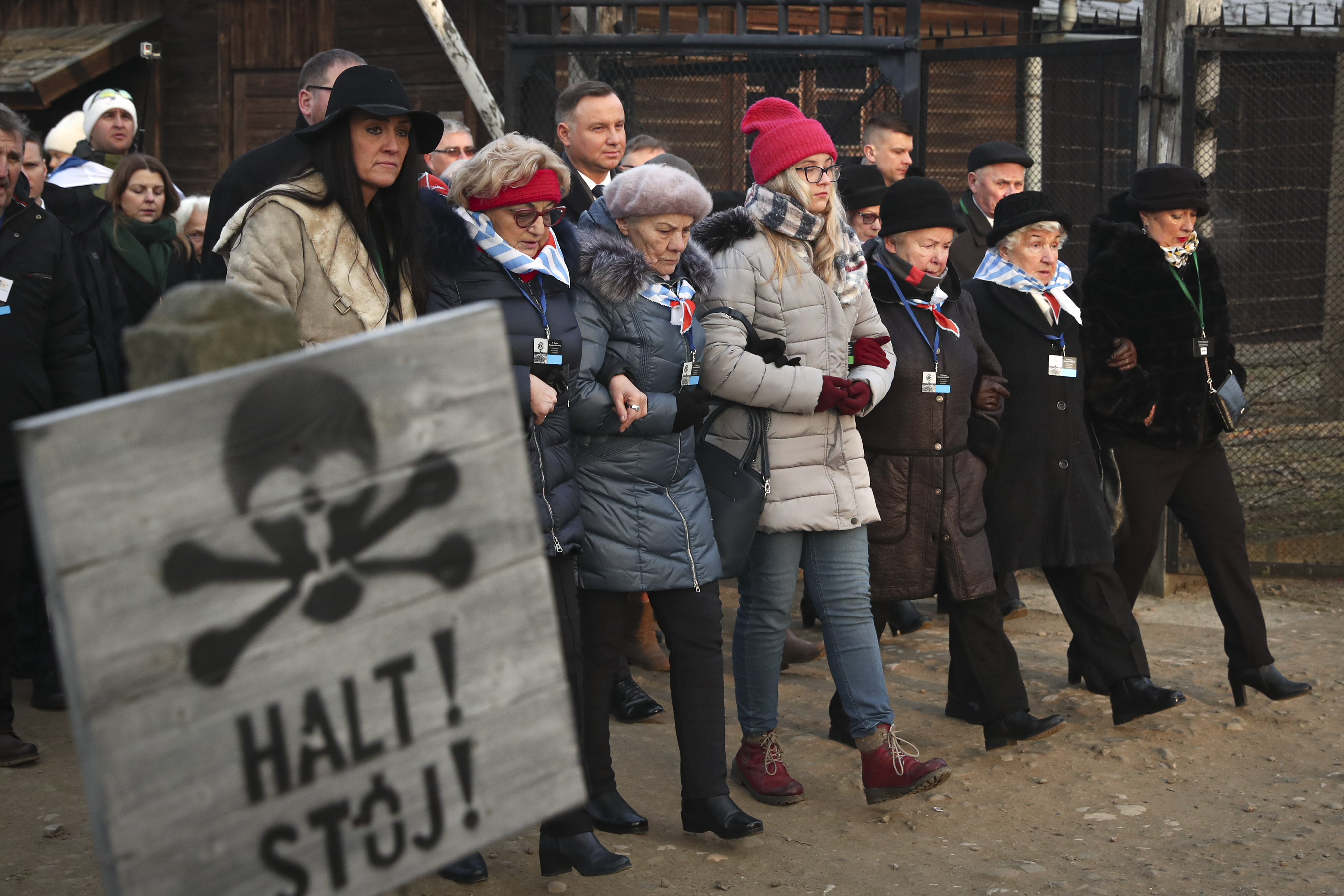
75 years ago, Auschwitz (Auschwitz) was liberated - a Nazi death camp, which became a symbol of a catastrophe that befell the Jewish people. January 27 is celebrated as an international day of memory of the Holocaust victims. Today, mourning events are held in the territory of the former death camp located in Poland. The heads of a number of states and governments gathered at them, as well as more than 200 people who survived the Holocaust, including the former prisoners of the camp.
Photo gallery:
See and survive again. Former prisoners of Auschwitz are remembering the dead
75 years ago, Soviet troops liberated the death camp of Aushvitz-Birkenau
Among those who came to Auschwitz - President of Poland Andrzej Duda, presidents of Germany and Israel. The President of Ukraine Vladimir Zelensky also arrived. Russia is represented by an ambassador to Poland. Vladimir Putin participated last week in another event in memory of the victims of the Holocaust - in Israel, in the Memorial Yad Vashem. The President of Poland did not come to this event-due to disputes with Russia about the Second World War. Putin was not invited to Auschwitz.
In 1941-1945, more than a million people, mainly Jews, were killed in Auschwitz. Auschwitz was the largest, but far from the only Nazi concentration camp, where prisoners were massively killed. Such camps were in the occupied territories of the USSR, in one of them, the Dead Loop camp in the Vinnitsa region, more than 50 thousand people died. Ida Spector was the prisoner of this camp from December 1941 to March 1944 and told Radio Liberty about her monstrous experience.
Ida Iosifovna was born on November 20, 1932 in the city of Tulchin, Vinnitsa region of Ukraine. Tulchin during the war became part of Transnistria - the Romanian occupation zone. In July 1941, Ida spector was in the ghetto created in the city. It placed not only local, but also a large number of Jews deported from Bessarabia and Bukovina. The Jewish community Tulchina remained one of the largest in the Vinnitsa region - after Vinnitsa, Mogilev and Zhmerinka. Before the war, about 5,000 Jews lived in the city. In December 1941, Ida spector was in the camp "Dead Loop".
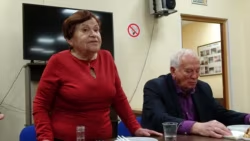
Ida Spector and Oleg Mortkovich (Associations of young prisoners of the ghetto and concentration camps)
- June 22, Sunny Day, we jumped, rode, and suddenly declared war on the radio. We were blown away like a wind, they immediately ran home. We knew the Germans would come, they quickly advance, burst instantly, drove into motorcycles, such sleek and well -fed. Unfortunately, our neighbors from below, I watched because of the curtains, met them with bread and salt. The German stopped near our house and photographed them. How many traitors were! Near the military registration and enlistment office there were our guys who were captured, they all the time before my eyes. Imagine, July, Fryshishchi, Ukraine, and they asked: "Drink, drink ..." And the police surrounded them and did not allow anyone to give them water. You will come - shoot.
How many traitors were!
- Why did you not manage to evacuate to the rear with your family?
- When the Germans were not yet in Tulchina, we reached the Dnieper with my mother. The authorities ran away, the entire center of the city was blown up, but they said: "We will be back soon!" How ours retreated is scary! In windings, dirty, boots on a stick, without weapons and running. The Germans behind them on motorcycles. It's scary!
- Why boots on sticks?
- So, it was inconvenient for them, faster to run barefoot. I see that his boots are hanging on his stick, legs in soldier's windings. There they crossed the troops across the bridge, and it was impossible to move anywhere. There was absolutely no case to us.
- Was there another crossing?
- No. They wanted to transport one boat with children without parents, so the Germans bombed her, all the children died. And my mother said: "No, to die, so together, if that." You have no idea what it was there! We decided to return. We walked for a week. The Germans entered Tulchin on July 23.
- When did the Germans create a ghetto?
- As soon as they entered the city, they immediately organized a ghetto. Many Jews lived in Tulchina, the Germans ate at night, especially mocked the old people, they cut off the beards, and humiliated them. We had a cellar under our house, and we were hiding there.
- What did the ghetto look like: barbed wire, posts, fences?
- Yes. Just a limited space, and we did not have the right to not go out. People live in their homes, if not in their own, so near, among neighbors, they communicate, they can agree with someone, take food, do something. This is not a concentration camp where all exits are closed. We had three rooms in a one -story house. We spent five months at the ghetto.
- How did you eat, where did you get food? Was there a garden?
- We did not have a garden, we did not engage in agriculture. Mom at school worked, dad at the factory, I studied. I don’t remember that we went to stores, but we had the products, probably, they changed things, rings, my mother gave them for food.
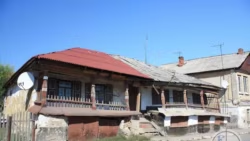
The city of Tulchin. Residential building in the town development of the mid -20th century.
- Who made the lists of Jews? How did the Germans know who is who?
- What are you talking about, denunciations went completely. Tulchin is a normal town, and everyone knew each other. And the lists were, and the headman showed up, and people reported everything.
- Five months in the ghetto, what did you remember the most?
- At night we hid in the cellar because we were afraid. The neighbors carried out everything they liked from the house, Russians and Ukrainians. That's how we lived, all the time under fear.
The neighbors took out everything they liked from the house
- Did people kill people in the ghetto?
- Killed. The Germans liked it, they could come and shoot. Once I saw the shot on the fence, they hung him in a bag and say: "Everyone who will contact the partisans is waiting for this." I remember this picture. I can’t compare the ghetto with the camp. In the ghetto, we did not have the right to go beyond the allocated quarter.
- What happened to the dad?
- How the war began, a day later he went to the front. We escorted him, I remember how now. He died in 1941 near Kharkov, I learned from the man who escaped, and my mother and I went secretly at night to him. I remember it was dark on the street, my mother walked slowly with me by the hand to ask him about her father. He said that they were left in the detachment of a handful, 20 people, but by the morning there would be no one. Our dad was listed as missing.
- When did you get to the concentration camp from the ghetto?
-In December 1941, we were driven into the bathhouse for some reason. They drove from there on foot, coldly, slippery, who fell - shot. My mother fell, I screamed so that the sky turned around, I lifted it, and the policeman drove past the horse, did not touch. We were mainly accompanied by police from the local population and Romanians. Vinnitsa region was under Romania. We walked for several days. Swamps, dirt, damp, water drank from a puddle. They slept in the open air, on cold earth. They walked and walked, drove and drove. We rested a little-went on. Without sleep, without rest ...
- Describe the concentration camp, what did it look like?
- The village of Pechora, on the river Bug. There was an unfinished military sanatorium there before the war. We were the first batch, the central corps, three floors, directly opposite the gate. Everyone was lying on the floor: men, women, children, old people, all mixed up. Opposite me lay a man, his legs were frostbitten, they were black, and he sat, unscrewed his phalanxes and discarded. I still have it before my eyes. Well, of course, he died. There, people died terribly, fluffy with hunger, some shouted terribly, I had this scream in my ears, and some died quietly. The first grandmother, dad’s mother died.
There people were terribly, puffed up from hunger
- Was she in this column from Tulchina to Pechora?
- Yes. Grandma, grandfather, cousin. Mom’s younger brother, the wife of Lisa, they only got married before the war, Shurik went to the front and died, and Lizochka got into the camp, and she was also shot in 1943.
- A family of six people, did you move together?
- Yes. I remember grandfather came and said: "Grandma died." She was painful, and grandfather is such a hero, but then he was not in a concentration camp. Lizochka was there, but I do not know where she was. She still had a sister Clara. But I almost did not see them in the camp, everyone was busy with the exchange of things to somehow soak.
The city of Tulchin. Old Jewish cemetery
- What did you eat?
- Our cleaning was a delicacy, all the grass around the bush, everything was eaten. We changed things. Ukrainians approached the fence, we threw their clothes, they were potatoes, bread to us.
- The police did not forbid this?
- By mood. One young man came up, wanted to exchange, take the cherry, he was shot on his forehead, and he was gone. We beat, drove, we again went for food. In general, everything was different. We were guarded by severe people.
- A sanatorium from several buildings?
-Near the main building there are still huts, someone lived on the stable. Stones and gates.
- How many days have you stayed in this concentration camp?
- Until March 14, 1944, two and a half years.
- How did the day begin and passed?
- It did not begin. It was cold, hungry, I wanted to eat. The police were atrocious. I was beaten by a policeman Smetansky, a former lieutenant of the Soviet Army, who surrendered.
-9-year-old child?
- Oh, how I beat me! You can’t imagine. Everyone asked: “Leave the child, well, that you ...” I was all sorted out. Mom used to turn me - and I lost consciousness.
I was all sorted out. Mom used to turn me - and I lost consciousness.
- Why did he beat you?
- So he wanted. Under the mood. He was a beast, a terrible person. He was a police officer in the camp.
- Have you been forced to work?
-Well, so, someone was cleaned ... How to force if people are half-dead. You understand that a lot of people died daily. Ours were dying, from other cities they drove new ones. Day, winter, I remember these bare corpses on the sled thundered. Terrible! They were stripped out immediately, as died, they pulled out golden crowns or teeth, they took all this to themselves. The bodies were thrown into specially dug ditches. We jerked. Sometimes I had to run away. How to run away? We jumped over the fence.
- Where?
- To the village, begging.
- Did you have the opportunity to run away and return?
- We did not have a way out. We were persecuted. Especially shepherds, they beat us. Shepherds were afraid of more police officers. In Ukraine, as a rule, people were embittered, there are a lot of anti -Semites. Maybe not all, but you understand that in any nationality there are bastards. Some will give potatoes, some of the dog will set you on you. Then we returned, brought [products], and for some time we ate this.
- Have you climbed over the fence?
- Here we were already walking through the entrance. We were beaten, but we passed. What could we do? These were Romanians.
- There were no Germans in the camp at all?
- The Germans were through the river Bug. They came, had fun, shot someone, followed you and could shoot at the back of the head. They go, and you do not know whether they will kill or not. I remember the baby was lying, he probably was 8-9 months, on the pillow, slept. The German came up and easily shot him in his ear and that’s all, the child was gone. We were beaten, drove, hunger, did not beat. It was impossible to go down to the bug, God forbid you, to the river. Water - it was impossible. We had to only die of hunger, without water and food.
- In the camp, people died more with their death or from executions?
- More often with its death, from hunger, typhoid and dysentery. The most terrible execution was in 1943. As I remember now, I’m standing at the window and say: "Mom, the SS people arrived." And there was something terrible here. People were exhausted, could not walk, and here they are from the machine guns-Zh-Zh-Zh, everywhere brains, a sea of blood, there was, who could not get out, stand on their feet. Then we were divided in half.
- How old was your mother?
- 36 years. In 1943, she [at this age] was considered an old woman. Mothers and children were taken in one direction, and with the opposite - young people. Lisa, the wife of her mother’s brother, was there. The woman, as I remember now, stood opposite and fed her baby, high, as it seemed to me. The German came up, grabbed the child by the legs, threw up, this child fell and crashed. She screamed like that. Her legs, hands and threw her into the car. All! They were taken away. We were driven to shoot, we knew that seven villages were digging holes. Seven villages. There they shot a lot of people who were buried alive, a lot of people died.
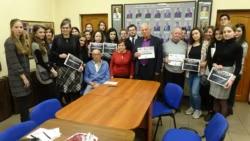
Ida Spector and Oleg Mortkovich surrounded by Moscow students during the memory of the victims of the Holocaust
There they shot a lot of people who were buried alive
- How did you manage to survive?
- Miracle. I was sick in a camp in a camp, lay all winter, could not walk, moved on all fours until my legs flared up. On the eve of the next executions from Romania, Jews were sent, so all rich, well dressed, all in gold, so soaked. And we were already undergoing. How did I escape? So that they would not be taken to shoot, they broke through to the Romanian commandant of the camp, gathered all gold, they told me later, bribed it, and he said: "This is my territory, I forbid you to be executed." And we were a handful, and thus I was alive. And they drove us back to the camp in Pechora. But still to die, what's the difference.
- And mom?
- Mom died in one of these villages, where the ditches were digging. I was nearby. She pushed me away, you see. And they were thrown into the moat. They shot half, buried half alive. I was left alone in this hell. It was something terrible. I asked me to be shot. Everyone thought that I was crazy. Where I fall, I’ll fall asleep there. And the woman asked, I remember, in Hebrew: "Who is this?" Grandfather, mother’s father, was called the Haimitsa. "This is Himitsyna granddaughter.
- Who shot, Romanians or Germans?
- This was done by the Germans with the police. They arrived, the SS men shot.
- Did you speak in the family in Yiddish?
- I did not know before the war that I was a Jewish. At home they spoke in Russian and Ukrainian. When my mother and grandmother wanted us to not know, they spoke Yiddish. I told them: "Why are you getting out?" Mom’s parents left for Moscow two days before the war. And we waited for the dad to go on vacation.
- Mom’s parents remained alive?
- Yes. In 1944, the camp was preparing for the shooting, the machine guns were already standing, everyone was spreading, who hid where, and suddenly ours burst. Not a single person went to them. Why? Thought a provocation. They left in the buttonholes, and came in uniform. Who knows? They found a Jewish soldier, and he told us in Jewish, this is the Soviet army that “you were released”, only then people began to crawl out of the basements, where we were hiding from the execution on the territory of the sanatorium. One military man carried me on one hand, on the other boy. And they sent me to the orphanage. There was 100-150 people in the camp. It was March 14, 1944.
- An orphanage in Tulchina?
- Under Tulchin. She spent in an orphanage from 1944 to 1948. I was found through the City Council, lists were compiled, who returned, who was not, and my brother, Uncle Misha, found me on the list and took me to Moscow.
- You have already been 15-16 years old.
- I was already a big girl. But, as they say, I was “lucky” largely, a year later, Uncle Misha was imprisoned, it is not known why they came and took it at night, and I again remained “with peak interests”, one. I was attached to the school through Rono so that I could eat there.
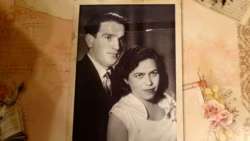
Ida spector and her husband Mikhail Spector. 50s.
After the war, Ida Iosifovna, the spector was transported to Moscow to the uncle’s family, then to the city of Pushkino, worked in the artel, then at the Fraser factory, first in the workshop, in the OTO, she studied at the machine -tool college and at the medical school, and worked for 40 years with a doctor. Since 1993, retired. He has a daughter and granddaughter. In 1990, she created the Association of Minor Prisoners of the ghetto and concentration camps.
- Did you look for grandparents on your mother’s line after the war?
- Grandma lived with Uncle Misha, with her son. She was old, unhappy and not necessary for anyone. Grandfather fell ill during the occupation and died somewhere on the way to Tyumen. Misha was released after the death of Stalin. He came with a trepanation of the skull. During this period, his wife died from oncology, his son died.
Misha was released after the death of Stalin. He came with a trepanation of the skull
- How did your life develop after the war?
- In an orphanage in Tulchina, I was recorded by a Ukrainian. Already in Moscow she found two witnesses and restored Jewry for seven months. The judge came across a terrible anti -Semitic, screamed at me, and I thought to myself: "Well, you, Esses!" If she had a whip, she would have beat me. Even people who were waiting for her reception asked why she was screaming at you so much. The judge asked the same stupid question: "Why do you need this?"
- Many in the days of the USSR hid nationality in order to avoid xenophobia and household anti -Semitism.
- I know. But I was born a Jewish and all my relatives died. I needed it in memory of the dead. I had witness Misha Surman, he was no longer alive, he was with me in a concentration camp. Before the war, he knew my family. In short, he was so angry in court and said: "What should I take off my pants and show you that I am a Jew?" She was confused, and she had no choice but to solve the issue in my favor. Issued a decision on the restoration of Jewry. I married Mikhail Spector (my maiden name Zaydel), unfortunately, he died. Although I was forbidden to give birth, the whole concentration camp got out, I am not a very healthy person, but I gave birth to a daughter. There is a granddaughter. I have a good family.
"What do I need to take off my pants and show you that I am a Jew?"
- Are you at home in Tulchina?
- Previously, we went there periodically, every five years, to Ukraine. The camp did not worry me, now there is a hospital. These ditches were more interested. So I walked around these places, [where] kilometer ditches, and it was easier for me. I talked, I believe in otherworldly life. It seems to me that my mother hears me there. I brought the earth from there. They say that when you transport the earth, I brought it to my grandmother’s grave, their souls are connected. I did everything.
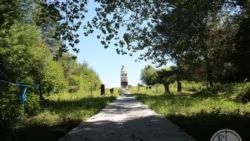
The place of the mass execution of the Jewish population in the concentration camp of Pechora.
- Do you get compensation from Germany?
- I get every quarter, as a victim from the Holocaust. Now it’s already one and a half thousand euros. Plus - a good pension for experience and disability of the first group.
-Russia pays something for suffering?
- They did not give us anything. Putin gave blockades of compensation, and we are all offended. Not that they are offended, but this is dishonest ... He gave the blockade a second pension ( monthly payments. - RS ), and we, like a dog, threw a thousand rubles a month. I experienced no less than the blockade. I can return this thousand to him. I do not have a single healthy organ. According to the general disease, I have the first group of disability. Only my character holds me afloat. When someone sees my extract, says: "Can't be! She is still alive?" - said Ida Spector.
Today, January 27, Ida Iosifovna takes part in commemorative events in the territory of the former Auschwitz.
An error at a price of thousands of lives. 40 years of invasion of Afghanistan December 24, 2019
On December 24, 1979, the Minister of Defense of the USSR Dmitry Ustinov signed Directive No. 312/12/12/1001, which spoke about the decision on the entry of "some contingents of the Soviet troops deployed in the southern regions of our country, into the territory of the Democratic Republic of Afghanistan." So de jure began the Soviet invasion of this country, which, according to various sources, turned out to be a death of 15 to 30 thousand soldiers and officers.
The participation of the Soviet troops in the hostilities in Afghanistan was not provided for by the directive, but after three days the order of the same Ustinov appeared to suppress the resistance of the rebels in cases of attack. On December 27, the forces of the KGB of the USSR carried out an operation to liquidate the chairman of the Revolutionary Council of Afghanistan Hafizullah Amin.
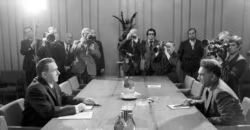
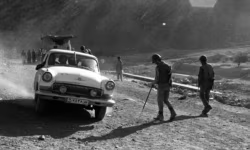
Soviet-Afghan negotiations. 1978
According to the testimonies of those events, during the commissioning of the Soviet troops, they did not have a clear understanding of the tasks, or how much their stay in Afghanistan will last, nor ideas about the features of the history and culture of this country.
Radio Liberty talked with Afghanistan expert Alexander Shkirando , who is sure that numerous mistakes and a misunderstanding of local specifics led to the Afghan tragedy for the Soviet Army.
- Naturally, no one had a complete understanding, no one realized how long all this would last. Moreover, everyone fulfilled his specific task. Naturally, no one imagined that this would all last almost 10 years and what would be the consequences for the country called the Soviet Union. In general, in my opinion, everything that happened can be called a big mistake that led to a great tragedy. Such specific countries as Afghanistan are not just countries of the near or Middle East, as we understand them in our time, this country is special. Take, for example, a period of history when Islam spread. There was such a province, which was called Kafiristan , which was only able to conquer in 1893, when the emir Abdur-Ramman was in power. At that time, almost the entire territory of the present Central Asia, the entire neighbor and Middle East, was under Islam. And this province, which was not conquered by either Genghis Khan, the great Mughals, or the great conquerors, did not recognize Islam. I give this historical example to make it clear what Afghanistan is, including the time when Soviet troops entered.
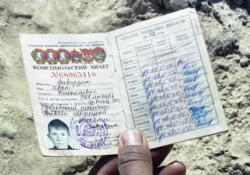
Komsomol ticket of a Soviet soldier in Afghanistan
It is clear that many years have passed, almost two centuries, but the national feature of the Afghans consists in this: they never subordinate to the conquerors. It is clear that no one considered us as conquerors. And, oddly enough, the first months and even, I would say, for about a year we were perceived as closest friends. Another thing is that then this resulted in a serious confrontation, which ended in the intern The Academy of Sciences between the Afghans themselves, when all this turned, in fact, into a serious civil war. Some Mujahideen were replaced by others, about seven of the so -called Islamic parties arose, and in the end it all ended for them with a certain disaster.
The Soviet military ended up in the place where it was later hard to leave
- You said that there was no understanding of how long all this lasted. That is, the understanding of the situation began to change in the process?
- At first, no one thought that it would have to be stationed by all our units, regiments and divisions throughout Afghanistan. The situation was different everywhere. If there was a safer zone in the north of Afghanistan, then in the areas adjacent to the Pakistani border, the situation was different - this border actually did not exist then, it does not exist now. It is called the Durand Line , by decision of Mortimer Durand, when there was still no country as Pakistan, and an artificial border was held between India and Afghanistan. This line divided independent Pashtun tribes into two parts. Resistance began in these areas, and the Mujahideen actively used them to penetrate deep into the territory of Afghanistan. There were the main serious intense battles between our 40th Army and Afghan Mujahideen.
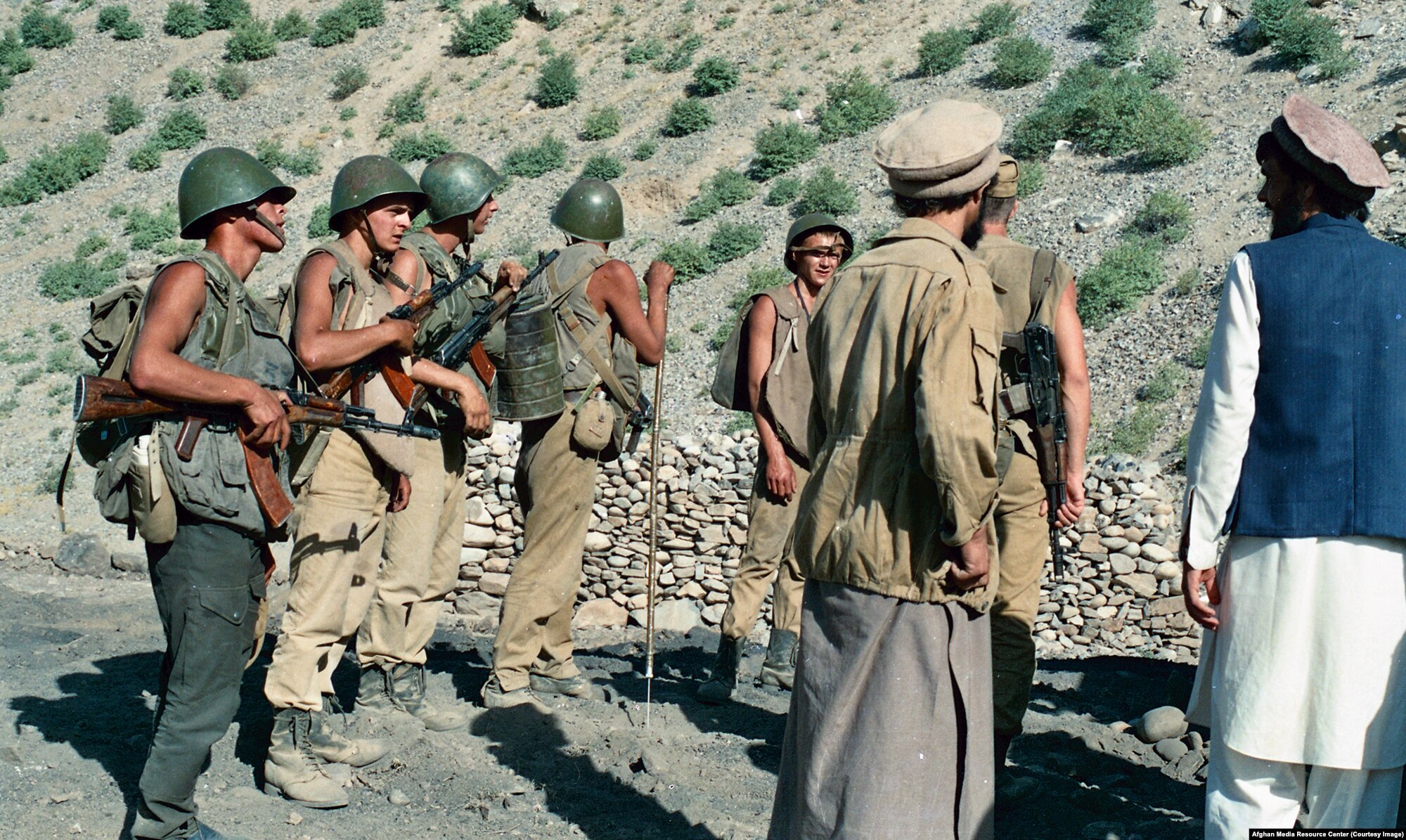
Soviet soldiers in Afghanistan
- Did the Afghan war change the alignment of forces in the world?
- Undoubtedly. Speaking more specifically, at that time the Soviet Union fell into a kind of trap. The West did everything so that our military would be in the place where it was later difficult to leave. But this is another problem for us. I consider equally the greatest mistake of both the commissioning of troops into Afghanistan and their conclusion.
- That is, you do not consider the withdrawal of troops the right decision?
As the withdrawal of the troops took place, this could not be done
- So, as the withdrawal of the troops was made, of course, this could not be done. In countries such as Afghanistan, and this is the Eastern country, to quit the people who believed you, and just as unexpected as to enter, is always a problem. Firstly, this is the formation of a vacuum of power. Even when [the President of Afghanistan] Najibullah agreed to transfer power to the transition government, it was needed elementary support at least from the side of not the 40th Army, but from the Soviet leadership. Unfortunately, there was no such support. As a result, as you remember, Najibullah was in the same, but in a miniature trap in which our country was also.
- The military complied with the order. But how can the order of the entry of troops can explain?
- It's hard to say. Firstly, the military is a military man, and he, of course, fulfills the order. Naturally, they did not think whether this decision was correct or not. In fact, as a witness, I can say that no one had thoughts that hostilities will have to begin against the civilian population.
- That is, not only military assistance was supposed?
-After all, we only in the first years built about 25 objects, which are still used by Afghans, together with civilian civilians. There is no longer the Soviet Union, but we are still called "Shuravi" (Soviet). And even that business Russian-Afghan council, which was created and works under the auspices of the Chamber of Commerce and Industry, shows that those friendly and trade and economic relations that were laid down at that time are partly working today.
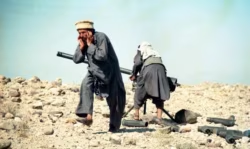
Soviet invasion of Afghanistan. Mujahideen
The introduction of Soviet troops into Afghanistan is also considered a mistake by the historian Boris Sokolov, who recalls that the main initiator of the invasion was the KGB:
- The decision to introduce troops into Afghanistan was, of course, a mistake from the Soviet leadership. The decisive word in making a decision was behind Brezhnev. And the most advocated for the entry of troops, as I understand it, the head of the KGB Andropov.
- Why did the Soviet leadership need this?
- At that moment, the Communist Government of Afghanistan was in a very bad position. They controlled a smaller part of the country. Most were under the control of the rebels, for the most part Islamists. To suppress this rebel movement, Soviet troops were introduced. The main motive was to keep in power the pro -communist government in Afghanistan. And in the future, Afghanistan was considered as a possible bridgehead for throwing to the Indian Ocean, if such an opportunity was suddenly created.
1979, Afghanistan, the murder of Amin. How it was
- If we talk about the price of the war, which began with the commissioning of troops into Afghanistan, what is it?
-According to the latest estimates, there were about 30 thousand Soviet troops, somewhere around 28 thousand. How many Afghans died - no one really knows, but ten times more, taking into account the fact that they died on two sides, that is, both government troops and opposed various rebels. And there were many peaceful population there. Well, and the costs of maintaining this government in Kabul were also rather big, and this, of course, is a loss. Then, by the way, after the withdrawal of the troops, until about the 92nd year, the Soviet Union supported the government in Kabul, that is, he was supplied with weapons, some kind of food, and humanitarian assistance. All this, of course, also cost money.
- Supporters of the input of troops claimed that if not for the Soviet troops, then there would be American.
- This statement has nothing to do with reality. In principle, there were no plans for the entry of troops into Afghanistan at that time in America.
- What were the consequences of this war from the point of view of geopolitics?
- Basically, a strong decline in the prestige of the Soviet Union among Islamic states. This is perhaps the main consequence. And also the fact that the Islamists in the end strengthened in power, such as the Taliban. But they were opponents of both Russia and the USA, that is, it cannot be said that someone won here, ” says historian Boris Sokolov .