
Translated material
In the affected area
In the affected area
Editorial “Layout” February 27, 2024 |About 400 settlements in Russia came under fire during two years of war

The war in Ukraine continues to involve more and more regions of Russia. In the two years since the start of the full-scale invasion, about 400 settlements have come under shelling and drone attacks, and at least 150 civilians have died from these attacks. Moreover, during the day, one populated area can be subjected to shelling from artillery, mortars, grenade launchers, and drone attacks. And for the last 9 months, Russian regions have lived for only one day without attacks from Ukraine. At the same time, the distances at which Ukraine strikes Russian infrastructure facilities are also growing.
In order not to miss new texts from “Layout”, subscribe to our telegram channel
What we thought
We studied reports of attacks published by regional heads, the media, regional departments of the Investigative Committee and the Ministry of Emergency Situations.
The statistics included :
- artillery attacks;
- missile strikes;
- shelling from grenade launchers and small arms
- UAV attacks resulting in damage to infrastructure or casualties.
The statistics did not include :
- missiles and drones shot down by Russian air defense and electronic warfare systems;
- UAVs that fell in populated areas without detonating ammunition;
- sabotage (arson, explosions of railway tracks and power lines).
During two years of war , settlements in the annexed Crimea and Sevastopol and 17 regions of the Russian Federation were attacked by Ukraine : Belgorod, Kursk, Bryansk, Moscow, Pskov, Kaluga, Oryol, Smolensk, Tambov, Tula, Voronezh, Leningrad, Volgograd, Rostov, Saratov, Ryazan regions, Krasnodar region. In total, by February 23, 2023, “Verstka” calculated that at least 404 settlements and districts were known (in 21 cases, attacks on districts and districts were reported without specifying a specific settlement) that became targets of military attacks.
View an interactive version of the infographic here .
Moreover, the number of these attacks increased over time. If in April-June 2022 the ratio of days under attacks and without was approximately 1 to 1 (1 day under attacks, 1 without attacks), after six months of hostilities it became 3 to 1 (three days under attacks, 1 without attacks). And after another 7 months, attacks became almost daily, increasing multiple times since May 2023 . Before this, the regions came under shelling and drone attacks several dozen times a month, after May - several hundred times a month.
Over the past 9 months, “arrivals” and attacks have occurred every day, with the exception of one day - November 24, 2023, and November has also become the “calmest” in the last 8 months: Ukraine carried out only 252 attacks on Russian regions during this month. The peak of attacks occurred in September 2023, when Ukrainian forces attacked Russian regions 479 times per month. There were slightly fewer attacks in January 2024 and August 2023: 452 and 438 military attacks, respectively.
In addition to the frequency, the number of daily attacks is also growing: populated areas may be subject to attacks more than once a day, which include not only shelling from artillery, grenade launchers or small arms, but also UAV raids or dropping ammunition from them.
In total , over the two years of “NWO” (730 days), Ukrainian forces attacked Russian regions at least 4,246 times: 354 times in 2022, 3,166 times in 2023 and 726 times in the first months of 2024 . Only in 63% of all attacks do officials specify what weapon was used to attack the region.
Over the two years of the war, regions of the Russian Federation were fired at least 1,170 times from mortars, 784 times attacked using kamikaze drones or UAVs dropping explosive devices, 713 times “arrived” from cannon artillery, 50 times from multiple launch rocket systems. Moreover, at least 138 times damage during these attacks occurred as a result of air defense, which caused at least seven people to be injured (including one child ).
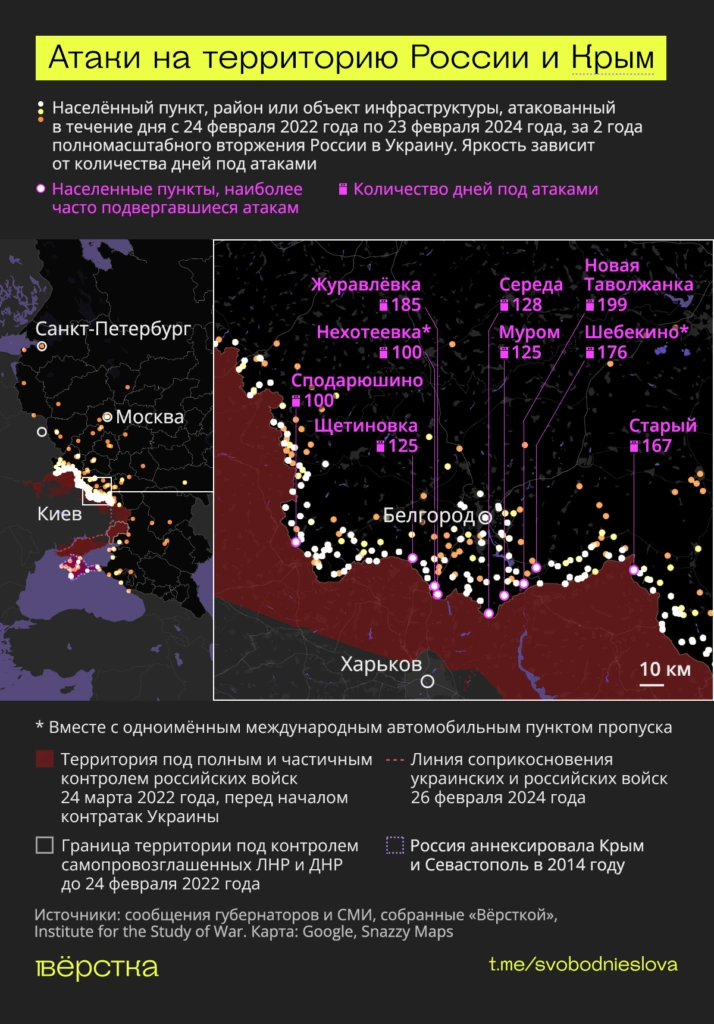
At the same time, it is the populated areas of the Belgorod region that are most often under regular attacks. Thus, the city of Shebekino (together with the Shebekino checkpoint) over the course of two years, the North Military District was subject to shelling and drone strikes for at least 176 days, the village of Zhuravlyovka - 185 days, and the village of Novaya Tavolzhanka - 199 days. In total, the Belgorod region was subjected to shelling and raids 3,572 times during this time (Kursk region was in second place and Bryansk region was in third place, which were attacked 375 and 209 times, respectively).
The Belgorod region came under attacks from the first days of the war and immediately became the “leader” in their number. But if in the first year of the war there were several dozen shellings and raids per month, then since May 2023 their number has increased to several hundred per month - as well as the total number of attacks on the regions of the Russian Federation.
Since June 2023, the Belgorod region has been attacked on average 300–400 times every month (the only exception was in November 2024: 225 attacks). But despite this, only after almost two years of regular attacks did officials decide to start building protective structures in the regional capital - after the massive shelling of Belgorod on December 30, 2023.
During this attack, Belgorod residents were unable to get into the bomb shelters, which were closed. In January, officials ordered to cover public transport stops with sandbags, and then installed reinforced concrete protective bunkers on the streets, reported the regional governor, Vyacheslav Gladkov. But at the same time, the warning system about the threat of shelling is still not “fully operational” in the city - this was stated by Gladkov himself in February 2024 after complaints about this from local residents.
As the number of attacks increases, so does the number of civilians killed and injured. The first civilian casualties in the Russian Federation appeared in May 2022 - two months after the start of the war, three people each died in the Belgorod and Kursk regions . Almost two years later, SVO, as calculated by Vorstka, has already killed at least 150 Russian civilians: 49 people in 2022, 91 people in 2023 and 10 people in the first months of 2024.
Most of the dead and injured occurred in the regions neighboring Ukraine: Belgorod, Kursk and Bryansk regions. The most serious attack in terms of casualties occurred on December 30, 2023, when after the shelling of Belgorod, 25 people were killed and 109 were injured. Another shelling on February 15, 2024, killed seven people and injured 19.
Potentially vulnerable area
Over the two years of war, the distance at which Ukraine attacks targets on Russian territory has increased. Thus, on January 21, drones attacked the gas reservoir of the Novatek oil plant in Ust-Luga, Leningrad region. Although the distance from the nearest point of Ukraine to the Leningrad region is at least 900 km. Thus, the attack range almost doubled in the second year of the “NWO”: in December 2022, Ukraine was able to attack the military airfields of Engels and Diaghilevo in the Saratov and Ryazan regions. The first is located at a distance of 475 km from the nearest point in Ukraine, the second - 460 km.
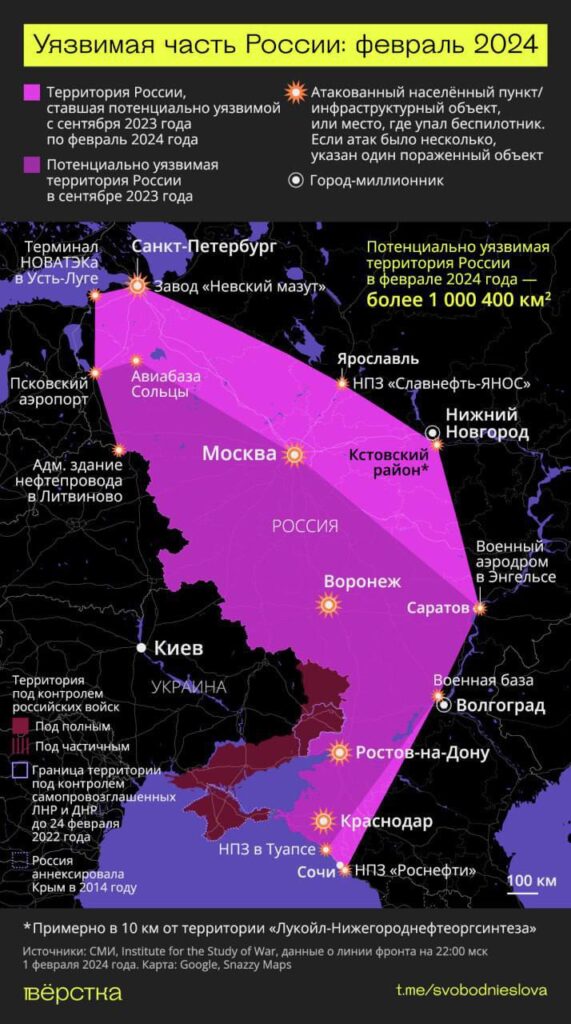
The territory of Russia potentially vulnerable to attacks by the Ukrainian army has also increased. Attempts to attack oil refineries in January were also recorded in the Yaroslavl and Nizhny Novgorod regions. Thus, the potential affected area has increased by more than 300 thousand square kilometers compared to September 2023.
Judging by these data, after two years of war, more than a million square kilometers of Russian territory (excluding the annexed Crimea and Sevastopol) have become potentially vulnerable to attacks by the Ukrainian army. Now there are six cities with a population of over a million in the affected area of Ukrainian drones, including two cities of federal significance - Moscow and St. Petersburg.
Cover: Dmitry Osinnikov
Infographic: El
You can support “Layout” from any country in the world - it is still safe and very important. We really need your support now. How to help us →