
Translated material
Friendship apart
Russia calculated friends and enemies in the post -Soviet space. The latter for a year only increased
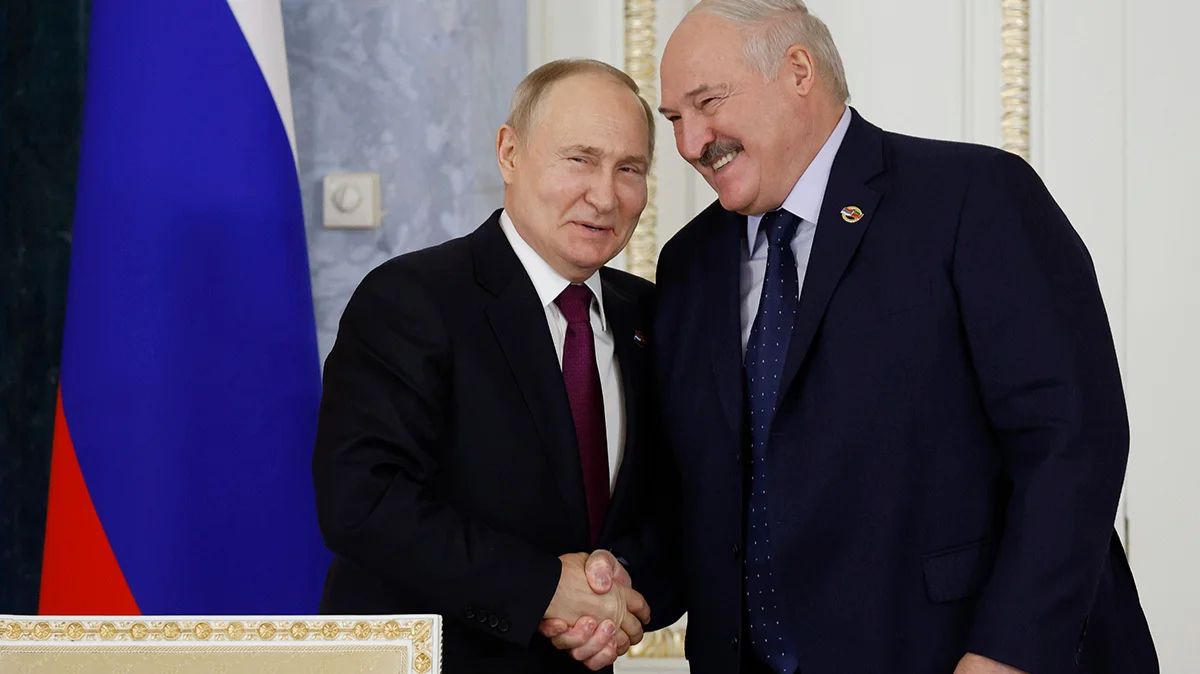
Vladimir Putin and Alexander Lukashenko at a meeting of the Supreme State Council of the Union State in St. Petersburg, January 29, 2024. Photo: Dmitry Astakhov / Sputnik / EPA-EFE
In Russia, they compiled a "rating of friendship of communication regimes" of post -Soviet countries. The assessment was held by the National Research Institute for the Development of Communications (NIIRK). The authors of the report were asked: do Russia have the opportunity to maintain close relations in the post -Soviet space?
As it turned out, in 2023, the group of “friendly Russia” included ten countries, and in the first three were Abkhazia and South Ossetia, which the world community considers the occupied parts of Georgia. Georgia itself is the only one in the ranking that is evaluated as "relatively friendly country." Five more countries, previously included in the USSR, today are unambiguously unfriendly, these are Moldova, Estonia, Lithuania, Latvia and Ukraine.
South Ossetia received the first place and 93.5 points, in which, as it turned out, the most friendly “communication regime” in the post -Soviet space.
NIIRK notes in South Ossetia “the formation of a single informational, socio-economic, cultural and historical space with Russia, on the basis of mutual foreign support and allied relations”.
A plus for the position in the ranking was the decision of South Ossetia "to send volunteers to the zone of combat operations."
Second place: Belarus, 87.6 points.
Among the advantages of this “communication regime” are “cooperation in the formats of the Union State, the CIS and the EAEU, active interregional communications, [close] personal positions of the presidents”. Monitoring also revealed the general political risks of Russia and Belarus: sanctioned pressure, the danger of socio-political destabilization or the influence of foreign centers and actors for this purpose.
Third place: Abkhazia, 81.4 points.
Only four countries recognize Abkhazia together with Russia: Nicaragua, Venezuela, Nauru and Syria. However, the compilers of the rating came to the conclusion that "the norms and rules of international communications that have developed in Abkhazia are largely similar to the Russian." It is also noted that Abkhazia would like to more profitably use her access to the sea and “build relationships not only with Turkey, but also with the Black Sea EU countries”, but “comes into an invariable position of non -recognition from the EU countries”.
In 2023, the positions of Abkhazia and the Russian Federation in the field of communication became closer due to "strengthening control of NPOs with foreign financing, expanding the spectrum of Russian -speaking media resources, and the emergence of more critical content in relation to Western countries."
Fourth place: Kyrgyzstan, 60.3 points.
NIIRK reports "the instability of the communication regime of Kyrgyzstan in 2023." Inside the political establishment "several centers appeared." If some of them are configured to cooperate with Russia, then others are more likely to be on Western countries. Still others are completely "radical actors who are looking for special identity."
There is also a decrease in the share of the Russian language in business communication and monitoring media content with an emphasis on traditional values.
Fifth place: Tajikistan, 58.7 points.
Russia remains for Tajikistan citizens the most attractive country for the formation, employment and obtaining citizenship, the compilers of the rating state. Sources of information about Russia in Tajikistan are not only the media, but also migrants who are in Russia. At the same time, communication along the NPO line in the case of Tajikistan is called "the most complicated type of communications."
Sixth place: Uzbekistan, 55.2 points.
In Uzbekistan, economic, cultural, youth communications not only with Russia, but also with other countries, including unfriendly Russia, are well developed in Uzbekistan.
The political communications of Uzbekistan is "very multi -vector, but with the preservation of the priorities of economic partnership with Russia." And in this case, the authors of the monitoring called the “vulnerable sphere” the civil sector, “experiencing the pressure of the Western NGOs”. According to the NIIRK forecast, in 2024 in Uzbekistan “changes in the working conditions of NPOs and the transformation of the media environment” may occur.
Seventh place: Azerbaijan, 50.1 points.
"The communication regime of Azerbaijan is more synchronized with Turkey than with Russia." However, the country "created mainly favorable conditions for the development of communications with Russia." The compilers of the rating make this conclusion on the basis of an analysis of the development of economic ties of the two countries and youth exchanges.
It is noted that in 2023, based on the new situation in the South Caucasus, the regime of foreign policy communications of Azerbaijan began to change. It is also said about “Azerbaijan’s clear understanding of its place and role in the civilizational strategic partnership with Turkey, the countries of the region and the countries of the Turkic world.”
Eighth place: Kazakhstan, 50 points.
The communication regime of Kazakhstan is characterized in the ranking as “controversial”. On the one hand, strategic partnership with Russia is declared at the highest level, on the other hand, “the country is working closely with Russia unfriendly Russia,” which affects the “interpretation of historical events, calculating the share of the necessary media content in Russian”.
The authors of the rating do not exclude that this year the communication regime of Kazakhstan can become less favorable for Russia, taking into account the "high competitiveness of the foreign policy environment, cooperation of Kazakhstan with countries and organizations supporting centrifugal post -Soviet processes."
Ninth place: Turkmenistan, 47.1 points.
The authors of the rating recall that Turkmenistan adheres to the principle of neutrality, and at the same time do not exclude that the interests of the economy and security will lead to strengthening its political ties in the region, including with Russia. In addition, Turkmenistan deepens its partnership with Turkey, builds a single cultural and civilizational space with it. However, according to researchers, in the future, Turkmenistan "has little chance of remaining a neutral country in the form in which it was recently."
Closes the top ten of Armenia friendly for the Russian Federation - it has 46 points.
The authors of the rating were called Armenia "a vivid example of how the ruling elite, using a power resource, can change the regime of communications contrary to the social position."
And "the country's public opinion showed how quickly it can transform under the influence of massive information attacks." We are talking about "the formation of public opinion by blocking alternative information, restrictions on entering the country of public opinion leaders from Russia, strengthening anti -Russian rhetoric and accusing Russia of errors and miscalculations of Armenian power."
The study notes that in 2023 the unfriendliness of Armenia "sharply increased, but did not become deep for the general public." However, it is highly likely that in 2024 the communications regime with Russia in Armenia "will be the most contradictory and variable."
In the 11th place of the rating-Georgia with 12 points. This is the only country that is part of the group of “relatively friendly” Russia of communication regimes. It is worth noting that in comparison with the last year, the position of Georgia in the ranking of “friendliness” doubled. According to the results of 2022, the country had 24.2 points.
“The regime of foreign policy communication remained anti -Russian. At all international sites and in political decisions, Georgia adhered to the positions of opponents of Russia. At the same time, the regime of economic and civil communications has become more favorable, thanks to an increase in trade turnover, cooperation of business missions, opening air traffic, etc., ”the ranking says.
It is also said about the special significance for relations with Russia of the upcoming Georgia elections. The compilers saw in the Georgian society "a split in assessments of the political and economic feasibility of relations with Russia."
Further, experts evaluated the already “unfriendly” countries of the post -Soviet space. And such has arrived in the last year. So, if last year, Moldova balanced on the verge with an indicator of 8.3 points, then this year she clearly joined the camp of enemies.
12th place: Moldova, minus 16.1 points.
The ranking notes the “growth of hostility” in communications with Russia in 2023. “In fact, the country's communication is controlled from the outside. 2023 showed tendencies to the loss of its own identity (expanding the Romanian influence), the erosion of statehood and the disagreement of a large part of the society with the positions of power in relation to Russia, ”the study said.
At the same time, according to the forecast, in 2024 the growth of hostility should be expected not only among the ruling elite, but also among the population. The situation in Moldova also affects the population of Transnistria, where "a special type of communication was formed."
13th place: Estonia, minus 57.7 points.
“The communication regime of Estonia is similar to the regimes of Latvia and Lithuania. The main trend of all changes is the growth of Russophobia and hostility. Estonia in 2023 continued to create new restrictions, blocking the possibilities of not only interstate, interregional interactions, but also private communications of Estonian and Russia citizens, ”the ranking compilers write.
14th place: Lithuania, minus 59.9 points.
“During the year, there has been a new reduction in the possibilities of communications with this country and the growth of aggression against Russia,” the ranking said. At the same time, Lithuania is called the Hab of the preparation of the opposition (including from the citizens of Russia and Belarus), aimed at destabilizing the socio-political situation in Russia and in Belarus.
15th place: Latvia, minus 63.9 points.
The verdict of NIRK is as follows: "The country continues to move towards confrontation and strengthening hostility against Russia."
Ukraine closes the rating with the 16th place and an indicator of minus 89.6 points.
“Ukraine is in military confrontation with Russia, being a source of Russophobia and false information. Not being independent in decision -making and not having its own resources for conducting military operations, Ukraine is oriented to the West, or rather, on NATO countries, ”the authors of the rating come to this conclusion.
NIRK clarifies that monitoring the friendship of the communication regime included an analysis of the content of public and political discourse in relation to Russia, as well as legal, political, organizational and other opportunities and conditions of communications with Russia.