
Translated material
The city is on the wave. Konstantin Doroshenko - about his trip to Nikolaev
From the first days of the full-scale phase of the Russian war against Ukraine, Nikolaev became a front-line city. The fighting in the city and its suburbs lasted from February 24 to November 10, 2022. The occupiers continue rocket attacks even now. Journalist Natalya Nagornaya recalls : "It arrived at trolleybus depots, at elevators, at factories, at places where equipment was repaired or at least equipment could be repaired, at business centers, at universities. Everywhere where military personnel could live or hide equipment. Most often, this fell on civilians who did not leave the city. Life today is different primarily in that in the morning there is no need to shovel out glass and sweep away the broken bricks.” They promise to return drinking water only by the end of this year.
Having visited Nikolaev for the first time in 2014, I was impressed by the scale of one of the former shipbuilding centers of Europe, the high-quality architecture in styles from classicism to brutalism, and the uncertainty in its identity. Freed from the regime of Soviet secrecy, having lost its position as an advanced military shipyard, it seemed to be wandering in timelessness. The monument to Lenin had already been demolished, but on its eight-meter pedestal, lined with pink granite, someone installed a bust of the father of world totalitarianism - one of those that stood in Soviet schools. This absurd construction revealed the real place of the imperial myth in modernity.
Signs of the free spirits of the 90s in the urban environment were in no hurry to give way to new urbanism. Friends took me to the Nikolaev beer hall "Eternal Call", where schoolchildren drank vodka and Yantar beer. Started in 1997 as a MAF pouring station, it grew into a brick building with a wrought-iron fence and gate. But the authentic tables and benches have been preserved.
On my current visit, I didn’t recognize Nikolaev. The tragedies of destruction, casualties and the threat of occupation not only did not plunge the townspeople into fear and apathy, but finally dispelled the darkness of the post-Soviet dream. Having survived, feeling the solidarity of fellow citizens and the support of the world, Nikolaev residents rethink the past and want a future for themselves, and not just a stopped present.
Nikolaev is no longer a monotonous “city of shipbuilders”. It lives up to its new motto , adopted in 2019, “City on a wave.”
The awakening did not happen suddenly. Behind it are the efforts of civil initiatives, the work and creativity of those who built their own and the city’s subjectivity. Since 2017, contemporary art festivals, educational projects, and research dedicated to the history of Nikolaev and its decolonization have been implemented by the MY ART platform. Its co-founder Evgeniy Gomonyuk says: "First, a community was formed around the organization of the first Mykolaiv ART Week. MY ART - the first letters of this name, a reference to the name of our city. Today we have come to unite and coordinate local cultural initiatives."
This year Mykolaiv ART Week was dedicated to the theme of memory . “The festival was about the experience of Ukrainian families, about the past of Ukraine and the personal stories of people that they cherish or want to get rid of,” says MY ART founder Dmitry Larchenko. Film screenings, concerts, lectures were held in five locations, and in virtual space in augmented reality there was an exhibition of artists from 18 countries.
The war against Ukraine is a paroxysm of the Russian world, revealing the primitiveness of its cultural tradition
Another initiative of the platform, supported by the Municipal Development Agency of Nikolaev, is the digitization of marine paintings from the collections of the Ochakov Museum , the Nikolaev Regional Art Museum and the Museum of Shipbuilding and Fleet. Thus, researchers and viewers gained access to images of exhibits, the public display of which was impossible during the war. "The idea was born to the team even before the full-scale invasion. The sea as the identity of every resident of the south of Ukraine, the sea as a representation of our region in works of art and cultural heritage," explains Evgeniy Gomonyuk.
The war against Ukraine is a paroxysm of the Russian world, revealing the primitiveness of its cultural tradition. The censorship of history, the devaluation of the heritage of neighboring peoples, the dogma of self-praise against the backdrop of savage military operations cause disgust. They stimulate attention to an alternative to this obsessive rudeness. In Nikolaev they remembered that a thousand years BC. e. in its place there was a Cimmerian port; in the Middle Ages, the Lithuanian prince Vytautas founded the castle. And about how the city is connected with the Ukrainian national movement. About the theater of luminaries of the Ukrainian stage, founded by Mark Kropivnitsky, and its star Panas Saksagansky, who first appeared on stage in Nikolaev. About the Nikolaev premiere of the opera “Katerina”, the first in Ukraine, written on the poem by Taras Shevchenko by Nikolai Arkas, the son of the local military governor. An ethnic Greek, Nikolai Arkas felt himself a Ukrainian, wrote and published the first “History of Ukraine-Rus” in Ukrainian in 1908. His son Nikolai Arkas Jr. was a military leader in the UPR, and in the 1920s he directed the Ukrainian theater in Uzhgorod.
Ukrainians managed to cure the world of fear of Russia. It’s painful for Russians to accept the fact that no one is afraid of them anymore
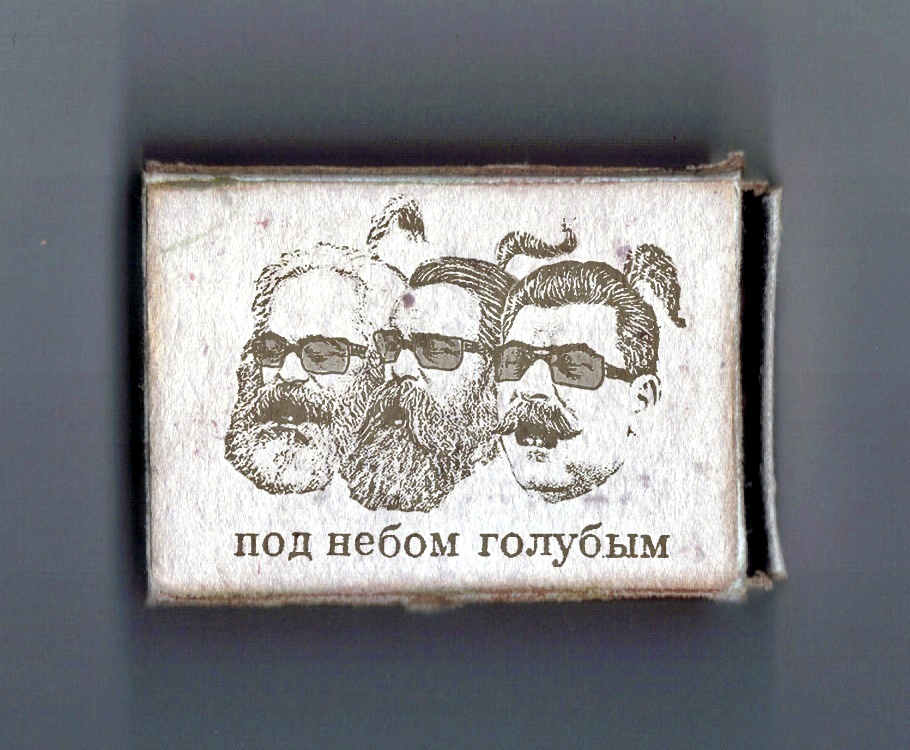
An artist significant for Ukrainian contemporary art, Nikolaev resident Viktor Pokidanets is consistent in deconstructing the pathos and cliches of Russian-Soviet culture. In 2016, he dedicated the series The Box to their obsessive and meaningless presence in everyday life. Objects in the form of a matchbox, an object that catches the eye and hand every now and then, a disposable utilitarian cheap item, he provided with images that combine common phrases, quotes from songs and films, political clichés and absurd images. For example, the work “Khrushchik”: a cockchafer flies into Mao Zedong’s face, which is called “Khrushch” in Ukrainian. Those familiar with Soviet history and propaganda will appreciate the comic effect, referencing the conflict between Khrushchev and Mao. It resulted in decades of confrontation between the two regimes, accompanied by mutual accusations of revisionism, neo-fascism and even leading to military provocations.
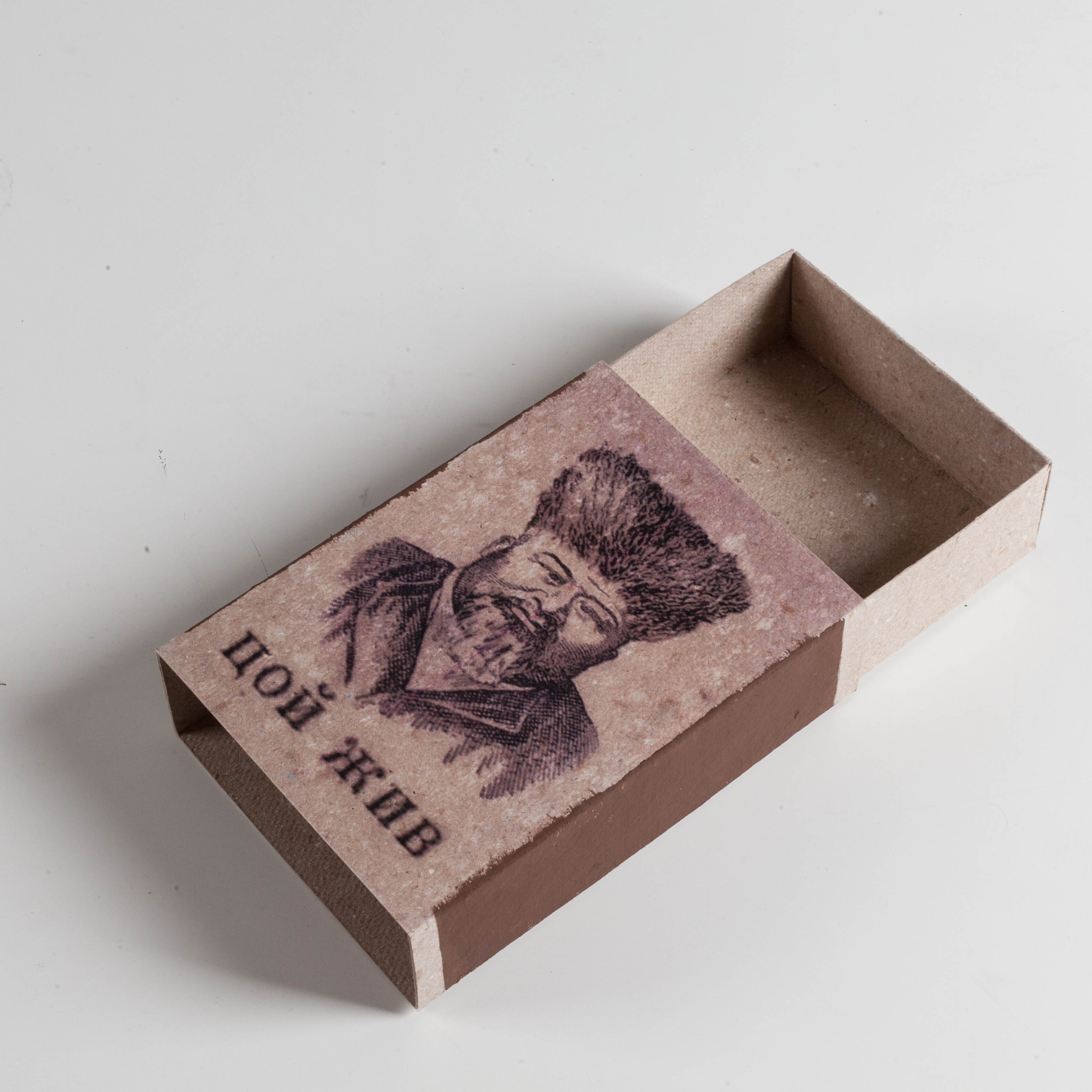
In his works “Under the Blue Sky” and “Tsoi is Alive,” Viktor Pokidanets charmingly ridicules the phenomenon of Russian rock, whose protest energy was channeled into a weak-willed expectation of change.
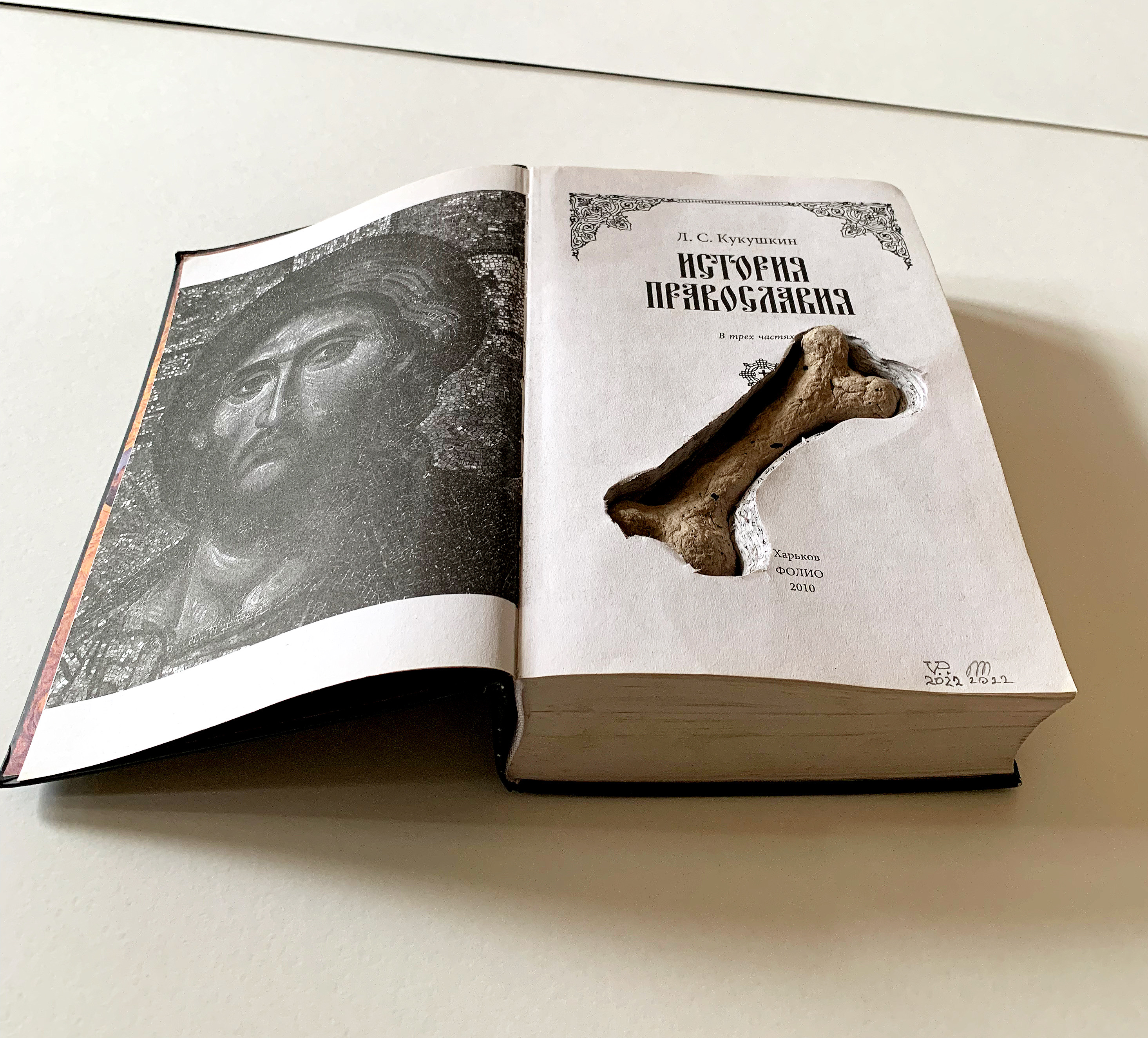
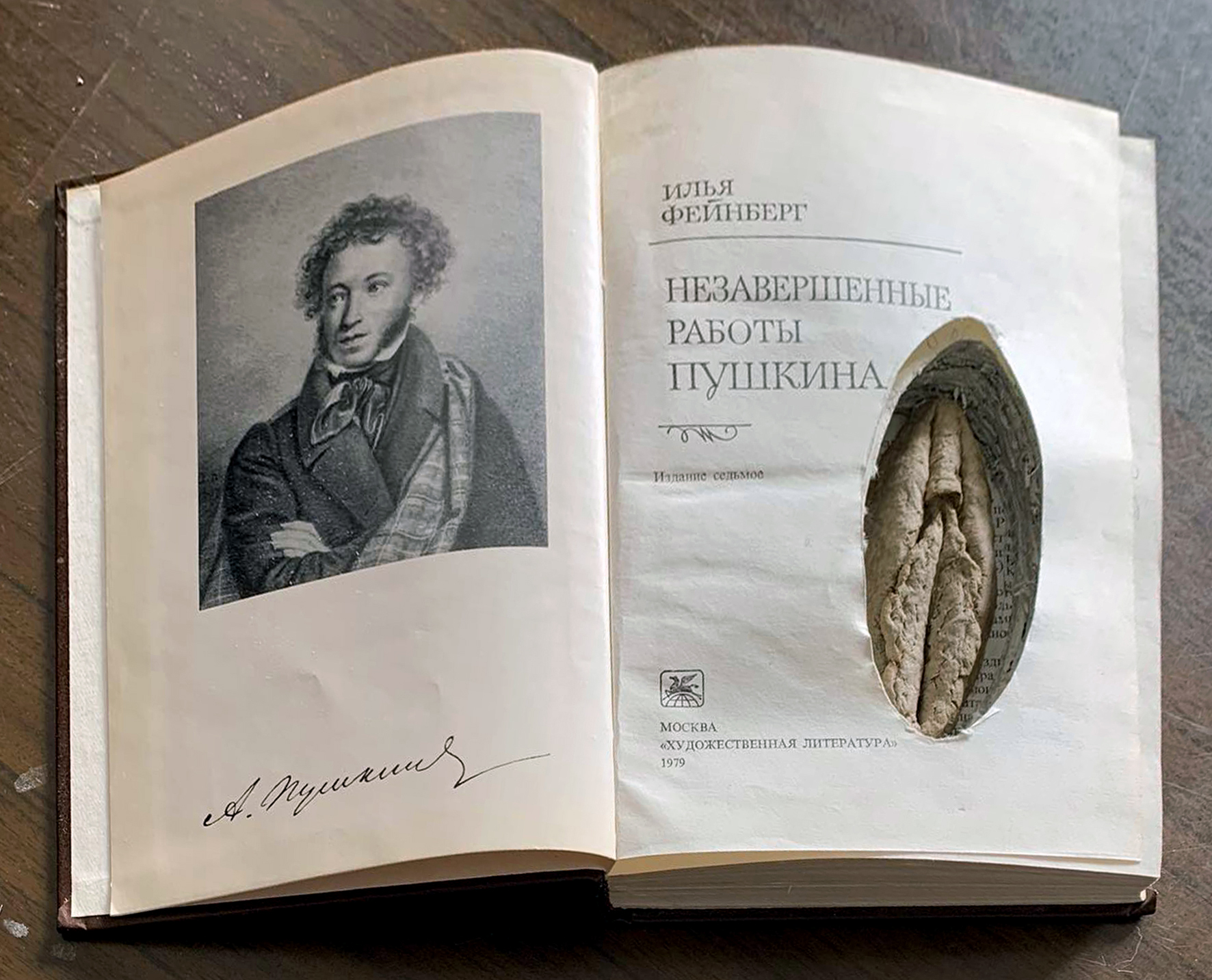
In the spring of 2022, the artist creates a series of objects “The Hidden Hidden Places of Russian Lit.” In the books of Russian writers and scientists, he cuts out three-dimensional holes in the shape of objects, which he considers reflecting the essence of the works and morals raised by this literature: pistols, brass knuckles, knives, dildos. Winner of the 2023 Václav Havel Prize for Creative Dissent, art critic and curator Yulia Manukyan, called Pokidanets’ project “a ritual burial of the misconceptions of the past.” “For many, the pearl of the collection is “The History of Orthodoxy,” the former property of the Odessa regional governor, with a bad odor of disbelief in the holy relics and God’s chosenness of the Russian people,” she writes .
The items placed in the “Secret Secrets of Russian Lit” were made by Uzhgorod artist Ruslan Tremba. The project has been exhibited in Warsaw, Oberhausen, Düsseldorf, Eindhoven and will continue to travel around the world. And Viktor Pokidanets remains in Nikolaev.
In the compartment of the Nikolaev-Kyiv train, my fellow traveler was a volunteer from Estonia named Hunt. He brought humanitarian aid to the front-line city, leaving with it the people of Nikolaev and the car in which he arrived. The way home is tiring: by rail to Kyiv, there is a transfer to Przemysl, then to Warsaw, from there an air flight to Helsinki, a plane to Tallinn and only then to your hometown. But Hunt is cheerful. “The Ukrainians managed to cure the world of fear of Russia. It’s painful for Russians to accept the fact that no one is afraid of them anymore. But this is the new reality,” he says cheerfully.
Konstantin Doroshenko – Ukrainian critic, publicist, curator of contemporary art
The points of view expressed in the "Author's Rights" section may not coincide with the position of the editors