
Translated material
In the Athenian abyss
Over the two years of the war, Greece has turned from the main Russophile of Europe into a “unfriendly state”. The Russian rocket almost killing the Greek prime minister in Odessa sends these relations to the bottom
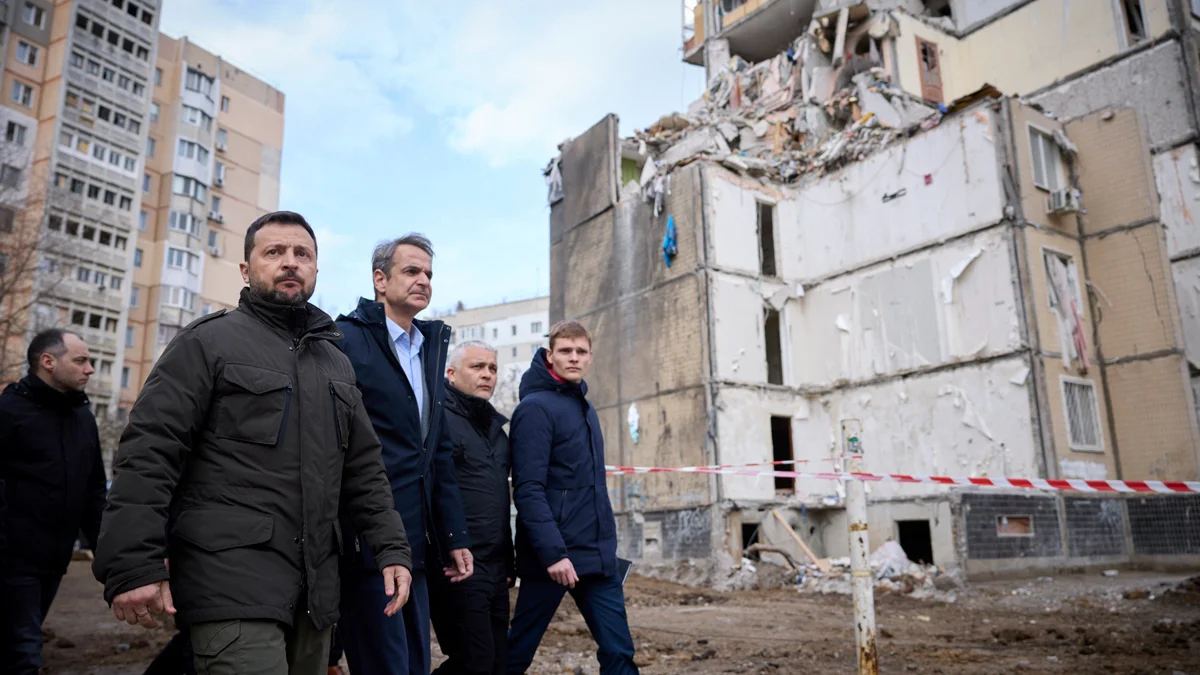
Vladimir Zelensky (left) and the Prime Minister of Greece Kiriaconik abouthotakis (second on the left) go next to the damaged residential building at the attack site of the Russian drone in Odessa, Ukraine, March 6, 2024. Photo: Office of the President of Ukraine / EPA-EFE
On March 6, the Greek prime minister Kiriacosik abouthsties visited Ukraine, met with Vladimir Zelensky and almost died from the port of the Russian missile flying to the Odessa port. “When we got into our cars, we heard a big explosion. For us, this is the best reminder that real fighting is going on here. Every day, ”said the Greek politician later to reporters.
Apparently, a blow to Odessa during the visit of Mitsikitis is a simple coincidence. Nevertheless, the Greek media were full of headlines with the words “terrorist attack”, “attack” and the like. Immediately after a visit to Odessa, Mitsikitis joined the congress of the European People's Party - the main political power of the EU. In his speech at the congress, he touched the experienced attack and stated that the Kremlin would not intimidate Europe. “We will continue to support Ukraine,” the prime minister promised. As previously, the allied relations of loved ones in the historical and religious plan of Russia and Greece reached this point, journalist Pavel Kuznetsov tells specially for the New European.
Old friend and creditor
If we lower the “short historical certificate” of ten centuries, then the current stage of Russian-Greek relations begins after the collapse of the USSR. “Russia and Greece are partners united by history and faith,” the early documents of the Greek Foreign Ministry said . In 1993, the parties conclude standard cooperation agreements in various fields . At the official level, the presence of a “significant number of Russian Greek origin” in the south of Russia is constantly emphasized.
With the coming to the power of Vladimir Putin, relations are developing: mutual visits are activated, including first persons and even ministers of defense. The declaration "On the further deepening of the relations of friendship and comprehensive interaction" was signed. The turnover is growing: Greece purchases oil and gas from Russia for billions of dollars. In 2007, Russia, Greece and Bulgaria signed an agreement on the construction of the Burgas -Alexanderopolis pipeline, which, however, will not be built. Initially, it was assumed that the oil pipeline extended from the Bulgarian Burgas to Greek Alexander Polyis would supply Russian oil bypassing Turkey. But in 2010, Bulgaria abandoned this idea and left the deal, considering it environmentally insecure.
At a new stage, relations reached after the global financial and economic crisis of 2008, which hit Greece stronger than other EU countries, and revealed the “manipulations” that the government undertook to underestimate the state debt level. To avoid bankruptcy, Athens were forced to ask Brussels about additional financial support.
Under the pressure of creditors, the Greek government had to go to strict savings: taxes grew up, salaries and bonuses to civil servants were significantly reduced, and retirement age grew.
This expectedly caused mass protests during which at least three people died. This shocked many: the last time people died during protests in 1991.
In the midst of the crisis, in the wake of public discontent, the left coalition of Siriza came to power (received 26% of the vote in 2012 and 36% in 2015). "Siriza" promised to abandon hard savings, which directly contradicts the interests of the EU. As often happens, tense relations with Brussels led to the rapprochement of the country with the Kremlin.
Probably, it was then that Moscow had a condescending attitude to Greece as a “hopeless debtor” of Europe. So, in 2015, shortly before Defolt, Greek Prime Minister Alexis Tsipras visited Moscow, and Greece received an “prepayment” of 5 billion euros for participating in the new project “Turkish Stream”. At the same time, as the Russian media wrote at that time, "everyone understands that the money will not go to the pipe, but to pay off the debts of Greece." Greece became more and more dependent on Russia and became close to it on the basis of Euroskepticism.
The struggle for the Church and NATO
But simultaneously with a forced political rapprochement, a spiritual split occurred.
Against the backdrop of the beginning of the “talent of autocephaly, the Orthodox Christians of Ukraine” worsened the conflict between the Ecumenical (Constantinople) Patriarchate and Moscow. In the fall of 2018, the Russian Orthodox Church decided to break off relations with the Patriarchate of Constantinople, which many other Orthodox churches, including Greek. The reason is the support of the “schismatic”, according to Moscow, the Orthodox Church of Ukraine.
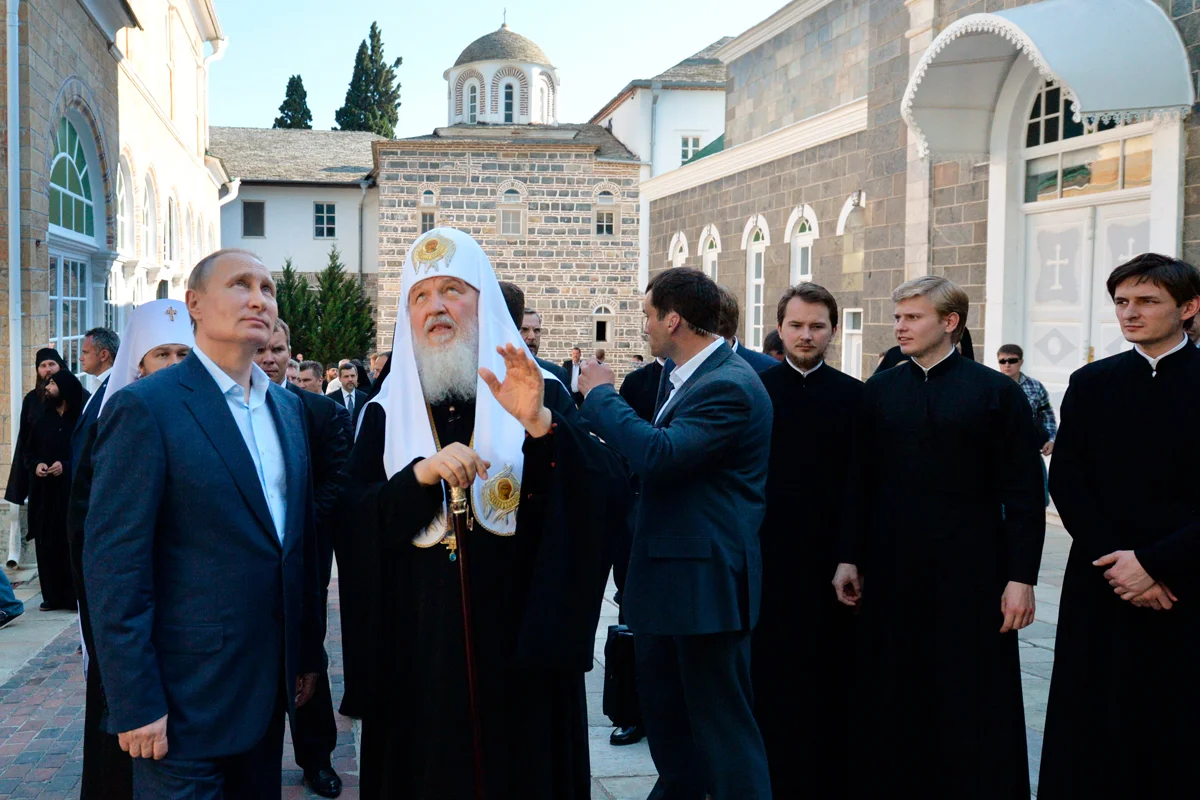
At the same time, in Greece there is an autonomous monastic state of the Holy Mountain, that is, Athos, which directly obeys Constantinople. For many centuries, Athos is the main Orthodox center that is extremely important for Russia. The Kremlin carefully overwhelmed it for many years: Putin repeatedly visited the Holy Mountain, the last time -in 2016 on the occasion of the 1000th anniversary of the Russian presence there. In 2011, Dmitry Medvedev created a special fund for collecting donations, which, according to the BBC, was able to collect 2 billion rubles.
The rupture of relations between the Moscow and Constantinople Patriarchate wrapped all these efforts, moreover, he closed the road to Athos to pilgrims from Russia.
The parishioners of the Russian Orthodox Church could no longer take communion and take part in other sacraments in the temples under the jurisdiction of Constantinople, including on Athos, although it was still possible to come there.
The political rapprochement of Moscow and Athens did not last long. In the summer of 2018, a scandal broke out between the two states: Greece sent two Russian diplomats, saying that they allegedly tried to bribe government officials and influence the clergy. In response to the symmetrical action of Moscow, Greece made a sharp statement that reported that “Russia cannot understand the fundamental positions of Greek foreign policy” and is removed from Greece, with which for two centuries has been on friendly relations.
Such a sharp reaction was quite unexpected. One of the assumptions about the reasons for the cooling of relations between Moscow and Athens was related to rapprochement, including military terms, Russia and Turkey. Greece has tense relations with Ankara due to a long-standing conflict around Cyprus.
Another version associated the diplomatic conflict with the fact that in fact, Moscow systematically tried to intervene in the foreign policy of Greece. One of these examples is the Kremlin’s attempt to prevent the resolution of the conflict between Greece and Macedonia, when there was a dispute about the official name of the latter. The completion of the thirty -year dispute opened Northern Macedonia - this is how this country is called now - the doors to NATO, against which Moscow actively spoke out.
Despite the fact that the political gap between Moscow and Athens began to grow, all this has not yet been reflected on the attitude of the Greek population towards the Russians. According to surveys, until 2022, Greece remained the main Russophile of Europe: more than half of the country's population was positively related to Russia.
Arsenal for Ukraine
The war unleashed by the Kremlin in Ukraine dealt a crushing blow to the reputation of Russia in Greece.
In 2022, the level of sympathy of Greek citizens to the Russians fell more than two times, up to 27%, which became the lowest result in ten years of observation. All the main political forces of Greece condemned the Russian invasion. Greece has joined the EU sanctions.
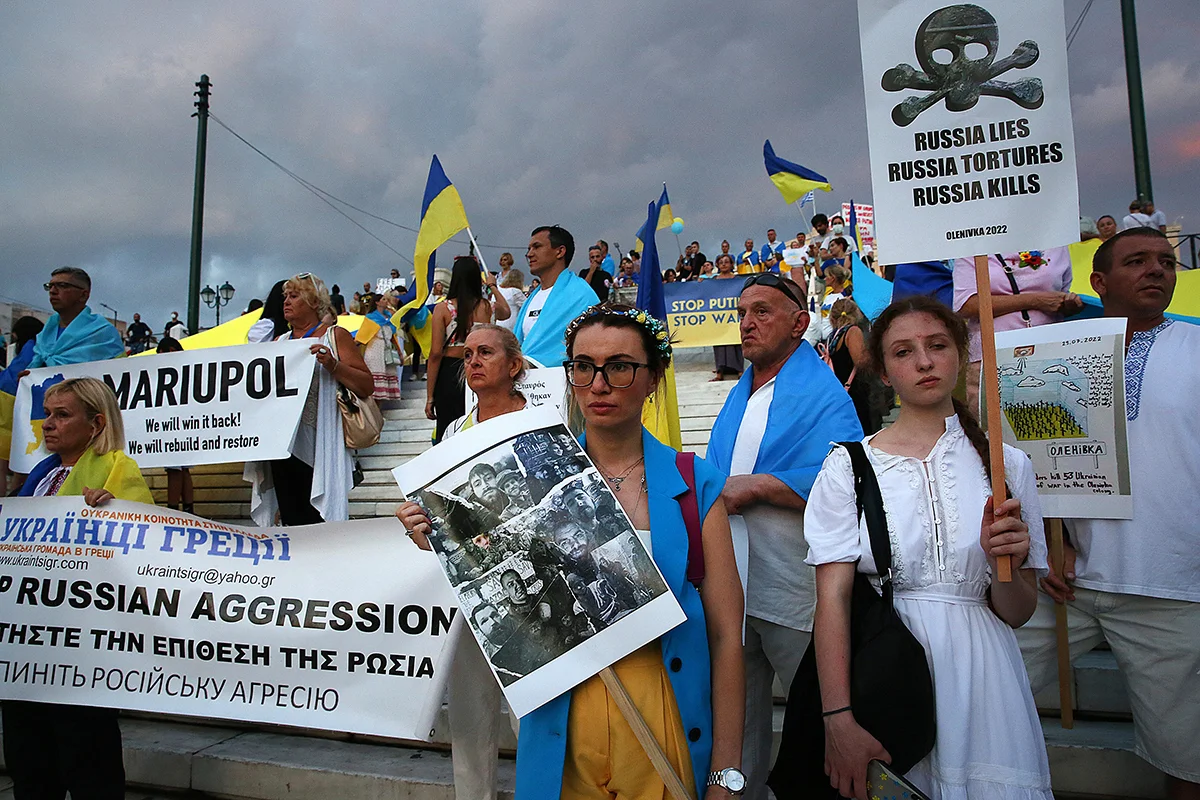
A critical blow to the relations of the two countries was the episode on February 26: as the media reported, the Russian army fired at the village of Sartan and Bug, located near Mariupol, where ethnic Greeks lived.
As a result, at least 12 people were killed, another 80 inhabitants of these villages turned to the Greek consulate for help. In response, the Russian media said that Ukrainian nationalists from Azov were behind the shelling, but no one believed in Greece.
Greece is a real “tank republic” : due to the conflict with Turkey in Cyprus, it has to contain 1,200 tanks and 245 fighters on combat readiness. This is more than anyone in Europe. Possessing such an arsenal, Greece was one of the first to decide to support Ukraine with a weapon. During 2022–2023, the country transferred weapons, ammunition, military equipment to Ukraine. In total, 122 BMP-1 with ammunition, 17 thousand shells for artillery, 15 thousand shells for tanks, 20 thousand Kalashnikov machine guns, dozens of “stingers”, hundreds of anti-tank grenades and much more. The Greek government also promised to transfer its old tanks to Ukraine, if in return it receives new German from Germany.
In August 2023, Greece proposed teaching Ukrainian pilots to manage F-16 fighters. Then the Prime Minister Mitsikitis called for "punishing the war crimes of Russia that took place in Ukraine, in accordance with international law." In the Russian Federation they responded with charges. “An unprecedented campaign was launched in Greece to discredit Russia's policy. They literally compete, hypocritically talk about “unprovided aggression” against Ukraine, ”said Maria Zakharova in March 2022, even before a decision on the supply of weapons. Then, in the summer of 2022, Russia introduced Greece along with other EU countries to its list of “unfriendly states”, and in May 2023 the Russian Foreign Ministry stated a deep crisis in relations with Greece.
The deterioration was affected by spiritual affairs. The split between the Moscow and Ecumenical Patriarchate took shape politically:
Patriarch Bartholomew assigned responsibility for the war in Ukraine on the Russian Orthodox Church, saying that “the Church and the government in Russia collaborated in the crime of aggression and share responsibility
For crimes related to this, such as the shocking abduction of Ukrainian children. ”
The Kremlin’s blow to Odessa during the visit of Mitsikitis was probably a coincidence. At least, both parties to the conflict stated this: the Ministry of Defense of the Russian Federation explained that the goal of the blow was the hangar in the port district of Odessa, and not the Ukrainian president and the Greek prime minister. The same goal was confirmed by the head of the press service of the Ukrainian Army "South" Natalya Gumenyuk.
But this did not stop the Greek press. One of the common opinions states that, attacking Odessa during the visit of Mitsikitis, the Kremlin sends the premiere a signal, trying to intimidate one of the active allies of Ukraine to the EU. Even if this is not so, then the very appearance of this version suggests that the split in the relationship between Moscow and Athens turned into a real abyss.