
Translated material
“Russian” Crimea in numbers
“Russian” Crimea in numbers
Editorial “Layout” March 14, 2024 |How has the peninsula changed over 10 years of annexation?

During the ten years of annexation, Russia built new roads for Crimean residents, but limited their freedom. While the occupation authorities are investing money in security forces and defense, there are not enough teachers and doctors on the peninsula. Salaries of residents are still 20–30% less than the national average, and the number of tourists remains the same as in 2013. “Layout” found out what improved and worsened in the annexed Crimea after the arrival of Russia: we show the changes in graphs.
In order not to miss new texts from “Layout”, subscribe to our telegram channel
What has become better: salaries, roads and subsidies
Crimea began to earn more, but still remains a subsidized region - spending on it is growing
On March 6, 2024, the head of the Ministry of Economy of the Russian Federation, Maxim Reshetnikov, reported that “investments here [in Crimea] have tripled compared to 2014, and the growth of the peninsula’s economy is three times faster than the Russian average.”
As the analysis of “Vestka” showed, after the annexation, Crimea actually began to earn more - while the growth rates of its economy are still lower than the all-Russian ones : over eight years, the growth rate of the peninsula’s economy decreased by 10.5 percentage points, while the all-Russian growth rate was +0.9 percentage points over the same period. i
Crimea, like two thirds of Russian regions, is subsidized, that is, it cannot fully provide for itself at its own expense. This is how it was until 2014. As “Vestka” found out, Crimea can independently cover only about a quarter of its budget, and Sevastopol – a third :
- Crimea independently earned 66 billion rubles in 2022 - with subsidies of 189 billion, reported the head of the republic Sergei Aksyonov;
- Sevastopol revenues this year amounted to 72.8 billion rubles, of which almost 48.1 billion were infusions from the center, according to the city budget.
- For comparison: under the Ukrainian government in 2013, Crimea independently covered 40% of its budget i , and Sevastopol - 65% i .
Over the 10 years of annexation, Russian injections into the peninsula - subsidies, subsidies and subventions - have only increased , the analysis of “Vestka” showed. If in 2014 Sevastopol was allocated 19.5 billion rubles free of charge, and Crimea - 105.3 billion , then in 2024 the amounts were 32.1 billion and 130.6 billion rubles, respectively.
What sanctions did Europe impose on Crimea and Sevastopol due to the annexation?
Expand ↓The Crimean package of sanctions includes a ban on the import of products from Crimea or Sevastopol to Europe, investment in the peninsula, trade and tourism here. Cruise ships from the EU cannot enter local ports, and planes cannot land.
Sanctions do not allow the purchase of real estate on the peninsula and participation in the construction of infrastructure. The European Union also introduced restrictions on the export of goods and technologies for the energy sector, transport and telecommunications, exploration and production of hydrocarbons and minerals. In addition, the EU has banned the issuance of entry visas to holders of Russian passports obtained in Crimea.
The Crimean Bridge, the Tavrida highway and other roads were built on the peninsula - over 1 trillion rubles were spent on them
Immediately after the annexation of Crimea, the Russian authorities relied on the construction and repair of roads in the region. This was one of the main problems of concern to residents: in 2015, according to a FOM survey , 44% of Crimeans noted problems with roads. In 2021, 92% of the population noted an improvement in the quality of roads, TASS reported .

In total, more than 4,000 kilometers of roads were built and repaired on the peninsula from 2014 to 2023, and 660 kilometers in Sevastopol, the heads of the annexed entities reported . At the same time, the share of local roads that do not meet regulatory requirements has increased from 29% to 61.7% over eight years. This means that, despite large-scale repairs and construction, more than half of the roads in Crimea have poor asphalt, no lighting, too narrow sidewalks or other problems .
Nevertheless, the Russian authorities nevertheless implemented several large-scale projects on the peninsula, which became useful under the conditions of annexation:
- The most iconic of them is the Crimean Bridge: the president personally came to the opening in 2018, the road even appointed its own mascot in the form of the cat Bridge. Large-scale construction was entrusted to the Stroygazmontazh company of Arkady Rotenberg, a childhood friend of Vladimir Putin.
- The Ukrainian authorities have been trying to build the Crimean Bridge since the 1970s, and before the annexation they discussed joint work on it with Russia. i As a result, the Russian Federation implemented a large-scale project on its own: the cost of the bridge amounted to 227.9 billion.
- Before the annexation, it was possible to get to the peninsula by land through Ukraine, so after the Crimean Bridge became the only road that connects it with the mainland and allows land deliveries of products. Up to 40 thousand cars and 47 pairs of trains can travel through it per day.
- Another completed major road project is the Tavrida highway, connecting the Crimean Bridge with Sevastopol. It turned out to be more expensive than expected: in 2016, the head of Crimea Sergei Aksyonov estimated it at 85 billion rubles, but a year later the Ministry of Economic Development announced the cost at 166 billion.
- “Tavrida” was also built to bypass populated areas and relieves congestion on local roads, reducing the amount of exhaust gases inside cities. In addition, the route speeds up the journey from Kerch to Sevastopol and Simferopol.
In just 10 years of annexation, the Russian authorities allocated 1.38 trillion rubles for the development of Crimea and Sevastopol under a federal target program aimed at the construction and development of social and road infrastructure, according to the Ministry of Economy. In March 2022, Putin said that the program to finance the peninsula should be in effect until 2027, and in the future until 2030.
The salaries of Crimeans have increased, but are still less than the average earnings of Russians and Ukrainians
Since 2014, they have been trying to bring the salaries of Crimeans and Sevastopol residents to the national level - this thesis has been repeatedly expressed by Putin since the annexation. According to “Vestka” calculations, wages here have actually increased since then, but do not reach the national average. Moreover, the average salary in Crimea has been declining for the last five years relative to the national average .
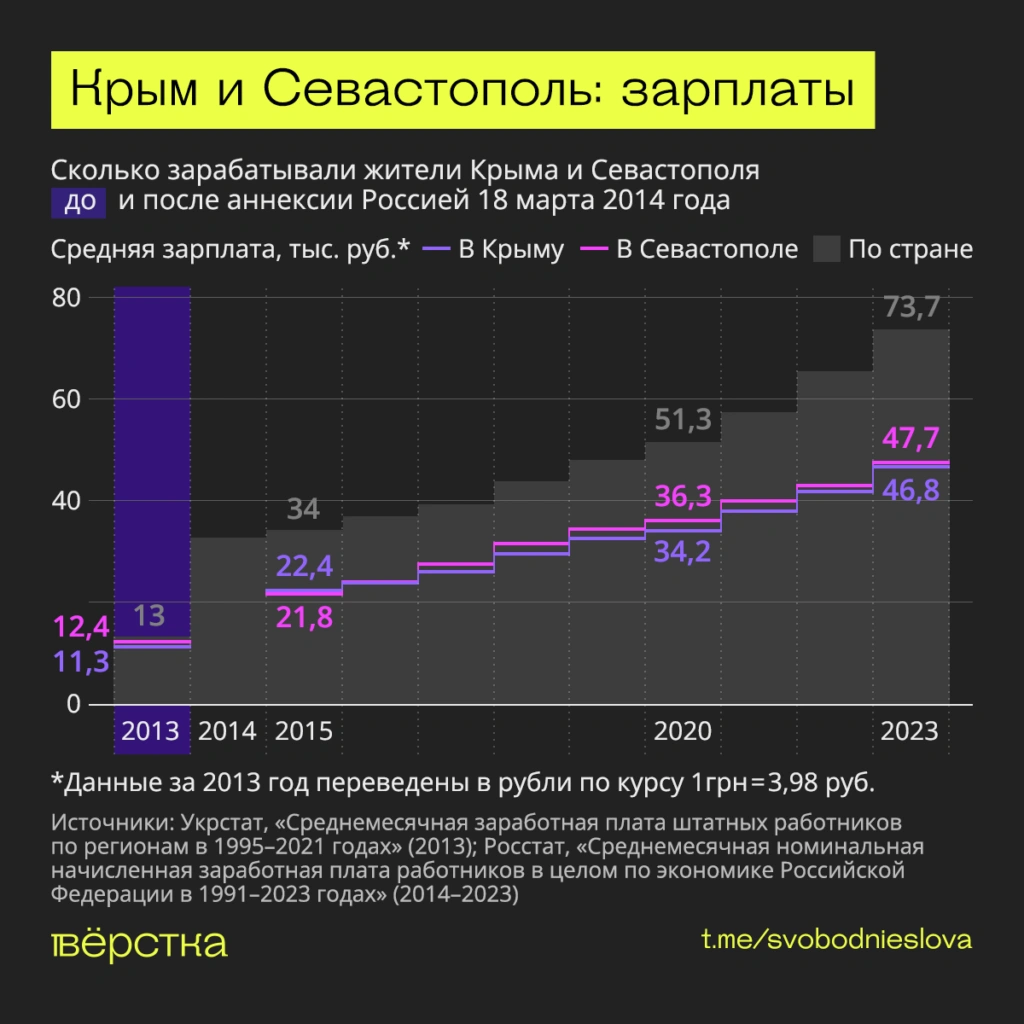
- In 2013, a Crimean citizen earned on average 2,850 hryvnia (approximately 11,343 rubles in prices of that year), Ukrstat reported. The amount was 87% of the average amount in Ukraine, Vorstka calculated.
- Since then, Rosstat has annually recorded an increase in wages, but the ratio with the Russian average has never exceeded 68%. In 2023, the average payment in the region was 46,825 rubles, and in Russia - 73,709 rubles.
- In Sevastopol, the situation is similar: in 2013, the salary here was 95% of the Ukrainian average. Over 10 years, according to official data, it increased from 3,114 UAH (12,394 rubles) to 47,650 rubles.
- But the maximum ratio of wages in the city to the overall figure for Russia over ten years is 73%.
- That is, the average Sevastopol and Crimean resident earn at least a quarter less than the average Russian .
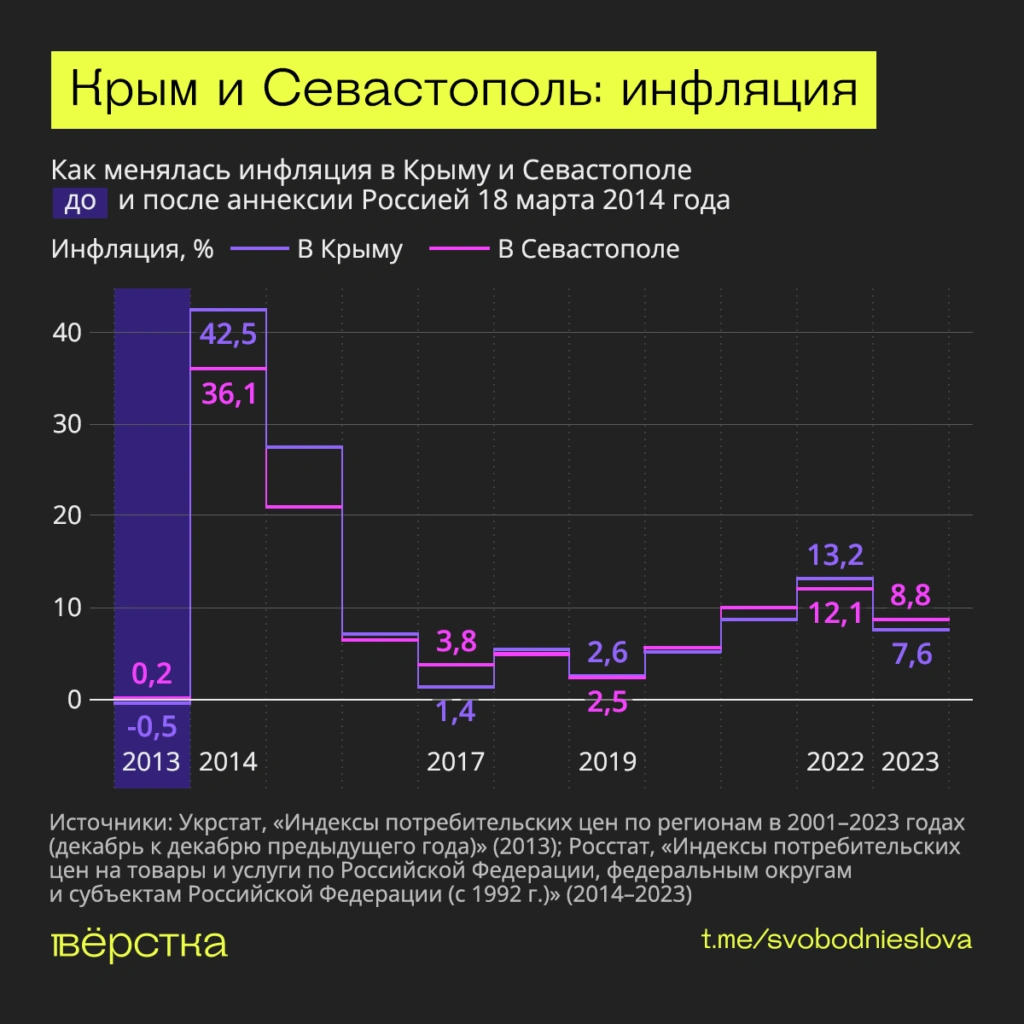
At the same time, the nominal values of average salaries do not take into account the increase in the general level of food prices - inflation. In 2013, Ukrstat recorded it at -0.5% in Crimea and 0.2% in Sevastopol - a year later, due to the economic crisis after the annexation, it increased to 42.5% and 36.1%. By 2017, the situation had leveled off, but the war in Ukraine provoked a new jump - to 13.2% and 12.1%. In 2023, inflation in Crimea again became comparable to Russia’s - 7.6% and 8.8% .
Agriculture in Crimea is developing, but is bringing in less and less money. But the tourist flow remained at the same level as before the annexation
Crimea’s budget is mainly replenished from agriculture and tourism - these are the main sources of income, a former Ministry of Labor official and economist who wished to remain anonymous tells Vorstka:
“Sevastopol is a city that is primarily a port. This is not a tourist cluster; there is no special production there. <…> This is a region that specializes in certain types of agriculture. First of all - the production of grapes (in recent years a lot has been done in Crimea to develop winemaking), secondly - vegetables, fruits, berries - cherries, apricots, peaches."
Agriculture on the peninsula has developed since the annexation . According to Crimean Statistics, from 2014 to 2022, the volume of grains and legumes sold per year by local agricultural organizations increased by 145.6 kilotons, potatoes - by 1.4 kilotons, grapes - by 70 kilotons, milk - by 40.7 kilotons, fruits and berries - by 53.6 kilotons. At the same time, in 2022, meat of all types was sold by 14.4 kilotons less than 10 years ago.
Tourism is also actively developing in Crimea, but the profitability of this area has nuances. “Firstly, tourism is limited by seasonality - the infrastructure is actively used only from May to September. Secondly, part of the population goes to the private sector, and revenues from guest houses are unlikely to reach the local budget in the form of taxes,” Safonov clarified.
Now the number of tourists on the peninsula corresponds to the level of ten years ago, despite the war in Ukraine . According to Rosstat, in 2023 the tourist flow to Crimea amounted to 5.2 million people - the same number as Ukrainian experts counted in 2013, before the annexation. The number of vacationers on the peninsula decreased after the start of the war and the coronavirus pandemic - before that, Crimea broke records for tourist flow for two years in a row for the entire post-Soviet period: 6.8 million people vacationed here in 2018, 7.4 million in 2019.

In order not to miss new texts from “Layout”, subscribe to our telegram channel
What got worse: war, repression, layoffs
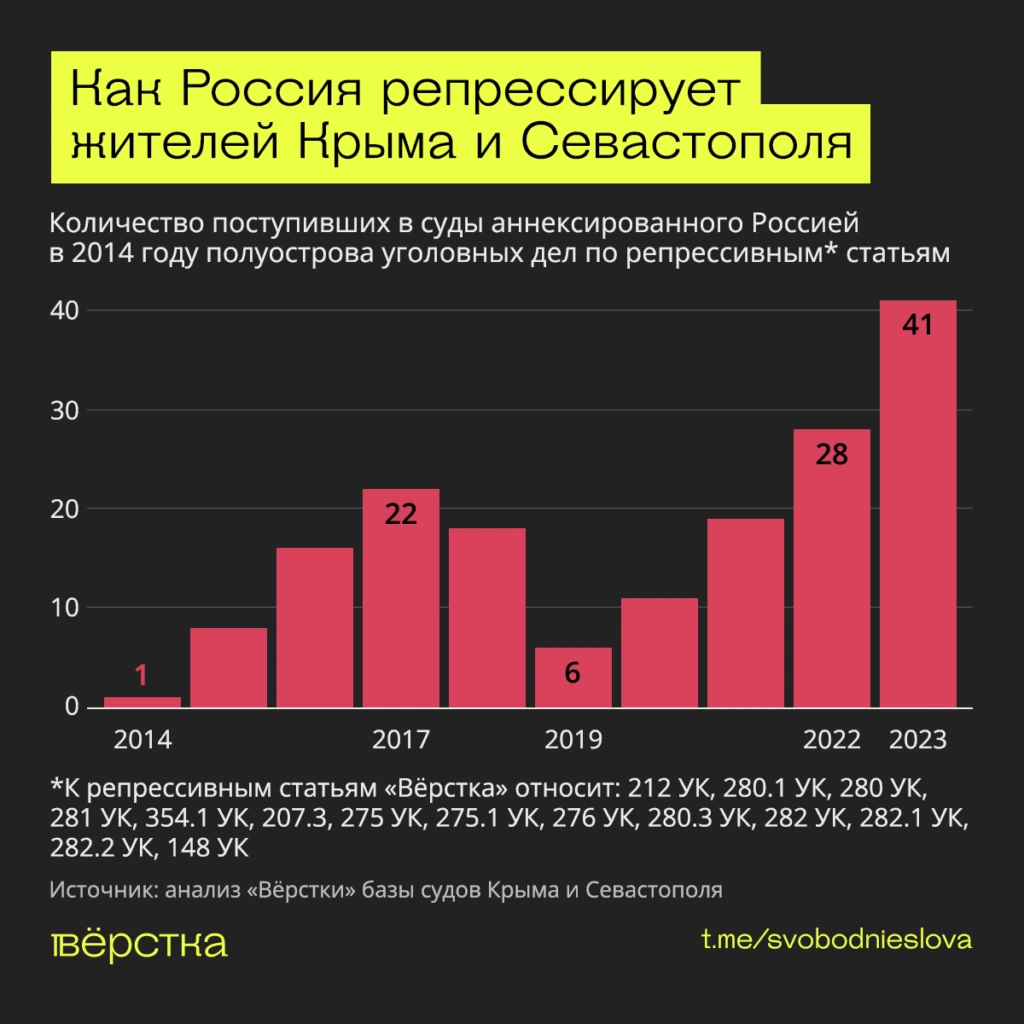
Over the 10 years of the annexation of Crimea, Russian judges on the peninsula considered at least 173 criminal cases under repressive articles i , Vorstka counted.
These figures do not reflect the full picture: some of the cases that Russian security forces in Crimea initiate under these articles are considered by district military courts in other regions. The texts of the verdicts on them are not published, and it is impossible to isolate from them cases concerning residents of Crimea.
For 10 years, Russia has constantly violated the rights of residents of Crimea, according to the Office of the UN High Commissioner for Human Rights. Since 2014, according to his office, at least 104 residents have been kidnapped in Crimea, often Crimean Tatar activists and journalists who opposed the annexation of Crimea.
The UN also documented at least 55 cases of torture and ill-treatment of detainees and persistent violations of the rights of defendants who were denied a fair trial, according to the report “Ten Years of Occupation of Crimea,” published by the Office of the UN High Commissioner for Human Rights.
Following Russia's full-scale invasion of Ukraine, political pressure in Crimea increased . 69 criminal cases - 40% of all cases under repressive articles considered on the peninsula - were received by the courts after February 2022. According to “Vestka” calculations, the number of political persecutions on the peninsula increased 1.5 times in 2022 and doubled in 2023, compared to 2021.
The most “popular” articles on which residents of Crimea are persecuted during the war:
- calls for extremist activity (32 criminal cases);
- dissemination of “fakes” about the Russian army and repeated public discrediting of the Russian military (7 criminal cases in court, three more are under investigation );
- high treason (8 criminal cases);
- espionage (5 criminal cases).
Not all criminal cases under repressive articles initiated in Crimea during the two years of war have already been brought to court, but even from these data it is clear that the scale of repression on the peninsula is somewhat higher than in other regions of Russia comparable in size . For example, in the Voronezh region (2.28 million people), according to the human rights project OVD-Info, during the two years of the war, 5 criminal cases were opened under articles of repeated discrediting of the army and fakes, in the Irkutsk region (2.34 million) - three, in the Saratov region (2.4 million) - five.
After the annexation, at least 123 Muslims and at least 32 Jehovah's Witnesses were repressed in Crimea
Since 2014 , Russian security forces also began to repress social groups on the peninsula that were not persecuted under the Ukrainian government . In particular, the religious movements Hizb -ut-Tahrir and Jehovah's Witnesses were banned .
As Vorstka was told in the project “Support for Political Prisoners. Memorial”, in Crimea, at least 123 Crimean Muslims and 32 Christians were repressed for participation in these movements. They became defendants in criminal cases under extremist articles.
Russian authorities massively persecute adherents of these two religious movements throughout the country, but in Crimea the scale of repression is wider , says “Support for Political Prisoners. Memorial". “Of the number of all Jehovah’s Witnesses persecuted by the Russian state, Crimean believers make up almost 5%. At the same time, the residents of Crimea make up no more than 2% of the population of Russia,” a project representative told Vorstka.
According to UN estimates , the recognition of Jehovah's Witnesses as an extremist movement affected at least 8 thousand believers who lived in Crimea in 2017. The number of those accused of participating in activities in Hizb-ut-Tahrir, according to the Memorial expert, significantly exceeds the number of persons involved in such cases in Tatarstan or Bashkortostan, although there are more Muslims there, compared to Crimea and Sevastopol.
In Crimea, the number of teachers and health workers has sharply decreased - by 5 thousand in each area. But spending on security forces and defense has increased
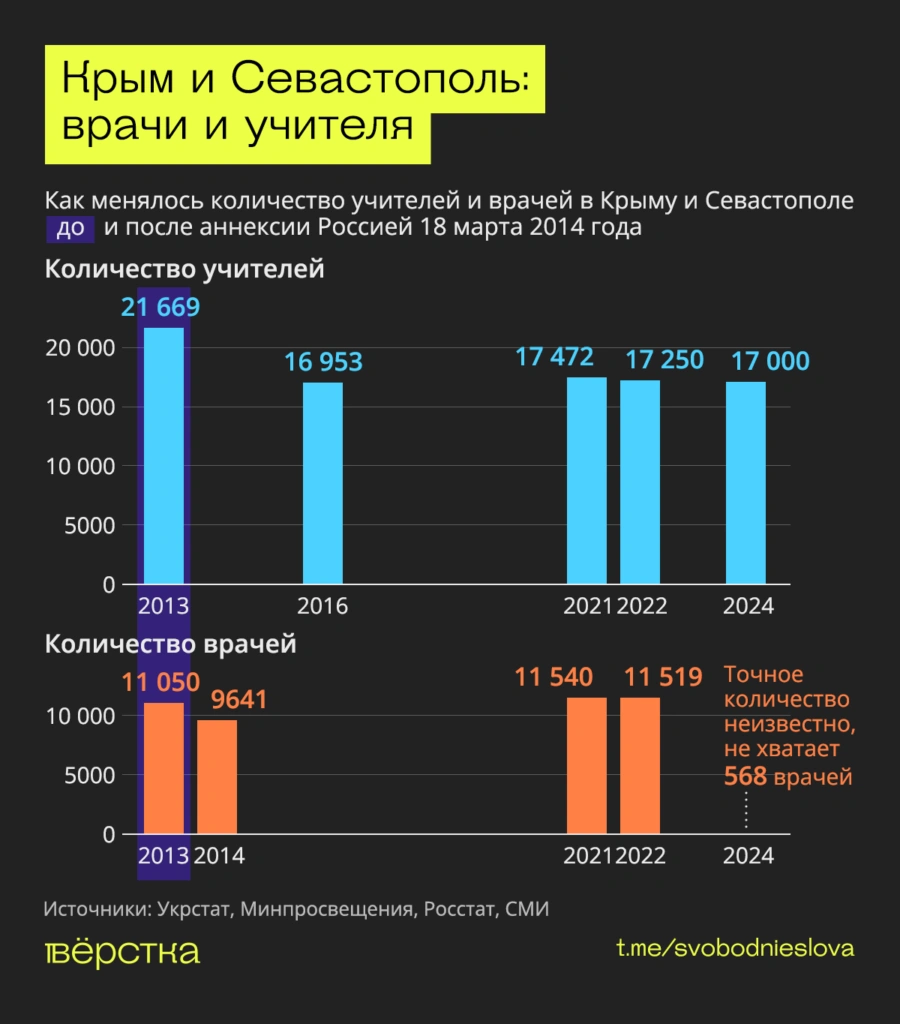
Some of the most affected areas on the peninsula after the annexation are healthcare and education, as follows from Crimean Statistics data, which was studied by Vestka. Before the annexation, in 2013, 11,050 doctors and 21,488 nurses worked in Crimea and Sevastopol.
When Crimea came under Russian control, mass layoffs began : some left of their own free will, others were laid off.
In total, in 2014, the healthcare of Crimea and Sevastopol, according to Rosstat, lost more than 5 thousand personnel working in various positions. After 10 years, the authorities managed to fill the deficit, but not completely, Vorstka found out:
- The number of doctors in Crimea and Sevastopol in 2014 decreased by 13% - to 9,641.
- The Russian authorities managed to make up for personnel losses by 2021 - then even more doctors worked in Crimea and Sevastopol than before the annexation.
- After the full-scale invasion of Ukraine, the number of doctors decreased slightly: in 2022, according to Rosstat, 11,519 doctors of all specialties worked on the peninsula.
- Judging by the news in the local media, the situation in Crimea and Sevastopol has not improved in two years. At the beginning of 2024, the head of Crimea, Sergei Aksyonov, said that the peninsula lacks one and a half thousand doctors.
- Crimea and Sevastopol are not the only regions where there is a shortage of medical workers. In the Voronezh and Irkutsk regions of comparable population (2.3 - 2.4 million people) in 2022, approximately the same number of doctors worked.
According to Rosstat, in 2014 the number of nurses remained almost unchanged (21,110 people). After the war, it also remained at a high level compared to the period before the annexation - 23,658 mid-level workers.
The Crimean education sector also lost almost 5.5 thousand personnel in the year of annexation. Now in Crimea and Sevastopol, as well as in medicine, there is an acute shortage of workers , Vestka’s calculations confirmed:
- In 2013, 21,669 teachers worked on the peninsula i . After the annexation, their number decreased and did not grow significantly for 9 years.
- In 2022, there were 17,250 teachers in Crimea and Sevastopol.
- In the 2023-2024 academic year, according to the Russian Ministry of Education, the number of teachers fell to 17 thousand.
- The peninsula needs at least 500 more teachers - mainly Russian language and mathematics teachers.
- The shortage of teachers in Crimea may be due to low salaries. In 2020, a teacher on the peninsula earned an average of 32 thousand rubles. By 2023, judging by media reports , wages have not increased.
- The sharp reduction in the number of teachers after the annexation could also be influenced by the closure of Ukrainian-language schools and the reduction of hours of studying Ukrainian. In 2013-2014, according to the UN High Commissioner for Human Rights, 12,694 schoolchildren received education in Ukrainian.
- According to Maxim Sukharev, associate professor of the Department of History of the Crimean Federal University, in 2013, 13,589 schoolchildren studied in Ukrainian in 7 Ukrainian-language schools. In 2017, the Ministry of Education of Crimea reported that there was only one Ukrainian-language school left on the peninsula, with 132 students.
At the same time, after the annexation of Crimea, the Russian authorities increased spending on security forces and defense, Vorstka found out:
- There is no official data on how many security forces and military personnel began working in Crimea after the annexation - law enforcement agencies and Rosstat do not publish such information.
- But in the collection “The Republic of Crimea in Figures”, Russian sociologists cite local budget expenditures on defense and law enforcement agencies, starting in 2017. Each year these costs grew .
- In 2017, Crimea spent 29.5 million rubles on national defense and 1.2 billion on the work of security forces. Over five years, by 2021, these figures have increased by 50 and 30%, respectively : defense spending exceeded 46.5 million rubles, and spending on law enforcement agencies exceeded 1.6 billion rubles.
More and more local residents are leaving Crimea. Perhaps the authorities of Sevastopol “drew” 60 thousand people for statistics
According to official Ukrainian statistics, as of January 1, 2013 and 2014, there were 1.97 million permanent residents living in Crimea. At the beginning of 2015, according to Rosstat, there were 70 thousand fewer of them - although the CrimeaSOS organization estimated the number of people who left at 100 thousand.
The largest wave of displaced people occurred in the first six months of annexation, when the expulsions of local activists, blocking of Ukrainian media and other repressive measures began, said the founder of CrimeaSOS and the representative of the President of Ukraine in Crimea, Tamila Tasheva. The second wave in 2015-2016 was provoked by the oppression of business, when entrepreneurs were deprived of licenses, premises and land.
As Vorstka found out, the largest number of Crimean residents lived on the peninsula during the 10 years of annexation in 2020: then government demographers counted 1.94 million Crimeans. But after the start of Russia’s full-scale invasion of Ukraine, by 2023, the outflow began again - and there were 1.92 million of them left.
At the same time, according to official data, the population of Sevastopol has grown sharply over the past years - from 385 thousand to 560 thousand people , which raised questions from Demoscope, a publication of the Institute of Demography of the National Research University Higher School of Economics.
As independent demographer Alexey Raksha tells Vorstka, this population growth is explained by the fact that some of the residents of Sevastopol most likely exist only on paper :
“2021 statistics have raised many questions among demographers. Then I learned that in July 2020, the office of the governor of Sevastopol or someone from there sent a request to Rosstat. It posed the question of what would happen to life expectancy in the region if the population there increased by 60 thousand. Moreover, they did not specify the age-sex structure of this population or other details, they simply asked to make experimental calculations. And, apparently, they really liked these calculations,” says Raksha.
Seeing inconsistencies in the statistics of Sevastopol, the demographer and his colleagues began calculations. “I realized that these people [in the statistics] are somehow strangely scattered across the gender and age structure. There, the number of infants aged 0 has increased by almost 17% compared to [last year’s] data. This doesn’t happen,” Raksha continued.
According to the demographer, the birth rate is recorded perfectly in Russia: “That is, there cannot be any unaccounted for babies, especially in large numbers. At this age, they do not move with children: migrants cannot bring with them 17% of additional [children to Sevastopol]. As a result, exactly 60 thousand people were added [to the city’s population]. This has never happened not only in my memory, but also in the memory of any demographer in Russia.”
The second population recount, which is published by June, according to Rakshi, looked “more decent.” “That is, they shuffled it all: the number of babies increased not by 17%, but by 12%, for example. But this is still, of course, beyond all reasonable probability; it, of course, did not fundamentally change anything,” he clarified.
The reason for such manipulation, according to the demographer, is the desire to meet KPIs for the regions , the key indicator of which is life expectancy. On paper, such a sharp increase in population could attract part of the subsidies from the federal budget to Sevastopol, which are calculated on the principle of per capita financing - that is, based on how many people live in the region.
“Population is the denominator in the KPI formula,” Raksha explained. — Sevastopol turned out to be the only subject of Russia in that year where life expectancy increased. That is, now we need to subtract a couple of years from life expectancy in the territory of Sevastopol, and increase the birth rate by 10–15%, because fictitious population growth reduces it.”
Infographic: El
Cover and illustrations: Dmitry Osinnikov
You can support “Layout” from any country in the world - it is still safe and very important. We really need your support now. How to help us →