
Translated material
"I love my family, but they are killers"
Comedian Andrei Ayrapetov released a conceptual concert - and set a new level of the Russian -speaking stand -upup
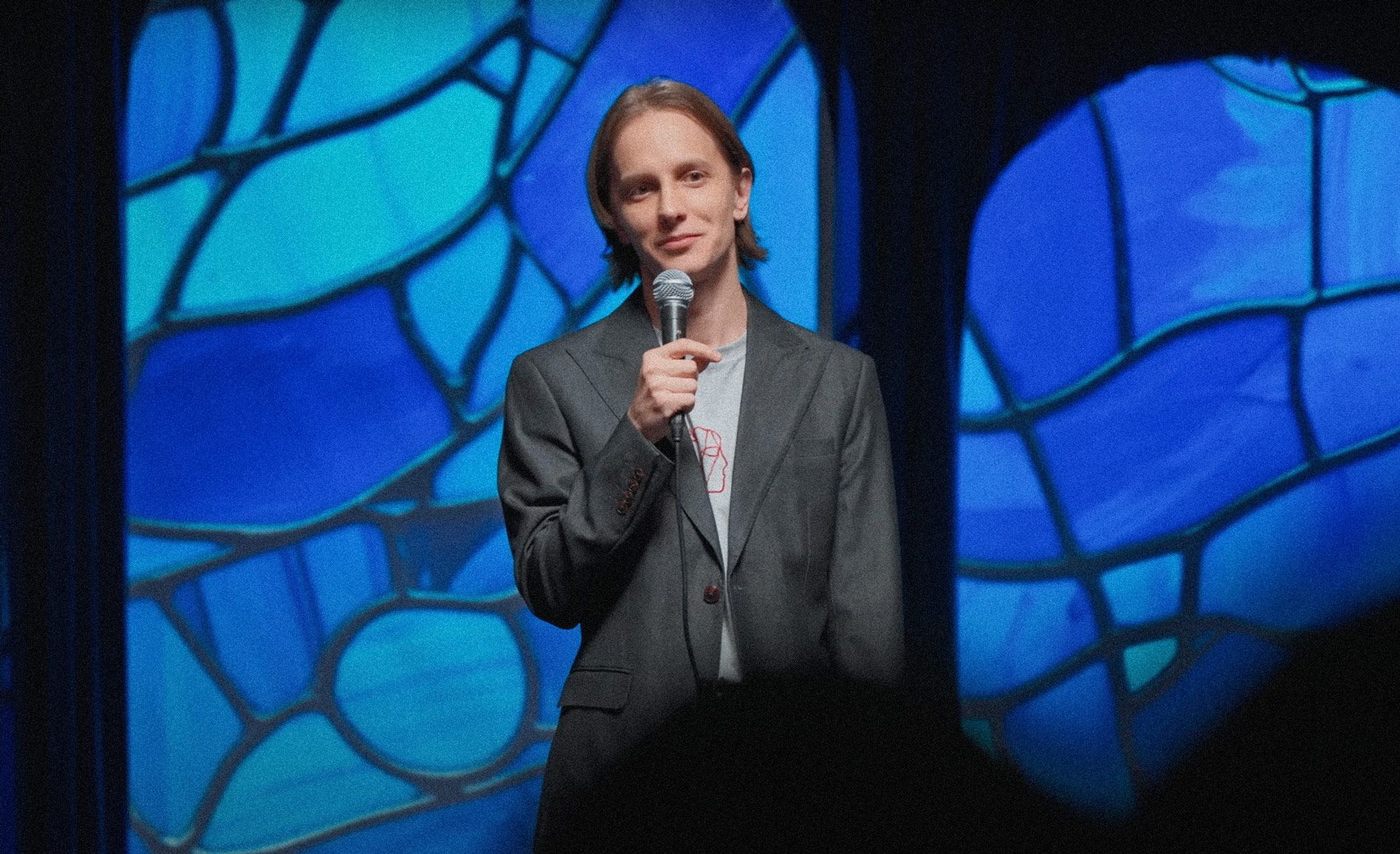
On February 29, the stand-up comedian Andrei Ayrapetov posted on his YouTube channel recording the concert “Satter”. This video shot in Almaty gained more than a million views in two weeks. The 27-year-old Ayrapetov talks about relations with his father, who, unlike the comedian himself, supports the war, about the great-grandfather sitting in prison and about his own attempts to differ from the family. The concert is arranged as a theater performance - with live music, scenery and video. Critic Anton Khitrov tells why the “disgrace” is a sign project for a Russian -speaking comedy.
Fans of Andrei Ayrapetov regularly quote his two jokes from the solo concert “Request to Sincerity” . One is about too serious to yourself. Rushing his own funeral on the stage, the comedian solemnly said: “How much he cried so that we laugh.” The other is about growing up. When Andrei was small, he was always asked to walk quieter. Only having moved to a separate apartment, he realized: “All my life it wasn’t I stomped, but your floor creaked.” Successful aphorism even hit the merchant .
Separation
Ayrapetov’s personal brand is outlined by these two jokes. The main stories in his stand -up is its own fragility and separation from the family. The comedian grew up in the Perm Territory, in the small industrial city of Chernushka. Provincial childhood provided it not only with comedic material, but also with topics for psychotherapy. Andrei does not look like a person who feels his own in the hinterland. He is vulnerable, not shy about tears and admits that he loves to regret himself. Just at the latter, his comic epitaph hints at himself.
The new concert "Satter" is simultaneously similar and not like other comic performances. Ayrapetov still seems fragile and reflecting, still dealt with feelings for relatives, but generalizations that were not before, and techniques rare for the Russian comedy as a whole appeared in his stand. On his Instagram, the comedian wrote that the “shame” summarize the first stage of his career and that in the future he wants to joke somehow differently. He is right: in this direction it is unlikely that it will already be possible.
The “disgrace” is the first concert that Ayrapetov recorded in exile. Two years ago, he signed a letter of comedians against the war (there are more than 260 names there in total). And a year and a half ago he left for Kazakhstan and in the very first weeks laid out the witty monologue “Ordinary Tourism” about the new life of Russian men who fled from mobilization. Now Ayrapetov travels to tours in Central Asia and the South Caucasus, writes together with its viewers the improvisational show “Book of complaints”, leads the podcast “Sweet Life” and arranges video broadcasts. The last stream for today the comedian organized in support of the Center for the Center for the Center for “Tinkoff Bank” without warning, disconnected the transfers.
What is the "disgrace" about? About classical music and copyright cinema - new hobbies of Ayrapetov, who are not divided by his relatives and to which he himself is not really used to. About the father adoring Evgeny Prigozhin and PMC “Wagner”, and his son calling a fascist in drunken voice messages. About the great-grandfather-bunker who was a model of a real man for the whole family, although he deservedly sat in prison (for which it is better to learn from the concert). And also - about relations with the country that unleashed the war.
Ayrapetov continues to talk about separation, but now it is not only about relatives. Rather, mainly about them, but everything said by the comedian cannot be shifted to Russia. “The wheel was rubbed, the knitting needles rusted. I love my family, but they are killers, ”the comedian sings this verse in the manner of the mournful folk song, hinting that with all“ but ”he cannot move away from his own“ Russianness ”.
Meanwhile, mainstream comedians in Russia returned to jokes about mother -in -law
 |
Stand -up or theater?
Usually, in the stand-up comedy, the show has one creator-the comedian himself. In the "disgrace", in addition to the author and the performer, there is a director - Lisa Popova. This is an artist and documentary from Perm, known, for example, by the photo project “fragility” for the Permm Museum of Modern Art. Popova took off the people who survived violence through the embossed glass and asked them to share their stories. Glass not only retained the anonymity of the models, but also turned portraits into painting. In March 2022, photographs were posted in the city, supplying each QR code with the history of the hero or heroine. Popova already worked with Ayrapetov, but in another quality - she shot and mounted a video version of his previous concert “Happy Man” .
The directing in the concert cannot be ignored. In the “disgrace” there is a scenography - meaningful, not decorative, as often happens in comedy - video and even live music performed by a quartet. Ayrapetov himself also plays playing on a melody (harmonic with a keyboard), which is compared by either the bayan of her great -grandfather, then with the organ that impressed him at the concert of classical music.
At the same time, judging by the prolon to the video version, the comedian does not like when the audience compare his concert with the performance. The fact is that in the "disgrace" the elements of the theater work differently than in the theater itself. On the theater scene, living music is a natural thing, and in the laconic format of stand -up it should not be at all: for comedy it is too costly, too artistic and too pathetic. That is why viewers react to a quartet or video as a joke. That is, Ayrapetov and Popov rethink the basic principle of comedy - to deceive the expectations of the public.
By the way, Ariansa Lolaev’s colleague, Ayrapetov’s colleague in her debut solo concert “Comics” , went like a similar way. Lolaev also works in exile: she opposed the war, went to Georgia after she had an administrative case of the “discredit” of the army, and now issues Comigration to comedy in exile with friends. In Comicics, as in the “disgrace”, political comments are combined with stories about personal experience (sometimes quite terrible). Lolaev performs in a real theater pavilion, who, judging by the artist’s words, repeats her children's room. So in an independent Russian -language comedy, theatricalization becomes a trend.
Actually, "disgrace" is the "theater" in Serbian. Ayrapetov found the name for the concert when he saw this word on the theater sign in Belgrade. His double reading reflects one of the important plots of the concert. What is before us, a real, serious “disgrace” or an awkward amateur performance? Noble classical organ or folk button accordion? A sophisticated fan of Andrei Tarkovsky or a simple guy from Chernushka, who is not averse to yelling songs in Karaoke? In general, was the storyteller the same separation that he dreamed of?
“I am not one of those comedians who need a faceless roaring crowd. I need a bunch of drivers, ”says Ayrapetov to the public. He himself is very convincing “driven up”, thinking about how strange the relationship between the artist and the hall is strangely arranged, or as it were to drink water so as not to attract too much attention to this. The image of an uncertain person here is only a mask that helps a comedian to set the audience in the right way: Ayrapetov wants the audience not only to laugh, but also tried to comprehend what is happening to them right now. This is a rare comedy concert that calls you for analysis - and calls for you to not be easy to refuse.
Mirror maze
Ayrapetov’s concert stands out against the background of Russian -speaking comedy with an integral idea. In the "disgrace" there is not a single monologue that would not be connected with the rest. Say, almost in every second joke, the comedian beats the motive of authorship. So he is ironic over his own demonstrative love for copyright cinema. And here - retold to the audience the textbook essay "Death of the author" of the French philosopher Roland Bart (according to Bart, when the author ends his work, he seems to die - and the right to interpret to the public).
A few minutes later, Ayrapetov wonders how his father, a supporter of the war, remains a fan of the DDT anti-war rock band. "Or for my father in the song " Do not shoot " after" Not "there is a comma?" - the comedian argues, offering a grotesque, but quite suitable illustration for the "death of the author."
The “disgrace” looks like a mirror labyrinth: serious is reflected in the ridiculous, low - in the high, the organ in the great -grandfather Bayan, and Rolan Bart - in the inconsistent fan of “DDT”. In this concert, everything is ambiguous: this indicates how subtly Ayrapetov understands the laws of comedy. In principle, any joke works only because we are capable of perceiving the same words or situations in two ways. An ordinary comedian knows how to use this on a scale of one joke, Ayrapetov uses on a concert scale.
We laugh when we meet an insoluble contradiction. Here is an example from the "disgrace": Ayrapetov retells the famous legend of the cow, which Andrei Tarkovsky burned on the set of Andrei Rublev. A comedian friend, outraged by this story, did not advise him to watch Rublev, assuring him that the film is “average”. “It will be more correct to say - Medium Well ,” Ayrapetov quarreled in response. The insoluble contradiction here lies in the fact that the film director, who allegedly killed the cow, causes people anger, while the majority perceives the fried beef calmly.
“I love my family, but they are killers” is also an insoluble contradiction. Andrei feels himself part of Russia and cannot do anything about it, although he knows that Russia is to blame for crimes. Its complete separation is necessary, but impossible. Laughter is the only thing the comedian is capable of in this situation. True, this laughter is not carefree, but rather sardonic .
Anton Khitrov