We compare the environmental programs of Trump and Biden: climate, resource mining, protected land Photo: Isabel Infantes / AFP Via Getty Images
In November 2024, the US will be held in the USA. The main candidates for the post of head of state is the Republican Donald Trump and Democrat Joe Bayden: the former and current presidents of the United States. On the primaries, most voters supported them.
The views of Trump and Biden are opposite to many external and domestic political issues. And their attitude to environmental problems, too.
Smola talks about the environmental policy of the main applicants for the post of US President: how they offer to deal with the climatic crisis, what kind of energy - oil or alternative - they want to develop and what they think about maintaining especially valuable natural territories.
Why is it important not only for Americans
Elections in the United States traditionally are much more important than simply the election of the head of one state. The first economy of the world finances many programs - from the military to humanitarian - throughout the planet and sets trends, including in the field of environmental protection. For American money, programs for preserving the ecosystems of the Congo and the Andian Mountains, the protection of lions in India and the development of renewable energy in Central Asia. However, at the same time, the United States is the second country in the world after China in terms of greenhouse gases emissions, the States itself also needs to restructure their economic and environmental models in order to solve the problem of climate change for the whole world.
It is also important that, unlike a number of other leading states, the US elections are really able to radically change the country's environmental policy. An example of this is the emergence of the States from the Paris Climate Agreement under Donald Trump and a new signing under Joe Bayden.
Part I. Climate
The victory of the miners
Although a consensus about the anthropogenic causes of climate change has long developed in the scientific community, Donald Trump does not consider global warming the investigation of human activity and doubts its danger. In November 2018, he even questioned the study prepared by his own administration, together with 13 federal agencies and 300 climate scientists. The document said that climate change can have catastrophic consequences.
“I do not believe in it,” Trump said.
In his climatic skepticism, the leader of the Republicans is consistent: under him in 2017, the United States left the Paris Agreement. Today, his environment again declares similar intentions. “I suppose that the exit from the Paris Agreement will be considered in the first few weeks [in the case of Trump’s victory in the elections],” said the former adviser to Trump George David Banks during the climatic Cop28 summit in Dubai.
“The Paris Climate Agreement does nothing to realize the environment in the United States or throughout the world,” says Mandi Gunasekar, former head of the Trump administration for environmental protection. According to her, the document “provides too little pressure” on China, India and other developing countries, but at the same time creates excessive restrictions for the United States.
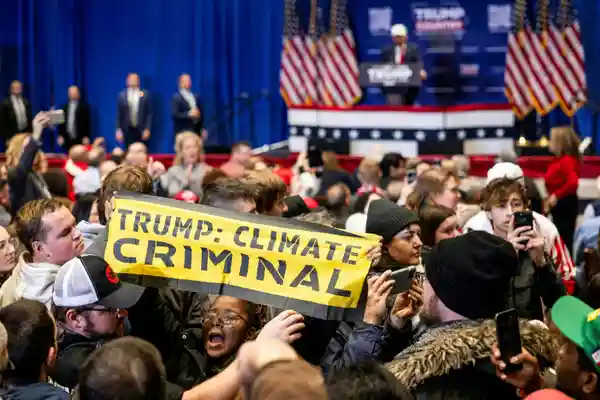
Climate activists at Trump’s rally in Aiov. Photo: Christian Monterrosa/AFP Via Getty Images
The denial of the climatic crisis for Trump is an electoral question: he sees his voters, including workers' resource -mining enterprises. Therefore, his associates called the exit from the Paris Agreement in 2017 the victory of American miners. At the same time, the desire for popularity among workers was already pushing the Trump administration to such actions as concealing environmental information.
According to the initiative on environmental data and management (EDGI), over the first year of Trump’s presidency, more than 200 pages with information about climate change were removed from the Site of the US Environment Agency.
Pages were especially carefully cleaned, which told about the efforts of President Barack Obama to reduce greenhouse gas emissions at coal stations.
"We can no longer pull"
Joe Biden, in turn, pursues the opposite policy. A week after taking office in 2021, he signed a number of decrees to combat global warming: for example, he instructed to stop subsidizing the extraction of fossil fuel and begin to provide financial assistance to developing countries suffering from the consequences of the climatic crisis. “In my opinion, we waited too long to cope with this climatic crisis, we can’t pull anymore,” Biden said at one of the briefings. “We see this with our own eyes, we feel it with all our hearts, we know that the time has come to act.”
One of the important climatic solutions was the signing in August 2022 of the Law on Reducing Inflation (IRA). It provides for the largest climatic investments of the US Federal Government in history: over 10 years, more than $ 430 billion will be aimed at reducing carbon dioxide emissions. John Larsen, a researcher of the US energy system and climate policy, believes that this law is a noticeable step forward to the goal of reducing greenhouse gas: “The result of IRA should be a reduction in pure US greenhouse gas emissions by 2030 by 32–42% compared to 2005. This is 10% more than with previous politics. ” In April 2023, the American investment bank Goldman Sachs calculated that in the future, the bill will stimulate investments in a renewable energy of $ 3 trillion. It is also assumed that this will create a “most favorable environment in history” for the development of green energy. In general, climate experts consider this decision historical, since it can help the second country of the world in terms of greenhouse gas emissions to lead the revolution in the field of pure energy.
“We have never seen such efforts to decarbonization,” says Noa Kaufman, an economist in the Center for the Global Energy Policy of Columbia University in Washington. According to her, the climate program of the Biden administration has a significant impulse, and four years will help the administration consolidate progress. “The question is what will happen if we lose this impulse,” Kaufman notes.
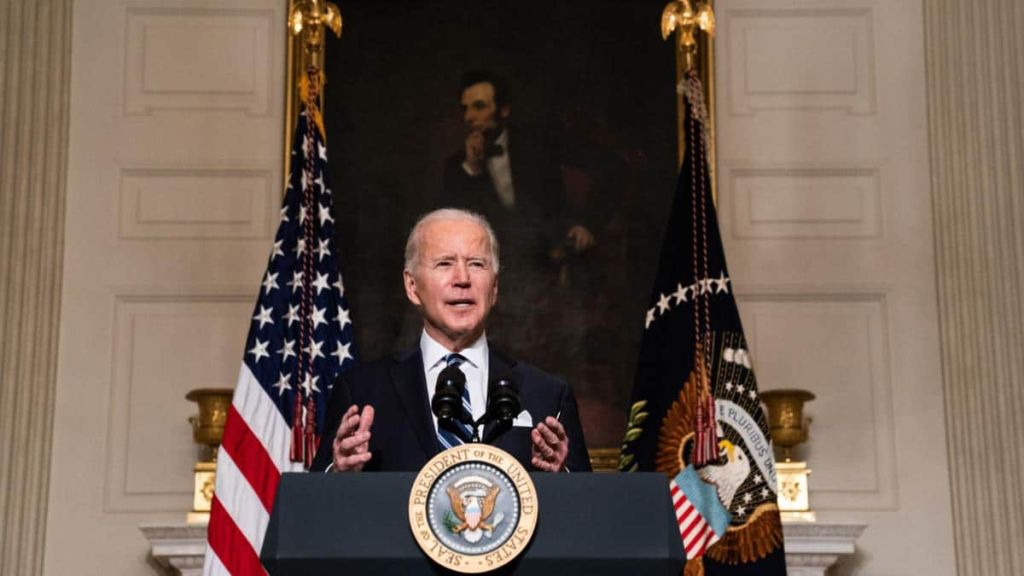
Joe Biden appears about climate change. White House, 2021. Photo: Anna MoneyMaker-Pool / Getty images
Representatives of the Republican Party were outraged that the law adopted without their participation, and called it their defeat. Tom Pyle, the president of the American Energy Alliance of the Free Market and the former head of the transition group of the US Department of Energy at Trump, expects that "Republicans will prepare their own very aggressive bill in order to cancel subsidies in IRA."
Ecologists and climatic activists are concerned that Donald Trump’s anti -ecological program will have serious consequences for the climate. “Let's make clarity: if Trump is re -elected by the president, the likely result will be irreversible climate changes that will worsen the quality of life of each next generation of people, and millions of lives will be dangerous,” comments John Noel, an activist of the climate change campaign. - And this is in addition to hundreds of thousands of premature deaths caused by climate change. It sounds like an exaggeration, of which some green “Alarmists” are always accused. But this does not cause special disputes among those who followed Trump’s actions in the field of energy and climate change. ”
However, there is an opinion that the impulse created by Joe Biden is so great that it can only slow down with anti -ecological policy, but not stopped. “Trump will be difficult to circumvent the investment in pure energy in the Law on Reducing Inflation. Congress will have to adopt a new law to cancel them, ” says Samantha Gross, who leads the initiative on energy security and climate at the Brooklyn Institute based in Washington, the district of Colombia. -In order to have at least some chance to do this, the Republicans need to maintain control of the House of Representatives, get enough places in the elections and take control of the Senate. But even then it will not be easy. The law already stimulates the business to invest and create jobs in communities throughout the country, many of them are in the republican districts. As soon as economic benefits come into business, political motives are changing. ”
Part II. Energy
"Given the abundance of oil"
If you look at Donald Trump’s energy program, it becomes obvious that he is a supporter of the use of fossil fuel. Back in 2017, shortly after the inauguration, he published an energy plan, which was called "America above all." The purpose of the development of this plan was to “achieve energy independence from OPEC ”, ensure national security and protect the state from “interruptions in supplies and fluctuations in prices in the global oil market”. At the same time, no attention was paid to renewable energy in the plan: apparently, it is uninteresting to Trump. Trump's most vivid performance regarding, for example, the energy of the Sun, occurred in 2017, when he proposed to build a wall on the border with Mexico and "supply it with sunny batteries so that it pays off." Even in a recent interview with Fox News, speaking of his vision of the future energy of the United States, he said : “We will drill, baby! Drill".
In this desire, by the way, Trump is as consistent as in the denial of the climatic crisis. Within its first presidential term, to simplify the process of obtaining permits for mining fuel, according to the law schools of Harvard and Columbia University ,
Trump canceled more than a hundred environmental rules. They regulated the standards for greenhouse gas emissions, maximum permissible concentrations of pollutants in the air and water, as well as the protection of nature. According to Trump, they created excessive restrictions for the development of the energy sector.
Today this legacy is used in the Trump election campaign as an argument in his favor: “President Trump revealed the abundance of oil, natural gas and environmentally friendly coal granted by God in our country. He approved the Keystone XL and Dakota Access projects, the opening of federal lands and sea zones for responsible oil and gas production. ”
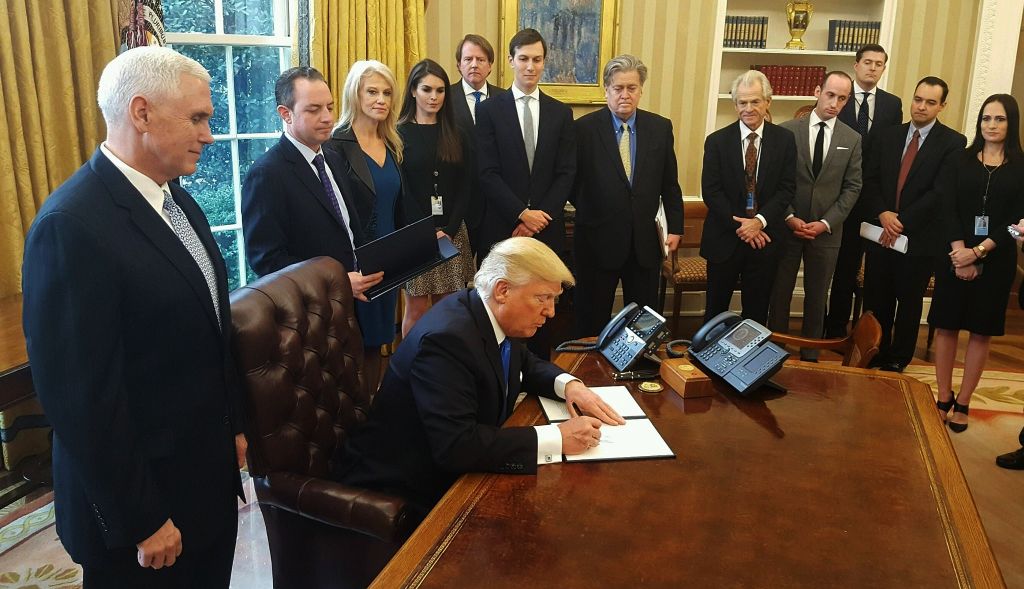
President Donald Trump signs presidential memorandums on the resumption of the construction of pipelines Keystone XL and Dakota Access. January 24, 2017 Photo: Public Domain
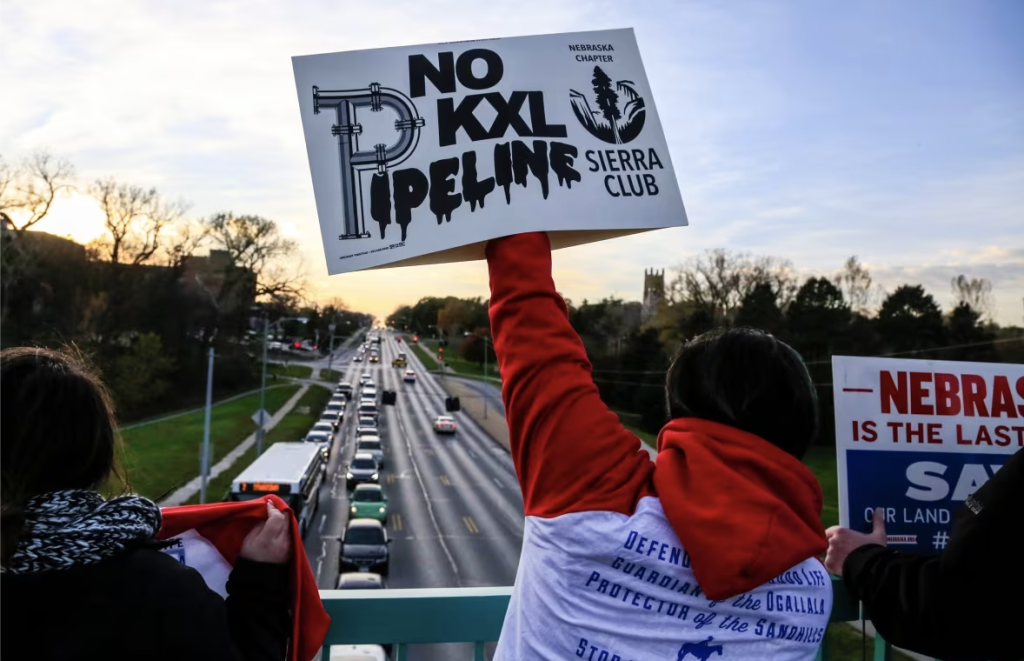
Indeed, in early 2017, a week after taking office, Trump signed a decree on the resumption of the construction of two oil pipelines - Keystone XL and Dakota Access, which were “frozen” by Barack Obama in 2015. Dakota Access planned to be laid through Lake Oaha - a sacred place for the indigenous peoples of Northern Dakota and a large source of drinking water. More than 100 Indian tribes protested against construction, which were concerned about the possibility of oil leaks in the lake and the creation of unjustified health risks. The argument of the Trump administration for the construction of the pipeline was the development of the economy and the creation of thousands of new jobs. As a result, the construction of the pipeline ended, and it went under the lake. True, according to Energy Transfer , after the completion of the construction of the oil pipeline, only 51 permanent workplace was created, the rest were seasonal.
With the Keystone XL pipeline, the situation has developed more favorably. January 20, 2021, on his first day in the White House, Joe Biden withdrew permission to build it. Six months later, the developer refused the project. At the time of its freezing, about 8% of the pipeline was built .
Today, Donald Trump promises to expand oil and gas programs to “release the production of internal energy resources, reduce the growing prices for gasoline, diesel fuel and natural gas, promote the energy security of US friends around the world, cancel the socialist“ green new course ”and make sure that the United States will never be in the power of foreign energy suppliers.”
The action of the opponents of the Keystone XL pipeline on the pedestrian bridge on Dodge Street in Omaha, Nebraska, 2017. Photo: NATI Harnik / Associated Press
And still drill
On February 7, 2024, the administration of Joe Biden committed an unprecedented act - suspended the issuance of new permits for the construction of export terminals of liquefied natural gas (LNG), which, as the American media write , Washington distributed as candy for Halloween. Although Bidden made a lot of efforts in his period to strengthen the environment after it weakened by Trump, this may not be enough for the United States to fulfill its international obligations to combat the climatic crisis.
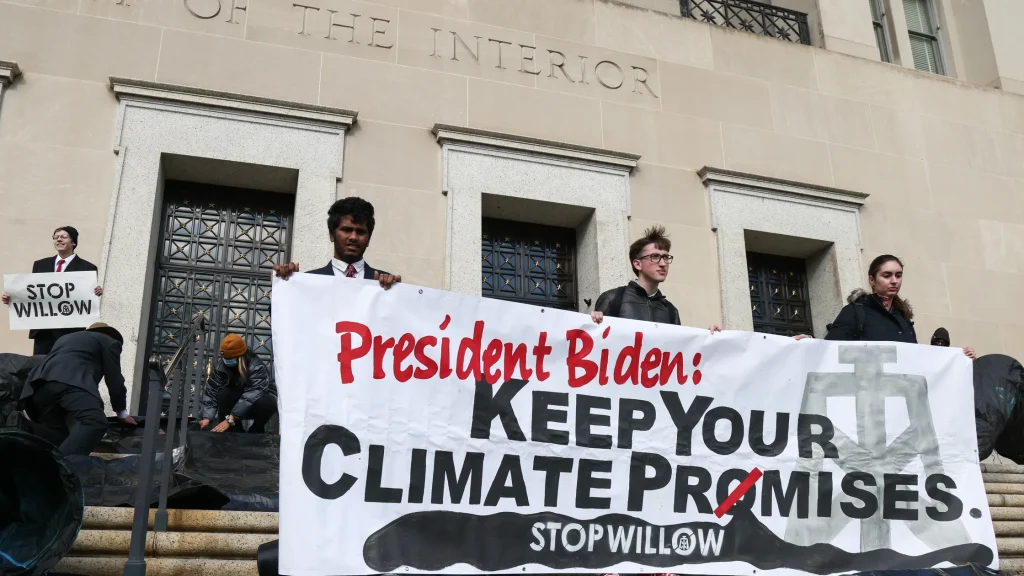
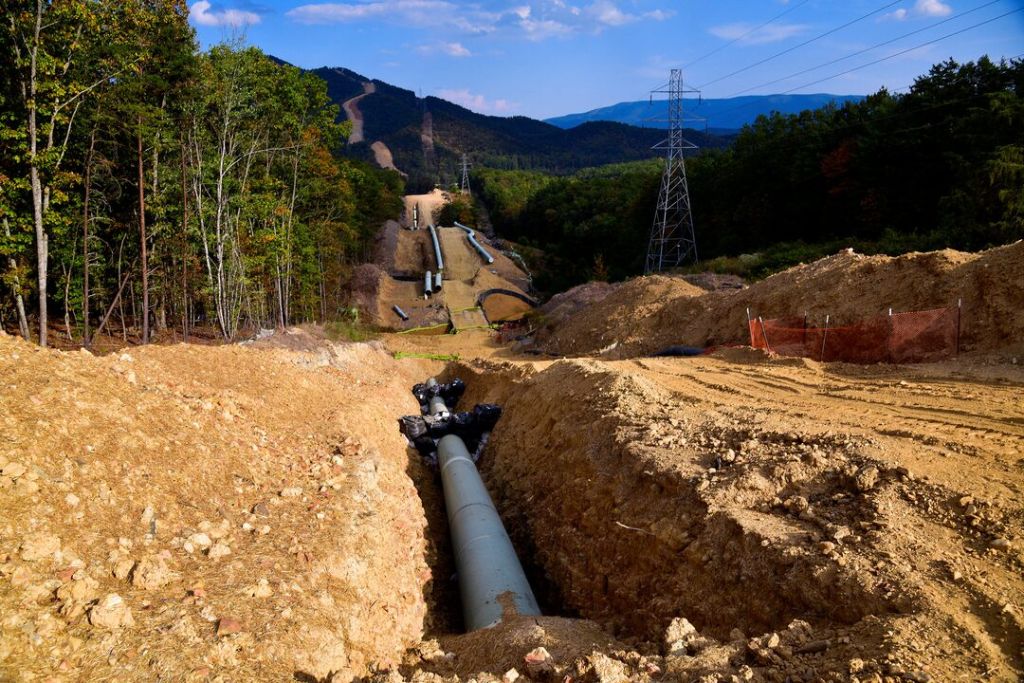
The latest reports of the International Energy Agency (IEA) and the intergovernmental group of climate experts (MGEIK) show that the world has at least a 50 percent probability of limiting global warming of 1.5 ° C, you need to immediately stop investing in coal, oil and gas production. Although the president’s rhetoric corresponds to world climatic expectations, his administration approved several large -scale projects for the extraction of fossil fuel. So, in 2023, Biden approvedthe Willow oil project in Alaska and several objects for LNG export, and his administration supported the construction of the Mountain Valley gas pipeline with hydraulic explosion technology .
Opponents of the Willow project. Photo: Getty images
At the COP26 UN climate summit, Joe Biden promised to put an end to the international state financing of fossil fuel by the end of 2022 and instead make state financing of environmentally friendly energy priority. But in May 2023, the Biden administration contributed to the expansion of the Indonesian oil refinery, investing about $ 100 million in it.
Despite all the statements about the restriction of the extraction of fossil fuel, the United States has not drilled as much as Bayden for a long time. The total oil and gas production during its presidential period increased by 12%, exceeding the peak of production at Trump.
However, under Joe Bayden, the production of renewable energy surpassed the production of nuclear power plants in 2021 and coal in 2022 according to the forecasts of energy control, by the end of 2024, the total power of wind and solar energy will be 76% higher than at the time Bayden entered the post. The capacity of network batteries will increase by 19 times. For the first time in 2023, sales of electric vehicles reached an annual indicator of 1 million. Investments in clean technologies in annual calculus have grown about half.
Mountain Valley, Virginia, USA, under construction. Photo: Reuters
Part III. Not very protected
Red lines in the form of protection of valuable forests, national parks, natural monuments or rare plants also did not stop the Trump administration from the expansion of territories intended for the extraction of natural resources. In August 2019, Trump instructed the Minister of Agriculture to remove the restrictions on cutting down in the National Forest Tonghass. This ban was established almost 20 years ago under the Clinton administration. Trump's decision opened up opportunities for potential logging, energy and mining projects.
Tonggass is the world's largest untouched tropical forest of a temperate belt , in which old cedars and spruce grow, there are fjords and rivers in which salmon is found. This is a huge natural carbon absorption. Preliminary trading from this forest was planned to start in July 2021, but this was prevented by eco -activists who achieved a judicial ban on cutting in Tonghass. And already in November 2021, the Biden administration stated that it was going to restore the protection of National Forest Tonghass. The new protection rules entered into force in January 2023 . There is reason to believe that if Trump wins the November elections, then the forest and rare species of plants and animals that live in it will again lose protection.
National Forest Tonghass. Photo: Robin Mulvey Us Forest Service
The Americans also express the fears that Trump, who wants to “stop the war with American energy”, will again open the Arctic National Reserve in Alaska for industry and generally weaken the protection of many specially protected natural territories, as he did in his first time. In April 2017, he already entrusted the Ministry of the Interior, which is also engaged in the protection of nature in the United States, to check 27 protected natural areas with an area of at least 40 thousand hectares. According to the results of this audit, the presidential administration ordered to reduce by 85% the area of the National Monument of the Bear Ears, to reduce the area of national monuments “Cascade-SiSkia” and “Big Staircase-Escalant”, the National Sea Monument of the remote islands of the Pacific Ocean and the Marine Monument “Atall Rose”. This was done mainly for harvesting wood and expanding the capabilities of commercial fishing.
On the first day of his presidency, Joe Biden ordered a wide overview of Trump’s policy regarding protected natural territories. В июне 2021 года администрация Байдена объявила, что начинает процесс восстановления и усиления их защиты. «Контраст между Байденом и Трампом невероятно резкий, — говорит бывший сотрудник Национального управления океанических и атмосферных исследований, научный сотрудник Университета Нью-Гэмпшира Эндрю Розенберг. — Считаю ли я Байдена лучшим из лучших? Of course not. Но по сравнению с Трампом — это жуткая разница. Любой, кто заботится об окружающей среде, должен бояться нового президентства Трампа».