
Translated material
The terrorist attack in Crocus City Hall is the failure of the special services? Can such attacks be prevented? Could the security stop the attackers?
The sociologist Kirill Titaev answers. He has been studying Russian security for many years
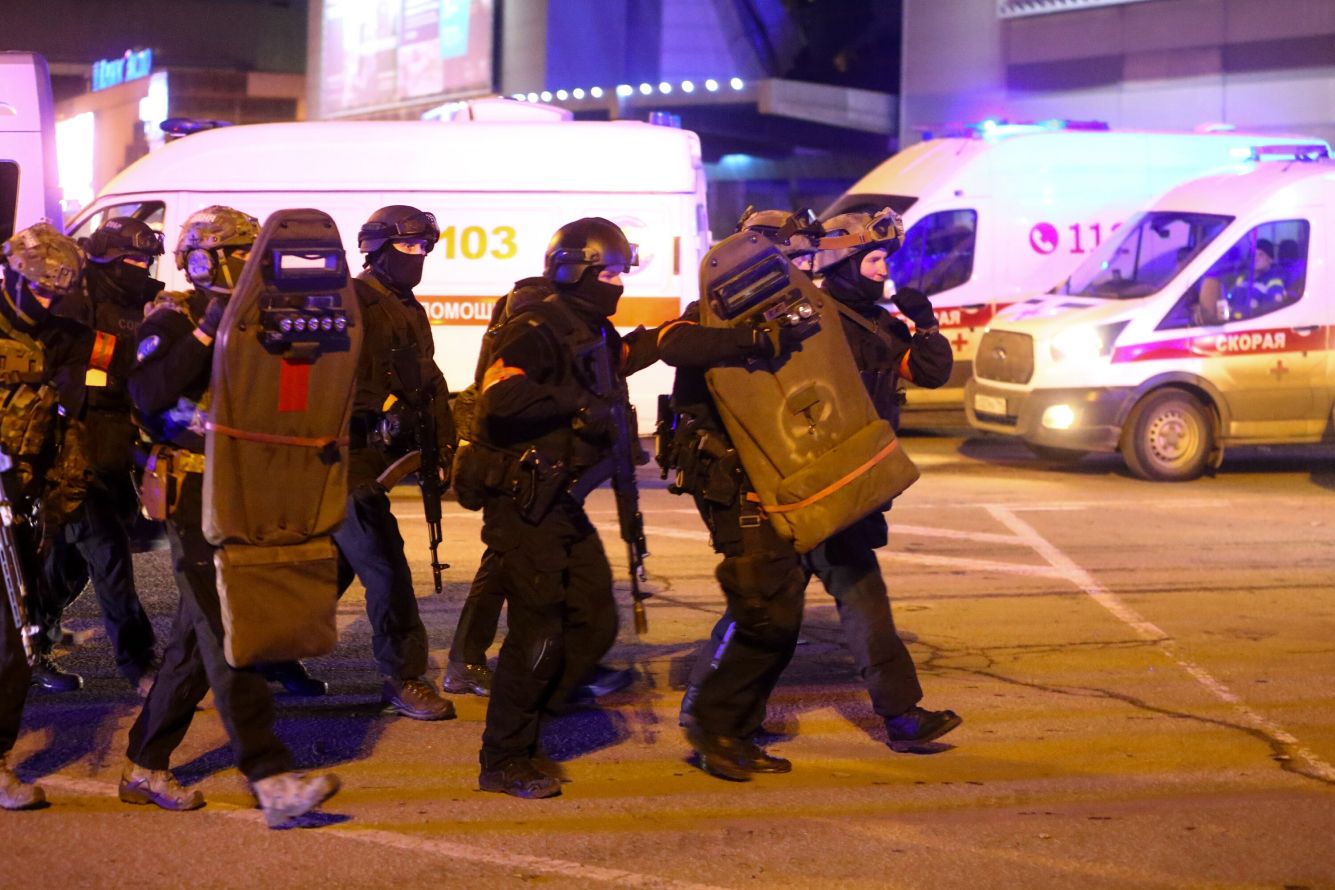
The next morning, after shooting at Crocus City Hall, the FSBannounced that she detained 11 suspects, including four alleged proper attacks. Formally, it is the FSB that is the main power body that is responsible for the fight against terrorism in Russia. Could special services prevent a terrorist attack? Why was the protection of the building could not detain terrorists? And why was this hall the goal of the attack? The cooperative of independent journalists “Bereg” talked about this with the invited researcher of Yale University and a specialist in Russian security forces Kirill Titaev. With the permission of the Medusa editors, this text publishes.
- Are there any such terrorist attacks at all?
- No. And if such a terrorist attack is prepared by a group of professionals, a certain terrorist organization. And if it is [on the contrary], relatively speaking, two students who accidentally gathered together. There is practically no opportunity to prevent this.
In general, the prevention of terrorist attacks is almost a fantastic story. The agents should be at the right time in the right place in order to know everything for sure. And even if there are agents inside this [terrorist] organization, as a rule, an agent will know some very small piece of information.
Now they say that the United States warned [Russian law enforcement officers], but, most likely, the information of the special services was at the level of "some kind of terrorist attack is planned somewhere in Russia." As a rule, this, in general, is quite useless information. Basically, terrorist attacks that are considered “prevented” are those that were initiated by the special services themselves.
-Is it possible to somehow prevent such terrible consequences-a huge number of dead and victims-say, due to the actions of the protection of the building or other services? Is it possible to judge by the available data how effectively they worked after yesterday's attack?
- We cannot evaluate it now. It can be noted that doctors and fire brigades are very promptly and in large quantities. But here you need to pay attention to two circumstances.
Firstly, [terrorists] was chosen an object that is located even in the Moscow region, but still outside Moscow. This is important because the control systems that could prevent us to carry weapons - and generally carry out such an attack - are closed to Moscow. I mean urban video surveillance infrastructure, metal detectors and so on.
-Because Moscow just has more money or because of the special status of the capital?
- We do not know. We can only assume. It is important that [what happened] demonstrates two things. Firstly, if we are outside the big city or on its outskirts, then, as it turns out, we can carry weapons to a very large cultural center. After all, the militants calmly passed with weapons and, apparently, with some explosive or incendiary ammunition (we don’t know this for sure). And then, most likely, they managed to hide. The FSBclaims that she found them, but there are questions to these messages, because in such a situation it is always difficult to understand whether these [most] people really found.
-Is there something specific that makes you doubt the latest statements by the FSB and other official information?
- So far, nothing of the kind is visible - simply because the messages are extremely mean. There are no distinct markers. Further as the trial will go, certain signals may appear [that official information is unreliable]. But, most likely, since it will be a case of terrorism, it will be considered closed, and probably we will not know anything. Including whether the people who are delayed now committed this terrible crime or are it [just] those who [law enforcement agencies] were appointed by the executors.
- You said that all the security infrastructure was closed to Moscow. But after all, Crocus City Hall is very close to her and is even perceived as a Moscow concert hall than a regional one. That is, even at such a small distance there is a difference in security level?
- Yes. Two factors are important here. The first is the number of observation objects and the density of transport infrastructure. Roughly speaking, in Moscow there are no rural roads along which you can quietly travel to its territory or, conversely, hide. This is a purely geographical story, and it will be the same all over the world.
The second factor is administrative. All over the world, the defense infrastructure works primarily through the number of barriers. In other words, if you need to get, say, to the Pushkinsky cinema [in the center of Moscow], you will go along the way through several control zones. They themselves are not aimed at protecting this cinema, but they complicate advancement. And outside of Moscow you will simply be physically fewer barriers.
And this, again, is not the specifics of Russia. If someone wants to arrange such a terrorist attack in the center of Manhattan [in New York], he will have to go through many zones of control, where the attacker has risks. If a terrorist attack is planned on the outskirts of Brooklyn, the task will be much easier.
- How could such an armed group be in Russia? Is it possible to assume where they got weapons and ammunition?
- As for ammunition, which were supposedly used for arson, there are many options: they are made at home, and so that this does not cause any suspicion. That is, this is not a problem. With small arms, in theory, it is much more difficult - automatic weapons in Russia are somehow prohibited from relatively free circulation. We do not know where exactly the weapon used in this attack came from, but there are translucent boundaries with Kazakhstan - south to Afghanistan.
Another huge risk zone is what the Russian authorities call a “special military operation” and “new territories”. In general, access to weapons has recently simplified quite a lot, but this is still a rather difficult task. In Russia, every fifth with a machine does not run. What we saw [in Crocus City Hall] gives every reason to believe that it was a very carefully prepared operation, provided with the necessary resources.
-In Russia, a large number of security forces in terms of per capita-this plays some significant role, if not in the prevention of terrorist attacks, then in monitoring the turnover of weapons and the overall security of people?
- This is a common discussion. When we, researchers, say that in Russia a very large number of law enforcement officers per capita, law enforcement officers traditionally object that not only the population, but also the territory is important. But in order to control the [all] territory of Russia, we need to make law enforcement officers about all.
Even if there are more of them, it still will not affect the security of people. Take any regional center. A competent driver always knows how to leave the city, bypassing all possible posts [DPS], cameras and so on - this is how the transport infrastructure is arranged. The territory has been populated unevenly and so on, and so on. That is, with the exception of Moscow and St. Petersburg, we [beyond their borders], which cannot be covered with any effective control-is outside of independence from the number of law enforcement officers.
- After all, there are security standards for mass accumulations of people in Russia, almost everywhere there is private or departmental security. What can be said about the effectiveness of such protection? Is it able to really increase the security of people?
- There are really standards, but they are relatively soft. The fact is that any security measures sharply reduce economic efficiency. This is always a choice between her and security.
Imagine that every time, going to the shopping center, you go through the frame of the metal detector. Two scenarios are possible here. Either the system works carefully, and all visitors are intensively inspecting - and then these are huge economic costs and big problems for visitors. Or, as in the Moscow or St. Petersburg metro, this is just work on reporting.
I know by myself: if you go in the morning with a perforator (and there is more metal in it than in the machine), then you will be held. But in the evening, when the reporting is already closed, I wrote [in the frame of the metal detector] - and went on. Moreover, the fact that this is work on reporting is obvious to any observation person: when you are inspected, there is an open paper journal nearby, in which they [guard] keep an account.
- Many noticed that the guards did not have firearms in Crocus City Hall. Could this affect anything? And in general, would there be more efficient armed protection?
-Let's imagine the situation that the guards would not be armed not with batons and electric shockers, but, for example, Makarov’s pistols (after all, it is quite difficult to imagine security with machine guns in such places). If a group of people with automatic weapons comes in, and, possibly, with some explosives, then the guards will not affect the outcome of the guards. Probably, this can affect something in the case of a joke, with a single shooter. But if a terrorist attack of this scale, this cannot play any role.
At the same time, the introduction of such a standard is a radical increase in costs. After all, the requirements for the guards who are given a stun gun, and for guards with lethal firearms are two completely different standards, which, of course, is correct. Accordingly, such people will require completely different service costs, completely different salaries, and the effectiveness of such a measure is not obvious.
- How is the work of security forces to counteract terrorism in Russia generally arranged? And what can be said about her quality?
-Firstly, this, again, is the work on reporting-all these cases of the “network” and the like. That is, it is, in fact, artificially generated crime. Perhaps there is real work on countering terrorism - we have no reason to categorically deny, but we do not know what exactly it is and how it is arranged.
“Is it normal that we don't know this?”
- This is fine. More precisely, if it really is and we do not know this, then this is normal. But the question is that we cannot understand whether it is actually or not.
- The main power body to combat terrorism is the FSB, right? Can such a terrorist attack be considered a failure? Or determine some other guilty?
- Yes, the FSB is responsible for the fight against terrorism. But there is no real guilty here-this is a clearly well-planned, thought-out terrorist attack, which, most likely, was carried out by some relatively large organization. I repeat: to prevent such a terrorist attack is an almost unsolvable task. From the point of view of bureaucratic logic, the perpetrators, of course, will be found.
-Does this mean any resignation? And how do you even see the consequences of this attack in the sense of the work of the power organs? What will the authorities most likely do - and what would have to be done?
- If we are not guided by bureaucratic, but real logic, then there is nothing to do: society is not protected and cannot be protected from such terrorist attacks - without transcendent economic costs.
If you try to predict what will actually happen, then there is a risk that some new idiological practices like additional frames [metal detectors] at airports and entertainment centers will arise.
But demonstration resignations in Russia are categorically not accepted.
- Because this is a recognition of your mistakes?
- Yes, and besides, "we do not hand over our own." There were no demonstrative resignations [for such occasions], in my opinion, about twenty years.
- You have already said that the zone, as the Russian authorities say, a “special military operation” is a risk zone in the sense of illegal turnover of weapons. Could the war still somehow affect the quality of the work of the security forces in the sense of fighting terrorism? Let's say they are engaged in the search for certain “Ukrainian Nazis” instead of real militants or lost their connection with foreign partners?
- This is a difficult question. We can say how this was reflected at the rhetorical level, but the data in order to judge how it affects real work, perhaps not enough. We do not know: perhaps the connections at the level of warning about terrorist attacks are preserved, but it is possible that they are destroyed. There is only some kind of insider information that always raises very big doubts.
Margarita Lutova for "shore"