
Translated material
Policy of the second category
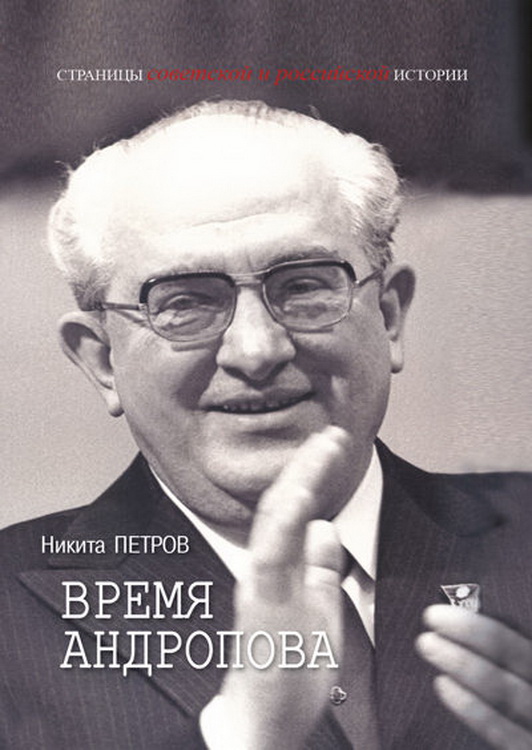
Konstantin Sonin - about the book of Nikita Petrov "Time of Andropov"
In the minds of many Russians who found the late Soviet time, the figure of Yuri Andropov is surrounded by an ominous aura: the powerful chairman of the KGB, transferred to the chair of the Secretary General of the Central Committee of the CPSU, began to restore order with an iron hand. It still seems to many that only his imminent death saved the late USSR from turning into second North Korea. The book of the historian Nikita Petrov “Andropov Time” dispels this legend and portrays his hero with a completely ordinary politician and man. About why this is an outstanding historical biography, as well as about what the works of this genre are generally, specially for readers and readers of Gorky was written by Konstantin Sonin.This material (information) was produced, distributed and (or) sent by foreign agent Sonin Konstantin Isaakovich or applies to the activities of the foreign agent Sonin Konstantin Isaakovich.
Starting from February 24, 2022, we were all in the face of the advancing barbarism, violence and lies. In this situation, it is extremely important to preserve at least the remnants of culture and support the values of humanism - including for the sake of the future of Russia. Therefore, the editorial office of Gorky will continue to talk about books, reminding our readers that the world remains in the world and fiction.
Nikita Petrov. Andropov time. M.: Rosspen, 2023. Content
 The modern history of our country-the USSR, and then Russia-, firstly, is not sufficiently investigated, and secondly, it is extremely politicized. Even if the historian finds and offers the reader new materials, the conversation quickly moves to the question of which of the well -established narratives confirms these materials. The same Andropov is a character of a large number of books and articles, which are minimized by the degree of historical facts, but offering powerful interpretations. Any author of a historical monograph is forced to deal with this problem. How to make the reader learn something new from the book?
Firstly, the author of the “Andropov Time”, referring to a wide audience, chooses a dry, academic style. A professional historian will not see anything wrong with this. But modern standards of historical biography are set by the books of Arthur Schlezinger, William Manchester, Robert Conquest, Simon Sebag Montephiore, Anthony Bivor, Doris Goodman, Rona Chernov, for whom the elegance of prose, vocabulary wealth, historically neat dramatization is the norm. Four volumes of the biography of President Lindon Johnson, written by Robert Caro based on a scrupulous, lasted decades, archival and large -scale field work, are not inferior in purely literary qualities of the masterpieces of modern artistic topics - the “Lincoln” of Mount Vydal, the “wolf den” of Hilary Mantle or the “civilization” of Lauren Bina. The book of Nikita Petrov cannot be put on one shelf with the works of modern masters of the Russian historical novel - Boris Akunin * recognized by the Russian authorities in the foreigner, terrorist and extremist. or Dmitry Bykov * recognized by the authorities of the Russian Federation by the ino -agent. . The author is not trying to make the book a literary work. It is quite conscious, in my opinion.
There is a temptation to attribute this author’s decision to the account of a fundamentally different approach in modern Russian historiography - more academic, less focused on direct competition with the genre of historical novel. Even Akunin, an outstanding prose writer and impeccable stylist, chose a rather dry, academic style for his History of Russia. This choice is clear, but in order to understand it, you need to look at the current context, and not at the historical tradition.
A century ago, examples of literary skill in the political biography in Russian were the biography of Napoleon, written by Eugene Tarle, and Stalin’s biography, written by Leo Trotsky. Then the tradition was lost, and even the best examples of Soviet historical prose in the second half of the twentieth century and did not come close to a high literary syllable. A separate example is the “Gulag Archipelago” Alexander Solzhenitsyn, defined by the author as Fiction and at the same time a large -scale historical study that is read in one breath. In the XXI century, competing with Simon Sebag-Montefiora, Robert Service, Stephen Kotkin, the authors of Stalin's biographies, each of whom is an outstanding literary work, Oleg Khlevnyuk, author of Stalin, made a successful attempt. Biography experience. " Nikita Petrov does not enter this competition. Dryness, and at times the frank lapidarity of the text are designed to contrast with the impressionism of lovers to invent Andropov, minimally relying on historical documents. Actually, this is probably taken from here - Petrov needs to demonstrate the contrast with historiosophical fast food, which filled the regiments of capital stores and the library of officials.
Secondly, in addition to the lapidarity of the style, the author of Andropov is completely relied on his readers regarding the knowledge of the historical context. And again - unlike the best examples of political biographies of recent times. The same Caro uses Lindon Johnson, one specific American politician, in order to talk about political institutions in the United States. One volume - about how the elections to the Senate took place in 1948, in the smallest details; The other is about how the Senate works in detail; The third is about the Institute for the transfer of power from the President to Vice President. In books on Russian history, this technique is demonstrated by Princeton historian Steven Kotkin. In the first volume of the biography of Stalin, published ten years ago, he tells the history of the Russian revolution. As Dumas used Anna Austrian and d'Artagnan to state important episodes from the history of the French monarchy of the XVII century, Kotkin uses Stalin’s life, which is not outstanding until 1917 to portray the history of the Russian revolution. In the biography of Andropov, the opposite is true: Petrov proceeds from the fact that his reader is well familiar with the history of the USSR. I am familiar with the Soviet official option, understands in which places the officialdom seriously deviated from the truth. This approach saves a place and allows you not to waste time on a dispute with an audience about the historical narrative, but for a person who is unfamiliar with this story, reading will be difficult.
Finally, thirdly, the author completely refuses the assessments of the activities of the mentioned politicians. This is partly the costs of style - the academic approach complicates the distribution of assessments.
The modern reader, sometimes, expects from a historian not the interpretations of events and the picture of what is happening “as a whole”, but minor details. Such a reader reduces the historian’s work to find and publish archival materials and data, and leaves the work of the interpreter and creator of the whole historical canvas. Often this reader opens the book, already having a idea of a historical figure in his head and its role. The meaning of reading for him is in finding the facts that fit into this picture. To me, a person from social sciences - and who considers political history to science primarily public, and not humanitarian - this approach seems counterproductive. The interpretation of the discovered evidence requires deeper professional training than the detection itself. But the fact that work in archives or “in the field” requires professional skills and hard work is clear to everyone, and the fact that no less skills are required to understand that these documents, words and events mean is clear.
Given these three restrictions “Andropov Time” - an outstanding historical biography, an epoch -making achievement of the Russian historical school. For example, Petrov did a scrupulous work on clarifying the origin of Andropov. I don’t know if it is so important in which family, in which religion, with what values and rules the future leader of the USSR grew-I myself am not sure that the origin of the politician is of some significant importance. However, these questions are of interest to many, and a new biography answers them. Petrov does the maximum of what, in principle, it is possible to do: he collects and publishes all the documents in which Andropov himself talks about his origin. In the USSR, especially in the 1930s, the filling of profiles was related to mortal danger-it is not surprising that, despite the investigations and punishment, people constantly distorted the information that they reported about themselves. The information that the young Andropov reported about himself in official profiles is very contradictory. It becomes clear why some commentators found confirmation of his Jewish or German origin, while others, on the contrary, did not doubt Russian. In addition to his own Andropov answers, Petrov collects and describes many documents about the possible parents of the hero and the family in which he grew up, but the final clarity does not occur. Andropov was a foster child in the family, possibly his real father - the adoption of their own children born out of marriage, as strangers, of course, is not uncommon.
Analysis of the issue of the origin of Andropov in the book of Petrov is a good example of a situation where, even if all archives are disclosed, and the documents and evidence are available, there are still no unambiguous answers. I think that when a genetic examination appears, clarity will not be particularly increased - at best, we will find out who was the biological father and mother of Andropov (with the mother of clarity more, but she is far from one hundred percent). Will it become clearer from this how the hero grew, who influenced his views and behavior? Not a fact; Rather, it will add more materials to the interpreters to evidence of their favorite theses - who likes them. What is the good book of Petrov - on the issue of the origin of Andropov, so interested in commentators, the author says directly: “Here, I show you all the existing documents. Interpret at your own peril and risk. ”
The political figure, which is described by facts, and not interpretation, is surprisingly ordinary. Throughout his biography, Andropov is a second -bit politician, located away from important decisions. Unlike their political peers - Brezhnev, Suslov, Gromyko, Ustinov, Baibakov, the first generation of communist leaders who did not take part in the 1917 revolution - Andropov at the age of 35–40 was neither the secretary of the important regional committee of the party, nor the Minister. During the war, he was neither at the front, like many party leaders, nor in the key region. For a long time, his patron was Otto Kuusinen, who was not enjoying serious influence. From the documents represented by Petrov, it is clearly visible that the “important point” in Andropov’s biography - work at the USSR Embassy in Hungary in the hot days of 1956 - was an important except for himself. There is no data on the fact that he played a serious role in making a decision on how the anti -Soviet uprising will be suppressed - and cannot be. What role can the ambassador play, the former second secretary of the Petrozavodsk city party committee, in the presence of members of the Presidium of the Central Committee of the CPSU Mikoyan and Suslov? And yet, the lack of a real role does not interfere, but helps myth -making: in the Bayopics of Andropov, he almost decides the fate of the uprising and the future of the Hungarian government.
In the same way, the complete absence of any achievements of Andropov in the field of state security allows myth-making to invent an important role that he played. The detailed story of the hero’s administrative career clearly shows that Petrov does not even say it directly - the main reason why Andropov looked for Brezhnev, whose power was strengthened every day, an ideal candidate for the post of chairman of the KGB. Obviously, from the point of view of the leader, the chairman of the KGB should be a man who does not pose a threat who does not have his own political base, who does not have charisma, etc. Brezhnev replaced the seven -part, a person as unambiguous as Andropov, but belonging to the competitors' clan, to a person who himself was not his opponent. A person who, in photographs with members of senior management, invariably stooped to hide a high growth, compared to more important figures. Brezhnev was not mistaken: with Andropov, the KGB grew physically and administratively, but completely fell out of political life.
For fifteen years, which Andropov spent as chairman of the KGB, the Committee, no matter what he did: prepared the processes of dissidents, collected a dossier for great musicians, poets and writers, recommended and did not recommend that Jews were released in Israel, arrested people trying to escape from the USSR-in a word, if only it did not apply to the field of state security. All those structural problems of the country's security, because of which it fell apart in the late 1980s, is the irremovability and archaic structure of power, information closeness and technological backwardness, economic inefficiency and corruption-all these problems were ignored. Instead, the KGB indulged in much more exciting activity such as the infiltration of student circles and persecution of the elderly academician Sakharov and his wife, that is, things that, as subsequent events showed, had nothing to do with state security.
The only moment when, we can say, Andropov took part in key decisions is to discuss the issue of introducing Soviet troops into Afghanistan. Of course, at that moment it was not clear how fatal the decision would turn out to be the introduction of troops - dissatisfaction with the war would play a role in the collapse of the USSR ten years later. The existing documents show that initially Andropov, like most members of the narrow circle of higher leadership, took a careful, skeptical position. Other, later documents say that he, along with the majority, changed his position, supporting the catastrophic, as it turned out later, the decision to enter the troops. His considerations against the invasion of Afghanistan were reasonable, and what convinced him - in addition to changing the position of other members of the leadership, is unknown. One way or another, in this episode Andropov could play a key role, but did not play.
In the popular story, Andropov is responsible for many things that occurred in the year when he was the Secretary General of the CPSU Central Committee, the main person in the USSR. A sharply reinforced - completely insufficient - struggle against corruption, and failure, ill -conceived reforms to “strengthen labor discipline” (the opposite of what was required by the stagning Soviet economy), and the deterioration of international policy, and the expansion of the powers of the new generation of leaders are associated with his name. The Chronicle of November 1982 - January 1984 shows that Andropov was too seriously ill to be quite responsible for so many changes. Most of them were associated with stagnation in all matters in the last years of Brezhnev's reign. Many positions were held by old people who have long been unable to fulfill their duties. The death of Brezhnev, Suslov, Pelsha, the most difficult condition of Ustinov, Chernenko, Kirilenko and the same processes at the level of ministries, departments of the Central Committee, the leadership of the industry departments, etc. - all this led to changes in the year of the nominal leadership of Andropov.
Materials collected and described by Nikita Petrov in the “Andropov Time” give great opportunities for interpretations and fit into more than one historical narrative. Nevertheless, freedom for inventing the past becomes much less, and this, whatever one may say, is an important achievement for any historian.
Author - Professor of Chicago University (John Distinguished Service Professor)