
Translated material
The Nobel laureate, psychologist Daniel Caneman, died. He told economists about how people make decisions. And I found out when a person is really happy
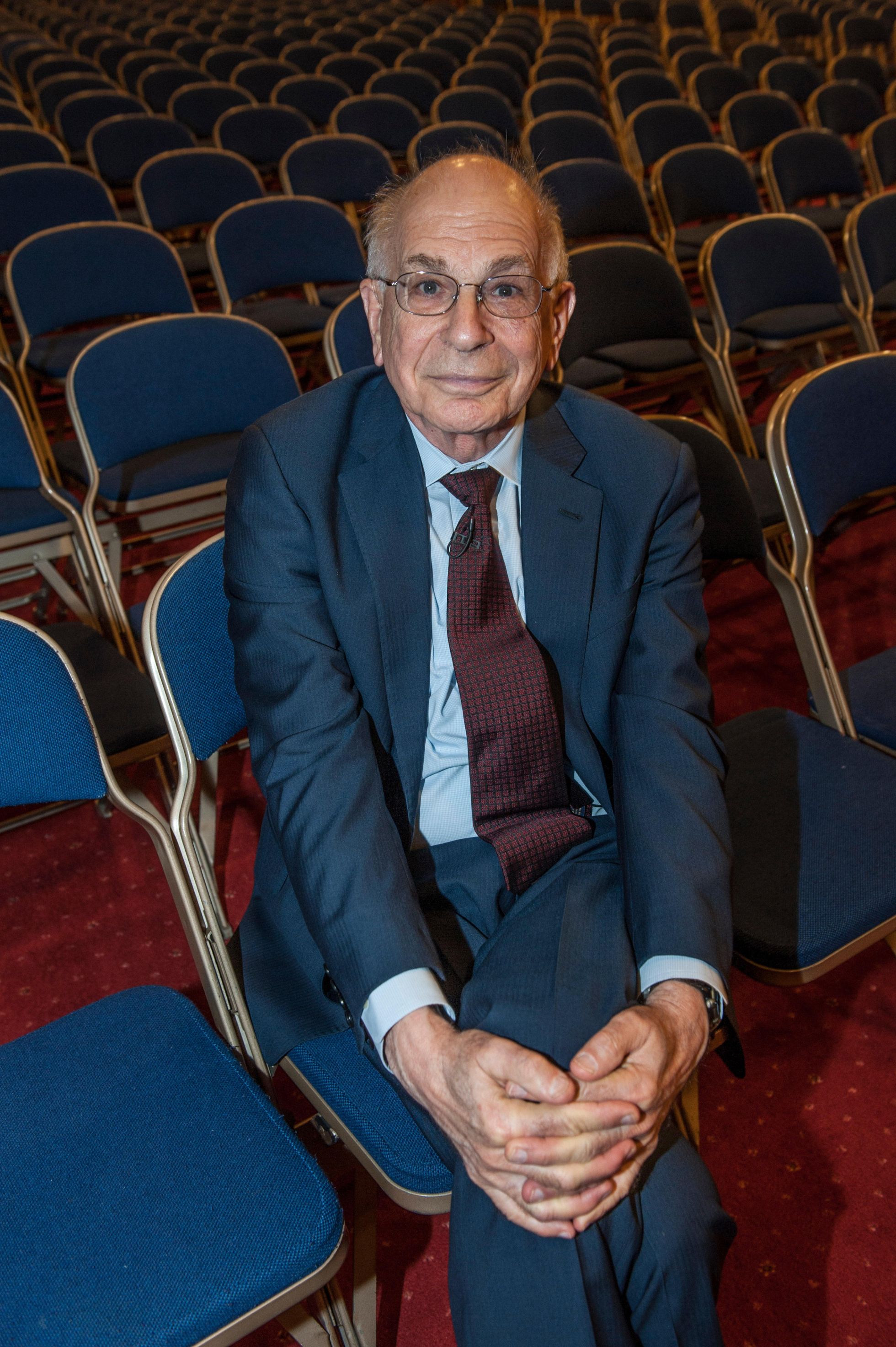
The Israeli-American psychologist Daniel Canemandied on March 27. He was 90 years old. The Nobel Laureate of the Economics Prize, Kaneman was not a professional economist - he received the education of a psychologist and mathematics. However, his work changed economic science and laid the foundation for its most important and very popular section - a behavioral economy. The special correspondent of Medusa Margarita Lyutova says that we learned about ourselves thanks to the research of Kaneman.
What is intuition and what does the gorillas have to do with it
Daniel Kaneman is the author of hundreds of behavioral research and scientific articles on psychology. He published his most important works, which economists continue to quote today, back in the 1970s. But he became widely known outside the academic environment thanks to the 2011 book Thinking, Fast and Slow (“Think slowly ... decide quickly”): in it the scientist tells about the structure of human thinking and describes how people make decisions.
In the book, Kaneman explained his ideas with the help of experiments, thanks to which psychologists managed to find out something important about the process of thinking. Often he turned into participants in the experiment and readers, inviting them to complete the same tasks that the subjects previously passed.
In one of the first chapters “think slowly ... decide quickly,” Kaneman spoke about the experiment of American psychologists Christopher Shabri and Daniel Simons .
If you also want to participate in the Shabri and Simons experiment, watch a short video below. In it, people are transferred by basketballs, and you, watching them, need to calculate how many programs players in white t -shirts will give to each other.
This is a difficult task that requires complete attention. The authors of the experiment tried to show how people who are absorbed in a specific task “blind” and do not notice things who, in a normal situation, would definitely attract their attention. Perhaps you could also miss that in the middle of the video a person appears in the frame in the costume of the gorilla. He passes among the players, stands in the center and hits himself in the chest. The Gorilla is in the frame for about 10 seconds, but almost every second participant in the experiment does not see it - and after that he cannot believe that he could miss this, and suspects scientists in a forgery. This experiment, Kaneman writes, shows that we can be blind to obvious things and, moreover, we do not even notice our own blindness.
An experiment with a gorilla is one of the many ways to explain the central idea of the book “Think slowly ... decide quickly”: each of us constantly operates with two systems of thinking. System 1 (Kaneman calls it so) helps to make decisions quickly, as if according to the already prepared “template”. It is often identified with intuition. And system 2 is responsible for complex thought processes that require efforts.
Counting the passes of players in white T -shirts, people use the system 2, and the system 1 at this time is disabled for a short time. But if you show the video from the experiment, not asking the participants to consider the pass, or even ask them to pay attention to the unexpected that can happen in the video, they will definitely not miss the gorilla. In this case, system 1 will enter into business - it is it that helps people understand what is happening around them.
Although system 1 helps to make quick decisions, this does not mean at all that, trusting it, a person acts at random. Most likely, to save time and effort, the brain simply simplifies processes and uses the accumulated experience that the system 2 had previously already processed.
In lectures, interviews and the book, Kaneman often gave an example a situation that a friend, psychologist Gary Klein told him about. There was once a fire in Klein’s house, and he called a fire brigade. They began extinguishing fire in the kitchen, but suddenly the brigade commander ordered to urgently leave the room. As soon as the firefighters ran out, the floor failed in the kitchen. Already after the commander realized what sensations told him about the danger - the fire was suspiciously quiet, but his ears were incredibly burned. These feelings, according to the fireman, involved his "sixth sense of danger." It turned out that the fire flared up not in the kitchen itself, but in the basement, right under the place where the firefighters stood.
The flair that the commander used can be called the "expert intuition." Here's how Kaneman’s colleague, psychologist Herbert Simon , described her work: “The situation gave a hint, a hint gave the expert access to information stored in my memory, and the information gave an answer. Intuition is nothing more than recognition. ”
The more experience and knowledge a person has acquired, the better his system works 1. At the same time, it protects the brain from overloading with information - otherwise when meeting with new people and situations, we would be painfully analyzing them with the help of system 2.
However, system 1 should be used with caution, Kaneman warned. Intuitive solutions can often be erroneous, because for the sake of the same energy saving, the brain often asks itself not the right and complete question, but simpler. Kaneman called this effect a trap of intuition. This is one of the many cognitive distortions that the scientist studied for decades.
The most dangerous of such distortions Kaneman considered supervision - a phenomenon, partly related to an intuition trap. In one of the interviews, the psychologist admitted that if he had a magic wand, he would save humanity precisely from super -reliability. The thing is that overestimating their abilities or excessively simplifying the analytical process, people, without noticing it themselves, often come to erroneous conclusions. This is the same “optimism” that forces the governments to believe that the war has begun to win, and in the estimate of a large construction site, to meet, even despite the fact that research and statistics have already told them about the opposite.
Unfortunately, it is extremely difficult to overcome overhead, if not impossible: it is too deeply built into the human mind, Kaneman believed. When Kaneman was asked how to at least try to confront her in truly responsible situations, Kaneman gave only one recommendation-“Separate and conquer”. If you crush a difficult issue that needs to be solved, to several small ones, the 1 system will not give a quick intuitive solution.
The point here is not only in slowing down the process of thinking as such (after all, if you just spend more time on reflection, there is a danger of paralyzing yourself with an endless analysis). Kaneman recommended making sure that a person has enough information on each of the polls, and if not, wait until it became available.
Nevertheless, it is not worth completely abandoning intuition, the scientist warned. For example, in many cases already prevailing preferences, there is no need to reinforce with analysis and reasoning. Roughly speaking, if you did not like the first piece of the cake, you should not waste time and effort to eat it entirely only in order to make sure that it is tasteless.
Why is the joy of winning hundreds of dollars weaker than grief from their loss
Many of Kaneman’s conclusions may seem obvious, and the scientist himself, speaking of his works, was even shy about this. Talking with the Columonist Financial Times, economist Tim Harford, Kaneman, who had long had become a classic of behavioral research, asked not to call his guru. And when Harford admitted that, making difficult decisions, he always recalls Kaneman's works, he replied: “Much of what I say seems to me obvious and banal. So I hope that I am not too much on people boredom. I am flattered and embarrassed. "
Despite the “evidence”, the discovery of Kaneman helped to radically change both economic science and the approaches of scientists and the authorities to economic policy. Thanks to the work of behavioral researchers, economists in their work began to take into account how people actually make decisions, not limited to the most simplified model Homo Economicus - an ideally rational person who always seeks to achieve the greatest win.
To study the economy, an infinite number of separate decisions of consumers, borrowers, employees, managers, heads of companies and governments, not knowing all the factors affecting decision -making, is difficult. Kaneman, who received the education of a psychologist and mathematics, with the help of experiments, was able to explain to economists what features of thinking and cognitive distortion affect people's decisions. In 2002, for this contribution to economic science, the Nobel Committee awarded the psychologist a prize.
The discovery of Kaneman, which economists are most often used, is a cognitive distortion called “Loss rejection”. This effect is Kaneman and its chief co-author, the psychologist Amos Tver, described and even measured in the late 1970s. When people weigh the risks when making a decision, the likely negative emotions associated with the loss seem to them more significant than a potential gain of the same size. In the course of various experiments, Kaneman and Tverski found that people from losses are twice as tangible to the joy of acquisition (scientists measured this, seeing how people evaluate their risks). It turned out that people twice up to the loss of hundreds of dollars more than the joy of getting $ 100 or even $ 150, and based on this they estimate their risks.
These conclusions of Kaneman and Tverski are used in many research. For example, it is precisely the rejection of loss that makes investors in the stock market for too long to keep assets in their portfolios that lose price. Their logic is dictated by the fear that the cheapest papers can still rise in price - and if you hurry to get rid of them, you can lose good profit.
The rejection of losses was also remembered in the covid time when the economists tried to understand how the transition to a remote or hybrid format of work affects performance. So, researchers from the London School of Economics noticed that due to rejection of losses, workers can pay more attention not to what the remote is given to them, but to what they lost because of it. For example, the opportunity to discuss working issues face to face, chat with colleagues at the cooler or have lunch together. These conclusions of employees can poorly affect their work efficiency, therefore it is important for employers to explain the advantages of the remotes, the study said.
Lennon and McCartney of behavioral science
Kaneman and Tverski are often called Lennon and McCartney of economic science. Psychologists, completely dissimilar to each other with characters and approaches to work, were friends and worked together for decades, perfectly complementing each other and literally continuing phrases. Kaneman himself has repeatedly said that all his best works were done together with Tverski, and the scientists themselves often could not clearly determine where whose contributions themselves could not. To choose whose name to put on a scientific article is the first, friends threw a coin. Receiving the Nobel Prize in 2002, Kaneman regretted that he could not share her with a friend - Tverski died from oncological disease six years before the award.
The book of Michael Lewis (the author of the “Reducing Games”, according to which the film of the same name) is dedicated to their joint work) The Undoing Project (“Abolved Project”). In it, Lewis described the close and fruitful, but not at all cloudless friendship of scientists: Kaneman and Tverski began to work in Israel and spent most of the time behind joint research. Kaneman said that he practically became the second father of the newborn child Tverski so that the co -author could not be too distracted from science.
Kaneman and Tverski met and began to cooperate back in the 1960s: both worked at Jewish University of Jerusalem. In 1977, they went to Stanford University, but a year later Kaneman and his wife moved to Vancouver. Scientists tried to continue their joint work, discussing it on the phone for hours, but, as Kaneman said, they “lost magic”. Following this, their friendship was also upset.
When Tverski found out that he was sick, his friends met and planned to write a book together about how people make decisions - but they did not have time to finish it. “The preface that I had to write alone was perhaps the most painful text that I had ever written,” Kaneman recalled in an autobiographical essay for the Nobel Committee.
After the death of Tverska, Kaneman worked with other co -authors, famous psychologists and economists. In the early 2000s, along with a labor market, Alan Kruger, he wondered: what makes people happy during the day? To answer it, scientists tried to analyze the everyday life of people by the clock and study how they feel, doing various daily matters. The withdrawal of Kruger and Kaneman may again seem predictable: most positive emotions to people brings the time they spend with friends. But the paradox is that people do not seek to maximize this happy time and rarely give him priority, even when they have such an opportunity.
The fact is, Kaneman explained that it is common for many to strive not so much to happiness as to a feeling of satisfaction and life, so that it includes their successes and external signs of well -being: a car, a house, a vacation in a beautiful place. Happiness, including happiness from communicating with friends, exists in the moment. It is more difficult to save for a long time (unlike, for example, from photographs from vacation). As a result, people tend to pay much more attention and time to what will probably remain in memories, because the memory is the only thing that is most likely to remain with them forever, the scientist said several years ago.
Having come to such conclusions, Kaneman stopped studying happiness and returned to cognitive distortions. Most of all he was interested in the complexity of the person. The scientist recalled that his interest in her appeared in childhood. Lithuanian Jews, Kanemans lived in Paris. The father of the scientist Efraim worked as a chemist in one of the companies that belonged to the cosmetic conglomerate of Lʼreal. A child of the future, the scientist liked to listen to how parents discussed the characters and actions of their relatives and acquaintances. Perhaps this was a sign of the future talent for psychology, and maybe this talent was formed, later Cantan reasoned . From the family stories, the future scientist brought out that there were no unequivocally bad or perfectly good people: those who were discussed in the house were always amazing in their complexity.
When Nazi Germany occupied France in 1940, Efraim Kaneman was among the first French Jews, who were sent to a concentration camp. But after a few months it was released thanks to the patronage of L too.
By that time, the Jews outside the camp walls had to wear yellow stars and observe the commandant hour. Once, Kaneman, who was then a child, lingered visiting a friend and returned home at night. In order not to get caught by the patrol, he turned the sweater with a yellow star sewn on him inside - and yet collided with the SS officer. Suddenly, the military hugged the boy, something joyfully told him in German and showed a photograph of his son, whom he kept in a wallet. And in parting he also gave some money. Already adults Kaneman recalled : “I went home, more than ever, confident in the fact that my mother was always right: people are infinitely complex and curious.”
Margarita Lutova