
Translated material
Does PR decide everything
Yelloufseis Rebecca Kuang is an actual novel about the crisis of identity and the inside of the book business
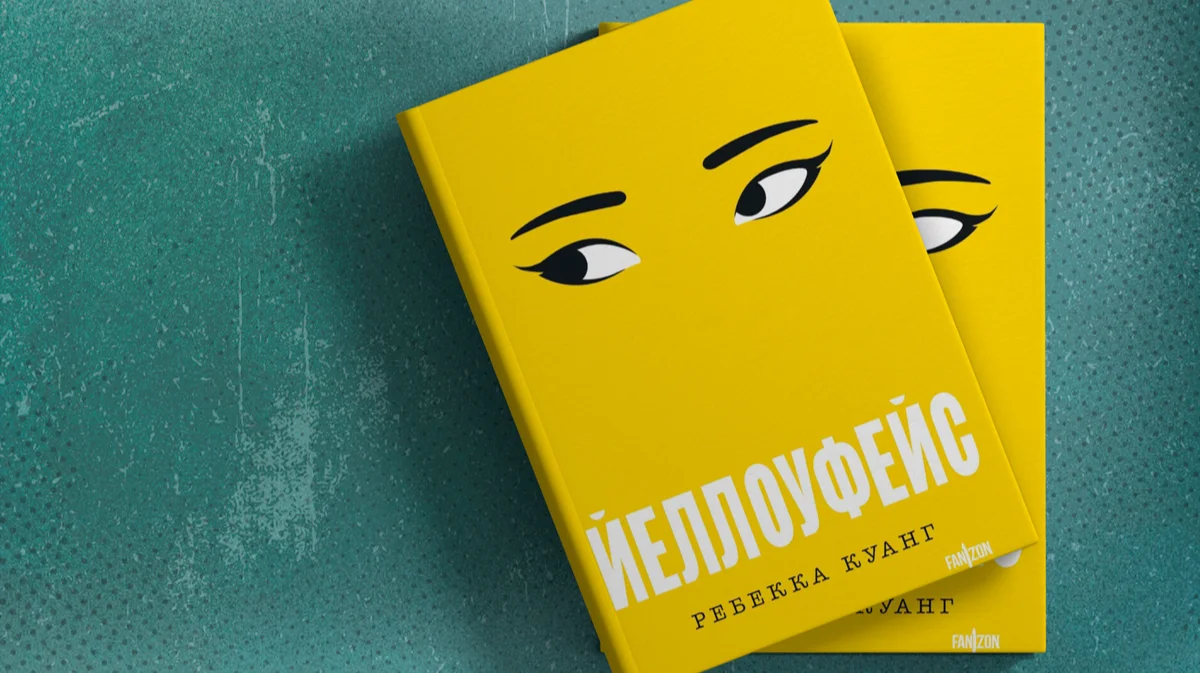
The cover of Rebecca Koang's book “Yellow face”. Publisher in Russian Fanzon, translation of Alexander Shabrin
While the Russian book industry
Squeezes
Under the press of the state and is forced to dig into self -censorship more and more, the American industry - belonging to the largest literary market on the planet - is experiencing its own crisis. There, of course, too
There are activists
eager to burn as many books as possible in righteous fire (
No, this is not a metaphor
), as well as politicians supporting them, but their point of view remains though loud, but marginal.
American scribes now have two main problems: the threat of a writer’s profession by AI and the crisis of the identity of the industry. And if ChatGPT developers now
They are judging
Two writer's initiatives at once, and the neural networks themselves based on a linguistic model are hardly able to replace writers
In the foreseeable future
, then the problem with identity seems deep and seriously raising the question of the adequacy of the market situation.
The texts of the "non -wary" authors are still
They make up a minority
In the market, although their share has increased slightly over the past decade. Top management is still mainly busy with white men, while editors and layouts
Work
Women representatives of minorities s
low wages
And inadvertent career prospects. The loudest of all these problems were spoke during the strike of employees of the largest publisher Harpercollins in late 2022 - early 2023.
This crisis of identity often becomes the topic of films and books that they create right now - scribes are very fond of reflecting, especially about work. The last example: the film "American Frighty" Cord Jefferson, released in 2023 based on the novel by Persival Everett "Erasing" (the original was published twenty years ago, but
plot
Sounds very relevant). About the same topic, Rebecca Kuang is arguing in the fresh novel “Yellowoface”, called the best book according to Amazon and the Reading Assessments of Goodreads in 2023.
Athena Li is a young superstar of literature. She has a conventionally attractive appearance, she was a fashionista, she studied at the Poyshch League University, writes brilliantly - and besides a Taiwan native. Her debut novel is welcomed as a new word in literature, a Netflix exclusive contract arrives at her. At the same time, her friend June Hayword all the time is not lucky: her debut passes by the attention of the media and the reader, the publisher does not respond to letters and does not help with the promotion, the agent behaves passively and is about to break the contract, and support from the girlfriend seems to be hypocrisy. One evening, Athena chokes on pancakes in the eyes of June and dies, leaving on the desktop the manuscript of an unwritten novel about Chinese rear units of the First World War. June decides to appropriate the manuscript and finish it, by issuing it under his own name. The deception gets away with her, but for a long time?
27-year-old Rebecca Kuang is not a beginner in the literature. She admitted that the images of Athens and June reflect her own experience in the industry. From 2018 to 2020, her opium war trilogy was released-fantasy, freely based on the Japanese-Chinese War of the 1930s-1940s. It won many awards and erected a native of Chinese guanzhou to the rank of young star of American fiction. Her next novel “Babylon” was accepted about alternative Victorian England more coolly - mainly for overly straightforward criticism of colonialism and the predictable plot - but this did not affect sales. And now Koang decided to bone the book industry itself: not least for those features that brought her the most popular.
Publishers choose the winner: someone is quite attractive, cool, young and, let's just say this, quite complies with the requirements of Diversiti-and spends all his money and resources on him.
The story is told on behalf of June herself, and Kuang masterfully unfolds the history of literary revenge, which at first does not seem at all: June is trying in every possible way to convince herself (and the reader) that she does not appropriate someone else's work, but only “combs”. Compared to the original manuscript of Athena about Chinese workers at the front of the First World War, June greatly smoothes corners: changes confused Chinese names, makes heroes-European heroes, introduces a love line between the European and Chinese workers, adds touching scenes-everything so as not to angry and not scare away white readers. As a result, the novel becomes more pathetic, but predictable - and the publisher is necessary. Yes, and June himself begins to slowly treat his girlfriend’s novel as a legitimate trophy: the plot in the draft was “not like that”, and the characters are “incomprehensible”, and the language “obscure, overloaded with unnecessary epithets”, and in general, the Athena should be grateful to June that she stole her manuscript. The former insults are also recalled: as Athena, for example, during a joint study, June about rape recorded the story and made a story out of it. Theft? Theft. So, June with the manuscript of a girlfriend can do anything.
Kuang subtractly shows every turn of the heroine's deception, up to the inevitable exposure. But the book industry in its satire looks like a ridiculous miserable: PR decides everything, an explosion of indignation on Twitter is able to bring down the sale of a superhite and ruin a literary reputation, and the publisher himself is more important than art. That is, Koang takes the plot of the novel far beyond the framework of the question “what is cultural appropriation and whether it is possible to borrow other people's stories”: it wonders what creativity is in general and how it happened that market indicators were more important than the joy to simply create something.
God, how I miss the university when I could open a notebook on an empty page and see a sea of opportunities instead of the upcoming disappointment. When I got true pleasure, connecting the words into sentences, just to see how they sound.
When writing was an act of pure imagination, the opportunity to transfer somewhere else, create something that existed only for me. I miss writing before I met Athena Liu.
And the main drawback of the novel is that he does not give an answer to this question. Kuang is quite directly pronouncing the main problems with the mouths of his characters, does not leave the space for interpretation, nuance. The irony is that June in the novel protests against the transformation of literature into a set of theses, but the same set of theses turns out if you collect all the main ideas of Kuang. Even the ending is strange: the lessons seem to be learned, but none of the characters will draw any conclusions. The last page is closed, we are going on.
For all the plot ingenuity of Kuang, it is not possible to go beyond the outlined Talking Points. A logical question arises: why then the novel became so popular? Well, the answer here is obvious: after the strikes of editors and screenwriters, the book market crisis from the internal problem became slowly the problem of the public. This crisis also reflects the general social crisis.
In the end, it is worth making a reservation that in Russia the problem of representatives of minorities is no less acute. Of course, they try to solve it (for example, Evgenia Nekrasova, who uses folklore of different regions of Russia in its texts), but rather sluggish. And, most likely, no one seriously for the representation of the small peoples of the country in the mainstream literature will undertake in the coming years: the regional culture is developing a regional identity too much, and it does not very much contribute to the desire to go to someone else's country to slaughter from the Kremlin. And regional protests are too concerned about the authorities so that the regional culture at least somehow becomes noticeable.
So talking about global important problems is again on foreign material. Alas, not the first and not the last time.