
Translated material
The Russian authorities continue to accuse Ukraine of organizing a terrorist attack of Crocus. Putin conceived a new trip to Kyiv? Or another mobilization?
Trying to deal with political scientist Kirill Shamiev
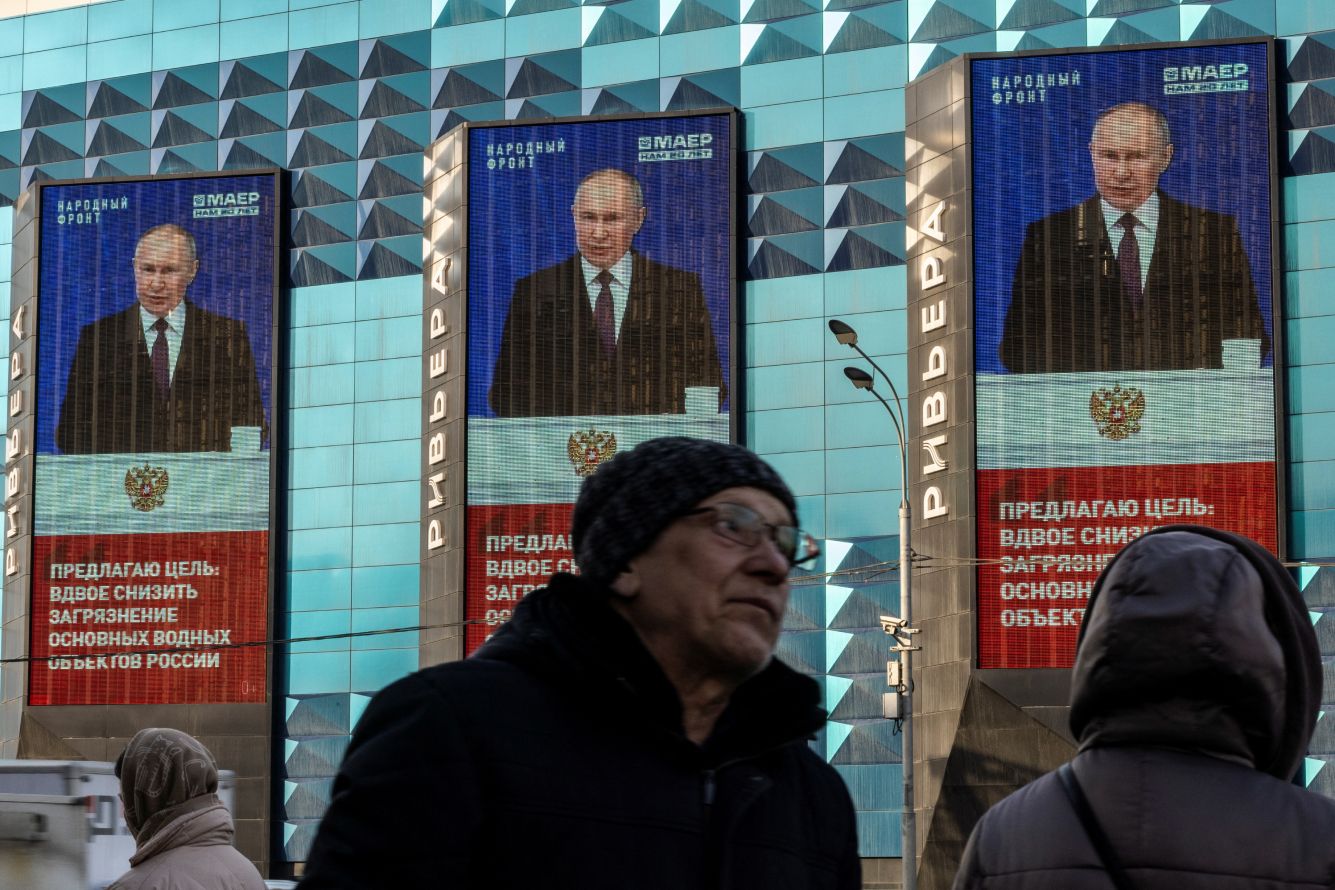
In mid -March, Vladimir Putin received record results in the elections: according to official figures, more than 87% of the vote with a reality of 77%. The Kremlin officials believe that with such support (even partially “painted”), Putin has a carte blanche on any, including the most unpopular decisions. About what these decisions can be against the background of a terrorist attack in Crocus City Hall, Medusa talked with a political scientist, a researcher of civil relations, Kirill Shamiev.

- The bureaucratic triumph of the authorities in the elections immediately was followed by their absolute failure - the terrorist attack in Crocus. How, in your opinion, is it worried in the Kremlin and law enforcement agencies?
- This is the elections for us were completely fabricated, and high administrative indicators showed the elites and the state apparatus that “everything is under control” - that Putin and his environment are still able to get the necessary results.
But the attack on Crocus became an unpleasant reminder that strong power does not mean effective. The failure of counterintelligence and anti -terrorism units led to a huge number of victims - and this is despite the Western warnings.
So the Kremlin is now trying to get out and constructs narratives that can redirect all this negative energy, especially the reaction of the Z-patriots, against Ukrainians. Such a very cynical policy: to wrap the tragedy in your favor. Even put this failure in the service of its main task to destroy Ukraine.
And partly the Kremlin succeeds. At least, in the wire-nosed telegram channels and communities of combatants [on social networks] I have never seen such hatred and aggression.
- How can almost 90%allegedly given to Putin in the elections can affect the course of the war?
- Such an electoral result increases the likelihood of a new wave of mobilization: “You have voted for us, gave us 90% almost - and now the state makes difficult decisions.” Maybe this will not look like a wave, but will turn out to be a smooth intensification of recruiting into the army - where, on the one hand, they will call more reservists, and on the other hand, they will persuade conscripts to sign a contract, recruit volunteers and contractors from a citizen. But replenishment of the Armed Forces of the Russian Federation is now needed at once for several reasons.
Firstly, with the onset of heat, the RF Armed Forces may have new tasks, for example, a major offensive may begin-and the personnel will need to replenish losses. And now there is just for at least a month or two to prepare these people.
Secondly, after the capture of Avdeevka , it became clear how difficult the APU is now difficult to hold the first line of defense. And I think that in the Russian General Staff, including the script for the breakthrough of this line. If this happens, then the breakthrough will need to be developed - and again a lot of people will be required. Both for development and to control the occupied territories.
- What else, besides the new mobilization, can the authorities decide?
- To continue the political economic experiment, which is now taking place in Russia. Indeed, a huge amount of funds is redistributed before our eyes. Western assets and enterprises of businessmen who have left [from the country] are nationalized or simply redeemed by new elites - supporters of the authorities, who are still relatively little known. Huge resources are allocated to the warring and members of their families, as well as the economic sectors related to the military-industrial complex [of the military-industrial complex]-up to sewing clothes, not to mention mechanical engineering. In addition, importing enterprises that use gray schemes or parallel imports are winning the winnings.
That is, a huge number of people in Russia become richer. Some, perhaps, are not reluctant, because initially they did not support the war. But even every day they become more and more wealthy - their life becomes better. At the same time, their well -being improves against the background of a powerful patriotic ideological campaign. These people are not only enriched, but also feel like patriots doing the right thing.
I think that at the end of the war we will see a new society, a new nation - with a slightly changed hierarchy and with a new ideology. Especially if this war ends at least a relative success for the Kremlin. I think that the difference between Russia-2021 and Russia-2026 will be noticeable.
- How will society react when high electoral results will try to “count” the same high mobilization performance?
- In my opinion, the reaction will be restrained. Firstly, the authorities learned to mobilize and the most obvious mistakes of the first wave will be corrected. Then, we are no longer in September 2022, when people were sent to the trenches on the move to hold the front-this time there will be time to prepare the recruits. Finally, active opponents of the war that could leave have already done this. The rest had time to find alternative ways to avoid calling or put up with a changed reality.
In addition, the war has been going on for several years. And this expectation that “soon will end” has already gone. I think that society will be even more ready for new hardships than before.
- Can a terrorist attack in Crocus be affected by the possibility of mobilization?
- This is a question for a million dollars. I took a rule to look at Russian society as a combination of its three units: active supporters of war, its active opponents and the passive majority. And if the wire groups were easily and quickly believed in the Kremlin narrative that the Ukrainians and the West in Crocus went on a crazy attack against civilians, then I can’t say for the rest of the society yet. I did not see the data and I do not want to speculate.
- But the citizens from the attack could not protect those very security forces on whom the country's main resources are now being spent. Didn't the authorities break the remnants of a conditional public contract?
- The public contract was violated many times - and when the constitution was distorted and completely spoiled, and when the retirement age was raised, and when a full -scale invasion began, and when Navalny was poisoned and planted.
The problem is that this contract is informal: it was not concluded anywhere. And there are not even people who could now go out and say: “We, Vladimir Putin, had other agreements. What are you doing?! " They are now either abroad, or in prison, or died or fell silent.
Therefore, at the emotional level, I can agree with you: we were again overturned and deceived. But what about that? First time, or what? Neither leaders nor resources - more precisely, our resources with the Kremlin are completely incomparable. Therefore, politically voice and use this discontent will not work now.
- The Russian authorities continue to insist on the “ Ukrainian trace ”, although they have no intelligible evidence. Why?
-In the place of the Kremlin dictator, I would worry even because of a little risk for my position: he would seem huge to me. And to redirect the rage of Russians to Ukraine means reducing this risk. And in addition to mobilize society - so that public mobilization supports the military, which will then be more effective and again with a lower risk to the authorities.
Finally, at the very beginning, the authorities reacted to the attack very slowly-with a lag behind telegram channels and Z-blogers. It was there that they were the first to talk about the “Ukrainian trace”. And if such a reaction has already gone, then why not the Kremlin not head it? This is easier than trying to plug people who have already begun to speak. Moreover, they are both ideologically and almost their own - supporters of war against Ukraine.
- Ten years ago, joining the fight against ISIS in Syria helped the Kremlin break through the international isolation that arose after the annexation of Crimea. Why now the authorities simply did not accept the condolences of Paris and Washington - and did not talk about the need to jointly confront terrorism?
- The context is now completely different, not comparable to 2015: Russia is isolated from Western international initiatives, its diplomats are sent everywhere in the West. In 2015, when the Syrian campaign began, this, despite the annexation, was not yet.
And the number one priority now is Ukraine. The war creates risks of different probability, but each risk accurately carries dangerous consequences. Huge resources are spent at the front, including human ones, and to miss such as Crocus, the moment of consolidation for the implementation of this priority, I would not be a dictator in the Kremlin.
- Why did the security forces merge the testimoniesof the torture of the accused of a terrorist attack? Why such demonstrative cruelty?
- I was surprised at this. This is terribly irresponsible. In addition, this is an attempt to deceive the internal Russian audience. People will think that “since the performers have tried well, it means they are fighting well with terrorism”, although in fact “a good fight against terrorism” is to prevent terrorist attacks and the disradical of those people who could commit them. As in Italy and Germany, for which such attacks are also a big problem. If the attacks cannot be prevented, then at least the reaction of the special services to the attack should be lightning fast - a couple of minutes, not an hour, as happened in Russia.
There were always torture. However, of course, the war could remove some internal restrictions on their publication: for sure, some of the security forces had already managed to fight - and the same ways to try Ukrainian prisoners. But if ultrousness during the occupation of the territory is working and the force of underground resistance is reduced, then the same level of violence against foreign terrorists, whose resources and leadership are based abroad, does not achieve the goals of the prevention. There are also fewer political filters. All this together leads to an increase in ostentatious violence. From below, there is a desire and ability to continue it, and if the Kremlin administrators do not want to control it, then this will continue.
A nation that feels like a victim after a terrorist attack is natural. But political administrators use this feeling to justify their actions. The victim is defended, not attacking.
In 2004, Putin also used a terrible attack on a school in Beslan in order to justify the centralization of power, to cancel the elections of governors. According to him, even then Russia was threatened both from the West and from the East. The idea is introduced that "they are trying to destroy us as a nation - and always tried." And this emotion should block all internal doubts-all internal questions: "Maybe in Ukraine our country is doing something wrong?"
In return, the authorities offer an artificial model with a zero sum: “You better not think that we are doing something bad: either we will win them or destroy us.” People are preparing for everything that can help Russia achieve its goals in Ukraine. To any sharp actions - potentially unpopular and threatening domestic political stability.
Talked by Lilia Yapparova