
Translated material
Do not breathe
The Government of the Russian Federation wants to reduce gas requirements due to a possible deficit. This means that Russians will have to get used to the dirty air
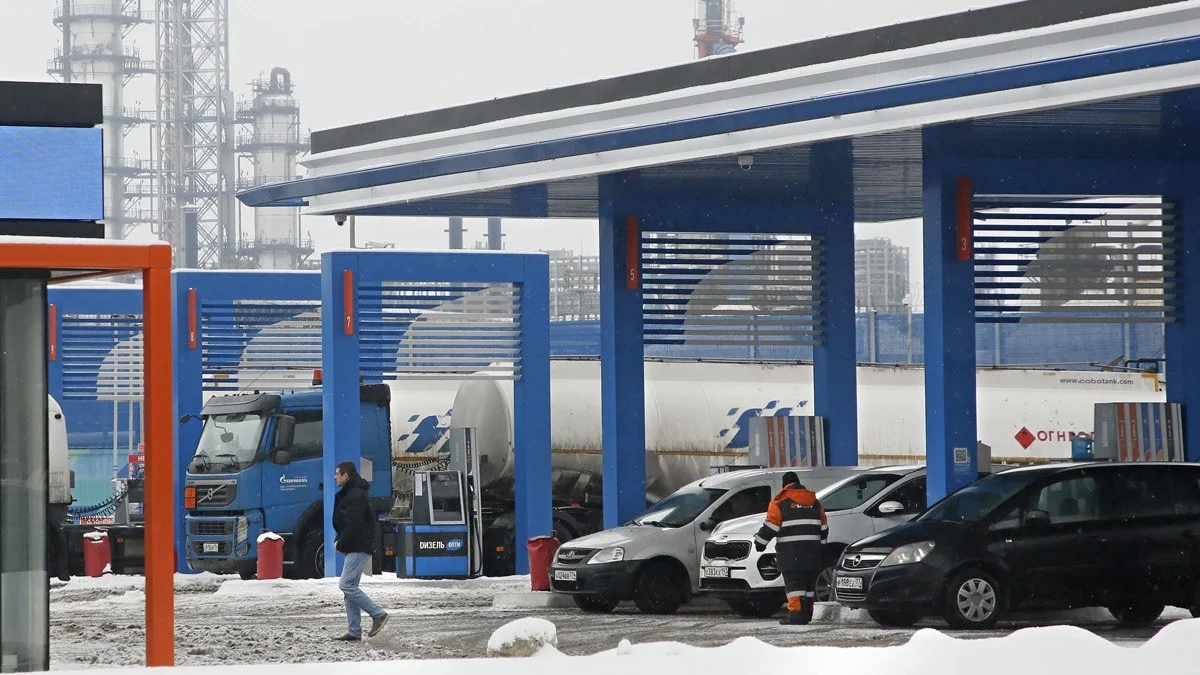
Photo: Maxim Shipenkov / EPA-EFE
One of the results of the full -scale invasion of Russia to Ukraine will probably be that the lungs of Russians will fall many times more sulfur and other harmful substances. This will happen if the Russian government weakens the environmental requirements for gasoline production and allow the release of more dirty Euro-3 class fuel, which has 15 times more sulfur than in Euro-5, more pure gasoline. The strict environmental requirements of officials accepted back in 2016 are caused by the threat of fuel deficiency: after the blows of Ukrainian drones on Russian oil refineries (refineries), the country's production of oil products fell.
Drones reached the goal
From January to April 2024, the Armed Forces of Ukraine undertook 25 air attacks on the objects of the oil infrastructure of Russia (Novo-Europe wrote in detail about this in a large study ). As a result, at the seven refinery were disabled for the primary oil refining plant. In two factories, Volgograd and Ilsky, the installations were able to quickly repair, for other repairs have been going on for more than one month.
In the midst of attacks, according to the calculations of the Novo-Europe, the Armed Forces of Ukraine were able to disable approximately the sixth part (16%) of the production of automobile fuel in the average monthly expression. As a result, the production of petroleum products has significantly reduced: over the past week of March (Rosstat publishes weekly statistics), gasoline production fell by 11.4%, and diesel - by 8.5% more than 2023. Over the first week of April, the production of gasoline decreased by 9.5%, and diesel fuel by 10.4% of the 2023 period.
The situation is also complicated by the fact that April and May are the season of annual planning repair of oil refining plants, which means that the “failure” in production may aggravate.
True, prices are still practically on the spot: on April 8, gasoline by December 2023 went up by 0.8%, and diesel fuel by 0.4%
In order to prevent a deficit and, as a result, rising prices, the surge of which was already in the second half of 2023, the Russian authorities banned gasoline export (leaving export of diesel fuel, which is produced twice as much as consumed in the domestic market), and also turned to friendly neighbors for help: they began export of fuel from Belarus and asked for Kazakhstan.
Dirty gasoline
Another measure to prevent the deficit discussed by the authorities may be temporary permission to produce dirty gasoline. Since 2016, in Russia, only Euro-5 fuel can be used.
The first that the government could sacrifice the purity of air in favor of volumes was written by Reuters. According to the agency’s calculations, if the authorities allow to reduce the requirements for the level of a number of additives and the content of ethanol, then this will increase production by 300-350 thousand tons per month, or by the same 10%, which are now “knocked out” by the throns from the market. At the same time, according to Reuters, sulfur requirements should not change. But according to Kommersant , the government is discussing more serious deviations from the standards: to allow the release of the Euro-3 class fuel, as well as the use of the octan-aligning additives-monomethylalinin.
In terms of sulfur content, Class 3 fuel is inferior to Euro-5 by 15 times, the Russian ecologist, who asked not to name his name, told Novy-Europe.
- From this we can conclude how much sulfur will be in the atmosphere. Due to such a sulfur concentration, car catalysts will stop working and are unlikely to be recovery.
Emissions will grow and nitrogenous compounds, ”he said. -First of all, all this will fall on Moscow and St. Petersburg, where there is a large car traffic. And secondly, cities like Chelyabinsk and Krasnoyarsk will suffer, where cars give a significant part of air pollution.
Between the classes of Euro-3 and Euro-5, the great difference in terms of environmental impact, another expert confirmed.
-In the Euro-3 class, there are more sulfur, more hydrocarbons, which, when burned, give nitrogen oxides and more substances that form soot during burning. And there are no additives that reduce the release of nitrogen oxides, ”he said.
Due to the deterioration of fuel quality, another problem may arise, which will result in additional costs of car owners. As the agency found out , talking with technical specialists,
This will harm the engines that are designed for Euro-5 and Euro-6 fuel and they will have to be repaired more often. Car repair costs can vary from 700 thousand to 1.5 million rubles.
A return to Euro-3 will lead to a serious reduction in engine service life, the vice-president of the National Automobile Union Jan Haitser told the agency. And the representative of the Atlant-M Autotechnical Center, which specializes in the maintenance of Skoda cars, described the consequences as follows: “Most likely, there will be problems with the burning of pistons, valves and other elements. The fuel will be poorly burned, continue to burn out in the exhaust manifold, the temperature there will be significantly higher than it should be. All catalysts can burn out, which is why lambda-zond will read the wrong readings that will fall into the engine control unit. And then in a circle - errors, unstable work, and so on, ”the expert said.
Bargaining with oil workers
The discussion of reducing the environmental requirements for gasoline can be caused not only by the desire to avoid deficiency, but also by the desire of oil companies to save, one of our experts explained to us. The fact is that a cleaner gasoline of Euro-5 is produced on new expensive and resource-intensive reforming and hydrotherapy plants. Their work requires a lot of electricity, and oil companies now have continuous expenses: it is necessary to repair the refineries lined with drones, and in addition, they lose their share of export revenue due to sanctions.
“Therefore, oil companies achieve from the government to allow the production of Euro-3 not so much for a physical increase in production volumes as to reduce their costs,” the expert explains.
Residents of Russia are traditionally very sensitive to the cost of gasoline. The government is trying to keep the price of fuel, acting on the company, and in response to this they achieve messages. And very often these reliefs are environmental.
- Now it is easier for oil companies to get bonds, because they know: the government needs to collect money to the budget, and the government simply cannot take money from business. It is impossible to increase the retail price of gasoline, the patriots will be most outraged. Therefore, an ecology remains in the role of the victim, the concern for which does not bring such a result, which gives the preservation of fuel price, ”said the interlocutor of Novy-Europe.