
Translated material
Collapse on the Belarusian border: how EU countries are fighting with the Lukashenko regime and re -export to Russia during the war
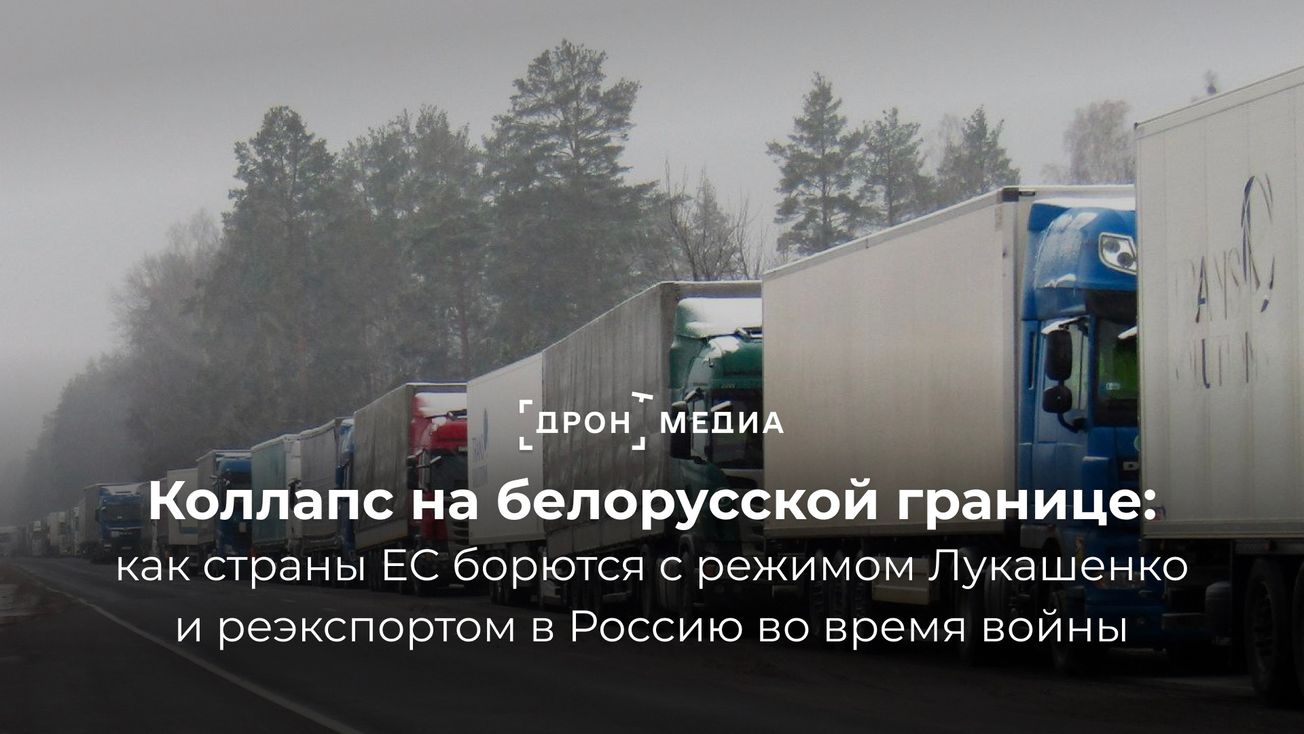
On the border of Belarus with the EU countries (Poland, Lithuania and Latvia), the last weeks have arisen transport collapse. The lines from cars and trucks stretched for tens of kilometers, passing the border takes a day or more. The situation was even complicated by passengers of regular buses, which usually quickly pass the border.
The EU countries say that they were forced to tighten control over the movement of vehicles to Belarusian territory, to block re -export to Russia of goods that fell under European sanctions. An additional factor was the aggravation of the migration crisis. Belarus, in turn, accused the EU countries of sabotage work on the border and predicts that the situation will only worsen.
The Drone was versed in what was happening on the border, how the EU countries are trying to block the re -export of sanctions goods through Belarus to Russia and how the transport collapse is connected with the migration crisis.
Attack on re -export in Russia
On March 23, Poland without warningintroduced a ban on the export of cars purchased in the countries of the European Union to Belarus, with an engine volume of more than 1.9 liters. Cars also more expensive than 50 thousand euros, regardless of engine volume, also fell under the restriction. Polish customs officers stopped issuing export declarations and skipping all cars with transit numbers.
To go through the border, drivers must fulfill a number of requirements. In particular, to provide documents from the manufacturer confirming the right to export the machine outside the European Union. You also need to have confirmation from the manufacturer that he knows the final owner of the car. In addition, drivers should have payment documents confirming the purchase of a car.
A similar ban was later introduced by Lithuania and Latvia. At the same time, the restrictions, as it turned out, affected not only cars, but also trucks, primarily trailers and semi -trailers.
Poland refers to the sanctions decision of the Council of the European Union No. 833 ten years ago. According to the document, for the sale, supply, movement or export, directly or indirectly, a certain list of goods to Russia requires preliminary permission.
After the full -scale invasion of Russia in Ukraine, cars also got into this list. In March 2022, luxury cars were included there, and from June 2023 - and cars with an engine volume of more than 1.9 liters, as well as electric cars and hybrids.
The Polish authorities said that they introduced restrictions and tightened control at the border in order to, among other things, to deal with the schemes of bypassing the sanctions that Russia and Belarus use. It is Belarus that is seen as a “country of high risk” , which helps Russia bypassing sanctions.
Belarus - a transshipment base for luxury cars?
Several investigations, both in the Belarusian independent press and in the western, showed that this is true. Against the backdrop of Western sanctions over the past two years, tens of thousands of luxury cars for tens of millions of dollars began to be supplied to Russia through Belarus.
Unlike Russia, the supply of cars from the EU to Belarus is not prohibited. And some world car brands that have left the Russian market continue to cooperate with Belarus. As a result, in nine months of last year, at least 60 thousand luxury cars for 1.7 billion euros were imported to Russia through Belarus. The main deliveries came from Germany, Lithuania and Poland.
European companies try to track so that their cars are not resold to Russia. Some even prescribe a ban on re -export in agreements with Belarusian dealers. But these prohibitions can be circumvented at the expense of intermediaries in a chain between the EU and Russia.
Line 50 km, border passage - 40 hours
Due to tightening control over transport on the border, huge lines of thousands of cars accumulated. The situation on the Polish-Belarusian border turned out to be especially difficult. The queue of trucks following from Poland to Belarus reached 50 kilometers in April. To get to the territory of Belarus, trucks are forced to stand in line for 40 hours.
The Polish side explains the current situation with two reasons: an increased number of trucks and tightening the control of documents for goods by Polish border services. Another factor also affects - the minimum number of working checkpoints.
Back in the fall of 2021, Poland closed three checkpoints on the border with Belarus against the background of the migration crisis. In February 2023 , "in the interests of state security" another checkpoint stopped working. As a result, at the moment, only two checkpoints on the border of Poland and Belarus are operating-one for passenger transport (Terespol-Brest) and one for cargo (Kukuryki-Kozlovichi).
Meanwhile, passenger transport is forced to idle in a multi -kilometer traffic jam, but already on the exit from Belarus. Poland stated that this was a consequence of the next exacerbation of the migration crisis, and accused the Belarusian authorities of this.
Recently, cases of attempts to break through the Polish border by illegal migrants have become more frequent. In April alone, the Polish border guards recorded more than 2.6 thousand attempts to illegally cross the border of Poland from the territory of Belarus, mainly citizens of the Middle East and African countries.
The Polish side assigned responsibility for the migration crisis on Belarus. And she explained that she was allegedly forced to transfer employees working on the checkpoint to protect the state border and restraint migrants. Poland is also forced to exercise more detailed control of persons entering the country from Belarus, "until the real threat of illegal migration will disappear."
As a result, large car lines.
Control of sanctions and "spies" from Belarus
The Baltic countries also tightened control at the border, especially in this, Lithuania succeeded.
Since March 1, Lithuania closed two checkpoints on the border with Belarus (Lavorishkes-Kotlovka and Raigard-Greek). The authorities forbade the movement of pedestrians and cyclists on the two remaining open checkpoints ("Moidininkai-Kamenny Log" and "Shalchininkai-Benakoni").
In the summer of 2023, Lithuania has already closed two checkpoints on the border: "Shumskas - Hors" and "Tverjachyus - Vidis." This was made in response to possible threats from the Russian private military company Wagner, which ended up in Belarus.
The decision to close the new checkpoints will allegedly allow you to more effectively deal with illegal migration and smuggling, explained the head of the Ministry of Internal Affairs of Lithuania, Agne Bilotaite. This will also enhance control over compliance with the sanctions regime.
Plus, Lithuania wants to reduce the number of permits for passenger transportation with Belarus about half to reduce the flow of people crossing the border.
"Recently, the flow of Belarusian citizens has increased by about 50%. As the flows of transport, goods and people increase, it is necessary to optimize the process of managing these flows, the concentration of technical means and an even more detailed search for people, vehicles and goods," the report of the National Center for Crisis Situation Management (NTsux) says .
Another reason for the restrictions introduced is the increased threats from the Belarusian special services.
According to the Department of State Security (DGB) of Lithuania, Belarusian intelligence allegedly began to actively try to recruit Belarusians who come to their homeland from Lithuania.
The recruited representatives of the diaspora, according to Lithuanian special services, can be used to collect various information. For recruitment they can use psychological pressure and blackmail, they say in Lithuania.
"Contacts between Belarusian intelligence and some representatives of the Belarusian diaspora pose a significant threat to Lithuania’s national security, especially if they are preserved after their arrival in Lithuania," the Lithuanian special services say.
True, the DGB did not submit any documentary facts of such a successful recruitment of the Belarusian special services in his document.
The reaction of the Belarusian authorities
The Government of Belarus, in response to the closure of two checkpoints by Lithuania, prohibited the import of individual food and non -food goods from the territory of Lithuania. The list of products of Lithuanian origin prohibited for import and sale in Belarus was also expanded.
The State Border Committee of Belarus accused of creating a collapse on the border of Poland and Lithuania. In particular, the department claims that Polish border guards passes less than half of the buses from the daily norm. “As the holiday season approaches, the situation with bursts will deteriorate,” the border guards are convinced.
President of Belarus, Alexander Lukashenko, in turn, stated that the situation on the border with the EU is quite complicated. At the same time, he emphasized that closing the border is not an effective way to interfere with recruitment.
“They closed the border ... It’s very difficult to work. And even the Chinese, Kazakhs with the Poles and others. Frantic queues are specially on the borders. They do it on purpose ... They do not let their people here due to the fact that we can recruit them. No one on the border of people does not recruit. If we need to recruit someone, we will do this,” Lukashenko said.
The opposition is also against it
The leader of the Belarusian opposition Svetlana Tikhanovskaya also criticized Lithuania’s decision to close the checkpoints. According to her, it is necessary to isolate not Belarusians, but Lukashenko and his regime.
“We understand the fears of Lithuania’s security services, but the closing of border crossings for passengers is the treatment of symptoms, not the causes of the problem. Closing will hit primarily by Belarusians, which are mostly against Lukashenko and support Ukraine. There is no need to build an iron curtain. After all, only Lukashenko and Putin will benefit from the isolation of Belarusians,” said Tikhanovskaya.
According to her, you can revise the inspection system, and "we are ready to help in this."
“ It is necessary to isolate Lukashenko and his regime, not Belarusians. It is necessary to limit cargo transportation, and first of all, the flows of the trade in suction goods. And the passenger message must be saved,” the leader of the Belarusian opposition said.
###
This material was prepared by the editors of "Deron Media" as part of the Stars 4 Media project