
Translated material
Defeat Brighton Beach
Gestalt therapist advises how to adapt in a new country, based on personal experience
Hundreds of thousands of Russians were forced to leave the country because of the war with Ukraine. Many of them admit that they could not adapt to life in emigration. Researchers of the European University Institute (EUI) at the end of 2023 talked about 15% of those who returned. Putin is about 50%, "according to his modest calculations." But what does it mean to "adapt to emigration"? Learn the language? Find a job? Make friends? Gestalt therapist, coach Olga Movchan gives an example of Brighton Beach-a Russian-speaking region in New York, where people continue to live, as if in Russia or even the Soviet Union. In the “cold” column, the Movchanes explains why such a life promotes depression and anxiety, and gives 10 tips to adapt in the new country.
In order not to miss the main materials of the "cold", subscribe to our Instagram and telegram .
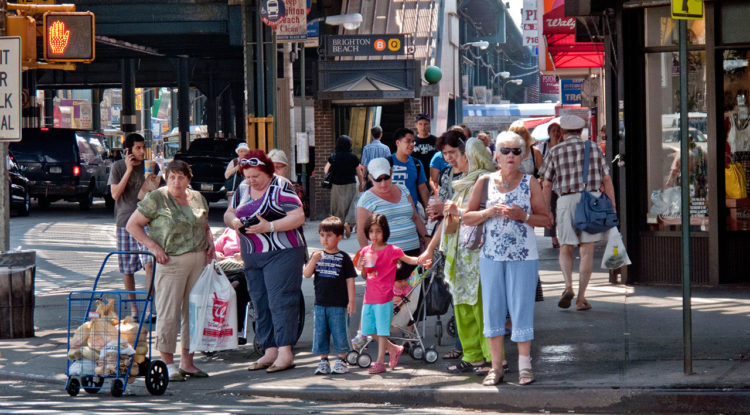
In 1998, I first ended up in New York and went to Brooklyn to watch Brighton Beach. I think if I went there straight from the plane, it would be difficult for me to maintain a connection with reality. Brighton Beach was similar to time, but overcoming the space and settled next to the ocean of Torzhok of the 1970s. Almost all signs were in Russian. In the toilet of the Primorsky restaurant, locks and holders for toilet paper were broken, which added the usual color.
Although the waiters were caring. The three of us came and ordered three cabbage salads. “Enough with you and two,” said the waitress - a beautiful large brown -haired woman with a bundle, and, looking at our confused faces, added confidentially: “Big portions.” In local stores, they sold black bread, buckwheat, cottage cheese and condensed milk, as well as sweets “Bear in the North” and “Squirrel”. And I appreciated the beat of my long -leaving friends, who invariably rejoiced at my nostalgic packages, in which she trembled candy wrappers.
Another sign of this place was people who, for all their heterogeneity-from charming old men in cervical scarves and noble old women with purple heads in wide white trousers to a prayer species of 40-year-old fun in caps-almost in no way built into American life.
The Brightons watched the program “Time” (which in Russia, it seems, no one has watched) and talked about the fate of the Motherland. They scolded America and loved America, but almost did not enter into a relationship with it. And if they entered, then most often through special Russian -speaking “attorneys” who made their small gesheft on a slightly better knowledge of local rules and language. These people left the Soviet or post -Soviet country, making great efforts for this. But they remained much more connected with their life that they left than with the one in which they found themselves.
***
Now I live in London. My emigration is almost four years old. And now I understand the Russians much better with Brighton Beach, who so surprised me in 1998.
Emigration is very difficult. Of course, it became much easier for me when I had a circle of communication, when it became clear that I could work in London. But the main thing - I accepted the idea that I would never assimilate. I will never speak English without an emphasis, I will never be “my own” - not that “to the fullest”, but even “to a large extent”.
The memory of the Brooklyn former Russians brought me longing and fear to freeze in time and turn into the same Primorsky restaurant with a broken castle and large portions of cabbage salads. This is a common story for emigrants around the world. Many Brooklynes, having moved somewhere, do not mentally move, experience depression, disappointment in the move, feel loneliness, inability to maintain close relationships. They are afraid of the future and want to return to the country of the outcome, regardless of the situation there.
I treated with my fear the usual way: I began to ask people in life and social networks and read articles on the topic in search of adaptation ways. Under the adaptation, which in a general sense is defined as adaptation to new environmental conditions, I understand the arrangement of life in a new place so that this life is subjective no worse than the previous one. Maybe it’s better in something, maybe not-but so that a person could say: “I am pleased that I have moved.”
After questioning people and reading literature, I found that factors that help adaptation can be divided into the following groups:
- Attitude to the language. It is clear that the opportunity to speak freely and beautifully in the language of the country that you moved helps to adapt. But this is not the main thing. For most people, this does not work out at all and almost always not as good as they would like.
But it is important to learn how to use the language as a tool. The most important thing is that you are understood, and you understand others. More important - mutual intention to understand each other. One of the colleagues, noticing my suffering because of my terrible English, calmly said: “This is not only your problem, we must also make efforts in order to understand you, and it is important for me to be understood.” I was moved, and this added inspiration and freedom to me in communication.
Own activity or, if you want, active socialization. Not passive (where you are invited to visit or for a concert-this does not particularly help), but active: you integrate into a new reality or suggest that you can, learn, work, volunteer, create communities, organize lectures, evenings and so on.
The creation of a mixed social circle, which ideally includes people from three conditional groups. 1) Those with whom you can speak your native language and with whom you have a common cultural code. 2) those with whom you can speak the language of the country you moved, but which, like you, are immigrants. 3) people who were born and grew up in this country.
Curiosity for local culture (its traditions, food, art, history, nature, and so on).
Building relations with the city, the village, the area in which you settled. The study of architecture, the choice of “your” places: your favorite cafes, bakery, corners, streets that you fill with personal associations. I remember when I just moved, my colleague and friend asked: "Have you already found a place where it is comfortable to drink coffee?" A friend knew a lot about crossings.
Meanings. A clear understanding why you moved. For example: “I want children to study at a school where there is no“ talk about important ””, “I don’t want to go to“ acceptable compromises ”. Or “I'm afraid that my son is mobilized”, “I want to engage in science where it is possible.” The list can be continued.
A sense of development and enriching experience. Understanding that as a result of moving you finally learned the language, learned to survive in different conditions, met amazing people, mastered a new profession, and saw the world.
Creating a house. It can be your own house or rented housing, but it is important to make it “your own”. This is a rather intimate process. For some people, “where I put a chair, there is a house”, but for others this is completely not enough. For some, the space becomes his own, if a person, for example, begins to invite other people to visit, cook for them. Someone grows his kindergarten. And it is important for someone to have a dog or fish.
The feeling that there is no other home. That is, what was no longer home. For many of those who left, there is nowhere to return. They are fireworks. All that is possible is to try to save “valuable things” away from the fire. It is scary to look at closed theaters, forbidden plays, books, stuck in garbage bags or seized from the library. It is good that we know that "manuscripts do not burn." And partly just because they can be saved outside the fire.
Recognition of loss. Any emigration, even the most desirable and planned, is associated with the loss (past familiar life, native smells, favorite places, the opportunity to easily meet and hug their native people) and experiencing grief from this loss. If the loss is not recognized and not experienced, normal adaptation is impossible.
Therefore, it is extremely important to treat it as with grief, including preserving, according to the exact expression of the beautiful Italian psychotherapist, Gianni Francesta, “double fidelity”. The fidelity of what we loved in the past, deceased life and fidelity and openness of a new life, new conditions, contacts, new favorite places. It is important to find the past such a place in the present, so that, remaining important, it does not obscure the new one.
***
All of the above does not mean that in order to adapt in a new place you need to “forget” about Russia once and for all. Of course, I, like many of my compatriots who have left, follow the news from Russia. And of course, I don’t care what is happening in the state in which I was born and spent most of my life, and around it.
The comments of some people still living (and no longer living) in Russia - “You have left and cannot talk about the country” - they sincerely surprise me. Of course, we can. And worry, and think, and reason. It is clear that the angle of view of people who left and remains is different. But this just creates a more complete picture.
By the way, I do not think that it would be so immersed in the news, if not for the war. Woe both from what is happening, and from the fact that many are impossible to return or do not want to return, on the one hand, interferes with adapting, taking the time and time that goes to immersion in Russian News, and on the other hand, supports the feeling of belonging. Paradoxically, this has its own plus: many who share the same values as I have found themselves in a similar situation. And this is the ease of finding like -minded people - just what the adaptation facilitates.
In numerous articles devoted to adaptation during emigration, there are two more factors, never mentioned by my interlocutors. One expected is age: people are younger to adapt, as a rule, easier for people; The second unexpected - appearance: people who look like local residents are much easier to adapt.
I am very grateful to everyone who shared with me my experience of adaptation. Thanks to them, I once again contacted what helps to adapt to another country. It may not always be easy to follow these recommendations, but if something from this suits you, it will become easier. I know by myself.
The author’s opinion may not coincide with the opinion of the editorial office.