
Translated material
Dennet died, but his AI lives
Memory of the American philosopher who predicted the new "spring" of artificial intelligence
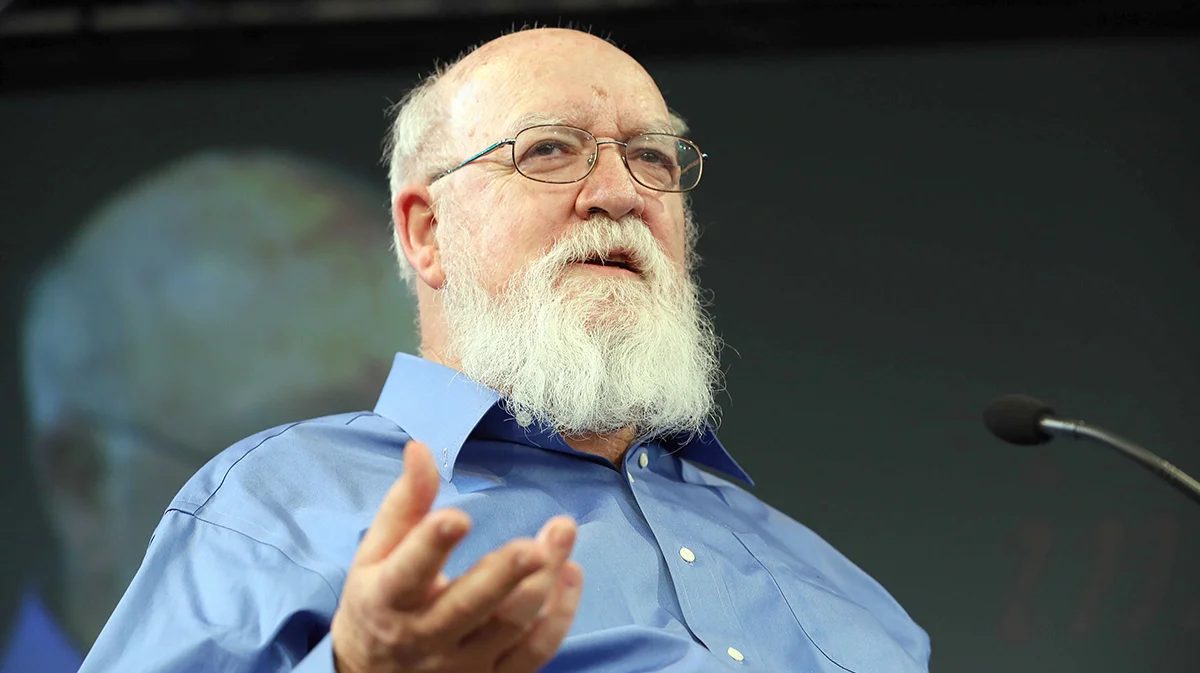
Daniel Dennet at the Literary Festival The Hay Festival, Wales, Britain, May 26, 2013. Photo: Vida Press
The philosopher Daniel Dennet is known to the general public in Russia primarily as one of the four horsemen of the Apocalypse is a representative of a group of new American atheists along with Richard Dokins, Christopher Hitchens and Sam Harris. This company made a fairly noise in the United States, proving that religion as a way of organizing society has outlived its evolutionary age and that humanity needs to learn to negotiate on new conditions. Such a platform for the four was secular humanism.
Dennet presented his rather polite analysis of religiosity in the book “Breaking the Spell” (“Destroying the Spell”), which was never translated into Russian. However, criticism of religion has not become the main subject of his interest. Dennet said: "Of course, I am an atheist, but not an atheist-atheist-atheist." For a philosopher in human life, there were more interesting riddles.
The fundamental work of Dennet Consciousness Explained (“Explained consciousness”) was published in 1991. He gave a naturalistic, based on natural sciences and experiments, an explanation of human consciousness.
Consciousness is extremely important for us people, a cognitive artifact that arose as a result of evolution.
On the one hand, consciousness determines who we are, so we cannot get rid of the discussion about “ourselves”, it is difficult for us to believe that the “I” machine, self, is only a cognitive mechanism created by nature for the survival of our distant ancestors, like the elephants during evolution, a trunk arose. We are proud of our consciousness and measure any cognitive systems, biological or artificial, the presence of this wonderful property (elephants would have done the same if they had an interest in writing philosophical treatises). On the other hand, experimental science leaves no place for secrets: it explores a person’s consciousness as any other natural phenomenon, which Dennet calls for “explained consciousness”.
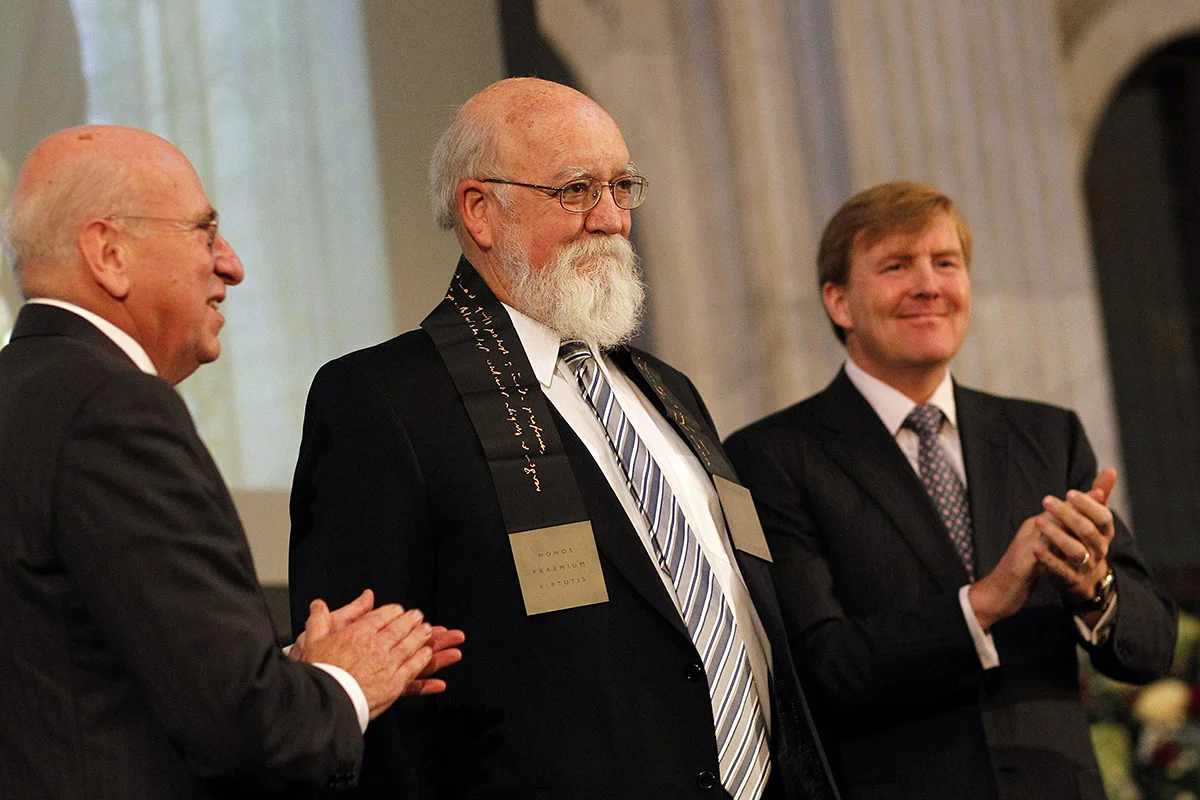
Dennet, who worked for a long time at the Massachusetts Technological Institute, received the nickname "Boston Zombies". It should indicate completely outrageous conclusions that follow from his philosophy:
A person is an illusion created by evolution, human thoughts, feelings and ideas about his own identity - nothing more than a form of adaptation to survival, characteristic of existing primates in groups.
In the philosophy of consciousness, there is the concept of “zombies”, represented by David Chalmers. Such a “zombie” is a person who looks and acts like any other people, but who is completely devoid of the so -called inner world. Dennet did not refuse the nickname: his philosophy suggested that the inner world was reassessed.
The second hero of Dennet, in addition to Charles Darwin (and his evolutionary model of reality), was Alan Turing. The idea of a universal algorithm, a turing machine that is able to perform any manipulations with information, but does not need human consciousness, in Dennet’s works becomes a technological equivalent of the idea of blind natural selection. In order to think, that is, to solve problems of systematizing information, consciousness is excessive, and in some case, a harmful essence. The philosopher cites an example of a chess computer: to try to predict his next move, the human player has three scenarios. Firstly, there is a level of physical analysis, which involves a complete analysis of the system at the fundamental level. This method is good for everyone, except that analysis would require many centuries and huge resources. Secondly, you can turn to the level of “design” : how this chess program is made and how exactly it makes decisions from the point of view of its internal device. The design from the design is less accurate compared to fundamental physics, it is less expensive, but in real conditions it is still too complicated. Therefore, the third scenario is to take advantage of the situation familiar to people with a cognitive analysis of the situation , and attribute certain desires or fears that will make him make this or that move to the chess computer. It is this cognitive machine that lies, according to Dennet, not only on the basis of our game of chess with the machine, but also determines our relations with other love agents, and also underlies our own ideas about ourselves. The philosopher claimed that there is no fundamental difference between attributing desires to the car, man or to himself.
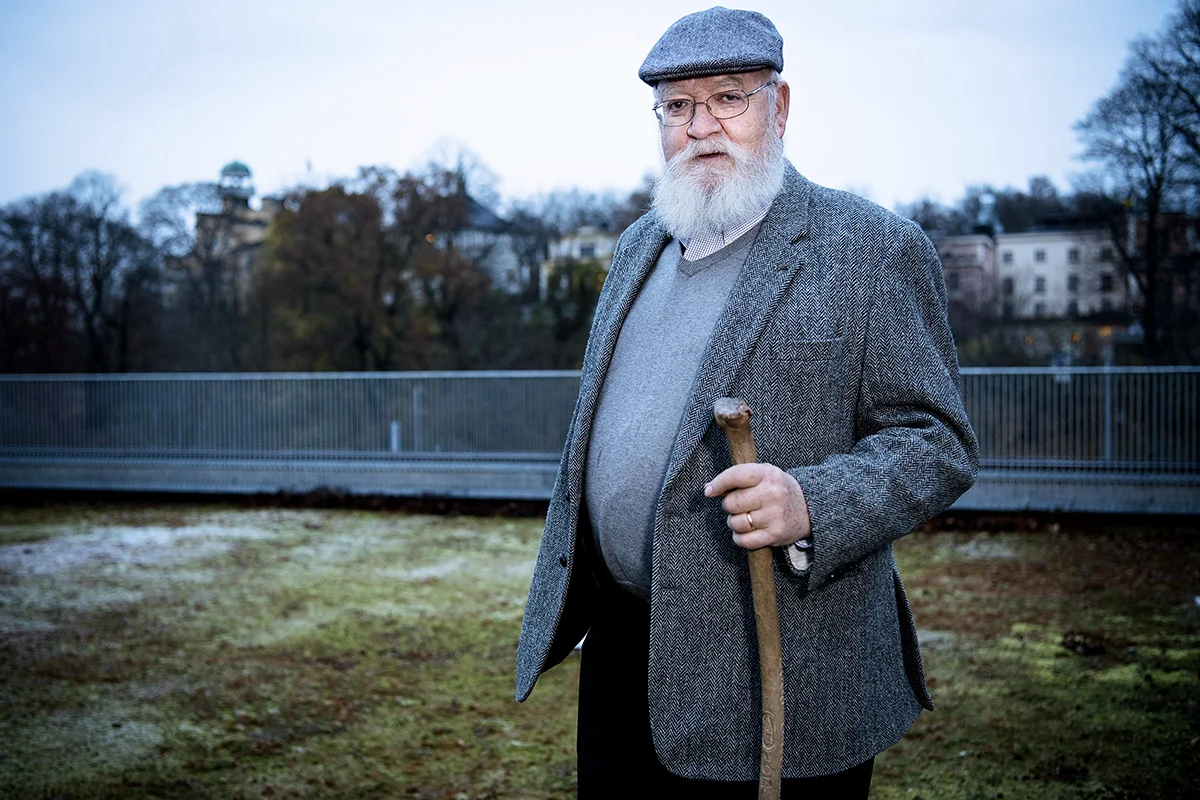
Dennet was a pioneer in the study of artificial intelligence long before modern neural networks broke into the world and the current “spring” in the development of generative linguistic models, such as ChatGPT. At a time when most scientists acted as skeptics regarding the prospects of artificial intelligence, Dennet relied on the fundamental intuition of the “explained consciousness”:
Intelligence is a natural phenomenon that can be modeled and, moreover, can surpass its original, associated with the type of homo sapiens.
Reading Dennet from the point of view of social theory pushes to the conclusion: we live on the last shore of human culture. If there is nothing unique in the human mind, then an honest forecast for the nearest future humanity is as follows: the number of functions that people can perform more efficiently will be minimized. For several years or decades, people (including their creative and existential functions) will be replaced by neural networks that can process the volumes of information for the human brain. We are the latest people, if people understand representatives of the old anthropocentric culture by people, where each action is the result of human intellectual efforts.
However, Dennet's naturalism never led him to misanthropy. On the foundation of the community of human fate, from birth to death, the philosopher, following Richard Rorti, proposed to build an ethical system that is designed to protect the dignity of people as creatures driven by curiosity and the desire to change their life for the better.
Among the latest books written by the philosopher are translated into Russian intuitions pumps (“Pumps of intuition and other thinking tools”), which is dedicated to how to use our imperfect brain to the maximum, as well as the theoretical work of From Bacteria to Bach and Back (translated as a banal “Reason from beginning to end”, which sums up the results of views philosopher for reality.
Dennet died on April 19, 2024 in the United States. The philosopher is quoted on the Internet:
“In order for your life to be happy, find something more than you, and devote your life to this.”
Dennet devoted his life to science and common sense. The philosopher-naturalist treated death not as a great secret, but as a natural course of things. He left behind books and students - including in Russia, where Dennet visited several times. For the first time during perestroika - at the invitation of a graduate of the Philosophy faculty of Moscow State University Raisa Gorbacheva.