
Translated material
Extremism of care
The story of Vladimir Makanin “The Caucasian Plane” about the love of the Russian soldier for Chechen was considered LGBT propaganda and removed from the school curriculum. We tell you what Makanin actually wrote about

Vladimir Makanin "Caucasian captive"
Last week in Russia, the story of Vladimir Makanin (1937–2017) “Caucasian captive” (1994) gained new popularity. It turned out that the text about the “extremist” “homosexual” relations of the Russian soldier and the prisoner during the Chechen war was part of the additional school curriculum for the 11th grade.
Naturally, immediately after the request of the deputy from Fair Russia, Yana Lantratova, “reacted to numerous requests of parents,” he was excluded from there. But this is not the first scandal that arose around Makanin's texts about the Chechen war. In 2008, when his romance “Asan” received the Big Book Award, the writer firmly went to Chechnya from various sides: from the military commander of Arkady Babchenko, and from the Chechen publicist Timur Aliyev, and from the famous critics of Viktor Toporov and Nikolai Alexandrov. The novel caused rejection among participants in military operations. No less prominent figures stood up to protect the prose writer - such as Alla Latynina and Andrei Nemzer. About why Makanin’s prose about the war was ambiguously perceived in the past, and looks strange today, and that “state” indignation with “literary” criticism is related, ”says Sorin Brum.
Extremist love in a mountain landscape
From the Duma rostrum, the young deputy Jan Lantratov severely, inconsistently and with the “old directness” broadcasts about attempts to “enemies” to defeat Russia by penetrating the children's heads. He gets to the Makanin text and either from righteous anger, or for some other reason confuses the name with the “Caucasian captive” of Lev Nikolayevich Tolstoy. The story of Makanin "offends the honor and dignity of a Russian soldier, regardless of nationality." A simple soldier Rubakhin, you see, dared to fall in love with a prisoner Chechen and showed his pernicious passion unscrupulously. Lantratova, of course, for reasons of morality avoids quotation. But if she brought them, the listeners would probably be disappointed with their innocence: they can turn on the imagination - and, without a doubt, are horrified.
“ The soldiers most likely did not know that beauty would save the world, but what beauty is, both of them, in general, knew. Among the mountains, they felt the beauty (beauty of the area) too well - she scared . ” This is the very beginning of the text and a kind of guidance of the sight. Just on the “swing” between the “reality of protecting beauty” and the “reality of the threat” the whole text is built. Criticizing the romance of Asan, Arkady Babchenko remarked: “ War ... is terrible that it tides the soul there. The coating of civilization is very thin, and the ability to feel beauty (the skill under fire is absolutely useless) is the first to leave, and returns to one of the last ... ”However, the psychological“ inaccuracy ”of Makanin,“ who does not know the war at all ”and never fought, partly its strong side.
Not connected by “trench truth”, he can afford to “play” with optics: look at a “peaceful life” at once and at the “military state” (although not on the war itself).
Soldier Rubakhin and his partner Vovka the shooter are captured by a young man-beevik, who is planned to quickly exchange a motorcade for the passage. He is very beautiful, and causes a complex gamut of feelings in the shirt. The joint path, obviously, will not be simple. Firstly, strong warm feelings are hardly a good ally in the war. Secondly, what if the “captive enemy” captivated you yourself? It is important how exactly Rubakhin “burns” behind a long -haired action movie:
“He yearned (Rubakhin delved into someone else's soul). Both of them fell into a nap (trusting), but Rubakhin already felt how longing for the young man again ... sitting next to Rubakhin, he could not worry ... After all, he knows (feels) that nothing threatens him. Moreover. He feels, of course, that he is pretty to him, a shirt ... "Well, well!" - Rubakhin said amiably, trying to cheer up ... Afraid of alarming this half -turn of his face and the amazing beauty of a motionless gaze, Rubakhin only slightly touched his fingers of his thin cheekbone and, as it were, corrected the curl, a long locking that hung along his cheek. The young man did not pull his face. He was silent. And it seemed - but it might seem, - barely perceptibly, answered Rubakhin's fingers with a cheek. ”
What is it, if not extremism?
Or another egregious example of criminal male proximity:
“The frozen Vovka also moved to them and buried his face, his shoulder in the back of the shirt. And on the side, a prisoner, a soldier, beckoning the soldier with a sweet spot of heat, clicked on the side. So the three of them, heating each other, they reached the morning. ”
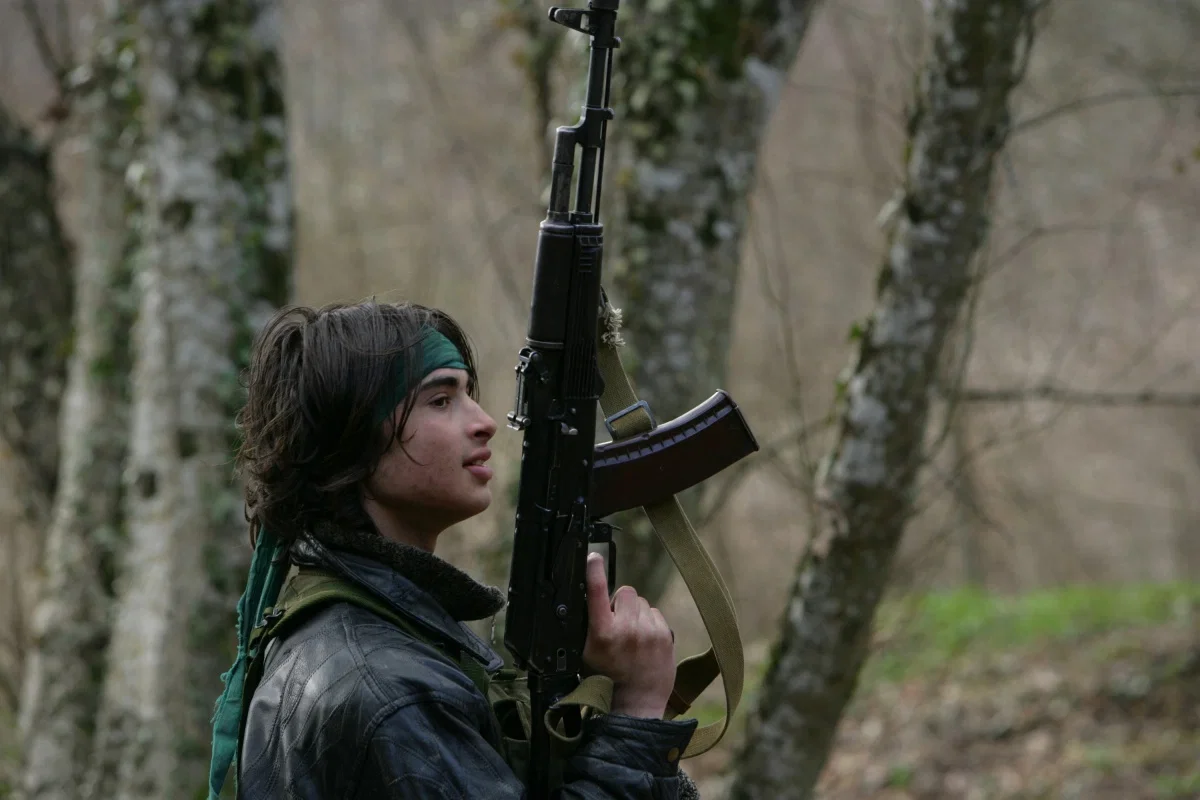
The “Caucasian” showed a very quiet form of love, which is based on “heat transfer” and concern. It is no accident that Rubakhin gives the young man woolen socks connected by the mother. No fatal passion, a minimum of sexual attraction. This is not the ardent love of the first months of the relationship, but the calm and strong “family” love that opens the window into peaceful life. Caring here is a synonym for protection, the result of overcoming role -playing relations (“your / alien”, “ruler / subject”) and manifestations of the sensitivity of the living to the living. On subtle descriptions of such communication, both the anti -war pathos of the story and its conflict are kept. What will win: the threat will “produce” violence or beauty will generate care? The finale, as is the case with Makanin, is solved in the spirit of the ancient Greek tragedy. Having almost an ambush to the militants, the frightened Rubakhin kills the young man so that he does not give them out.
A bad good romance
The winner of the “Big Book” Roman “Asan” is the case when a serious author swung on a serious topic and in places coped with her brilliantly, and in places did not cope at all. The book was reproached for the facelessness, artificiality, tortured language, and especially in a careless attitude to texture. The literary critic of Alla Latynina meticulously collected the “non -priests”:
We are talking about the war for scarce gasoline, while there was no deficit; Mobile communications spread in Chechnya later; They could not bring the military to the station in Grozny, since it was bombed to the events in the book; Showing the militants a naked ass, as the recruits drunk to freeze do, and it is impossible not to get a bullet in this very ass - the Caucasian will not endure such an insult, etc., etc.
It is significant that Latynina "Asan" liked it.
The criticism of the journalist and military commander Arkady Babchenko was reduced to the long -standing “trench” thesis: “Only the author who knows firsthand has the right to write about the war.” “ It is pointless to disassemble all the asian non -Urazians, because they are not that they“ meet ” - the novel on them is built completely. There is not a single one in contact with reality in Asana , ”he writes; And closer to the end he argues “to think”: “ What do we want to comprehend from our past? Do we want to know him or want to eat inventions? What does my country want to know about its war? "
As a blurry, Makanin’s “picture” turns out, shows at least that critics cannot understand which of the Chechen wars we are talking about. According to Babchenko - about the first, according to Latynina - about the second. But it seems that the time of the Assan is the gap between them (there is no war, but there are clashes - there are).
If the pronounced audience expects an exalted myth from the writer about the hero-defender of the Motherland, then a significant part of the “independent” is ready to perceive only documentary texts. In this sense, it is funny that both the “opposition” critic of Babchenko and the “state” Lantratova are determined by dogmatic expectations from the literature about the war. And Makanin (and just Latynina paid attention to this) solved a completely different problem. And in the "Caucasian Polish" and in "Asana" he wrote a parable. But in the novel he also created the image of the post -Soviet time, grabbing one of its main pain points. The war in Chechnya is not interested in the prose writer in itself, but as a sign of the era.
Major Alexander Sergeyevich Zhilin sells a “scarce” fuel to the warring parties, and a house for his wife and daughter builds for the proceeds. “ Not that war to rush to life ”, “ Where are you going, shit in camouflage, when is your wife and daughter at home? .. War is separate. You are separately , ”the hero explains to yourself. The first acquaintance can hardly be called pleasant. Before us is a swivel corrupt official, a person who comprehended the essence of the “war-cuping-producers” and has mastered its rules. But it is no coincidence that Makanin endowed the protagonist with the name of the positive character of Tolstoy.

The war in the novel is controlled by the market. The writer introduces the fictitious deity of the war - Asana. And the formulas “Asan requires blood” and “Assan requires money”, repeated in the book with a refrain, explains the presence of two hands in this gigantic predatory bird.
Soldiers pay for life with blood. Guide is money when possible. Women are bodies. It is significant that perhaps the most terrible scene of Asana is not a fight or torture at all, but a video of a video with a captured liberal journalist (the name is not called, but it is clear that it is about Elena Masyuk ). Obviously, the heroine will be saved (as in life), and tens of thousands of others, including young soldiers, will die.
One of the central plots in Asana is a visit to the hero of the father and dialogues with him. Then Makanin introduces another quasi-mine. The father dreams of the revival of socialism in Russia through the Chinese occupation, drawing the image of the “liberation” by the Hunweibons of the tomb of Lenin-Christ. It is here, in dialogs, that the character of Zhilin is implicitly revealed. Logically, the major should react to this trep with cool irony and irritation, but in fact he sympathizes with his father and yearns for warm stories about his life, which, of course, will not hear. Zhilin regularly helps the soldiers' mothers to redeem captive soldiers from the pits. Yes, and on this is welded. But gradually it becomes clear that “personal benefit” for him is only a form of disguise. Zhilin is afraid to admit to himself that he sympathizes with the "Jammines." The relationship of the major with the shell -shocked, whom he harnesses to work for himself, is also built. Toward the end, it is clearly clear that his warehouse as a place of operation is only a cover, and in truth is an almshouse.
The entire second half of the book is built on the major attempts to achieve the demobilization of two “contours”, one of which, at the sight of a pack of money (consumer attitude), flows into uncontrolled rage and begins to fade from the machine gun. This information is enough to predict a new “ancient Greek tragedy” in the end.
“Asan” is a detailed continuation of the “Caucasian captive”.
The controversial, “good bad” Zhilin is the Hero of the Time, notable for the fact that alternative values ripen in it.
They are based on the same as in the story, the love care, which is actually protecting the living (perhaps the most reliable antidote from both war and totalitarianism). The death of the major at the end only seems to be a defeat from the era. In reality, this is a defeat of the era itself, which, as now can be seen, was precisely predicted by Makanin.