
Translated material
Dead-affirming Self-Help
About the book of Kostya Braudatan “Dying for ideas. About the dangerous life of philosophers "
Philosophers are rarely killed for thoughts (at least for the reason that they usually do not take seriously)-however, sometimes they still have to make a choice between fidelity to their ideas and preserving life. Those who make a choice in favor of the first are devoted to the book of Kostya Braudatan. Roman Korolev tells about this curious work of the American philosopher.Starting from February 24, 2022, we were all in the face of the advancing barbarism, violence and lies. In this situation, it is extremely important to preserve at least the remnants of culture and support the values of humanism - including for the sake of the future of Russia. Therefore, the editorial office of Gorky will continue to talk about books, reminding our readers that the world remains in the world and fiction.
Kostika Bradatan. Dying for ideas. About the dangerous life of philosophers. M.: New Literary Review, 2024. Translation from English by E.V. Musikina. Content . Fragment
I Will Choose Death
Spiritual Front, Death
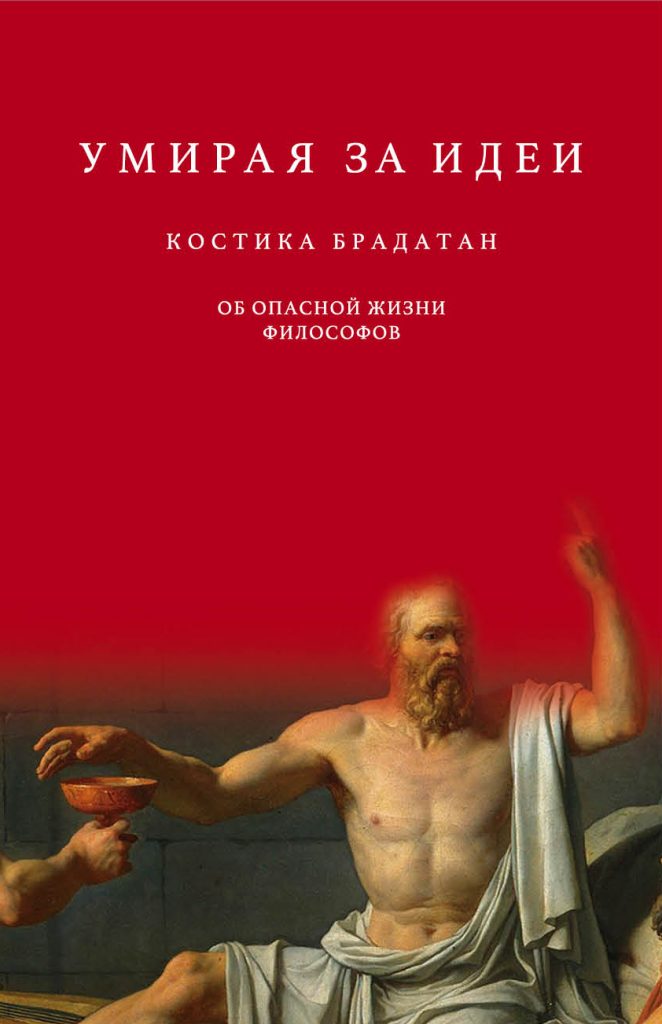 The American philosopher of the Romanian origin of Kostik Bradatan in his small book “Dying for ideas”, written in 2015 and recently translated into Russian, sets his task to do no less “what no one has done earlier: to consider the dying bodies of philosophers as a training ground of their thinking.” Philosophers who went for the sake of their ideas until the end become martyrs in the eyes of subsequent generations, and without talking about them, understanding of death as one of the central problems of world philosophy is hardly possible.
Bradatan proposes to start this conversation with the appeal to the “quiet revolution” that occurred in the history of world philosophy thanks to the works of Pierre Ado - and the Books of Foucault followed by him. At the end of the twentieth century, ancient philosophy was revealed for us as “the art of life”, a craft, which must be practiced every day, engaged in slow, but steady self -transformation. Various techniques for changing yourself or spiritual exercises, as ADO showed, have been developed in all basic philosophical schools of antiquity. Philosophy, as Braudatan writes, “is really performive; She is not just what you are talking about, but above all what you are doing. ”
However, among philosophers, as he adds, one should learn not only the art of living, but also the ability to treat death correctly. The life of a person who will avoid any mention of death will be destroyed by the first blowing from the afterlife; On the other hand, if there are too many deaths at your table, you risk her poisoning. According to the thought of Montean, to which Bradatan refers, "in order to make life viable, it is necessary to find a place for death in it." To live well, you need to not only realize the presence of death, but also tame.
In this part of the reasoning of Bradatatan, both meaningfully and stylically (the book is written in a nomadialist with a language, and the author analyzes in detail each concept used in it) can be compared with the philosophical Salf Help. However, unlike such a literature, which is usually a life -affirming character, Braudatan’s book was more appropriate to call “Death -affirming”, because his chosen topic for reasoning is closer to ARS MorienDi than to learn how to transfer everyday hardships from the Stoics.
The main characters of his books, however, went further - not just to tame death, but to turn it into his last performance: "Living, carnal, sometimes a bloody performance."
These heroes are such.
- Socrates, whose story to the reader, think, is known.
- The philosopher and mathematician Gipatia, who lived in Alexandria of the IV-V centuries, a representative of pagan neoplatonism, who, as a result of the conflict with the patriarch of the city, was torn into pieces of a crowd of Christians.
- The founder of utopian socialism Thomas Mor, who refused to take the oath of the dominance of the English monarchy over the church and beheaded in 1535 in the London Tower.
- In 1600 at the stake, Jordano Bruno alive, who did not want to renounce the eight heretical points of his teachings, which included among other things the approval of the use of magic, the denial of the divinity of Christ, the faith in the relocation of souls and the multiplicity of the worlds.
- The Czech phenomenologist, student of Edmund Husserl Jan Patochka, who participated in the creation of the dissident movement of the Charter 77 and died in 1977 from an apoplexy strike in the Prague hospital after the 11-hour interrogation of the Czechoslovak secret police.
As secondary characters in the vastness of the book, Simon Weil arises, actually freezing himself with hunger of solidarity with people who suffered due to a meager soldering in occupied France; Michelle Montaigne with his composition “that philosophizing is to learn to die” and Boels, writing a treatise “On Consolation by Philosophy” in imprisonment before a brutal execution. The “seventh seal” of Bergman is read through the Catholic philosopher Paul Landsberg, who was thinking about the religious sense of dying, and the story “The Death of Ivan Ilyich” by Leo Tolstoy is considered through the prism of the philosophy of Martin Haydegger and his reasoning about the unhustness of human being.
Braudata distinguishes several levels of approaching the philosopher to death. At the first, when the philosopher is just getting acquainted with death, it represents for him only a theoretical problem or a difficult situation that should be considered. Her shadow does not hang over the activity of the philosopher, since the end of the earthly existence seems to be an uncertain future. At the second level, death directly contacts the philosopher’s body, there is nothing more abstract in it, and “if the philosopher cannot cure himself from fear that he, like any living creature, experiences, faced with the inevitability of his extermination, then according to his own standards his philosophy is useless.”
In the case of philosophers about whom Braudatan writes, death became the climax of their philosophical biography; an event without which she would seem incomplete. However, in addition to the act of violent and brutal death, a philosopher is needed by someone who will preserve his biography for descendants, having built a coherent and integral narrative from him: “There would be no Socrates without Plato, there would be no Jesus Christ without the gospels.” The storyteller’s work obviously is not to write down everything that he knows, but in the murder of “alive, permeated by the contradictions of the figure of the philosopher and turning it into a heroic (literary) character”. Finally, the dying philosopher needs an audience that will be susceptible to his ideas - and even if this audience at the first stage will applaud the executioner, then it will spread the narrative about his heroic death.
When these conditions coincide, the philosopher turns into a martyr. An unshakable commitment to his image of thought acts for him the same as faith in God and the need to save his soul - for a religious martyr and fidelity of the chosen ideology - for a political martyr.
If we talk about the social significance of the death of the philosopher, then Bradatan proposes to use here the Girardian theory of the “scapegoat”, according to which an atoning sacrifice is the mechanism of deliverance from violence. This victim becomes a driver of social changes, and if initially it was completely powerless, then, having died, "is being built to an unprecedented level of power."
Rene Girard as “chosen” victims identified prisoners of war, slaves, disabled people who are not married, children or adolescents; Bradatan proposes to attach to this list of categories of philosophers located on the sidelines.
To make the sacrifice more effective, it is often carried out in a deliberately brutal and orgiastic form: the execution of Hyppatia, which was torn by Christians of Alexandria into pieces, later scattered around the city, can serve as the best example here. After the sacrifice made, society is fastened and cleaned. Moreover, sacrificial death can become the basis for something fundamentally new: as, for example, in the case of the murder of Rem, which begins the history of the eternal city.
It is no coincidence, Bradatan notes, some of the sacrifices of philosophers are perceived by us as the founders of whole philosophical traditions. Hippathy - as the founder of feminism; Bruno - anticlerical free thought; Socrates - all of Western philosophy as such. At the same time, Braudatan agrees that the emerging tradition can seriously differ from the ideas for which the philosopher has actually died. So, we can hardly judge how Hippathy would react to such a phenomenon as modern feminism, and to understand what the built -in reward Jordano Bruno, built into the enlightenment, died, began only in the second half of the twentieth century.
Here I would like to note that, in order for us to perceive the death of the philosopher as the final performance, who freely or involuntarily became a continuation of his ideas, the latter does not have to give our body to be torn to disseminate the conditioned “Roman authorities”. So, Michelle Foucault becomes one of the first public victims of AIDS, which looks like the logical end of his studies of the relations of power and sexuality in theory and in practice; The Christian anarchist Ivan Illich fighting with the medication of society dies from the brain tumor, which he refuses to operate due to the risk to fall into a vegetative state; Nietzsche, falling into a dying insanity, casts a gloomy shadow of irrationalism to the corps of his work. Those who want to continue this row with a reflection to the “ Book of Dead Philosophers ” by Simon Khimon, who incorporated two hundred stories of varying degrees of instructiveness about the deaths of representatives of all kinds of philosophical schools.
The design, built by bradatan of five thinkers of the far from the first row (not counting, of course, Socrates) testifies in favor of the fact that philosophers are not too much burning to become martyrs. Moreover, the selection of figures included in this design looks relatively arbitrary. The author, of course, may argue that “the civic position of the path, like Socrates, not only corresponded to his philosophical views, but represented their climax and the inevitable end,” however, he was clearly tortured for phenomenology, but for his political activity. In the same way, the reason for the deadly stubbornness of the Mora, who refused to recognize the divorce of Henry VIII with Ekaterina Aragon and the creation of the Church of England, was not so much in philosophical views as in his Catholic faith. On the other hand, the victims of the Nazi and Stalinist regimes are not included in the number of philosophers who died for ideas - since their death, in all evidence, does not suit Braudatan with his insufficient “voluntariness” (although here we can argue about the extent to which the rest of his heroes became their conscious choice).
Be that as it may, during the period of total cynicism and moral degradation that happened before our eyes with a considerable number of public intellectuals, a reminder that your life should live (and complete) in accordance with the ideas you have chosen, sounds quite refreshing. To live in full agreement with their ideas - and, if necessary, to die for them - I would like to wish Kostika himself Braudatan, although, what exactly is the circle of these ideas (with the exception, in fact, the appeal to philosophy as the art of dying), we are far from difficult.