
Translated material
Will Russians cease to issue passports abroad?
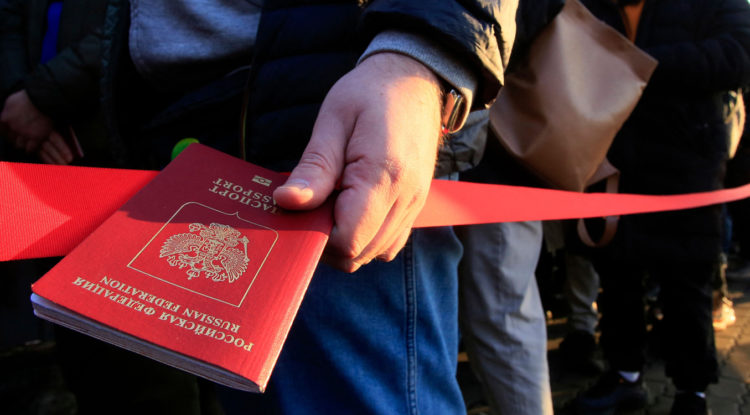
Is it true and what can be done right now to protect yourself in the future
On the morning of April 25, New Gazeta published news that Russians abroad can stop issuing new documents. The Russian Foreign Ministry immediately denied this news, in independent media it also caused serious doubts. We say that it is known about the potential ban on the exchange of documents and how Russians can protect themselves from the “Belarusian script” now.
In order not to miss the main materials of the "cold", subscribe to our Instagram and telegram .
What is known
At the disposal of Novaya Gazeta was supposedly a draft order of the Ministry of Foreign Affairs of Russia, which implies a “temporary suspension of passports, the provision of notarial services, services for legalizing and demanding documents, resolving citizenship issues.” The “new” did not write about how the editors received this document and from the entire draft order was demonstrated only a fragment.
According to the "New", the ban is proposed to be introduced already in 2024. According to this project, the Russians who are abroad will be forced to return to their homeland to receive documents, the term of which has expired, primarily passports. Also, in the case of approval of this (or similar) order, Russians will not be able to draw up notarized documents in diplomatic missions abroad.
To a request to “New” with a request to clarify the details of the order of the Ministry of Foreign Affairs, but shortly after the publication of the material, he issued an official statement that “this information is absolutely not true and is frankly provocative.” The Foreign Ministry also noted that all projects developed by regulatory legal acts, including departmental orders, should be published on the federal portal and be publicly available.
True or not
The lawyer, creator and manager of the Ark project , Anastasia Burakova believes that the Russian authorities are unlikely to go to such a step and order, most likely fake. “Of course, you can expect anything. But a large number of Russians live abroad, and not all of them people with opposition views [who are afraid of trips to Russia]. The “elite” abroad has two citizenships, ”Burakov commented on the situation. The Committee “Civil Assistance” believes that, while there is no ready -made bill, these are only rumors and there is nothing to talk about.
The publication "Mediazon" in the telegram channel "Mediazona. Exclusive ” said that the same“ draft order ”was sent to the editorial office, as well as Sotavision and, probably, to other publications on April 18.
“I think this will interest you. I am an employee of the Ministry of Foreign Affairs, and I needed to transfer such a document to the proceeding. In our department, it is said that this is either revenge to the relocates, or to return them to replenish the valiant ranks of our army, ”the Mediazon quotes the message that they received from the user named Valentine.
He did not send any evidence of the authenticity of the document, he could not verify his identity, and since then he did not go to his account.
The agency writes that he received the same document through the feedback bot for last week. The editors showed this “draft order” to the former adviser to the representative office of the Russian Federation at the UN in Geneva Boris Bondarev - and he noticed several oddities in the text. For example, in the introductory part, the year of the adoption of Law No. 127-ФЗ “On Amendments to Certain Legislative Acts of the Russian Federation” is incorrectly indicated (2024 instead of 2023), and the document does not have a reference to the consular charter of Russia from 2010, which directly regulates consular activities.
How to protect yourself for the future
- If your current passport expires in the next few years, it is better to make a second foreign passport in advance. The new passport for 10 years can be made in any diplomatic representative office of the Russian Federation in addition to the existing one - both will be valid.
- To issue a power of attorney for a long validity period with broad rights to a person in Russia: for interaction with state bodies, receipt of documents, receiving mail, action with a telephone number in communication salons. So your representative by proxy in Russia will be able to get the necessary documents in the future. The Ark project has a detailed instruction on how to issue this power of attorney in different countries.
If the draft order is not a fake and the relevant law is already being prepared and will be adopted in the near future, then the Russians living abroad risk soon with invalid documents in their hands. In this case, Anastasia Burakova advises, you can file an application for the impossibility of receiving a national travel document to the migration body of the country of residence. It will be necessary to provide evidence that the travel document (passport) cannot really be obtained. Having submitted an application, citizens with expired passports will be able to apply for “gray passports” - travel documents that some European countries issue in such cases - for example, Germany and France. True, this happens quite rarely, Burakova notes.
Another option is to try to go to the shelter in one of the safe countries and get a “blue” refugee passport, but for this you need to prove the risk of persecution at home. It is also worth considering that each case is considered individually - as Burakova says, in the case of a person’s refusal with an invalid travel document, most likely, they will be sent to the country of citizenship.
The difference between “blue” and “gray” passports is in the grounds on which you request them. The validity depends on the laws of a particular country.
Burakova also draws attention to the fact that the refugee “blue” and “gray” passports have many restrictions. For example, you can move freely with them to the EU countries and several other countries - for example, Montenegro and Georgia. In other countries, a visa or other permission to enter, and somewhere such a passport may not be recognized at all.
Another difficulty is to wait for a decision to issue a “blue” passport for several years. In 48% of cases, the expectation is more than six months, notes the project “to be precise”.
Another aspect that needs to be taken into account: the EU countries after the outbreak of war in Ukraine tightened the requirements for the provision of asylum. On the average of the European Union, the share of positive decisions for Russians in 2022 amounted to only 33%. Such statistics are given by the project “to be precise”: most often, the Russians were approved by the Russians in the Netherlands (87%), Austria (65%), Italy (61%), Norway (60%), Switzerland (58%) and Spain (53%). In 2022, Greece, Denmark, Slovakia, Luxembourg, Croatia and Hungary were made in 2022.
According to the latest UN data, about 11 million Russians lived abroad in 2021, but after the outbreak of war, about 800 thousand people left the country. Only about 155 thousand of them received temporary types of residence in Europe, Turkey and the CIS in 2022.
"Belarusian scenario"
The ban on issuing documents abroad is already operating in Belarus - the corresponding decree was signed by Alexander Lukashenko on September 4, 2023. Belarusian emigrants who have ended the validity of passports are now forced to live with expired documents-they cannot return to their homeland as many Russians, cannot due to the risk of repression. (In places of imprisonment in Belarus, there are now almost one and a half thousand political prisoners.)
Belarusian oppositionists thought about creating an alternative passport even before the decree on the ban on the exchange of documents was adopted. “We began to work on the passport of Belarus a year ago, and initially he thought as a document indicating that the person is Belarus. Our idea was more symbolic, ” said the leader of the Belarusian opposition Svetlana Tikhanovskaya in an interview with Novaya Gazeta. Europe". Her team managed to agree on the production of these documents with a Lithuanian private company - a hologram, watermarks, heat -sensitive ink will also be used in the passport, the document will also be biometric.
In September 2023, alternative Belarusian passports were discussed at sessions of the European Parliament, and their approval was supported, for example, a deputy from Lithuania. As he told Novaya Gazeta. Europe ”a representative of the United Transition Cabinet of Belarus of Foreign Affairs Valery Kovalevsky, one of the European countries agreed to share her three -letter country code, which is applied to the passport pages and shows the owner’s citizenship. What kind of country decided in this way to help Belarusians, until it is revealed.
It is still incomprehensible whether it will be possible to implement this project - the Tikhanovskaya team needs to be recognized as at least in every country in the European Union.