
Translated material
Know how to read
Reading is the main difference between man and the rest of the animal world, from all nature. Library of Alexander Minkin

Photo: Alexey Dushutin / "New Gazeta"
18+ This material (information) was produced, distributed and (or) sent by foreign agent Minkin Alexander Viktorovich or concerns the activities of foreign agent Minkin Alexander Viktorovich.
Some scientists read the old books Professionally. The philologist is interested in the then spelling, the historian - what kind of Ivan the Terrible’s wife gave birth to the unfortunate Tsarevich Demetrius, the chemist is completed, what kind of poison Socrates were poisoned and what the letter that Huttab did not read.
We (ordinary people) read old books about ourselves . In the "Three Musketeers" the boy is interested in courage and valor, betrayal and cunning, love and betrayal, greed and generosity. Man is interested in the feelings of the heroes, not the cover of the camisole. We read about ourselves, about our time and our country, otherwise, few books would read old books.
If your TV is disconnected and the Internet disappeared - do not be upset, light a candle or a light, take a book from the shelf, there is everything and is very clear.
Want a play about the meaninglessness and mercilessness of the 21st century? She is ready. It was written 424 years ago.
**HAMLET.
What are these troops? Where is the campaign? **
** Colonel.
Tell the truth and without additions,
We want to take a piece of earth
Which is only rich in name.
I would not have given three chervonets for him,
Yes, it will not give income anymore
Neither we nor Poland, if they sold. **
We recall especially picky readers: there were no other countries between Poland and Russia in Shakespearean times. Before Shakespeare's eyes was a map that you see here.
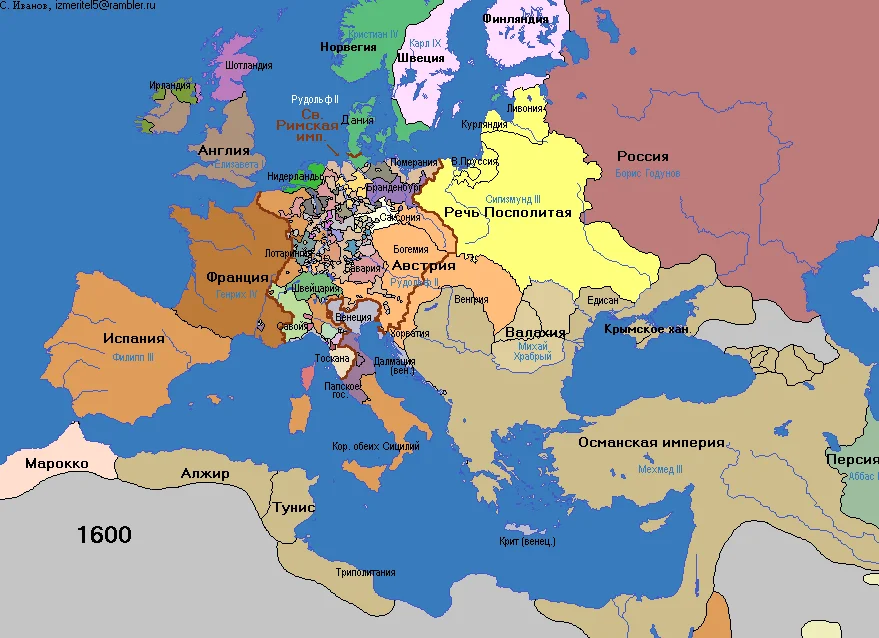
And Hamlet continues the conversation with a real colonel.
**HAMLET.
Poles, then, will not protect him. **
** Colonel.
Oh no, they have already strengthened him.
A strong garrison is already pulled there. **
**HAMLET.
Two thousand souls, tens of thousands of money
It is not a pity for some hay Klok!
So during the years of external well -being
Our contentment is of death
From internal hemorrhage.
Here it is, the abscess of contentment and peace:
Breaking inside, he does not make it clear
Where did death come from.
Here is the ulcer of prosperity and the world:
She burns inside when outside
There are no reasons for death. **
Shakespeare. Hamlet. 1600
Read the last remark carefully: "So in the years of external well -being / our contentment comprehends death / from internal hemorrhage." Here every word is our portrait.
And then no better: “The abscess of contentment and peace” - is this not about us? Not about the society of consumption, stability and indifference?
And the "ulcer of prosperity" , which burns inside and pushes to arrange a small victorious military conflict, although "there is no reason for death outside."
Learn this text, go on stage, say with an accurate and strong feeling - a storm of applause is provided to you.
From the scene you can read prose. For example, Maupassana. At the end of the 19th century, he was considered writer No. 1 in Europe; Leo Tolstoy admired, and what was critical of.
Here Maupassant writes about the war and the army:
... to unite in four hundred thousands of human herds, to march day and night without rest, not to think about anything, not to learn anything, not to read anything, do not bring any benefits to anyone, rot in mud, sleep in slush, live like cattle, in continuous dullness, rob cities, burn the villages, and then meet with the same same accumulation On it, to create blood lakes, plains of piled bodies mixed with wet and stained ground, pile up piles of corpses and remain without arms and legs, with a broken skull, without benefit for someone to die somewhere in the field, while your old parents, your wife and children die from hunger ... The people of war are a distress of the world.
Maupassant. On the water. 1888
Since the time of Shakespeare and Maupassant, technology, as everyone was enthusiastic, stepped forward. You can even say up. Toynbee wrote something about these achievements-perhaps the greatest historian of the 20th century.
The bombardment is illegible in nature.
Even if its intended goals are military facilities (that is, enemy troops, fortifications, communications and plants that produce weapons or various types of military equipment and equipment necessary for the enemy’s troops), it is still actually impossible to lose the bomb on the legitimate military goal without at the same time not to kill and not injure many civilians, not destroy and not damage civil property.
Moreover, the warring party, which resorts to the use of the Air Force, constantly experiences the temptation under the pretext of defeating military facilities to deliberately terrorize the civilian population of the enemy country in the hope of undermining the morale of the civilian population and disorganize his life to such an extent that the enemy troops are paralyzed, and the government put to his knees.
***A. J. Toynby.
War: changes in its character and in relation to her people.
The second half of the 1950s ***
What comments are needed here? As Ivan the Bezdomny said: "Take this Toynbee, yes for three years in Solovki." But Toynbee (unlike us) is in places much more distant, and it is impossible to extract him from there in no way.
Gathered Alexander Minkin