
Translated material
The murder of a Japanese deer
In Russia, the film-prize of the Venice festival “Evil does not exist” from the Oscar-winner Ryusuke Hamaguti was released. We tell you why it is worth paying attention to this quiet eco-entry

Khan (Ryo Nisikawa), living in the village of Mizubiki near Tokyo. Photo: Pandora Film / Neopa, Fictive
The master of meditative conversational cinema, Ryusuke Hamaguti, imperceptibly for everyone, turned from an original author, whose films are attracted only by regulars of festivals, one of the main Japanese directors. In the post -shaped 2021, while the film industry recovered from the pandemic, Hamaguti released two significant paintings at once, which were successful in both critics and the general public. First, the anthology “Randomness and conjecture”, awarded the “Silver Bear” in Berlin, was released on the screens, after which the premiere of the drama “Sit the wheel of my car” took place in the Cannes, which received a prize for the best scenario, and then Oscar as the best film in a foreign language. Three years later, already in the status of the superstar of author's cinema, Hamaguti returns with the film "Evil does not exist." And, it seems, she closed even the most devoted fans of his work.
The idea of the film was born to the director almost by chance. Once, a composer Eiko Isibashi, who wrote a soundtrack to “Sitting the wheel of my car”, asked Hamaguti to take a dumb video sequence for her live concerts. As a result, Ishibasi's amazing music inspired the director who did not have any script in the hands of the creation of a game full meter. Before us is the rare case when music gave birth to a movie, and not vice versa. It is no wonder that the picture that arose under such unusual circumstances turned out to be the most extraordinary in the whole work of Hamaguti.
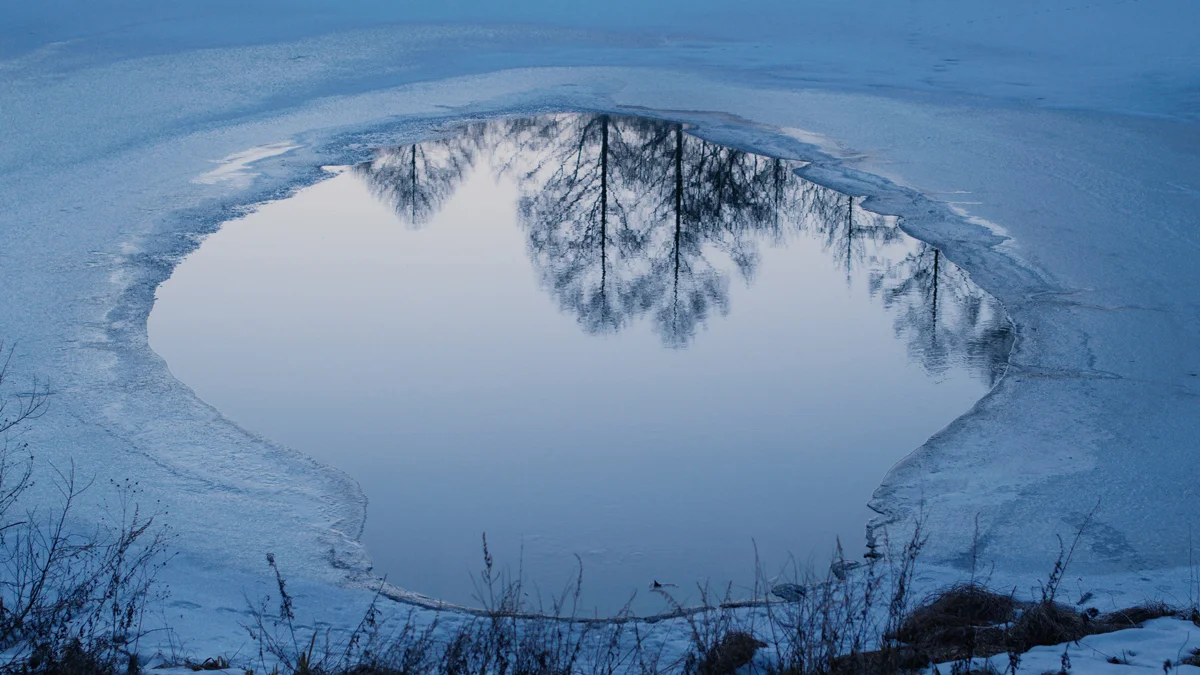
The first about ten minutes to the viewer show the branches of trees captured from the lower angle, and the violin is dramatic dramatically. There are no people in the frame, and nature is the main character, which is fascinating and scared at the same time.
Poetic opening unexpectedly breaks off and the audience is still introduced to the representative of the human appearance - the silent handful of Takumi, so insignificant against the background of a majestic forest.
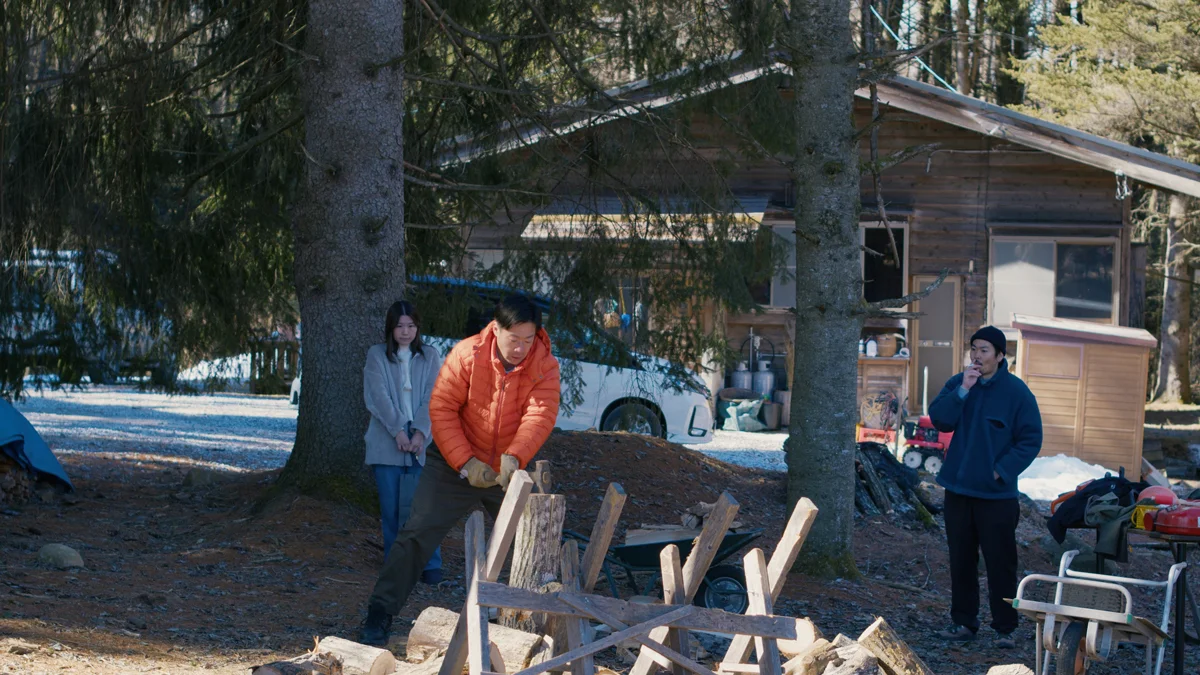
Every next day of a closed hard worker, living in the outside of the outside world, is similar to the previous one. In the morning, he goes to the forest, where he thoughtfully chop wood and collects spring water for the local lapshitina, and then goes to school for the little daughter Hana. The scattered Takumi often forgets about the last point, because of the girl he has to return home on his own. In the evenings, an exemplary introvert is spent in a rural house, where he silently sits at a table in a circle of loved ones. The secret of the past man is discovered only thanks to the photograph of his wife, twice falling into the camera lens. What exactly happened to her will not be told. She will not even be mentioned. But everyone understands everything without words.
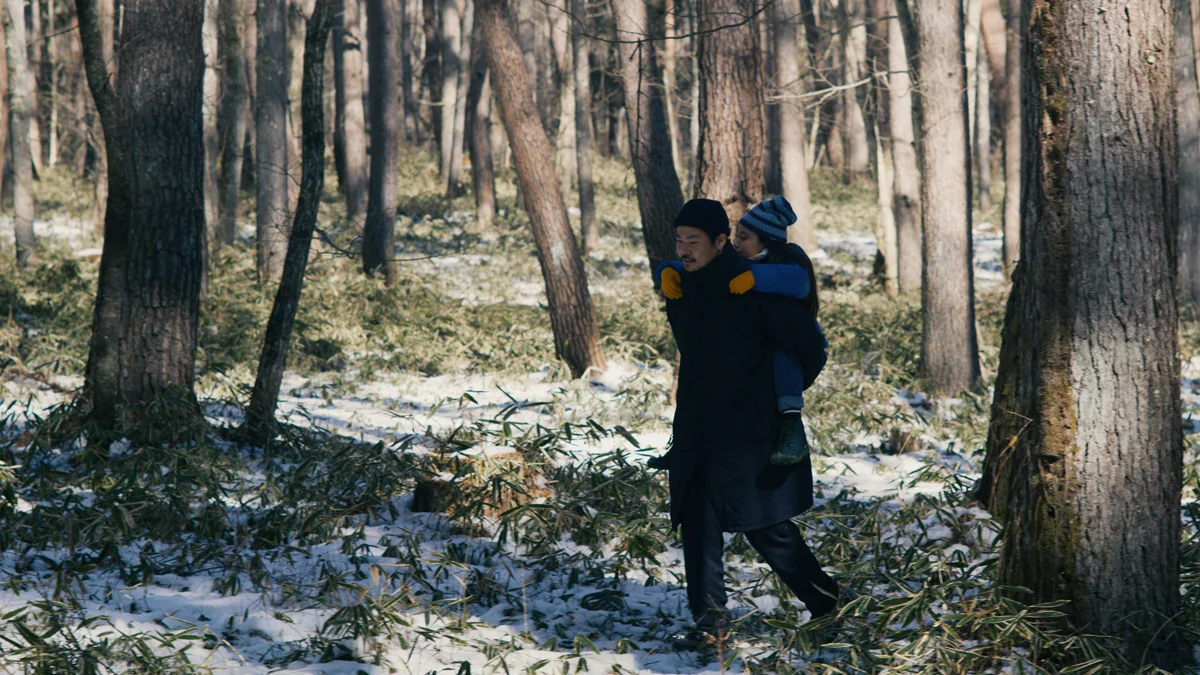
The role of Takumi was played by the debutant of Hitoshi Omik, who was a member of the filming team of the film “Accident and Guess” and was engaged in the search for locations. Then Hamaguti periodically asked Omsk to play a couple of scenes to better understand how to build a frame. The director remained so impressed by a movie genius ( expressiveness in the frame. - Approx. Ed. ) Of his employee, that without a shadow of doubt, he approved him to the main role in "Evil does not exist." And this is a sniper hit in the image. The Omika is natural in every movement, and conveys all that pain that tears his character from the inside with just a glance.
At first, “Evil does not exist” and really looks like an abstract video unusual director. The scrupulous demonstration of the routine Takumi is much closer to the so -called “slow cinema” in the spirit of Love Diaz, Jia Zhanke and the Apichatpon Virasetakul, rather than the unhurried, but purely conversational drama of Hamaguti.
However, after half an hour, an almost plot of spectacular personnel suddenly turns into an eco-drama, which is fully built in conversations.
Takumi learns that not far from the settlement it is planned to build glamping - an expensive tourist complex for wealthy citizens. The action is transferred to the assembly hall, where a hot discussion unfolds between the representatives of the developer who arrived from Tokyo and dissatisfied residents. In this phenomenal scene, shot by two static cameras, it is fully manifested by what the whole world fell in love with the Khamaguti movie - filigree dialogs. Through verbal skirmishes, perhaps the central conflict of the tape is revealed - the conflict of the city and the village, civilization and nature. The hired speakers, without really understanding the issue, try to convince the villagers that the construction of glamping will only benefit them: they say, the construction will attract tourists to the hinterland and at the same time increase the profit of the local institutions. The provincials, on the contrary, rightly complain that the construction of the complex will cause unauthorized harm to the environment. In their opinion, the septic tank of the river established where it got, which adversely affects not only the inhabitants of the village, but all the settlements downstream. In turn, the wild deer living in the forest will inevitably penetrate the private territory, and the absence of round -the -clock protection will lead to the fact that the guests will begin to burn bonfires and generally do everything that will lament into the head.
The contrast between the city and the village is emphasized by an unexpected mounting transition: after the end of the discussion, the events suddenly move from the quiet hinterland to the metropolis, the noise of which knocks down the hypnotized viewer from the feet. Diligently avoiding banal division into white and black, the director switches to the point of view of uninvited guests. Under the impression of Takahashi’s business trip and Miyuzumi - the same speakers - are trying to reach out to their greedy boss so that he takes into account the opinion of the villagers. But the logic of capitalism, of course, wins. The most important is Takahashi's feedback and Miyuzumi from Tokyo to the village. Through the branded for Khamaguti, an unobtrusive conversation in a car, taken with a minimum of speakers and without “eights” at all, they are opened as, in general, good people.
Closer to the final, Hamaguti once again turns the story inside out, turning a defiantly leisurely and seemingly absent drama into a mystical thriller. However, the feeling of anxiety does not allow you to exhale all two hours of timing. And here it will not be superfluous to recall that once Hamaguti comprehended the directing under the leadership of Kiyoshi Kurosawa-the creator of the gloomy slush “Healing”.
In the film “Evil does not exist,” the student more accurately recreated the atmosphere of all -consuming horror, characteristic of the cinema of his teacher. The Japanese province removed by him is far from the open.
And this is certainly not the forest where Totoro lives and forest spirits are happy for you. Given the overall tone of the narrative, the ending with a surge of violence uncharacteristic for Hamaguti no longer seems so discouraging. Like any self -respecting artist, the director does not give direct answers and provides space for the audience interpretation. However, the most attentive will certainly notice that dozens of barely caught details lead to the proposed denouement, as a result of which the Chekhov rifle ultimately shoots (in the literal sense).
“Evil does not exist” - pure improvisation, now and then deceiving spectator expectations. On the one hand, the experimental film incorporated all the elements of the Hamaguti style, on the other hand, it is radically different from any of its past works. The output turned out to be by no means the best, terribly strange, but definitely worthy of attention, the work of an outstanding Japanese.