
Translated material
Why don't we stop arguing about the nineties?
Issue "Signal" on "Medusa"
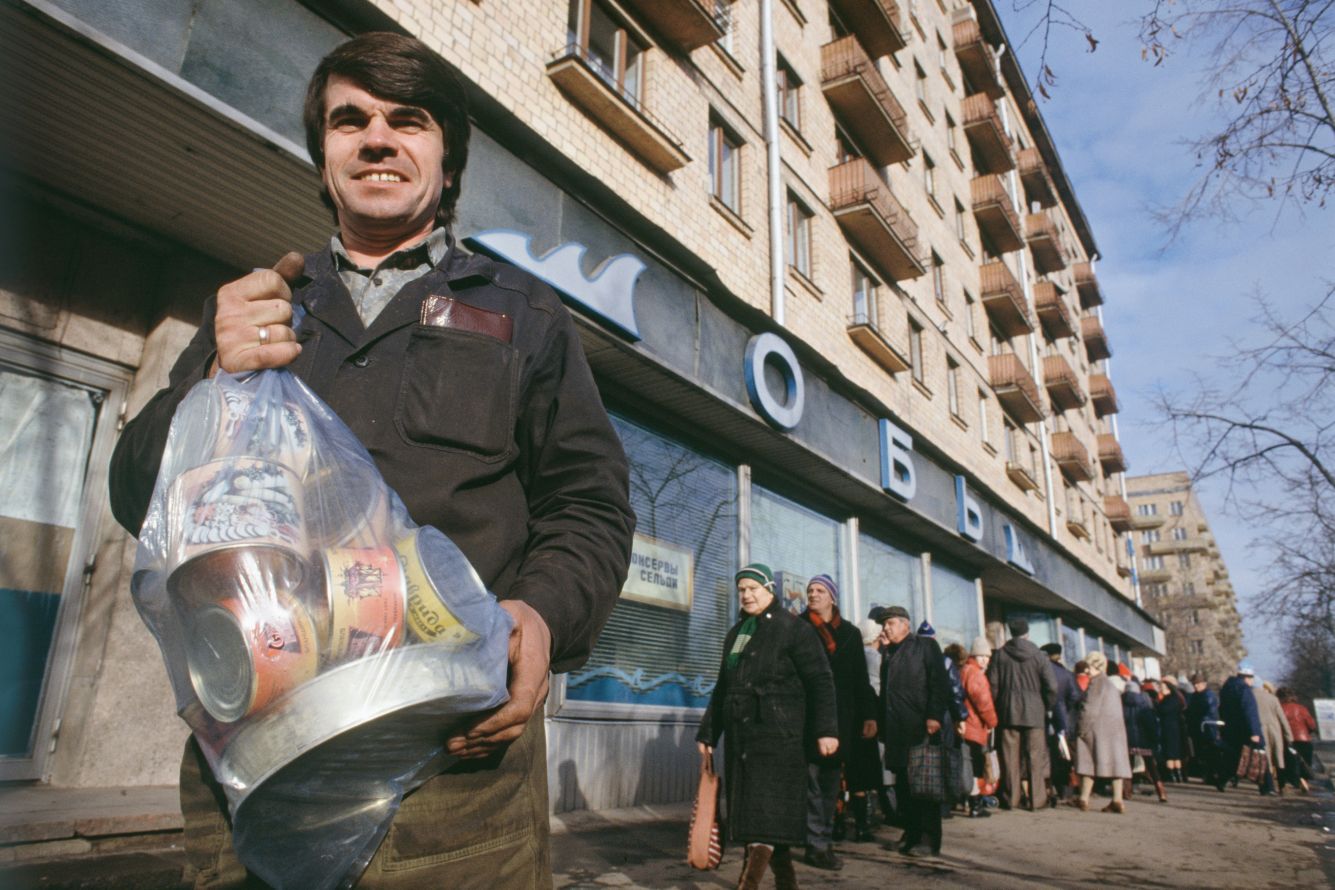
The release of the series of the FBK “Traitors” ( the first episode , the second ) caused another wave of violent disputes about the Russian 1990s. Many critics say that the FBK did not take on this topic in time: war, repression, dictatorship - before now to find out who was right and to blame thirty years ago? The FBK answer: firstly, it was important to Alexei Navalny-it was about the 1990s that he wrote his first software text after he was sentenced to 19 years for “extremism” in August 2023. And secondly, it is in the 1990s that the roots of Putinism, and it is this era that can teach us how to overcome it.
Imail “Signal” from the creators of Medusa is versed in why political discussions in Russia invariably returned to the nineties.
This text was first published in the “Signal” newsletter on April 27, 2024. You can subscribe to the "signal" here .
To begin with, two reservations. First: personal memories of the nineties and the image of the nineties in a collective imagination are very different things, they almost never coincide completely. Everyone who remembers the nineties remembers them somehow in their own way-and attaches their personal experience to some kind of common image.
It may look, for example, like this: “There was a dashing time. I lost my job and all the savings, tried to do business - brothers squeezed out. As he survived, I don’t understand. ” Or so: “There was a time of freedom. I abandoned graduate school, created the company - two years later I went to Merce.
And the second reservation: history and memory are also very different things. The memory is selective: usually we remember something especially bright and forget the ordinary. And then we tell, write books and make a movie primarily about the memorable, lowering the ordinary.
Of all this, a picture of the absurd post -apocalypse is formed in the head of the moneter, which is, which is, which is, ordinary at Monetochka (born in 1998): “In the nineties they killed people and all ran completely naked.”
Owing to many details, about the Russian nineties, as well as about many other historical periods, there are two legends - “black” and “gold”. None of them is full and not reliable - they are legends.
The “black legend” - the image of the “dashing nineties” - began to construct (not always consciously) writers and filmmakers, and when the nineties have not even ended. Victor Pelevin’s novel “Generation P” was released in the spring of 1999, at the emotional day of the crisis after the default of 1998. Then the “big ration” Julia Dubova appeared - a novel based on the biography of Boris Berezovsky, written by his close associate under the still living prototype.
At this very time, Alexei Sidorov, Igor Rubblev and Alexander Velensky wrote the script of the series “Brigade”, and Vladimir Bortko shot the first series of “Gangster in St. Petersburg”. In 2002, the “brigade” and “oligarch” (the free film adaptation of the “Big Deck”) were released, and Mikhail Weller published the book “Cassandra”, in which the expression “dashing nineties” first appeared. The "Zhmurki" by Alexei Balabanov with Taglain "For those who survived in the 90s"-this is already 2005.
The most important creator of the Black Legend about the nineties is Vladimir Putin, who became the prime minister, and then. O. President in the same 1999. In 2018, HSE researchers came to the conclusion that at the beginning of his reign he constructed a myth of his overcoming the weakness of the state, victory over the delays in salaries and pensions, the collapse of science and foreign policy impotence. The “dashing” end of the 20th century in the Putin picture of the world became a springboard for a “real” power, which brought the people to “well -fed” and “stable” time.
For all that, say, the crime rate in zero was higher than in the nineties. And Putin himself came to power not as a revolutionary-liberator, but as a protege of the same “weak power” and “greedy oligarchs”.
The champions of the Golden Legend about the nineties went on a counterattack at the end of the zero. There was, for example, the program “nineties - the time of hopes” on “Echo of Moscow”. In the tenth former oligarchs and high -ranking officials, they actively developed a counterattack: they distributed software interviews and wrote books ( once , two , three , four , five ). In 2015, Yeltsin Center was opened in Yekaterinburg. The widow of the first President of Russia Naina Yeltsin (and not only her ) insists that the nineties should be called "saints", not "dashing".
In recent years, another version has become more audible. Her supporters (say, Alexei Navalny and Elena Kostyuchenko ) believe that there were neither "dashing nineties" nor "fat zero". Like, the opposition of the eras is false, it is a single - and has not yet ended - the era of deceit and robbery of Russians.
Why look for meaning in the nineties?
This gives a serious political advantage.
Politics turns the past to the benefit of the present and future. Therefore, politicians grab the desired part of the collective memory and reassess the nineties, using them as a reinforcing argument.
This, of course, is actively using Putin. He has the nineties not only “difficult times”, but also the time of popular feat. In an interview with the propagandist Dmitry Kiselev in March 2024, Putin equates the heroic work of the current older generation with heroic work after the Great Patriotic War. Approximately the same words - “labor feat” - he calls work in the nineties of BAM employees.
But Putin’s image of the nineties largely depends on the target audience. For example, with its help you can get scores and send an alarm signals. In the message to the Federal Assembly of 2024, he mentions the nineties once - but not as a feat of feat, but as a time of betrayal. Like, those who “filled their pockets at the expense of any processes in the economy of the nineties” are definitely not an elite. Two months later, he meets with entrepreneurs and, on the contrary, says that since the nineties did not follow privatization, then there is nothing to worry about.
At first, Putin “dashing nineties” were needed mainly as an excuse for failures: they say, with such a heritage, how can you expect a lot? And when the zero retroactively assigned “obese”, “black legend” about the nineties became a profitable contrast background for Putin's “stability”.
But Putin with his Putinism has a much deeper attitude to the nineties. This is a resentment turning into a resentment.
Putin has a very long offense list. Let's call two. The first is the expansion of NATO east. First in 1999, then in 2004, at the very beginning of the second Putin term.
The second resentment is disrespect, and it is even more closely connected with the nineties. All this period - from the collapse of the Soviet Union before the election of Putin - the country, in general, expected that the transition to a market economy is a ticket to the Club of Civilized Countries. But these very countries did not want to perceive Russia as equal. For them, she was only the largest fragment of the power, which lost the Cold War.
This emotion of unpleasant bewilderment is very understandable and easily covers any person who has survived in the nineties, but did not receive at least some prize. Not that someone promised this prize, but there was a feeling that all these reforms and hardships were not in vain. It turns out that we were deceived? Betrayed? Who is this traitor?
Having come to power, Putin worked as a transformer of this resentment. In zero, most people in the nineties were associated with resentment. This was a resentment not at the first McDonald's or widespread calculations in dollars, but on the collapse of the Soviet Union, the dishonest privatization and default of 1998, which put many on the line of poverty.
Putin, initially emphasized neutral in relation to the nineties, redirected popular resentment, gradually adding anti -Western aftertaste. Munich speech in 2007, Valdai in 2014-milestones along this path. And a few weeks before a large invasion of Ukraine, he will combine resentment at NATO and West in one. He will say about the expansion of the alliance: “They inflated it. They just arrogantly inflated ”, referring to the phrase already 1990.
Naturally, the idea of resentment, resentification, betrayal is not limited to the period of the nineties. For example, since 2014, Putin additionally introduced the concept of “national expense” (we had a separate issue about him), assigning the opposition to this role primarily, but later expanding to any groups of citizens who are easily shown as accomplices of the West and alien generally.
In the early nineties, many Russians considered Mikhail Gorbachev the main traitor - they say, he ruined the Soviet Union (we also had a letter about this). After the shelling of the White House in 1993 and the 1996 elections, approximately the same people wrote on the walls of the Yeltsin gang. This understandable emotion was exploited by politicians who are always very important to understand who to appoint guilty.
The destructive emotion of the resentment with ease becomes a generator of the images of the enemy. According to the same political scheme - the rehabilitation of the resentment - the series of FBK “Traitors”, which appoints the oligarchs and the “family” of Yeltsin, is built. Moreover, to blame for everything: in the deceit of the people, unfair privatization, mortgage auctions, dishonest elections in 1996, and most importantly, in the fact that the dictator came to power. It is not surprising that the attachment of Putin to the tail of this enumeration caused old disputes to life.
Why can't we stop arguing about the nineties?
In short, because we are not allowed to forget about them.
Look. The 2015 VTsIOM survey : in 53% of Russians, the nineties are associated with something bad (crime, decay, poverty, corruption, impunity). But the poll of the same 2015: 46% believe that now society is more fair than in the nineties; Only 20% believe that in the nineties there was more freedom; 63% believe that the authorities were then less competent and effective; 51% - that the international situation of Russia was worse; 63% - that President Yeltsin brought more harm than good.
Attention, the question: why suddenly two pro -Kremlin survey services at once almost synchronously - in the fall of 2015 - became interested in how the Russians relate to the nineties? Everything is very simple: November 25, 2015 - the official opening of the Yeltsin Center in Yekaterinburg, the climax of the “counterattacks” of the champions of the Golden Legend about the nineties.
In order for everyone to understand everything, the VTsIOM communications director commented on: “The study shows that attempts to romanticizing the nineties come across an emotional“ slab ”of misunderstanding and rejection of this period by a noticeable majority of citizens and therefore remain the lot of an insignificant, although informational active minority.”
Well, here is the third survey - this time “Levada”. 2020, the stated reason - "Thirty years ago, a decade of the nineties began." 62% of Russians believe that the nineties brought the country more bad than good. 42% cannot recall anything good about the nineties.
But the fundamental problem is not even that. If people ask about the nineties, the majority replies that the bad was time. But if you can’t ask, how do they think about it? Do the nineties consider the “most important and urgent political theme”, as Maria singersinsists ?
It is clear why the nineties (more precisely, “black legend” about them) is needed by Putin. It is clear why they (more precisely, “golden legend”) need people like Peter Aven, Mikhail Khodorkovsky or Alexei Venediktov . They will probably protest that they do not promote any “golden legend”, but only insist that “everything is not so simple.” But this is the logic of polarization: who is not “for these”, he automatically “for those” whether he likes it or not.
The battles around the nineties in zero and tenths are understandable. There was a lot of personal. For the participants of those battles, the nineties are not history, but a biography, including political. The debaters largely determined their place in the world through their attitude to the nineties. And it is clear how these battles they drove the memories of “ordinary people” over and over again.
This dispute could have sunk into a generational break, a dispute about perestroika sunk into it - that Gorbachev did the right thing, which was wrong - it was important to people who participated in this and experienced it. And now what, the situation is already played out, it remains only to deal with the consequences.
But some historical periods acquire a symbolic meaning even for those who themselves did not survive them. In Russia, this, for example, is a large terror of the 1930s, on a global scale-the 1960s, the period of birth of modern culture (both political and popular). They always return to them as an ideological guideline. The memory of them is always a political position. And even identity: repressed or repressive, hippies or conservatives are not just characters of some long history, but “ours” or “enemies”. And sometimes even "traitors."
Maria of singers insists that the nineties should find the same meaning.
The unexpected discovery that we made while preparing this letter
Researchers from Levada and from VTsIOM especially noted: in polls of the tenths about crime nineties, youth speaks much more often than older people. Apparently, there is a key difference between those who judge the nineties according to personal memories, and those who only read about them, listened to other people's stories or watched the “brigade”, “Zhmurki” and the like.
Editors "Signal"