
Translated material
Stablecoin's scrapers
Why the Russian economy depends on cryptocurrencies more than ever, and the prohibition of their appeal will not be
Logos of Russian digital rubles in Moscow, August 15, 2023. Photo: Sergey Ilnitsky / EPA-EFE
The Russian Duma put up in its loins to the NO613616-8 amendment to the bill on mining cryptocurrencies, which is originally regulated by the Law N259-ФЗ “On Digital Financial Assets, Digital Currency and Amending Certain Legislative Acts of the Russian Federation”.
Amendment No. 613616-8 from 04/26/2024 translates into Russian amendment No. 237585-8 of 11/17/2022, because the previous version looked like this:
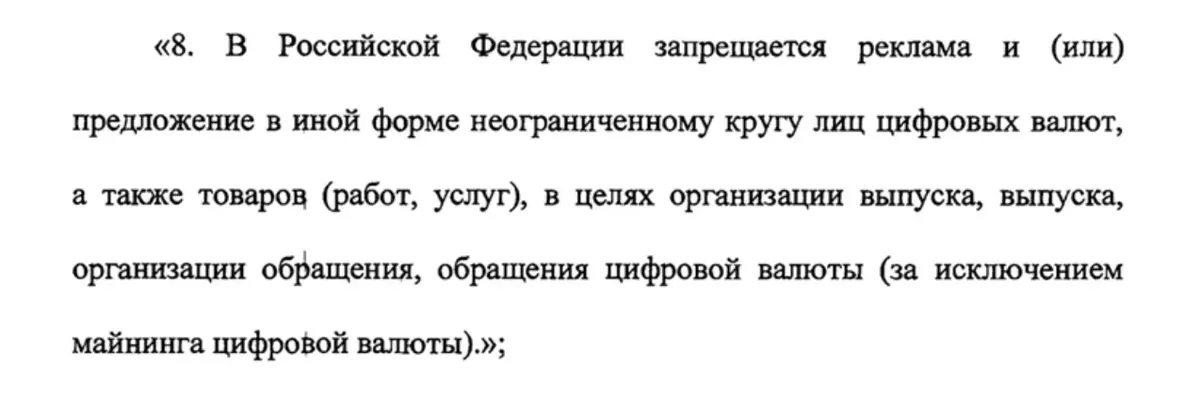
In the updated version, which served as the reason for the media wave, cacophony was slightly combed, breaking the text into two points:
In the Russian Federation, advertising and (or) a proposal in a different form of an unlimited circle of digital currencies, as well as goods (works, services) in order to organize the release, release, organization of circulation, and circulation of digital currency.
In the Russian Federation, the organization of the circulation of digital currency is prohibited, with the exception of the implementation of activities specified in parts 13 and 14 of Article 1 of this Federal Law.
Our journalist brother tried to understand the publication and scored the alarm: “Deputies are going to ban the appeal of cryptocurrencies! Chef, everything is gone! "
I would venture to assume that the excitation of the media happened due to the wording of 2022, because in the updated version of April 2024 it is difficult not to notice the semantic difference between the “ Organization of the circulation of digital currency” and the “circulation of digital currency”.
We will pay troll trolling to the Hokhmachamami. Fortunately, the state importance of the topic (yes, precisely that the state!) Holded the people's deputies from the protracted torment of the excited public.
After a couple of hours after the publication of the April abstract, deputy Anton Vadimovich Goryekin moved on the stage and, barely restraining laughter, poked a frightened mainstream with his nose: “Of course, the circulation of cryptocurrencies will not be prohibited. The organization of circulation falls under the ban: the creation of exchanges and exchangers outside the zone of the experimental legal regime. ” Having shimmering a sigh of relief over the country, the deputy was even deeper:
“I do not exclude that in the future this restriction can be removed. However, no one prohibits, as before, to use foreign cryptocurrency exchanges and exchangers. ”
The information water chosen to comment may seem to the reader a meme of Alexander Twardowski (“It’s kind of like an ambulance that goes: it cuts, puts it off itself, gives help itself”): the journalists, they say, sucked a pun from his finger and debunked it themselves. However, directly the fact of a commotion , caused even by an erroneous reading of the legislative amendment, deserves, as I see, serious attention, because it indicates an unprecedented in historically the importance of a cryptocurrency topic .
The importance of the theme for the layman lies on the surface: in a situation where ordinary fiat money (dollars, euros, Swiss francs and Japanese yenam) has practically no left -handed francs left, the main tool for protecting against ruble inflation is “stable cryptocurrencies” (the so -called stabilcoins). The second priceless function of cryptocurrencies in Russian society today is the most effective, fast and unsuitable channel for cross -border money transfers.
There is, however, the second side of the coin. As I mentioned above, the importance of a cryptocurrency topic has gained a unique state aspect. In the sense that there has never been a situation in the history of the Russian Federation, that the country's economic survival not only depended on cryptocurrency exchange, but would depend critically.
The state value of cryptocurrency for the Russian Federation is an opportunity to establish payments in the conditions of maximum limited access to standard payment instruments (all the same dollars and euros) and blocked payment channels (network of correspondent banks in the EU and the USA, as well as the SWIFT disconnected).
It is funny that until recently, the Russian government has not drowned out the prohibitive Rapsodia of the Central Bank of the Russian Federation, which from the first day has consistently spoke for an absolute ban on cryptoeconomics in any of its manifestations. The behavior of the Central Bank of the Russian Federation is fundamental and consistent, and therefore does not differ from the line of behavior of its senior brothers - the Central Bank of the European Union and the US Federal Reserve.
The motive for cryptonenavity of the central banks is logical: the pillars of the traditional fiat banking world system are considered (fairly!) Cryptoeconomics only as their burial man.
For years, the authorities of the Russian Federation (more precisely, from 2014 to 2023) have not prevented the native Central Bank from scorching and intimidating the population (the same song about the crypt as a shelter for pedophiles, drug dealers and marginal hater of ethism). They didn’t interfere, because they sincerely believed in the implementation of at least one of their two rates: the opportunity to prompting traditional monetary relations to the CBDC level (the digital currency of the Central Bank) and the ability to establish a cross -border trade turnover based on a fiat currency, an alternative dollar (for example, renminby, Rupia or Real).
Both bets were shamefully bits. CBDC was launched at an unheard of speed, but almost immediately it became obvious that not only the inhabitants, but also commercial banks that rightly appreciated the digital currency of the Central Bank as an effective way to move all the intermediaries from the feeding trough: CBDC allows the Central Bank to engage in money and lend loans directly.
If even in China, where CBDC was introduced long before the Russian Federation, the population accustomed to centuries to obey any state arbitrariness, exposes the “digital yuan” unprecedented ostracism, what can we say about Russia with its eternal figs for the authorities who are in the pockets of the townsfolk?
The second rate of the Russian state - to establish alternative payment channels with their remaining trading partners on the basis of their national currencies - unlike CBDC, turned into a zilch, but serious troubles. The idea of the Russian Federation: We sell them raw materials, and we buy what we do not have for the proceeds/yuan - rested on the objective reality and conflict of national interests.
The objective reality is such that it is not possible to directly buy the “necessary”. In the case of China-due to fears of second-level sanctions, in the case of India-due to the banal absence of the “necessary” on the domestic market.
The option with converting revenue from sale also does not grow together: the national currencies of the partners of the Russian Federation are not converted into normal money. As a result, the revenue from the sale of raw materials hangs in rupees / yuan in the domestic markets of India and China, where this “money” can only be used to invest in the development of the national economies of these countries. I would venture to assume that this is the last thing today's Russia dreams of.
Ideally, for the Russian Federation, it would be necessary to establish a trade exchange with partners on the basis of some new fiat currency-excellent both from the dollar / euro, and from the yuan / rupe. But, for obvious reasons, this option is neither China nor India seduces: why should they produce extra entities?
It was then that the understanding came that the only option to establish commodity-money relations with the world is to use cryptocurrencies, more precisely, stablecoins, and even more precisely, one of the two most common fiducial assets: USDT and USDC.
The USDT market capitalization today is $ 110 billion, USDC is $ 33 billion. There are literally thousands of stablcoins in nature, but they are only dwarfs against the background of two mentioned monsters.
In the use of USDT / USDC for trade and exchange operations, the Russian Federation has two difficulties, which, however, are easily overcome.
Difficulty No. 1: USDT is the corporate product of Tether, USDC - Circle. Despite the fact that Tether (under the control of IFINEX) is registered on the British Virgin Islands, it is de facto under the full control of the American state (due to countless economic and banking ties). USDC issuer, Circle Internet Financial Limited, is generally spelled out in Boston, Massachusetts.
The described nuisance, however, is easily removed due to the pseudonymous nature of cryptocurrencies: USDT / USDT (as well as bitcoins, broadcasts and tens of thousands of other non -anonymous crypto acts) are stored and controlled not by the Russian state, pirate Petya or Donald Trump, but by network addresses that look approximately: this is approximately: 0xa0b86991c6218b36C1D4A2E9EB0CE3606EB48.
There is a philistine opinion (which is in every possible way strengthened by the speculations of the mainstream media) that to connect a cryptocurrency address with its genuine owner in the riallaife - a trifle business and a couple of trifles for professional analytical companies. We will somehow devote a separate story to the debunking of such a myth, but so far we can believe the word: this is complete nonsense. To establish a connection between the targeted pseudonym and the real owner is extremely complex, and with the special desire of the owners, and an insoluble task. If you use completely anonymous cryptocurrencies , such as Monero, Zcash, Beam, Grin and hundreds of others, then there are practically no chances to get to the beneficiary.
Therefore, at the very least, the Russian economy is able to solve the problem of USDT/USDC.
The difficulty No. 2 is very fond of remembering “experts” far from monetary science - this is the limitations of the emission of top stabelcoins. It’s seemingly indecent to even oppose, since the debunking of delusions rests on the school law of monetary circulation: “The amount of money necessary for contacting the state is directly proportional to the amount of prices of goods and services and inversely in proportion to the speed of money turnover.”
It is enough to scroll through the “small” issue of USDT ($ 110 billion) 10 times, as it turns out already $ 1 trillion 100 billion, but this is actually half of the annual GDP of Russia ($ 2.2 billion; a meaningless figure of purchasing power-5.7 trillion, for obvious reasons, I will not consider). Given the speed of adding blocks in the Tron network, which accounts for the lion's share of the USDT turnover (5-7 seconds), the entire GDP of Russia can be scrolled in the blockchain in 1 minute.
These numbers, of course, are conditional, but give an understanding that the USDT daily turnover (today it is $ 33 billion) for the eyes is enough to cover the calculated needs of the state of the Russian scale.
Given the battered rate on the national currencies of trading partners, as well as the potential resolving of the problem of limited emission of liquid stabiblcoins, it becomes clear why the accusative-pre-pre-reference Rapsodia of the Central Bank of the Russian Federation has been pushed into the backwater of the state choir: it is not not possible to overshadow the fears around the graveter of the global financial system in a situation where the pipes of the local economy are burning.
In the context of the declared information farm, we can close, as it is fashionable to say now, two gestalt. Firstly, it is necessary to understand that the artificial separation of the discourse: “crypt” for the state is salvation, and “crypt” for the population is to think, not, it resembles schizophrenia and fraught with nervous breakdowns that are unnecessary today by the Russian state. Therefore, citizens can sleep calmly:
Stablecoin will continue to not only protect against inflation of national money, but also move the savings to anywhere in the planet, despite banking prohibitions and restrictions.
The second gestalt is associated with the understanding that the real troubles for the triumphal procession of the decentralized monetary system (Defi) come today not from the Central Bank of the Russian Federation, but from the central banks of states in which relations with subjects are built on a healthy public agreement: you delegate us to control your money, we provide you with a set of goods that a majority of humanity cannot dream of.
I mean, of course, the European Union and the USA. In these territories, the announcement of certain actions related to the circulation of crypto acts is fraught with the exception of those who disagree from that very social contract (which is completely undesirable for the vast majority of the population). For this reason, in the United States and the European Union, large -scale legal battles and lobbying contractions between society and the state bureaucracy have reached the apogei today.
The US Congress discusses a complete ban on decentralized finances, and the European Union is preparing to enter into force on June 1, III and IV sections of the Mica Law (Markets in Crypto-Assets), which due to the absurdity and duality of the formulations are fraught with the prohibition of the turnover of all stablecoins.
This topic deserves a separate conversation, for the meantime, we restrict ourselves to the closure of today's question: “En Toda Rusia El Cielo Está Despejado”* - in terms of cryptocurrencies, of course.
* “Above all of Russia, a cloudless sky” is a reference to the alleged code phrase, transferred on the radio and marked the beginning of a military rebellion in Spain in 1936. - approx. Ed.