
Translated material
Frank Stella died-one of the most important abstract artists
He dreamed of creating an art that means nothing. It turned out that this is impossible
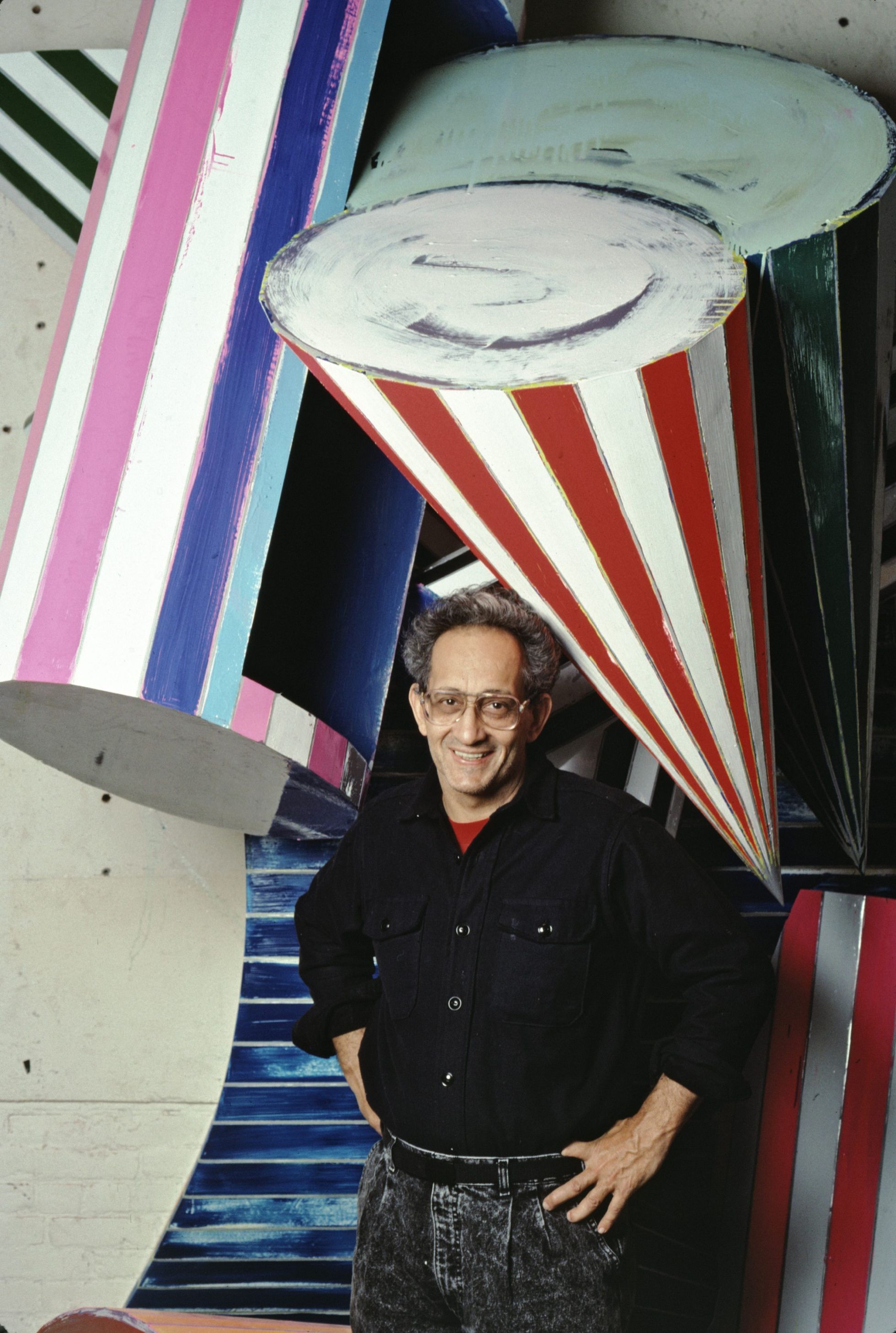
Frank Stella, one of the most famous artists of the 20th century, died in New York. He was 87 years old. At the end of the 50s, Stella brought the line under abstract expressionism, the most important flow in the art of that era, and launched new processes in art. Critic Anton Khitrov tells how the artist sought to create a “pure art” - and why in the end he got something else.
"You see what you see." Frank Stella uttered this famous aphorism in an interview with art for Bruce Glaiser in 1966: Glazer interviewed Stella and Minimasimalist Donald Jadd for the WBAI-FM radio station. The artist talked about how to perceive his painting. Stella strove for art that would be a completely independent, independent family of human activity - free from political, religious, research and other tasks. He wanted to write paintings, and nothing more. At least at the beginning of the career.
Stella's most textbook work belong to his early series “Black Pictures”. This is just an attempt to create a painting that does not refer to anything and does not convey anything. The artist’s black color is not mourning, this is the color of the negation, the color is nothing. Stella drew a pencil with a pencil on large ill -pounded canvases, and the gaps between them painted an enamel, and not picturesque paint. The former painter, he painted with a painting brush. He put up work without frames, but he chose the subframes thicker - and their thickness was equal to the width of the stripes drawn on the canvas. The audience noticed that the picture has an end and that this is actually a massive three-dimensional object, and not a window at all in an illusory reality (it doesn’t matter, familiar or unfamiliar). Painting as a product - this was the ideal of an artist.
Stella became famous, being a very young man. In 1959, the New York Museum of Contemporary Art showed the exhibition "16 Americans" under the curators of Dorothy Miller. They argued a lot about the project, especially about the “black paintings” of 23-year-old Stella. Critic Robert Rosenblum, for example, wrote that they are unemotional, primitive and do not express the individuals of the artist. It must be understood that Rosenbbum judged him according to the laws of abstract expressionism - then the most important current in the United States. And among expressionists, the goals were not as mundane as that of Stella - for Mark Rotko , say, abstract painting was a modern analogue of icon painting.
"Delta", the first in the series "Black Pictures", was originally not black, but red. Stella was inspired by the paintings of Jasper Jones, his senior contemporary, who wrote star-striped flags in the entire width of the canvas. The young artist looked at Jones's work exactly as he called for his own to look at his own. The symbolic baggage of the American flag occupied it significantly less than abstract red stripes. In the Delta, Stella tried to develop this motive - but then he changed his mind and repainted the canvas into black.
The abstractionist Robert Mazervell spoke about the cycle like this: “It is very interesting, but this is not painting.” In principle, we can say that “black paintings” are rather sculptures: early Stella is related to sculptors as a rejection of color and the desire to emphasize the three -dimensionality of his work.
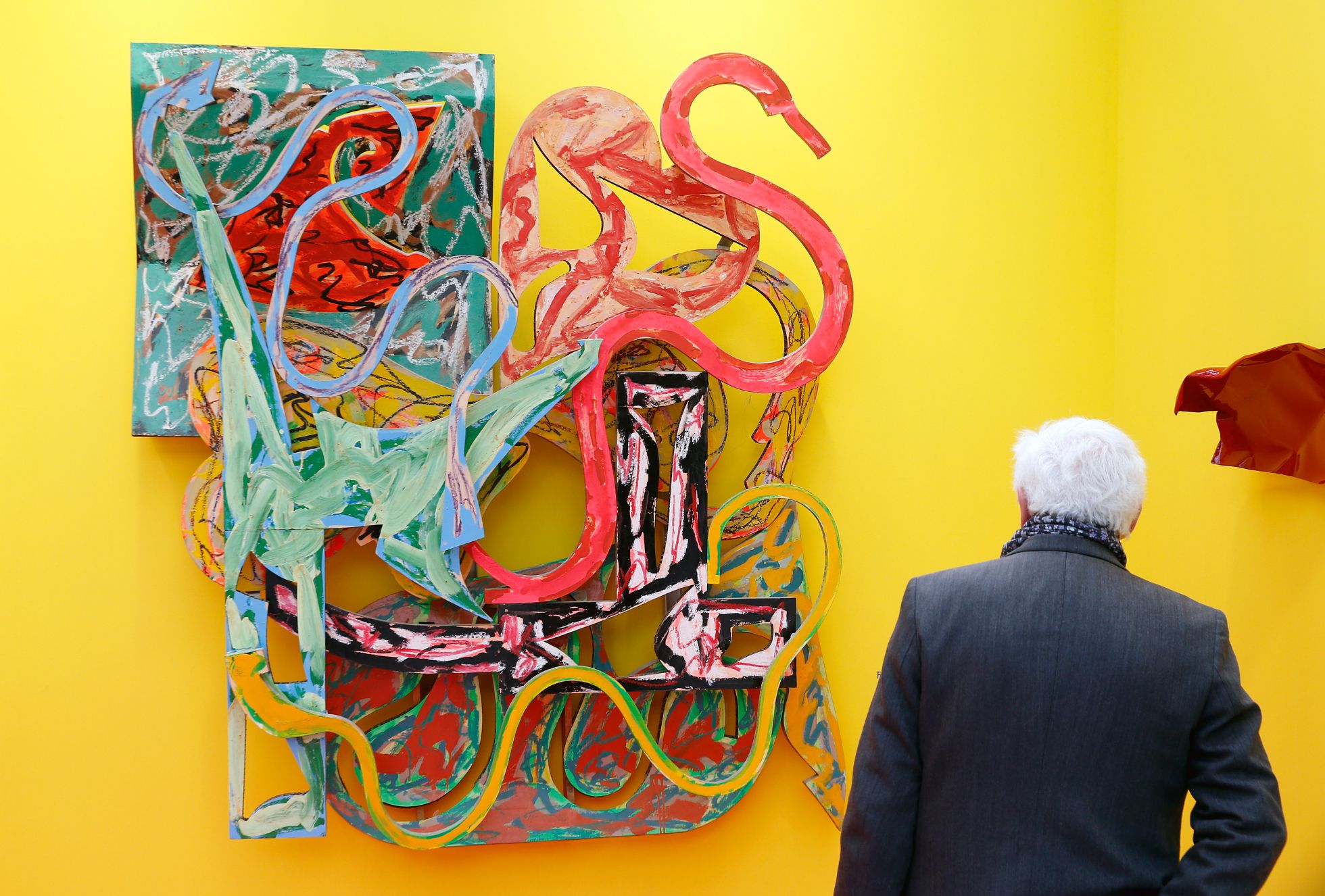
Over time, the artist completely evolved into the sculptor. In the 1960s, he experimented with the form of canvas: one of his episodes was called- "The wrong polygons." Having breaking the usual contour of the picture, Stella “objectified” her even more, protruded her materiality. In the next decade, in the 1970s, its work even acquire a relief (for the first time in the cycle "Polish villages" ). And late Stella is already an unconditional sculpture . Trying to remove the focus from the topic to the equipment, from the signified - to the signifier, the artist found a solution in volume. After all, if the work can be felt, examined from different angles - its independent, independent being is obvious.

.jpg?mode=max)

At the same time, Stella’s work clearly prove that “pure art” is utopia. The artist gave the works suspiciously specific names. For example, he put one of the Black Pictures with a label Die Fahne Hoch! - From the German "Banner up!" (This is a quote from the Nazi "Songs of Horst Wessel" ). Stella himself assured that the canvas in proportions reminds him of the banner with the swastika. What is this, a reference to Jasper Jones or just a joke of a 23-year-old artist who was mixed with spectators and critics who are looking for a subtext in everything. But over time, the researchers really saw in the work a commentary on the horrors of Nazism.
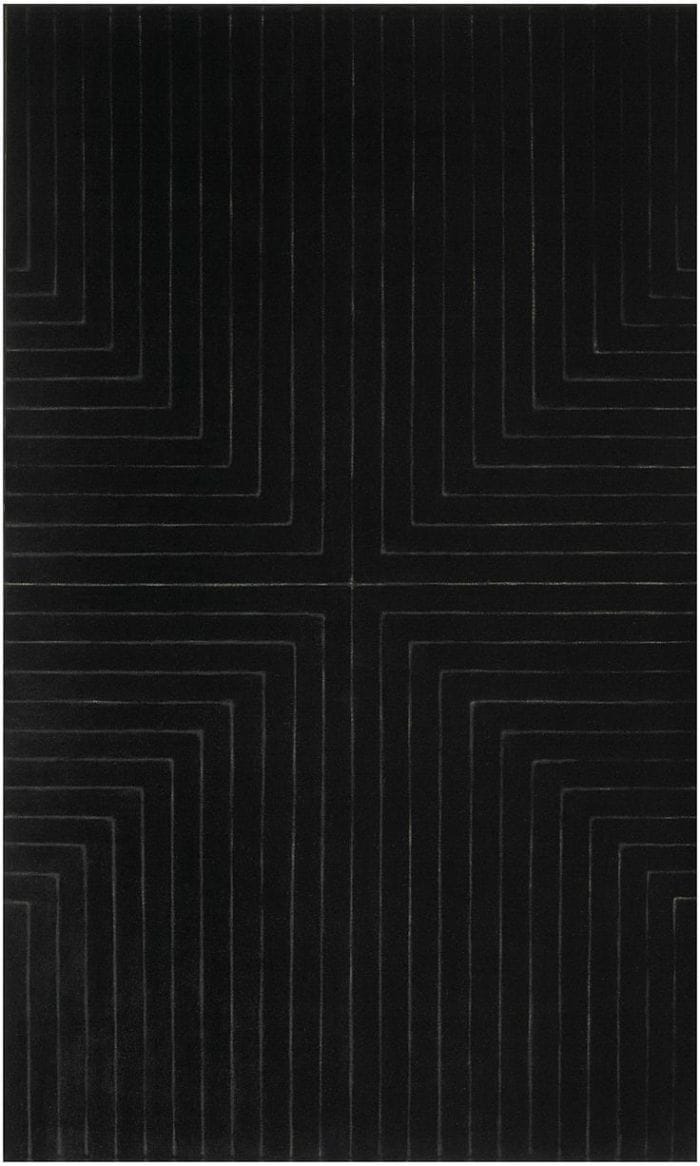
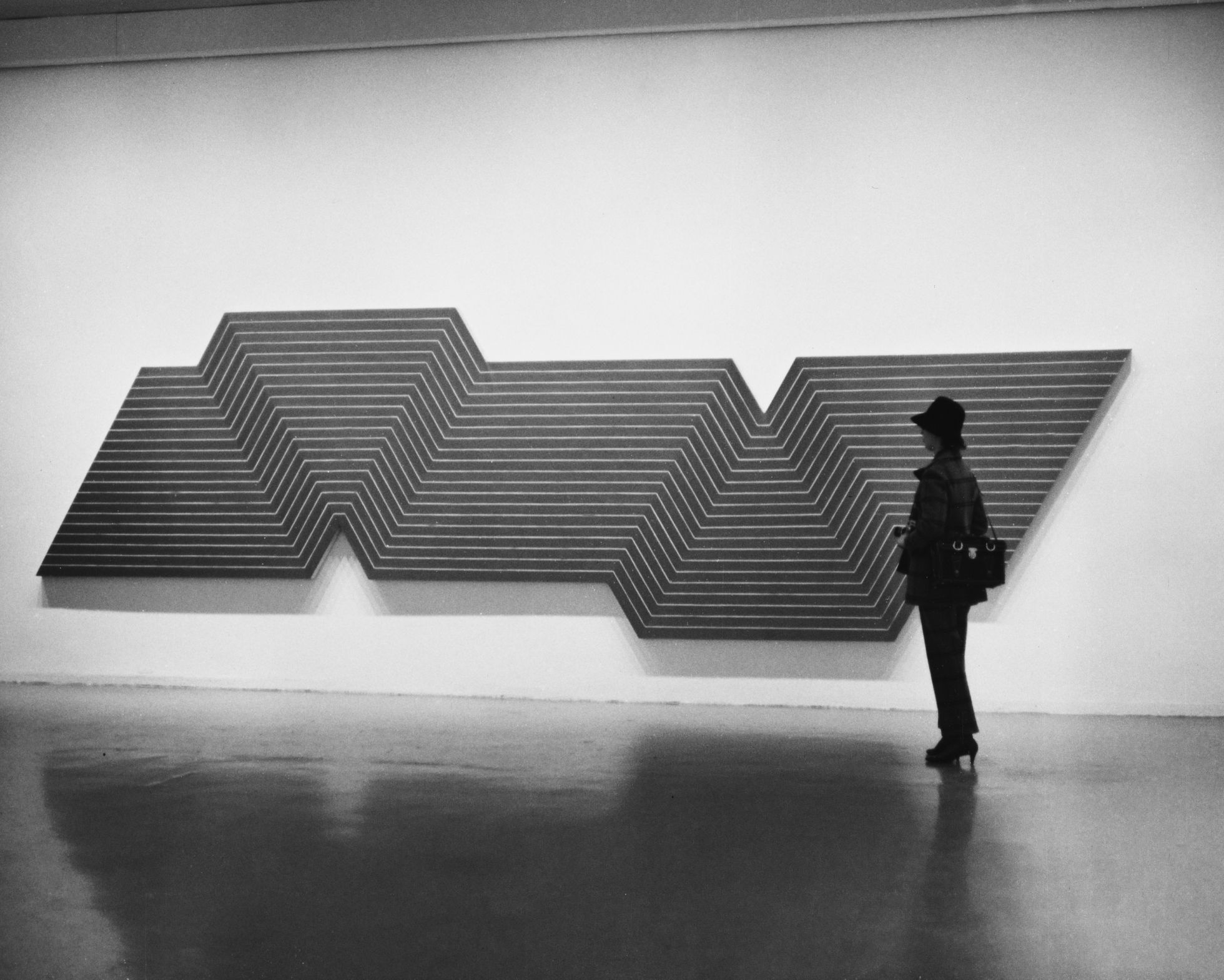
“Black Pictures” are visual whether the artist wanted whether or not. Even if you do not read the names, it is difficult not to notice in this painting, say, architectural images - steps, arches, suits.
Stella herself moved away from the idea of “pure art” and even introduced the narrative into abstract painting. In the early 1980s, the artist created a series of engravings “Had Gadya” based on the Jewish song, which was illustrated by the Russian avant-garde El Lisitsky (in fact, the engravings of Stella were conceived as an absentee dialogue with Lisitsky). And from the mid -eighties to the end of the nineties, he painted paintings inspired by Henry Melville’s novel “Moby Dick”.
If the early Stella is 100 percent man-made things, then the late-technological objects created using computers and 3D printers. Digital technologies interested the artist in the eighties. And his modern works are similar to 3D models transferred to the real world. In general, machines, technologies, industry - that which always inspired the stella: he painted on millimeter paper (and even on leaves in a cell!), Painted cars, his paintings of irregular shapes are similar to scanning and drawings of details .
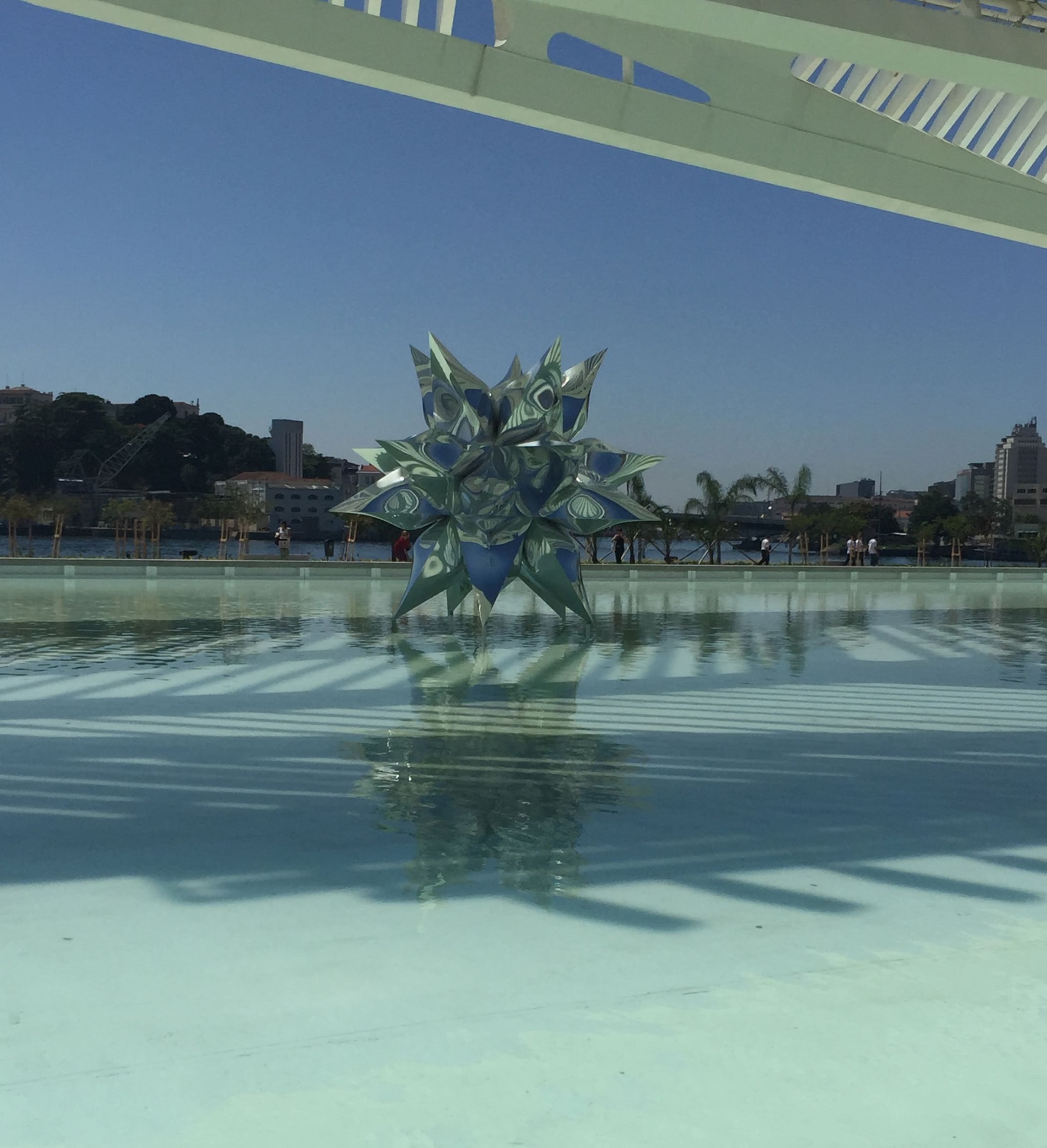




Another thing is that the artist’s early things - like the same “black paintings” - is now more interesting to consider than impeccable late. Perhaps because Stella made them manually, leaving small, barely noticeable flaws. His first “drawings”, “schemes” and “scanning” in the 2020s cause the same delight as, say, architectural paper models or hand-filled old tables. Stella today, in fact, retrofuturism: his painting makes him nostalgic for times when technical progress inspired artists, and humanity had a future.
Anton Khitrov