
Translated material
Bulat
May 9 - centenary of the Great Okudzhava
Victory Day we celebrate on his birthday. This is by chance.
The war was present in his life, and then in prose and verses. This is natural.
Quietly, cordially, without pathos, with humor and talent, he sang his and our lives to us. He offered us solutions that were too good for fierce time.
I really love Bulat Shalvovich. Not one. When he said goodbye to us in the theater to them. Vakhtangov, I put a video camera and for many hours I shot people who came to him. They moved an endless series, stopping for a moment at the coffin and remaining on the film forever.
These people - elderly, middle -aged, are completely boys, different at all - instilled hope. They all had good faces. In the military, among civilians, in women and men. Most came with one rose or clove, but it was nothing ... The flowers were a sign of love, like a gaze of genuine sadness. He left us alone. But he was.
What you read is a conversation in the kitchen at Okudzhava in a godless lane. About his life and about the war. He said - I listened without imposing topics. God bless. Then we were together, now you have joined. Let's pour along the glass for him and for victory and listen.
Bulat war
I was born in the 24th year, on May 9, at the graneman, on Arbat. My first apartment is the house 43. The apartment is on the 4th floor, medium sizes on a communal scale, five neighbors. Previously, it was an apartment of the manufacturer of Kanevsky, Nepman. After the NEP, he was the director of his own factory. And then he left for France with his family.
My father was sent to a mosquito from Georgia to study. On Arbat, he was given two small rooms in that communal apartment. And the mother lived with us. After my birth, my father was sent back to the Caucasus. He continued to work as the Commissioner of the Georgian Division. And my mother worked in the apparatus of the city party committee, here.
And then it's time for me to study. And I was sent to Tbilisi, where I entered first grade. It was such a strange first grade where there were exams-in Russian. On the exam, everyone was given a sign, a labyrinth was drawn on the plate. In the center of the labyrinth is a sausage, and the mouse outside, it was necessary to find the shortest way to sausage.
We did not hear anything about Pushkin, Pushkin did not exist, Lermontov did not exist, Turgenev did not exist, Tolstoy did not exist. They were all landowners.
Then his father worked as the secretary of the Tbilisi city committee of the party. He had something with Beria, very serious. And it got to the point that my father went to Crimea, to Sergo Ordzhonikidze, and asked him to go to work in Russia, because he could not work in Georgia. And Sergo sent him to the Urals. The party organizer of the Central Committee for a non -construction plant being built in the first or second five -year plan.
In the 32nd year, his father went to the Urals-there was still a wild taiga and several barracks. And then he wrote us out. I lived there, studied - before my father’s arrest. Until February 37.
We returned to Moscow. Again in the same two rooms. Mother, of course, was expelled from the party right there. She got a job as a cashier in some kind of artel. And she was engaged in the fact that in her free time she ran, sought to accept Beria to tell him: you knew him at work, he could not be a trocke or an English spy. She achieved, sought until they arrived one night and took her either.
I stayed with my grandmother. At this time there was already a brother. He was born in the 34th year. We lived starving. Absolutely scary. I studied badly. He began to smoke, drink, girls appeared. The Moscow courtyard, there is no mother, one grandmother in despair. I began to put the money at home - to cigarettes. Contacted the dark guys. As I recall, I had a Moscow-Arbat crook with a model of a young man, thieves. Boots in an accordion, vest, jacket, forage, bangs and a gold fixture.
I was a very political boy. And I knew that my parents are such communists that do not happen in nature at all. Some kind of mistake occurred. And when it comes to Stalin, he will fix everything.
At the end of the 40th year, the aunt decided to take me from here. Because I completely fought off my hands, I didn’t want to study, I didn’t want to work. I arrived in Tbilisi before the war.
Then the war. Of course, I began to bombard the military registration and enlistment office. With friends, we demanded that we be taken into the army.
We defeated Captain Kacharov. At first he shouted at us, stomped with his feet, then he got used to it and, in order to get rid of, he instructed to carry the summons. We walked around the yards. We were beaten for these summons, it happened. They brought sorrow.
Then I left school. He worked at the factory by a student of Tokar. He was engaged in the tag of the stake of flamethrower. What is a ditch, I still do not know. We did something heavy every day, from night to night, for 14-16 hours, it was unlimited. And I all went to the military man, bored. Finally, this Kacharov could not stand it and said: here are the summons. We sat down and wrote them ourselves.
I was 17 years old. My aunt was alarmed, said that she would go to the military enlistment office, that everything would turn over, that this is a disgrace. I told her, if she goes, I will run away from home.
My friend Yuri Popenyans received a direction in the 10th separate reserve mortar division. In Kakheti, he was located.
It was April of the 42nd year. We walked at our home, did not take the oath, because there was no form. And then we were given the hats of the alpine shooters, and we, wrapped, barefoot, in these alpine wide -brimmed hats, singing and hitting barefoot in the mud, walked in construction.
And then one fine day the autumn we were relocated to Azerbaijan. There we lived a little, dreaming of getting to the front.
Because they fed badly here, and everyone said that they are better fed at the front, there is a front -line ration, there you need to trump, there is your own life. The front was the coveted happiness. Everyone dreamed about it.
Once we were suddenly raised. We were taken to the bathhouse and after washing gave out a new form.
But they took it not to the front, but near Tbilisi in some kind of military town for barbed wire. There we studied the art of using a hand grenade. They distributed grenades in the evening and warned that if you put the capsule unsuccessfully inside, then an explosion, and that’s all. Grenades forced to attach to the belt. Capsules separately, and ordered to go to bed. We lay down slowly, trying not to breathe. The night was terrible.
In the morning we look: there are “Stodebekkers” brand new American, our mortars are attached to them. By car! And our front -line wanderings began.
It was a separate mortar battery, which was given to different parts. Here we are going, we should give us such a regiment. We come, it turns out, there is already a battery. Then we wait a few days, then we are sent to another place. Again, the train, again give some shelf. Gave; It turns out that we have no contentment. Everyone eats, but we have nothing. What to do? And the commander once tells us that we need to get food ourselves. We divided into pairs and went to various Kuban villages to ask for alms. Who gave what. In the barracks, all this was laid out into the same heaps. Then one turned away: "To whom?" - "That." So the commanders ate.
Then we got to the front. Where I was wounded very prosaically from a large -caliber machine gun, from an airplane. "Rama" flew and shot. By accident, some kind of bullet crushed the bone and stuck in the thigh. I then wore it on a rope for a long time ...
I generally fought very little in its pure form at the front. Basically wandered from part to part. And then - a reserve regiment, they pickled there. But the spare regiment is just a camp. They fed some kind of Burda. They forced to work. It was terrible.
In the fall of the 43rd year, again a bathhouse, again new clothes. Echelon. And they took it. The rumor went that we were being taken under Novorossiysk. On the way, the peasants went to the train. With a ghost. We are American boots to them, and they are also boots in return, but broken, and even in addition to a piece of bread and lard a piece.
Therefore, we came to the destination of dirty, torn, similar to monkeys, sleeping. Both commanders and soldiers. And we were ordered to be sent to Batumi, to some military unit to be in life. There are barracks, on the floor of straw, we slept right on straw. They did nothing. I only remembered the fact that they took us on an excursion for some reason to look at Beria's cottage. Big White House on a hill. Allowed through the windows to see the decoration. Luxurious dining room, huge, lamb. And my comrades were professional crooks in the past. Very kind guys.
They ran there in the cottage there, sniffed. We came, went to bed. At night I woke up - they are not. By morning, some people came to the barracks and the guys arrested. It turned out that at night they carried away all the table silver. At night, they took it into buying up. They were tracked down.
And we were loaded into the barge and taken to Novorossiysk. For some reason, we have a lot of wine: we drink and float, drink and float. Once in the early morning we were built on deck. Some front-line boss came, looked at us and left. In this form, they do not accept.
I was again sent to the reserve regiment, where I was tormented again, until the recruiters came. I have already visited the front, I have already scooped the dugouts, I already ate all this.
No romanticism - to eat, sleep and do nothing - this is the main thing. One officer recruits people in high -power artillery - the reserve of the main command. Part stood somewhere in the Transcaucasia, in the mountains. I did not fight from the first day. And it is not assumed what will fight. I thought: what could be difficult there? To bring shells - this work is not terrible for me. What else? I think: such a laf. And I recruited.
Most of the guys rushed to the front. Because there was a better priest. And in general it was more apparent. If they don’t kill, then it’s good. And I went to this part ...
We were taken high in the Nagoric Karabakh, there, in Stepanakert, was located either the Kuban or the Saratov Infantry School. And I was turned into a cadet into him. I counted: six months later I will be a younger lieutenant ...
They enlisted me, and the mushtra began unbearable. Such a drill began that God forbid. For six months to wait - I will die. I am an impatient person. I suffered for three months. I go to the political officer, allow me to report: so, they say, and so, my father is arrested, the enemy of the people. He says his son is not responsible for his father. I say, I know everything, but just in case, so that you do not say that I have hidden. Well done, he says, they did the right thing. Go, work calmly. And I went to work calmly with a bitter heart. The next morning, building after breakfast; Okudzhava, Filimonov, Semenov - get out of order, the rest - in a step by step! And to us - sales tests and appointment to the artillery part from which I was lured.
There were dignity at the front: some kind of relaxation, the opportunity to tell the truth in person, to show yourself, there was some kind of brotherhood. And that's all. The war taught courage and hardening, but they received hardening in the camp.
But basically it was horror and destruction of souls. There were people who remember the camp with pleasure. One woman was sitting with my mother. And then, when the convicts met, they talked about the past, about the nightmares of the camp, she happily recalled: “Do you remember how they lived together, how I poured you soups? There was a time! "
I wanted to say something else. When I just went to the front, the passion of protecting, participating, and be useful in me. It was the youthful romanticism of a person, not burdened with concerns, a family. I do not remember that the ordinary people went to the front joyfully. Strange as it may seem, intellectuals went volunteers, but we are still silently silent about this.
And so the war was an absolutely stringent duty. Moreover, the workers, as a rule, were protected by all sorts, because it was necessary to make shells. But the peasants tore off the ground.
The suppression apparatus functioned in the same way as before, only in extreme conditions - more rigidly, more frankly.
I remember, a military man wrote one material: either a man is an inexpensive war, or if this is a writer, then only one who makes it the subject of speculation. And therefore, I cannot read all these novels and the novels of our military writers, I understand that they are unreliable. Prizes, defeats - all this is silent. And now especially. The past 60 years generally turned into a lie. In the Hall of Tchaikovsky, a poetic evening.
I go out, read poetry against Stalin, against the war, and the whole hall applauds (this is for example I say). Then Andrei Dementiev comes out and reads poetry about how gloriously we fought, how we poured the Germans, so let them know their place, let them remember who they were, and the hall applauds again <...>.
He will survive. He will survive. Shy wisdom. With your fairy tales about our friendship and love in songs, verses and prose.
We scatter, even if the term of the main departure has not come out, we are scattered and disappear one by one. We disappear without noticing it. We accidentally met, participated in someone else's joy with effort, honestly appeared for the funeral. They shook hands (but never took them up).
But Bulat Shalvovich asked ...
No, I didn’t ask, of course.
He sang in the form of a gentle command that we had already happened or did not happen, and fantasized for us.
He understood something very important for me and is not at all compulsory. I will not live according to his laws (I do not succeed in my own), but it warms me that somewhere near me there was a man with deep breathing and a noble disposition. He was not a guide to me, but the warm light that I absorb from childhood, from the first records of Okudzhava on the bobbins of the Dnieper’s tape recorder glued two hundred times, warms the soul, recalling that he was not from everything that he had dreamed about, he was cured and that there is still a product made not to sell, but for a gift.
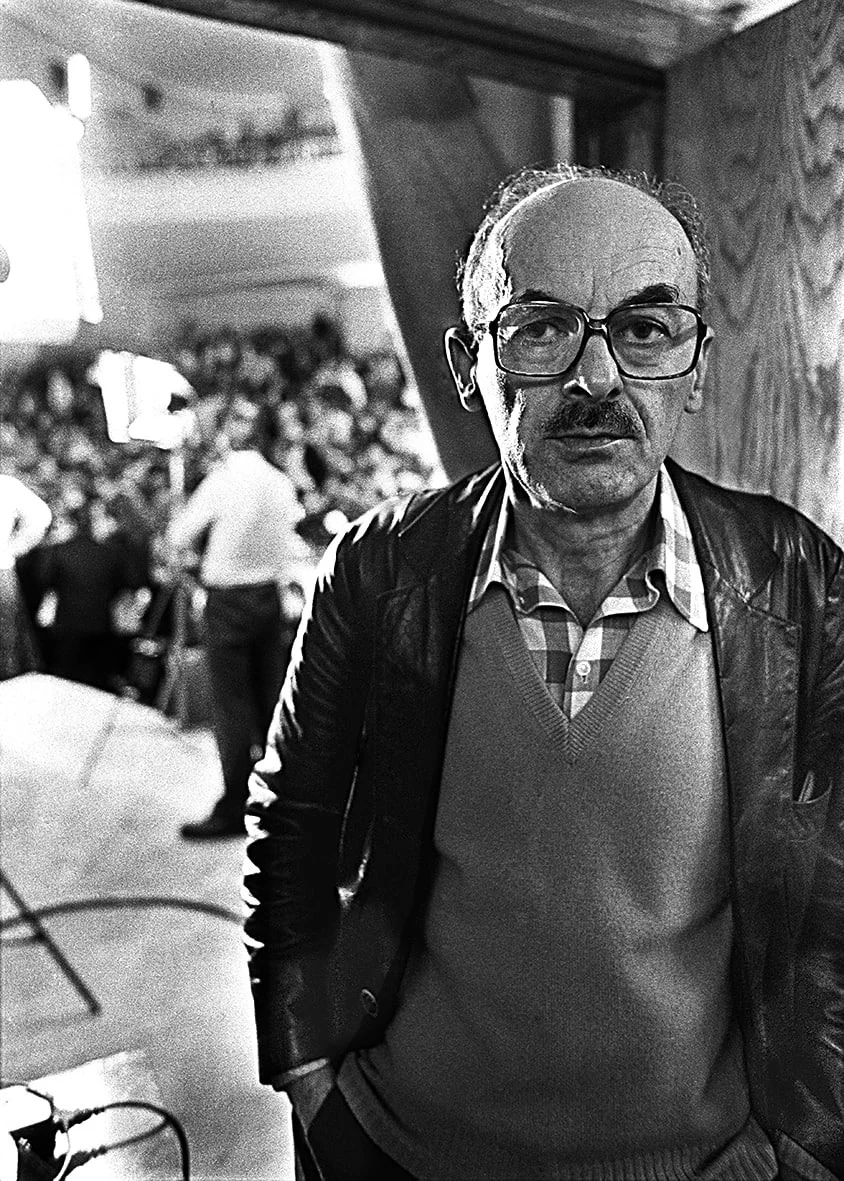
Now about the photo
Once upon a time, Marlene Khutsiev, working on the film “Ilyich’s Outpost”, shot Akhmadulin, Okudzhav, Voznesensky, Yevtushenko, Christmas ... Romantic hall of weakening a stray at the Polytechnic Museum.
Twenty years later, the remarkable Leningrad documentary Vladislav Vinogradov again gathered those poets and those spectators in the hall of the Polytechnic. Not everyone came and not everyone entered the stage, but the Bulat came out, and the evening took place.
There, in the backstage, I took this picture. In the intermission. Just at the moment when the artists of the Taganka entered the hall, fighting for the preservation of the theater in the absence of Lyubimov ... The defenders divided into enemies, but today, many years later, go on stage Bulat Shalvovich - they, like us, also divided into friends, would have calmed down for a short while, listening to the voice and looking at which we wanted to hold on.