
Translated material
In Moscow, after a year and a half of the repair, multimedia art museum opened
Capital changes affected not so much the building as the exhibition policy of the once progressive site

Multimedia art museum, or mamm is one of the most important art institutions in Russia. Among the main areas of his work were international projects, which are much more difficult to do in the conditions of isolation of the country. This is only one of the problems that the museum encountered in 2024 - after the completion of the repair, which dragged on for a year and a half. Medusa tells how exhibitions of an updated mamm look like in a changed context.
Large and small exhibitions, art markets and fairs open in Moscow almost every day. But now the collections of “the most anticipated exhibitions” do not look like several years ago. Bringing Western art has become much more difficult than before. In museums, there are lists of authors prohibited for showing. Exhibitions are regularly closed due to denunciations. Now artificial studies get work from the storerooms, arrange the anniversary retrospectives of the classics and turn to formal themes like colors and fruits, avant-garde and movement, sports and architecture.
The opening of the multimedia art museum after a protracted repair against this background is a noticeable event. Back in 2020, on the eve of the 25th anniversary of Mamm, the founder and director of the museum Olga Sviblova said that the museum did not build a souvenir store and a cafe on the roof-despite the promises of the city authorities. And in September 2022, mamm closed for reconstruction.
The museum managed to make new floor and roof, replace ventilation and plumbing, update the foundation and engineering systems, open a cafe and a souvenir store (though not on the roof). Overhaul lasted a year and a half instead of the initially planned three months, and the opening had to be transferred several times. The situation was complicated by problems with the import of building materials. However, visitors are unlikely to notice capital changes.
What is the famous creator Mamm Olga Sviblova
In an interview with the photographer George Kardava, Sviblova herself joked about her “character that legends go about”, and the tendencies of “screaming terrible”. Nevertheless, journalist Leonid Velekhov, the host of the Personality Cult program on Radio Liberty, noted that Sviblova managed to create the first museum of photography in Russia, make photographic exhibitions fashionable and achieve recognition of photographs with a type of modern art - precisely thanks to its temperament.
By the specialty of Sviblov - a psychologist. She began to oversee the exhibitions in 1984. A little later, she began to make documentaries about art and Soviet unofficial artists. Over time, Sviblova’s interests became wider: today her work is focused on photography, historical and modern, but no less carefully, she monitors modern art, especially its digital forms. That is why Mamm, founded by Sviblova in 1996 (then it was called the Moscow House of photography), promotes not only the photograph itself, but also contemporary art. The institution collaborates a lot with young Russian artists: finds new names, embeds them into the context of the Russian and international art world.
Sviblova’s career quickly reached the international level: her films received prizes at European festivals, she oversaw exhibitions of Russian, Ukrainian and Georgian artists in different cities of Europe, and brought foreigners to Russia. In 2007 and 2009, she was the curator of the Russian pavilion at the Venetian Biennale of Contemporary Art. Its most important projects in Russia-Biennale “Fashion and Style in photography” (since 2001), photobiennale (since 2008) and “The Art of the Future” (since 2022), where art projects are shown based on new technologies.
In 2006, the Moscow School of Photography and Multimedia named after Rodchenko, one of the most important Russian universities in the field of contemporary art, which did a lot for domestic photography and video art, opened. Graduates of the School Rodchenko are not only photographers, but also painters, video artists, musicians, interdisciplinary artists. Among them, for example, Danila Tkachenko , known for photographs of burning abandoned villages, members of the Pussy Riot group, Ekaterina Samutsevich and Diana Burkot, laureates of art-premium Polina Kanis, Sasha Pirogova, Dmitry Venkov, Evgeny Branilshchikov and Albert Soldatov.
Another important project of Sviblova is a gift to the French center Pompido from Russian collectors. In 2016, the Paris Museum received 357 works of modern Russian artists as a gift-it was a serious step for cultural diplomacy.
The founder of Mamm is working closely with the Russian authorities and supports her projects. In 2021, she received the Tavrida Legends Award for many years of cooperation with the Crimean art-cluster Tavrida-he appeared shortly after the annexation of Crimea at the initiative of the state. In December 2022, Sviblova presented in the Kremlin awards to the winners of the Russian Society “Knowledge”, created by decree of Vladimir Putin. And in May 2023, she fired from the School of Rodchenko the photographer Valery Nistrutov for the fact that the chairman of the Duma Committee on Culture Elena Yampolskaya did not like his comments on the pictures of the Soviet military photographic correspondent Evgeny Khaldey.
Olga Sviblova did not comment on the invasion of Ukraine: in March 2022, she was reproached for both pro-government telegram channels and opposition media . She herself in a recent interview explains her silence as follows: “Firstly, every word will respond, and secondly, if a matter cannot grow from my word, then it does not have to be pronounced.” Sviblova says that she could have closed the museum from the principle and go abroad, but considers it necessary to do what, from her "point of view (even if it is our illusions), should bring some result." And he adds that "art will not save the world," but it "gives a fairly large number of people to live on."
Previously, international projects played an important role in the success of mamm. Damien Hurst’s personal collection was shown here, the first retrospectives of Konstantin Brancusi, Lucho Fontan and Joseph Koshut (all of them are the largest values of contemporary art) in Moscow. Of course, the classics of world photography were exhibited-for example, Henri Cartier-Bresson and Annie Leibovitz. Mamm collaborated with the center of Pompis, European, American and Asian galleries, foreign funds and cultural centers. Now that the museum is returning to work after a long pause, it is obviously impossible to do international projects with such intensity. The updated mamm showed eight new exhibitions. More than half of them about sports and fashion. Among the projects there are, in fact, two international ones: the exhibition of Eric Bulatov, living in Paris, and the exposition of Italian photographers Edoardo Delille and Julia Piermartiri.
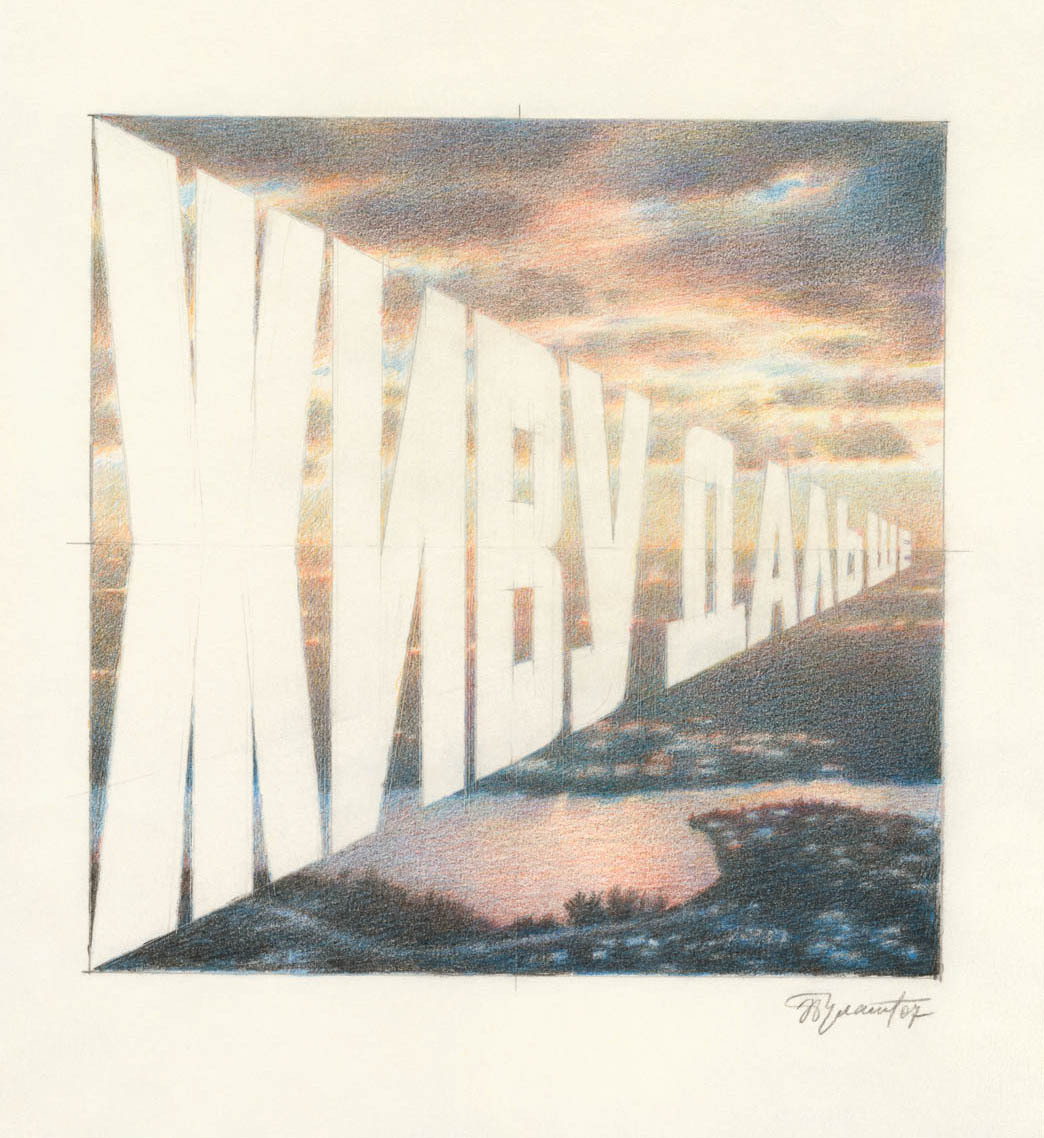
The works of Bulatov-the classic of social art and Moscow conceptualism-are united in the project “I live on. Laboratory of the artist. " Exhibits belong mainly to domestic state and private collections. Part of the work from the author of the author. Mamm is not the only institution that Bulatov decided to celebrate the 90th anniversary of Bulatov: in the fall, his anniversary exhibition was opened in Nizhny Novgorod under the curator of Marina Loshak, ex-director of the Pushkin Museum, and in December the Moscow Gallery Pop/Off/Art showed the artist's graphic works. But no one could collect a comprehensive retrospective: it is impossible to import paintings from Europe, to set picturesque works of the last 20 years, written abroad, too.
The series “Freedom is freedom”, created in the 1990s and presented in mamm, now sounds acute again-like the latest graphic work called “Enough”. “This is how I perceive today's life,” Bulatov said in an interview. - It seems to me that everyone is talking about and think about it now. Everyone was already tired of it, that the Russians, that Europeans. "
The installation of Alexei Kallima The “Rain Theorem” recalls the times when Russia lived in a global cultural context. This work was first shown in 2009 at the 53rd Venice Biennale, when Olga Sviblova was supervised by the Russian pavilion. And in 2012, the installation participated in a large-scale exhibition in San Francisco. This is a large fresco with jubilant football fans voiced by the noise of the stadium. It can be seen only in ultraviolet light - when it is replaced by ordinary lighting, the audience remains in the silence of the empty white hall. “The contrast of experiences makes us think about how differently we exist in the crowd and left alone with ourselves,” the museum’s website reports.
Two more new mamm exhibitions on a sports theme is “Sports in photography. From Rodchenko to the present day ”and“ Konstantin Batynkov, Sergey Shekhovtsov. Football". In general, sports exhibitions regularly appear in Moscow exhibition spaces and often broadcast nostalgia for the USSR. As a rule, the curators of these projects do not distinguish the totalitarian beginning in sports and sports photography, but in the expositions of mamm it is precisely it. For example, in the text for the “Sports in Photo” exhibition, Anna Zaitseva and Maria Lavrova write about “The ability to merge into a single, coherent collective body”, which Soviet photographers in sports parades tried to notice.
Museum projects about fashion - “Collection of the Still Art Foundation. Masterpieces of world fashion photography ”and“ Fashionistas of the XIX - early twentieth centuries. From the collection of mamm ” - make an unclear impression. The topic leaves space for feminist and even decolonial criticism, but there is nothing like this at exhibitions. The accompanying texts talk about the frames on dresses that formed “piquant convexities lower than the waist”, and about Russian fashionistas, whom “no one can force the fox or mink.”
In the exposition "Gift to the museum. The memory of Yuri Rybchinsky ”included work from the collection of two photographers, Yuri Rybchinsky and Eduard Gladkov: they began to collect a domestic photograph before the appearance of mamm and other specialized museums and galleries (the project was dedicated to Rybchinsky, who died last year). This is a wide panorama of Soviet photography: both pioneers and heroes of unofficial culture are found in the pictures. But this is not so much a statement about the recent history and different ways of its interpretation as a tribute to collectors.

The Atlas of the New World, an exhibition of young Italian photographers Edoardo Delille and Julia Piermartir about climatic changes, could turn out to be the most relevant among new mamm projects. But bright lightboxes, randomly located in several rows, look like a photo zone on the topic of environmental disasters.
In the first series of exhibitions of multimedia art museum of multimedia art itself - that is, uniting different mediums - not so many: the viewer sees mainly standard photographs, painting, graphics and sculpture (Sviblova, however, considers the name of the museum “masking”). But most importantly, almost all these projects are emphasized in relation to the surrounding reality. This is understandable - but this is not in the traditions of the former mamm, which made exhibitions about both the victims of political repression and the pandemic of Covid .
The current mamm is forced to adapt to new realities. Most likely, the museum will expose more Russian art and work from domestic collections. Perhaps more interact with the cultural institutions of the CIS countries. Or maybe he will take a closer look at the art of the global south, to which the attention of the whole world is now cooked-in particular the Venetian Biennale 2024. The motto of Eric Bulatov “I live on” , which gave the name to the mamm exhibition, now in a sense the motto of the museum as a whole.
"Jellyfish"