
Translated material
Navalny was compared with many historical personalities, but most often with Mandelia. Are their paths and really similar?
Says Russian politics Eliot Boreinstein
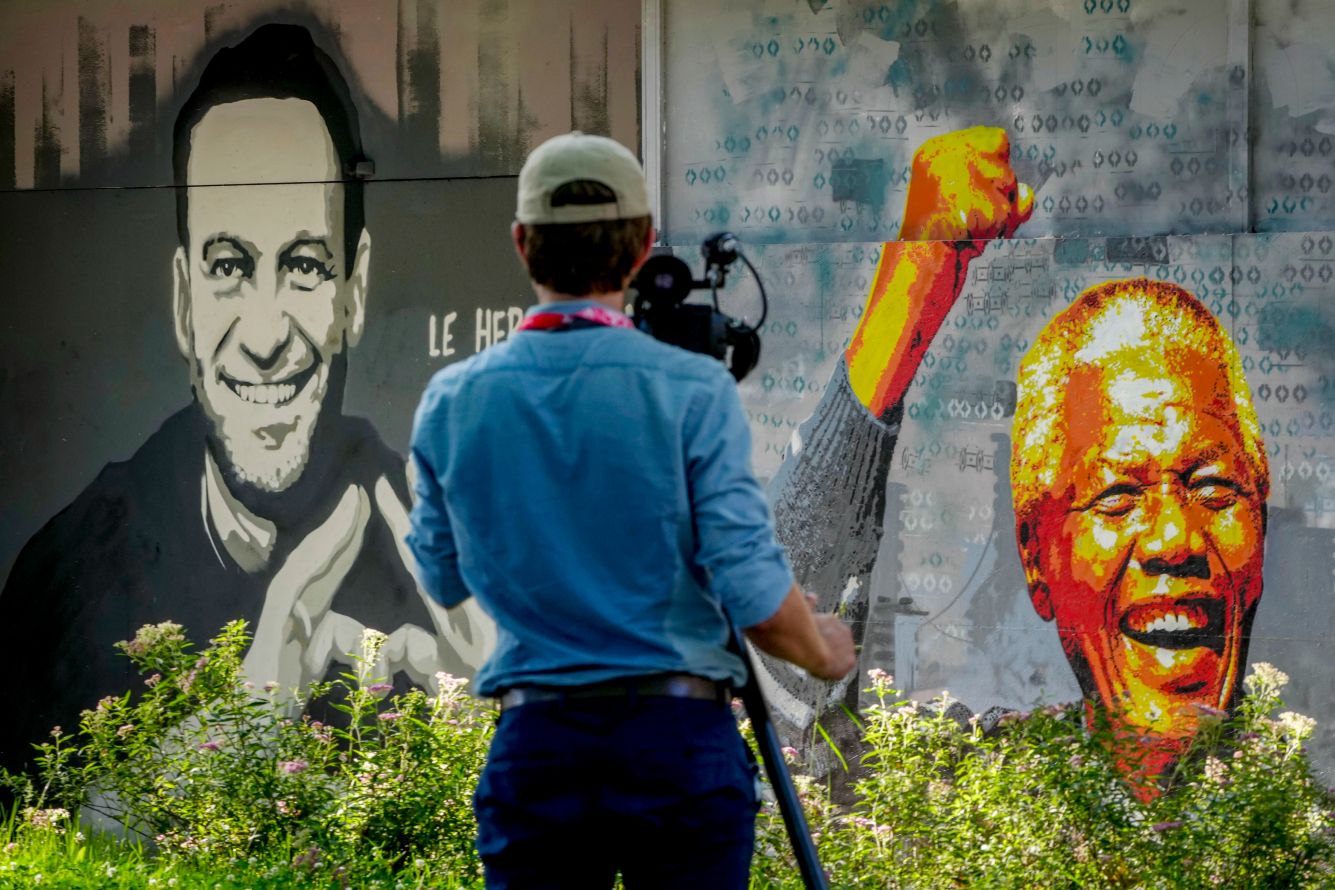
30 years ago, Nelson Mandela headed South Africa, having been released after 27 years of imprisonment. Alexei Navalny, who, during his life and after death, was repeatedly compared with the South African politician and human rights activist, this failed. As the American philosopher Francis Fukuyama formulated , "Navalny would become the same indisputable leader" as Mandela, who "left prison as if immediately to the presidency of South Africa." According to Fukuyama, "it was the fear of this script that made Putin kill Navalny." What is the main Russian oppositionist like the leader of South Africa? And why, despite the similarities in their biographies, Navalny could not repeat the political path of the Mandela? Medusa asked these and other questions to Eliot Boreinstein, a professor at the University of New York, who is engaged in research on modern Russia.

- Navalny was often compared with Nelson Mandelia. Alexey himself wanted to equal him.
-It was inevitable: people needed hope so much that they decided to compare Navalny with a person who not only could survive a 30-year conclusion and go out to freedom, but also lead their country as a result.
Each of his acts, every new impossible choice incited this hope in people. When someone devotes himself to the idea, and then consciously goes to prison ... Of course, everyone wanted him to be freed and brought Russia straight to its bright future.
Both were able to radiate zealous sincerity, and Navalny did it on the Internet, which Nelson did not have to face. It is incredibly sorry that history never provided Alexei with the opportunities that she gave to Mandela.
- Do such comparisons have a meaning?
- We are always looking for analogies and parallels; To say about something that “this is the new second world”, “New Vietnam”, “New Afghanistan” is a kind of instinct. I sometimes wanted to compare Navalny with Maria Koruson Akino , who became an opposition leader in the Philippines only after her husband’s death, also a politician [Benigno Akino] - he was killed by the then dictator of the country Ferdinand Marcos. As a result, in 1986, Kory headed the national revolution, which overthrew Markos - and she fought all this struggle with a smile on her face! Such a happy warrior.
Navalny and Akino united the same unknown optimism: they seemed to be not discouraged even in the most hopeless situations, remaining absolutely affordable, earthly, such “non -scricid”.
He is compared with Vaclav Gavel - the Czech intellectual, who became the leader of the bloodless revolution and the first president of the independent Czech Republic. But Havel always behaved with such gloomy seriousness ... But Navalny joked, posted memes and, in general, was part of the Internet culture-mischievous and Trikster.
Navalny refused to perceive the Russian regime seriously - and thereby deprived his authority. And it worked perfectly until the Kremlin decided that "to hell - we will just begin to kill and plant." Pay attention to how often Russians are now pursued precisely for “disrespect” to power and symbols of statehood.
And initially I generally perceived Navalny-because of his early nationalist statements-skeptical. And he publicly compared him to Aun San Su Zhi , who was 15 years old, while the military junta was ruled by Myanmar, under house arrest. After the liberation, she headed the new democratic government of the country, but in the end, when they carried out the genocide [Muslim minority] Rohingya, she simply mourned himself .
Aun San Su Ji came to power as a leader of an influential producing movement, but at a critical moment did not take the complaints of the country's national minorities seriously. I also once thought about Navalny that he could not become a very “ideal” leader of after-Putin Russia and would probably continue to allow himself to be nationalist statements. Now I understand that he was unfair to him - and underestimated the transformation that he had done over the past 20 years.
I don’t want to compare Navalny anymore with anyone. Just no one comes to mind. His ingenuity, political dashing, ultimatical readiness to return to Russia, finally his death ... This is a unique political trajectory.
- Human rights activists from Amnesty International excluded from their lists “prisoners of conscience” both Navalny and Mandel . Is it possible for a practitioner to remain impeccable?
- The revolutionary who is trying to change power in the country, comply with the standards of Amnesty, is almost impossible for moral purity. Navalny, obviously, was a prisoner of conscience.
I often see similar in American politics and media: first we choose someone to the position of the “saint”-and then we exaggeratedly react sharply to every mistake of it.
-His first term-then still conditional, in the Kirovles case -Navalny received on July 18, 2013, on the day when Mandela was 95. Since then, they often said that the Kremlin repeats the mistake of the government of the apartheid of South Africa: it gives the status of the martyr its main critic.
- By 2021, when Alexei was in prison, Putinism became absolutely ruthless. Previously, when people went to jail, there was a hope that they would come out of it. And the regime was a little better pretended that the country has a working legal system.
Then it seemed to me that he could go out only if Putin dies first. The percentage probability of this existed, but the regime already, obviously, wanted to discard all these subtleties-and start to produce martyrs. As much as you want.
Returning to Russia, Navalny played roulette. It was impossible not only to predict whether he could leave prison, but what Russia itself would be by that time.
When Mandela was freed from his long imprisonment, a kind of restructuring has already begun in South Africa. It was obvious to everyone that the apartheid regime collapsed, and the people standing behind him - so as not to get into prison - joined in full -fledged negotiations with those who came to their place.
In today's Russia, this is not even close. I don’t know anyone who would believe that at least some negotiations between the departing Putin (or his successor) and Navalny are possible. That is, Alexei would be in a very unstable situation, even he left prison.
In addition, the black majority, a significant percentage of the population of South Africa stood behind Mandelia; The unacceptability of the apartheid system was spoke publicly. And Navalny, given the Russian repressive machine and propaganda, did not have the opportunity to increase the same support.
In South Africa, the majority of the population was refused rights simply on the basis of skin color, depressed for decades-they had no reason to believe that the regime was at least somewhat legitimumen. In Russia, a significant part of the population is forced to rationalize the current situation.
- With the death of Alexei, Russia has lost the only potential leader in peaceful transit of power: South Africa had Mandela, Russia had Navalny.
- It is much more important, Russia has Putin, and in South Africa there was [the last white leader of the country Frederick] de Clerk - and he was ready for negotiations, because he understood: a bloody civil war would become an alternative.
In Russia, this is not close. And Putin is unlikely to represent himself anywhere except as the president’s post. And he also understands that after the transit of power will not leave him at large. So he can only continue.
- After the death of Navalny, they began to compare not with Mandelia, but with Martin Luther King - the younger, who fought for racial justice and whose murder in 1968 convinced thousands of people that non -violent resistance is at a dead end.
“It's too early to talk about it.” After the murder of King, people could openly remember him, demonstrate his images, say that they intend to continue his work. In today's Russia, it is impossible to say that you are “going to continue the case of Navalny,” and not go to jail.
Navalny was not allowed to turn his charisma, mind, beliefs and moral authority into real political power - and this is incredibly sad. If someone could carry out transit of power, then this is it. But the Russian regime wanted his death too much.
If Mandela died in prison, we would remember him as a martyr - and the continuation and ending of his stories would not be written. Unfortunately, this is how we will remember Navalny - as a person who has never received his chance.
Talked by Lilia Yapparova