
Translated material
"Do not be too specific"
Macron's constant hints of the willingness to send troops to Ukraine are nervous both the Kremlin and the EU. But this is exactly what the president of France achieves
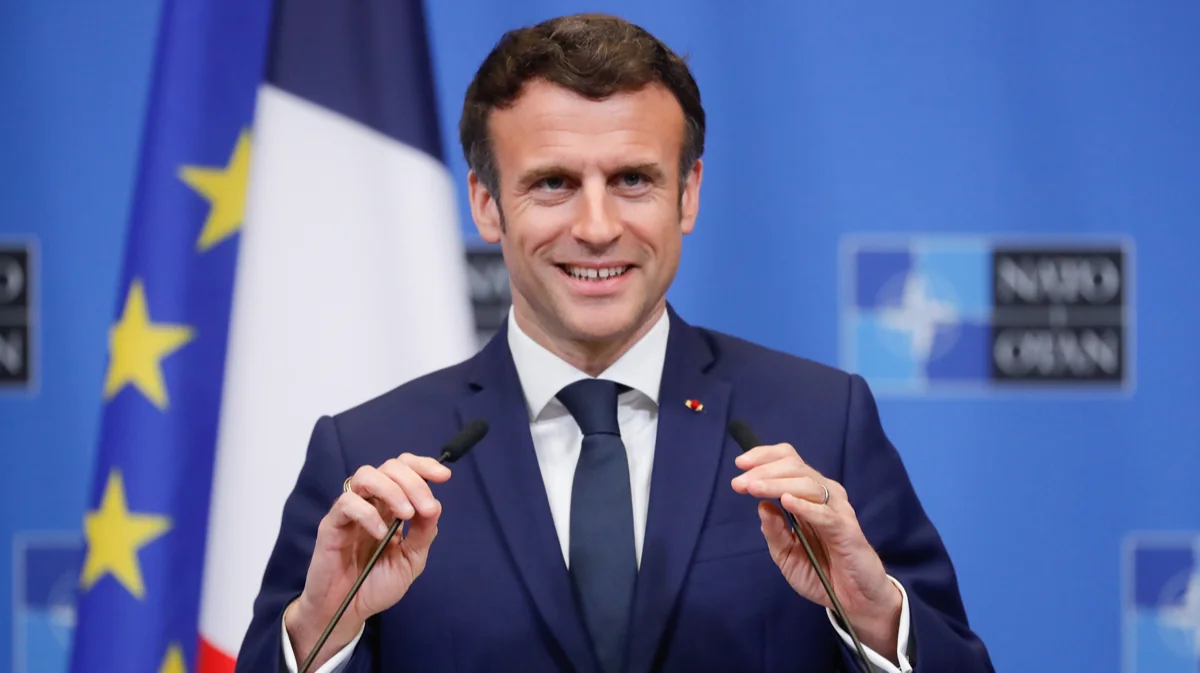
French President Emmanuel Macron at a press conference at the end of the meeting of the leaders of the Big Seven countries at the NATO headquarters in Brussels, March 24, 2022. Photo: STEPHANIE LECOCQ / EPA-EFE
“I do not exclude anything, because we are faced with a person who does not exclude anything,” said Emmanuel Macron in an interview with The Economist, published in early May, when he was once again asked about the possibility of entering the Western forces into Ukraine.
The President of France regularly repeats this abstract formulation in different variations for several months, forcing political scientists and guessing all the others what he actually means and is really ready to send the French army to the aid of the Armed Forces. It seems that Macron admits the ambiguity of his statements specifically. This approach is called “strategic ambiguity” and is used so that the enemy does not understand exactly where the red lines pass, and thereby be more careful. Whether this ambiguity will lead to the fact that the French troops will eventually find themselves near Kiev, and what else is trying to achieve Macron by statements in Ukraine, the New European European was versed in.
On the evening of February 26, 2024, high -ranking officials from three dozen countries gathered in Paris for the next conference in support of Ukraine. The event in the Champs Elysees began according to the scenario, which has become traditional in two years of full -scale war: a video message from Vladimir Zelensky, a discussion of the supply of weapons to Kyiv, a long -term plan for the support of Ukraine. But the end of the meeting turned out to be unexpected for many in Europe: at the final press conference, French President Emmanuel Macron first spoke about sending the ground forces to Ukraine.
There is no consensus regarding the entry into the Ukrainian territory of the Western forces, but “nothing should be excluded in dynamics,” said Emmanuel Macron, answering the question of the journalist of the Bloomberg agency, who asked him to comment on the speech of the Slovak Prime Minister Robert Fitzo. On the eve of the conference, he stated that several NATO and EU countries are allegedly discussing the possibility of entering the army into Ukraine as part of bilateral agreements with Kiev - a decision that Bratislava, according to him, would never support.
“Many of those who say“ never today, ”two years ago said: never tanks, never aircraft, never a long -range missile, never, never,” Macron said caustically.
The questions on a hot topic were asked twice more, but the owner of the event escaped with hints: “I did not say that France does not support this”, “We are ready to do everything necessary so that Russia does not win this war,” “This is strategic ambiguity.”
“The pigeon has turned into a hawk,” one of the main French newspapers Le Monde commented on this transformation of Macron.
Macron’s statement did not go unnoticed in the Kremlin: in the event of the appearance of the military NATO in Ukraine, it will be necessary to “talk not about the likelihood, but about the inevitability [of a direct conflict with the alliance],” Dmitry Peskov emphasized at a briefing.
Ping Pong explanations
As a result, his ministers had to explain the words of the French president the next day. Answering the questions of the macron of the deputies of the National Assembly, the head of the French Foreign Ministry Stefan Sejurn, tried to mitigate the president’s statements: the clearance of the territories of Ukraine, protection against cyberosis and the production of weapons may require the presence of the French military. At the same time, the “threshold of warfare” will not be crossed.
The head of the Ministry of Defense did not lag behind the Minister of Foreign Affairs. “It's not about sending troops to war with Russia,” said Sebastien Lekornny. “Saying that nothing can be ruled out is not weakness and not escalation.”
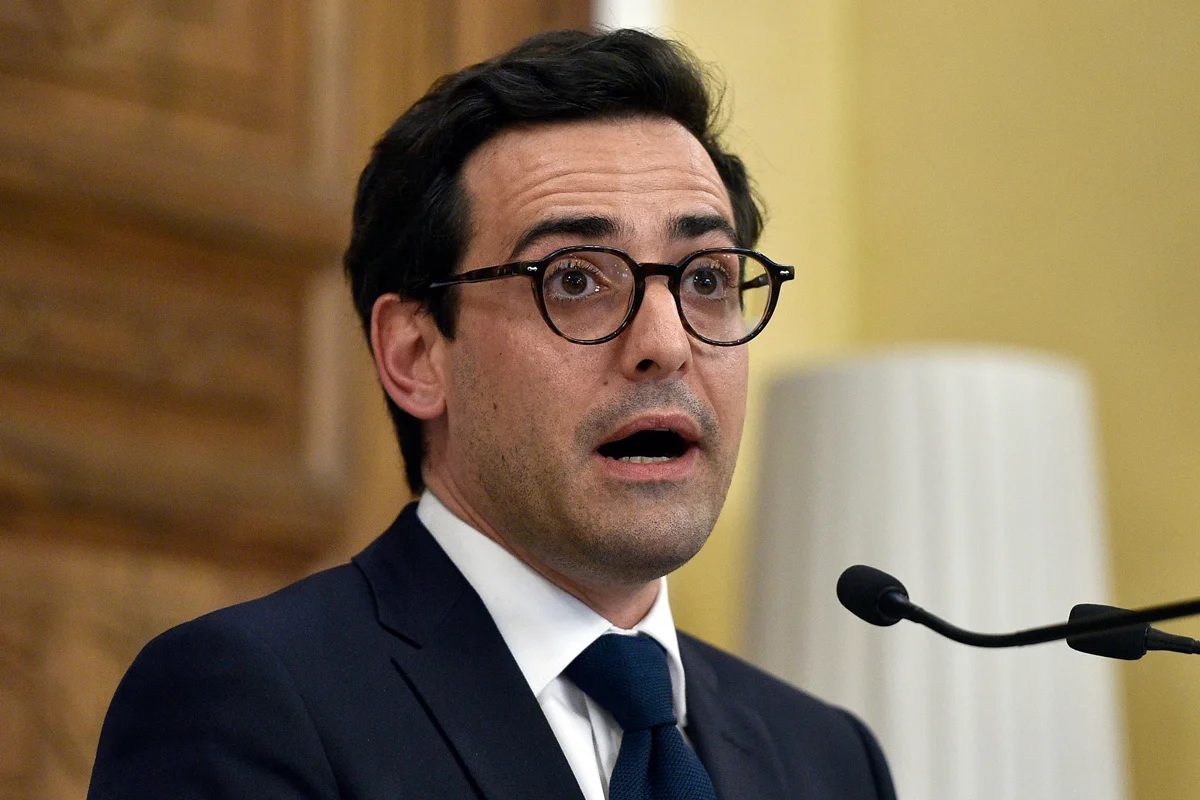
It would seem that the tension was removed. But two days later, on February 29, Macron himself commented on his previous statement: "Each word of mine on this topic has been balanced, thought out and verified."
The discussion resumed, and with it - a public dialogue between President Macron and Foreign Minister Sejurn.
“Paris will not send troops for warfare. The French will not die for Ukraine, ”the head of the French Foreign Ministry said on March 1 on the air of France Inter.
“Answering the question asked to me about the sending of troops, I said that nothing is excluded. We open the debate and think about everything that can be done to support Ukraine, ”Macron again emphasized on March 4 in an interview with the Czech publication Novinky.cz before a visit to Prague, where he later called on the Western allies“ not to be cowards ”and make a“ strategic breakthrough ”.
“We must defeat Russia without waging a war with Russia. We never crossed the threshold of joint warfare and will not cross it, ” - as if in response to the president’s statements, the head of the Foreign Ministry of Sejurn on March 5 convinced the French on the air of LCI.
A week later, Macron again raised the question in a large interview with the two largest French television channels TF1 and France 2: “All options are possible. [...] France is the power of the world. Just today, in order to have peace in Ukraine, we should not be weak. ”
Such a ping-pong between the head of state and the head of the Ministry of Foreign Affairs, and at the same time the rest of the world has been going on for several months.
The last episode was the Macron interview to The Economist magazine, in which he repeated that he “did not exclude” the sending of French troops to Ukraine upon the occurrence of certain conditions. Among them are the “Front breakthrough” and Kyiv’s request for support. “I think that it is a priori to exclude this is not to learn from the last two years,” the French president summed up.
Five scenarios
However, the key question, the answer to which politicians and political scientists have been trying to find for three months is as follows: for sending to Ukraine what kind of army units and for which missions the macron hints, pronouncing the phrase “ground forces”?
Assessing which units Paris could send to help the allies, it must be borne in mind that now people with French citizenship are fighting in battles on the side of Ukraine.
We are talking about volunteers who went to the front in the ranks of the so -called international legion of territorial defense of Ukraine. In Kiev, it is argued that at the beginning of a full -scale war, about 20 thousand people joined it - immigrants from 55 countries, mainly from the USA and Great Britain. But there are also the French - according to various estimates , there are from 100 to 300 people. Among them, people with the experience of service in the French army, and without it. However, openly talking about their trips to the front to journalists, they all emphasize that at the moment they are not related to the Ministry of Defense of France and are obeying only the Armed Forces of the Armed Forces. It also pays them a salary - according to volunteers, it is about 1,500 euros.
French volunteers from the International Legion also are not related to the famous French Foreign Legion - a division of the regular army of the republic, which conducts operations abroad and in which mainly citizens of other countries serve. Entering the ranks of the legion, they take the oath and change the names, and after five years of service they get the right to a French passport.
In early May, stories were dispersed on the Internet that 100 military French foreign legion was supposedly already fighting under Slavic, but this is a “fake” and “disinformation”, the Foreign Ministry claims . And the American Steven Brian, who launched his hearing, who calls himself a former Pentagon employee, admitted that he actually learned about the imminent arrival of 1,500 French legionnaires from telegram channels to the front, and not from informed sources.
At the same time, military personnel of the Western armies are probably unofficially present on the territory of Ukraine and now - although not as part of military units. The United States and the UK have already publicly admitted that their military advisers are working in Ukraine, who "help and consult."
It is logical that 50 countries that send Ukraine to Ukraine as part of the Ramstein format accompany their weapons, ”the president of the Institute for Prospective Analysis and Security in Europe (IPSE) Emmanuel Dupui agrees with this. -250 armored personnel carriers, about 40 AMX-10 RC tanks, Earth-Air missiles, Krytal complexes and so on. The Ukrainian military needs to learn to manage with all this. ”
According to Dupui, the next step in France, which does not lead to a serious escalation of the conflict, may be just an increase in the number of military advisers, as well as sending French sappers and cybersecurity specialists to Ukraine.
Five scenarios for the strengthening of the presence of France in Ukraine were also determined by the Le Figaro newspaper. The first of them is the construction of French defense plants there. The second and most popular experts in the midst is the option already described above with military advisers. The third is the sending of the French troops to protect Odessa and its ports. The fourth is the creation with the participation of the Western military so -called security zone in the disconed territories of the Kherson and Kharkov regions. And the fifth, the least likely, is a real trench war, where the French will fight side by side with Ukrainians.
Three of these five scenarios suggest a direct military clash of Paris and Moscow, which in France they are still trying to avoid. “This would be feasible only with huge risks and significant resources,” said Francois Shevansi, general and geopolitics consultant.
Enharging ambiguity
Macron's ambiguous statements on the introduction of troops into Ukraine are explained by following the principle of “strategic ambiguity”.
The idea underlying the author is attributed to the author of the book “The Art of War” by the Chinese philosopher Sun Tzu.
But the general meaning of the approach is to prevent the enemy from understanding in advance what exactly you will do if he crosses this or that “red line”, and thus force him to be careful.
Simply put, as Macron himself defines the concept, “strategic ambiguity is not to be too specific.”
“In conditions of war, it is important to play not only on material resources - tanks, fighters, military budget - but also on feelings,” the French political scientist Samuel Ford explains the approach. First of all, on a sense of fear.
In the case of France, the fear of its opponents can be quite justified. As the president of the Institute of Perspective Analysis and Security in Europe (IPSE) Emmanuel Dupui, the French defense doctrine-the White Book, allows you to deploy an expeditionary building of 15–20 thousand military personnel-that is, almost a division along with all military equipment in a conversation in Europe.
In addition, France is a nuclear power and winner of the second largest defense budget in the EU. According to the Stockholm International Institute for Research of World Sipri Problems, in 2023, Paris spent $ 61.3 billion on military costs - this is still not comparable to the United States ($ 916 billion), but already not much less than Russia's expenses (about $ 109 billion).
However, in addition to “strategic ambiguity”, Macron's repeated statements, probably, have another reason - the desire to earn points among its nuclear audience.
On the eve of the June elections to the European Parliament, the president is trying to distance himself as much as possible from the image of a politician who talks for hours on the phone with Putin, and appear before voters in a more profitable light,
than the Le Pen party, which is often accused of flirting with the Kremlin.
True, the latest surveys show that the transformation into “hawk” did not help Macron: in April, about a third of the French were ready to cast their vote for the ultra-right ones, for the presidential “revival”-almost half as much.
Unperethical idea
The idea of introducing French troops into Ukraine is not very popular among citizens of the republic. The French media often describe the reaction of the public to the hints of Emmanuel Macron on the entry of troops into Ukraine with the word Tollé, which can be translated as a “storm of indignation”.
According to a survey from the end of February, 76% of the population opposed the participation of French troops in the war with Ukraine. Supporters of the right and ultra -right protest are especially fiercely - 76% of those who vote for the “Republicans”, and 84% of the voters of the National Association. Reacting to the presidential statements, the leader of the French ultra -right Marin Le Pen indeed accused Macron of neglecting the lives of French children.
The situation is not much better on the left flank: 67% of supporters of “unconquered France” and 65% are opposed to the introduction of troops - the socialist party. “The war with Russia would be madness! -exclaims the leader of the ultralery Jean-Luke Melanshon. - Verbal escalation is already an irresponsible act. No war! "
Those who usually support the Presidential Party “Renaissance” did not like the idea of Macron either: two -thirds of her supporters spoke out against.
Against the backdrop of crises of recent years-pandemia and inflation due to growth in energy prices-residents of France are increasingly interested in domestic problems, not foreign policy, therefore, protectionist promises of nationalists are more response.
Macron also added a lot of dissatisfaction, as a result of which the retirement age was increased from 62 to 64 years, and other attempts by the French government to save .
Sending the army to Ukraine would definitely demand even greater costs. “The dead end, which the war entered, seems to give rise to fatigue among part of the French population, and it looks at Ukraine not so favorably,” said Jerome Furke from the French Institute of Public Opinion (iFop) in the spring. Over the past two years, the number of Frenchmen who are ready to express support to Kiev decreased from 82% to 58%, showed data from IFOP and the Foundation Jean Zhores.
In the winter of 2024, only one out of ten Frenchmen believed that Ukraine would win the war, show the results of research ordered by the European Council (ECFR). And only a third of the citizens of the republic said that Europe should help Kyiv return the captured territories.
The French continue to support Ukraine, but not so much as to send troops, especially if it also requires significant economic costs.
Lone wolf
“Macron took a taboo on the introduction of troops into Ukraine” - another phrase, which in Anglo - and the French -speaking press is often used to describe the new rhetoric of the President of France.
“Without excluding” the sending of the army to the front, the French leader discovered a discussion, which had previously been difficult to imagine: Germany , the United States and NATO leaders spoke out against, but continued the debates in a public field.
A little more than two months have passed since the first mention of Macron of the Ground Forces, but the statements of the Western allies on the issue of assistance to Ukraine have already become more courageous. So, during a visit to Kiev in early May, the British Foreign Minister David Cameron for the first time admitted that the Armed Forces of Ukraine can be used by British weapons to strikes Russian territory.
It is likely that Macron is trying to push his German colleague Olaf Sholts with such statements to share Taurus winging missiles with Ukraine-at the end of April, the German Chancellor again excluded their supply to Kiev.
There are precedents. In the winter of 2023, Macron was the first to agree to send Kiev light tanks. Then this caused surprise and even the anger of the allies, including the closest - Berlin. Today, “Leopards” and “Abrams” are supplied from more than a dozen countries. Later, the French President made the supply of Western fighters to Ukraine. This is “there can be no talk,” said Boris Pistorius, Minister of Defense of Germany Boris. And after a year and a half, Kiev is preparing to accept the first F16 from the Netherlands and Denmark.
In mid-February 2024, France is one of the first-after the UK and Germany - concluded an agreement on security guarantees for ten years with Ukraine: Paris promised to help, first of all, financially, Kiev with the strengthening of the army and economy, as well as “in the event of a future armed attack” from Russia to conduct “consultations to determine the measures necessary to counteract or contain aggression”. Paris was followed by Copenhagen , Rome and Ottawa .
«[В Европе] Макрон прославился тем, что спешит с радикальными предложениями в стиле одинокого волка», — написал бывший посол США в ОБСЕ Дэн Бэр. При этом он напомнил, что
в последние месяцы в НАТО всё чаще звучит недовольство тем, что Франция пытается играть роль лидера на континенте, при этом не подтверждая слова действиями. Среди стран ЕС она находится лишь на 22-м месте из 27 по объему помощи Украине в сравнении с ВВП.
Кроме того, если в рамках двусторонних соглашений о гарантиях безопасности Берлин пообещал Киеву 7,1 млрд евро, то Париж — лишь около 3 млрд евро, что ставит его в один ряд с менее крупными и обеспеченными странами типа Нидерландов, которые согласились выделить более 2 млрд евро.
Макрон де Голль
Заявления Макрона, которые звучат последние несколько месяцев, имеют куда более широкую цель, чем решение вопроса об отправке войск в Украину. Они призваны добавить французскому президенту очков как лидеру на общеевропейском уровне.
Так, предложение Макрона отправить войска в Украину, помимо прочего, принесло ему поддержку в странах Восточной и Северной Европы. «Вопрос о войне в Украине, несомненно, является более острым для стран Балтии и Центральной Европы, чем для французов», — подчеркивает политолог института Жака Делора Тьерри Шопен. Учитывая, что Макрон хотел бы видеть себя лидером объединенной Европы, преемником экс-канцлера Ангелы Меркель, эта поддержка ему важна.
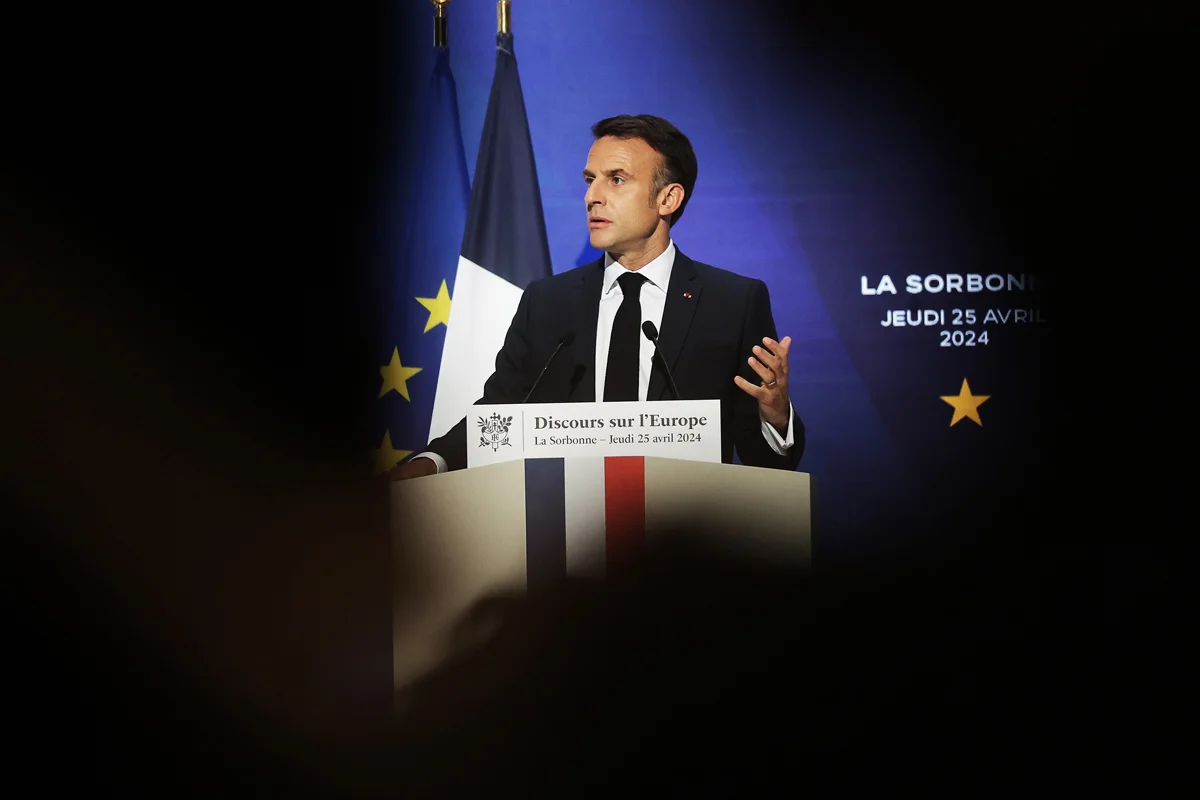
О проблемах Европы — вплоть до угрозы «смерти» — Макрон в конце апреля говорил и в своей второй программной речи в Сорбонне. Первая была произнесена шесть лет назад и дала старт его общеевропейским проектам.
Одно из главных предложений Макрона в этом году — усилить интеграцию ЕС в вопросах обороны, учредив «европейскую оборонную инициативу», которая включала бы в себя «щит от российских ракет». Предупреждая об опасной зависимости от НАТО, французский президент напомнил, что «первый приоритет для США — это США», а второй — борьба с Китаем. Он призвал европейцев надеяться только на себя и вновь подчеркнул, что сознательно «не исключил» возможность ввода войск в Украину, но всё так же не сказал ничего более конкретного.
И хотя Эмманюэль Макрон выступал в Париже, его сорбоннская речь куда больше обращена к европейцам, чем к французам.
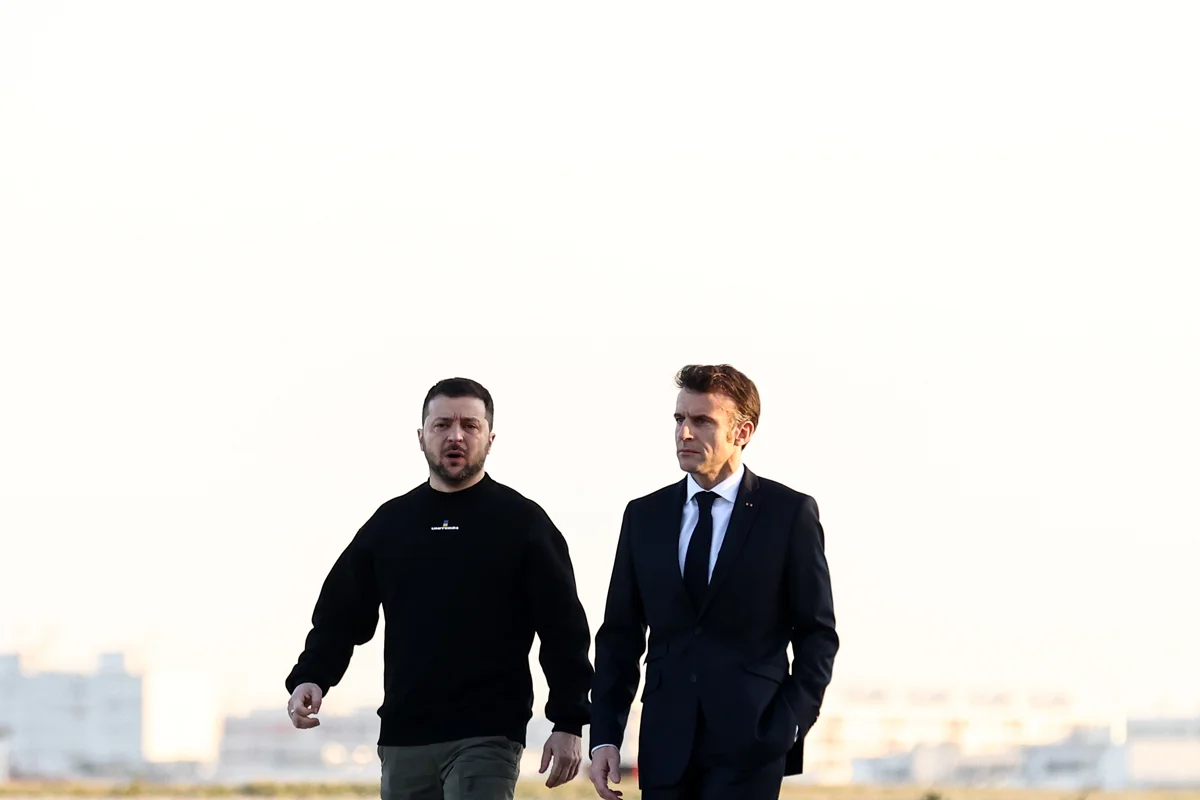
Рейтинг занимающего Елисейский дворец свой второй и последний срок президента уже много месяцев стабильно плохой: его поддерживают лишь 29% французов.
До следующих выборов осталось меньше трех лет, по истечении которых Макрон, вероятно, собирается продолжить карьеру на общеевропейском уровне.
И даже если войска в Украину так и не будут введены, а европейская карьера не сложится, в истории Французской республики Эмманюэль Макрон всё равно хочет остаться лидером, который своими заявлениями и поступками сформировал позицию всего ЕС.
Как уже писала «Новая-Европа», Макрон видит себя продолжателем идей де Голля, и для этого он готов брать на себя больше ответственности и формировать внешнеполитическую повестку ЕС. Пусть даже и путем намеренно двусмысленных заявлений, наталкивающихся на острую критику и собственных избирателей, и союзников по западной коалиции.