
Translated material
Buffon for a hundred rubles
About how, 25 years ago, Moscow received and held the final of the UEFA Cup in Luzhniki
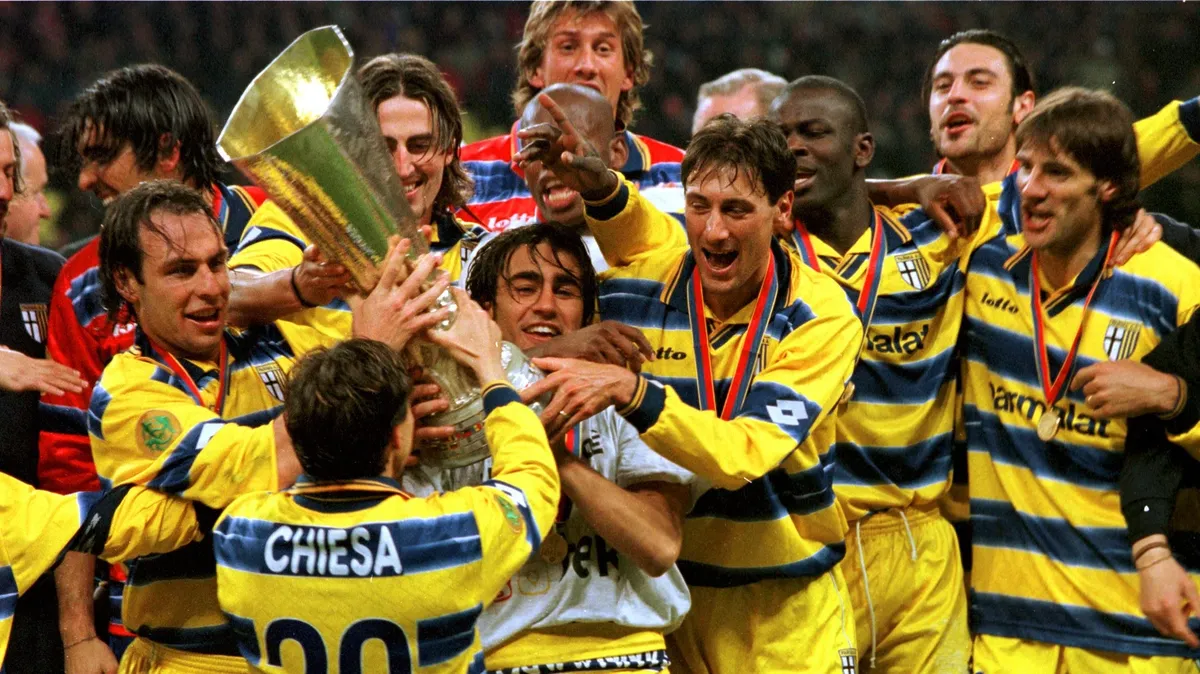
Players of the Italian team "Parma" celebrate the victory in the final of the UEFA-1999 Cup. Photo: Sport-Express / ITAR-TASS
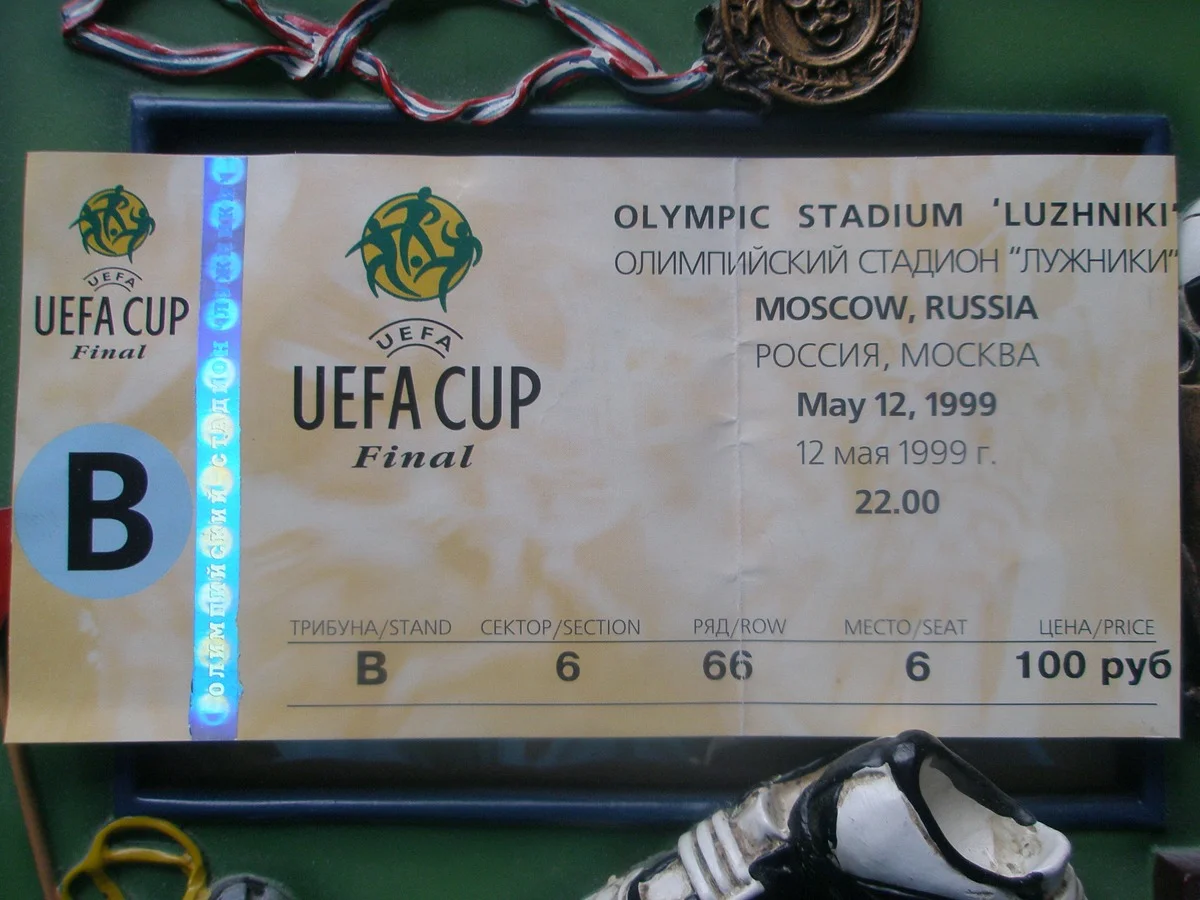
In April 1999, I was probably in the happiest queue for football tickets. People, joyfully pushing, noisily moved from the “Sportivnaya” metro to the treasured cash windows and did not believe that they would become the owners of a yellow rectangular piece of paper, on which it would be written: UEFA Cup Final.
"Come up, we survived to a big game!" - The theatrically looked like a tear and at the same time loving a friend of Leshka beat me in the side. And every five minutes he played jokingly: “The main thing is that it does not end us ...” We did not end us. We broke up with money, and three weeks later, on May 12, we watched the Italian Parma and the French “Marcel” from the 66th row of Luzhnikov. Leshka is no longer there, and I still keep my “Ticket” from an elegant historical action in the frame.
That match in some way served for our “non-football country” (determining the coach Leonid Slutsky) with a starting point and showed that we can really. No, not to drive skillfully the ball, but to arrange football performances at the highest level. And I’m not sure that Russia would have received a decisive Ligocepion fight between Manchester United and Chelsea in 2008, and then held the 2018 World Cup and adopted Euro 2020 matches in St. Petersburg, if a quarter of a century ago, the then mayor of the capital, Yuri Luzhkov and the head of the RFU, did not create an attractive miracle.
The time was difficult and not at all sports. The country with difficulty came to her senses after the August default. There were enough other military-political conflicts and problems. Here it was not necessary to think about the passes of the passes, but about how not to glue the fins. State and their own. And when on October 7, 1998, the UEFA Executive Committee announced that the main fight of the second most important European Cup will be held in Moscow, many were naturally stunned. "Come on?", "How?", "What is the joke?" - Such questions spun in the heads of the fans. I don’t know what to compare that incredibly pleasant shock. It was easier to believe that Boris Yeltsin, who adored tennis, would once lure all the star -seated racket masters to the Kremlin Cup.
The thing is that the Luzhniki competed for the right to accept the final with the Swedish Arena Rosunda, and then the Union of European Football Associations Lennart Yukhansson headed. Well, you understand ...
But Moscow, of course, also had trump cards. And above all - Vyacheslav Koloskov, who led Soviet football since 1979. In fact, the spiteful people say about him (they say, he had close ties with Alimzhan Tokhtakhunov and Otari Kantrishvili), but after the collapse of the Union, Vyacheslav Ivanovich managed to maintain and maintain a football federation in the conditions of absolute lack of money. In FIFA, the doctor and spikelet (Koloskov’s nicknames) were respectfully. Our unsinkable cartridge was friends with Joao Avlange and Zepp Blatter and knew how to achieve the necessary goals, like no other.
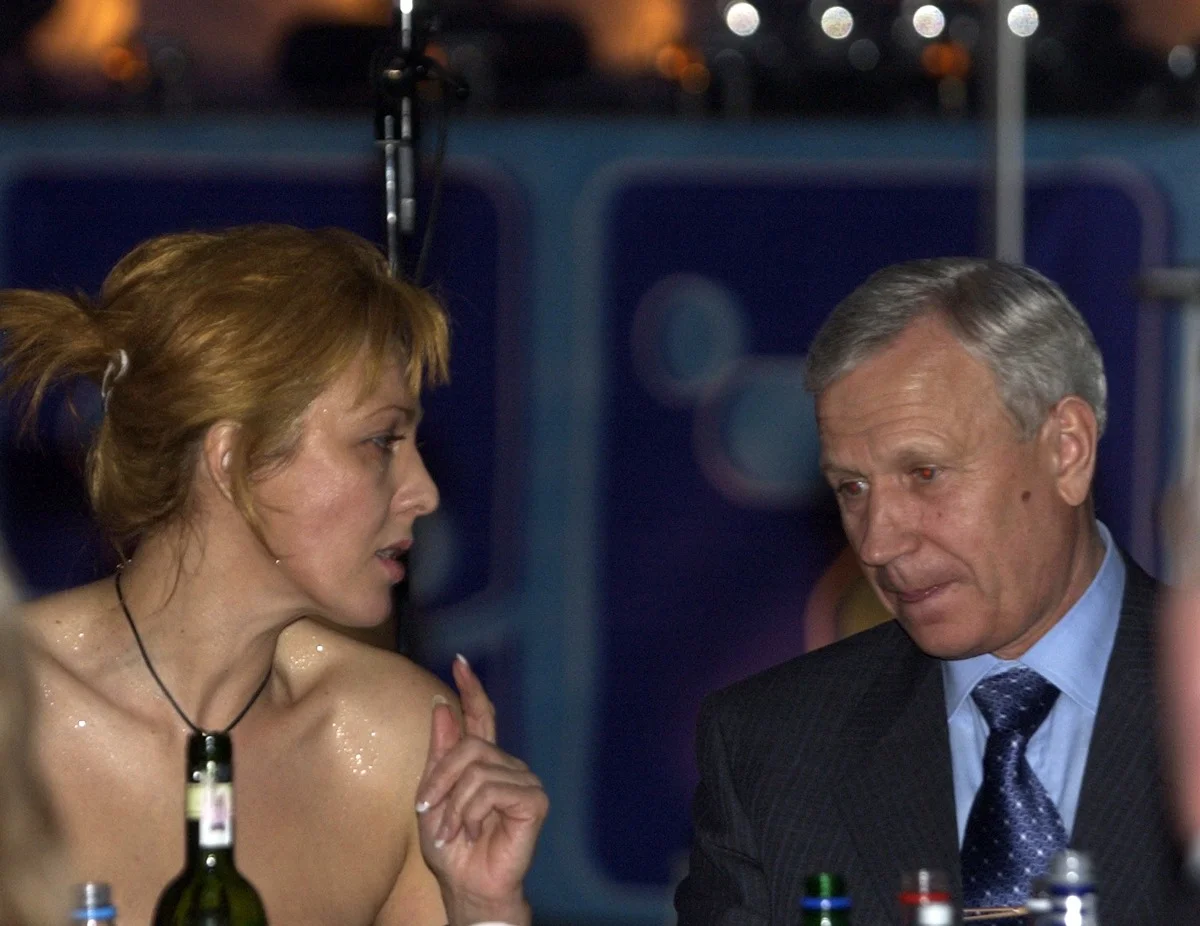
From the memoirs of Vyacheslav Koloskov
“Many treated the idea of holding the final in Moscow with suspicious. We had to connect large diplomats, people from the Olympic Committee of Russia. It was required to convince all the censors that everything would be in perfect order. ”
Convinced. And not without the help of Yuri Luzhkov, who first sent a letter to Lennart Johansson on his own behalf, which guaranteed that guests of all stripes would be placed, fed, drink and entertained in full, and then the mayor personally arranged lunch and dinner with the wrappers for a prominent Swedish boss, which he melted his heart. No matter how funny it may sound, but in the end, the Swede and pushed the metropolitan application, “spit” on his native “Rosund”.
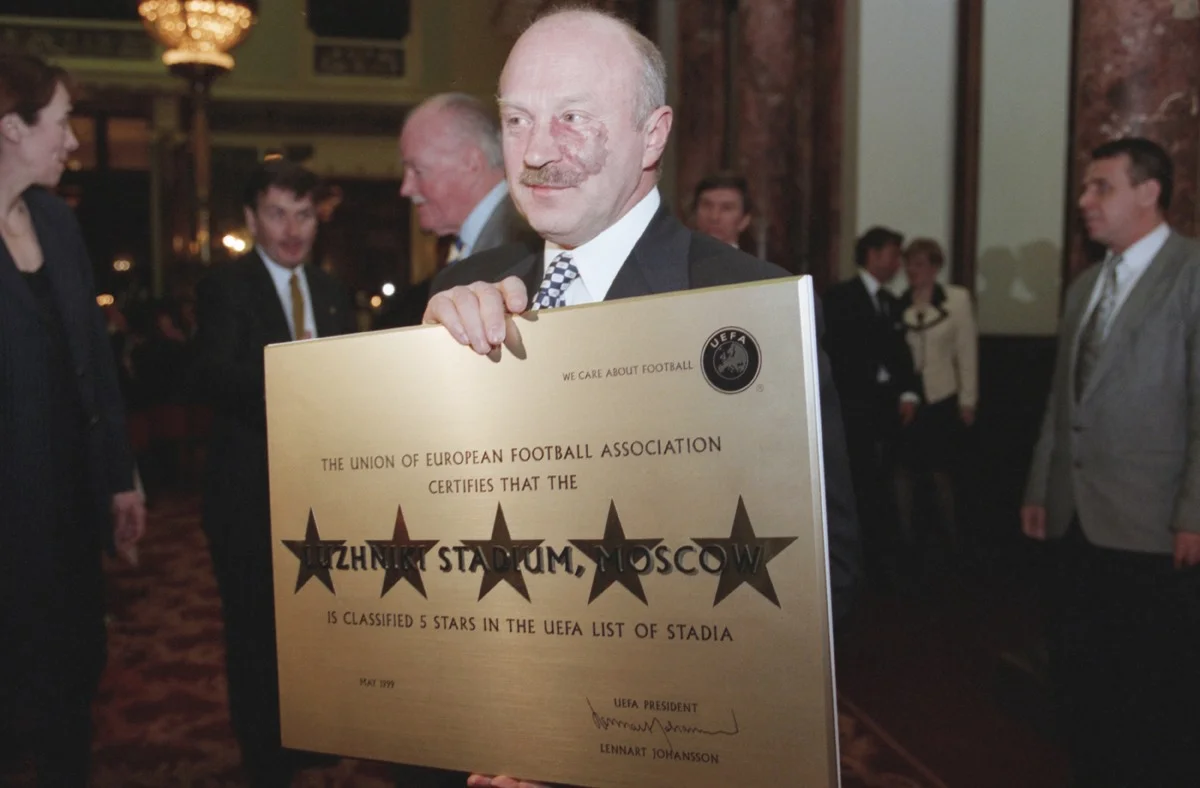
However, the mayor should say thank you for the Luzhniki, who, after the reconstruction, received the status of a five -star arena. By the way, the restructuring of the former stadium named after Lenin cost 1 billion rubles, or $ 200 million. For today, the amount is ridiculous. But then ... each of the 80 thousand multi -colored chairs cost about $ 12, and 2.5 million were spent on the scoreboard.
When the representatives of UEFA saw the finished product on the Sparrow Hills (the updated “Palace” was opened by the match of the Russian team and FIFA stars on August 6), they almost lost the speechlessness, calling the “Luzhniki” “the coolest sports structure in Europe”. True, there was one but - a terrible lawn that suffered from the fact that in addition to football, many other events were held in the Olympic Coliseum. The agronomists, who were discharged from Moscow State University and other relevant institutions, could not cope with the task of fixing the clearing, and then the director of the stadium Vladimir Aleshin promised to simply lay a new “carpet” by May 12. Which, I emphasize, was done. Although partially ...
Two more dangerous points (political and “economic”) were drawn after the fighters were determined for the trophy. And it happened on April 20. “Parma” was not particularly nomaded, but “Marseille” demanded to transfer the final from Moscow, as he was afraid for his safety. The fact is that France was a member of the NATO alliance, who bombed Yugoslavia. And Michel Platini's compatriots were afraid that Russian fans (and not only) could perform bad actions against the team. But the French quickly made the necessary suggestion from above, and they calmly accommodated at the Sofitel hotel, and the training was carried out on the Torpedo destroyed now (Parma settled in Marriott on Tverskaya, and kneaded in Luzhniki).
Another problem (and quite serious) was that the teams entered the final did not possess a large army of fans. Neither in his country, nor, of course, in Russia. To ensure order at the walls of the Kremlin, it was, of course, great, but how to fill in brand new stands in this situation? And do not forget that foreigners still had to apply for visas ... In short, the Italians requested 1,600 passers, and the French - 3300. And almost 78 thousand were released for a minute. In addition, initially the organizers planned to sell them at European rates, which would probably scare away neutral fans in the white stone.
Realizing that the old -world tariffs of the full house, to put it mildly, will not contribute, the RFU turned to UEFA with a request to introduce a separate, fourth category of “coupons” for the Aborigines. And they were heard. So, the cheapest ticket began to cost quite acceptable 100 rubles. And I remember very well how the speculators who bought up a huge number of “cheap” smooth quitches were bought hard, and then sold them in face value an hour before the performance, since the expected excitement did not happen. But again, 62 thousand spectators of Parma and Marcel were gathered. And this record of the final matches of the UEFA/League of Europe is still not beaten ...
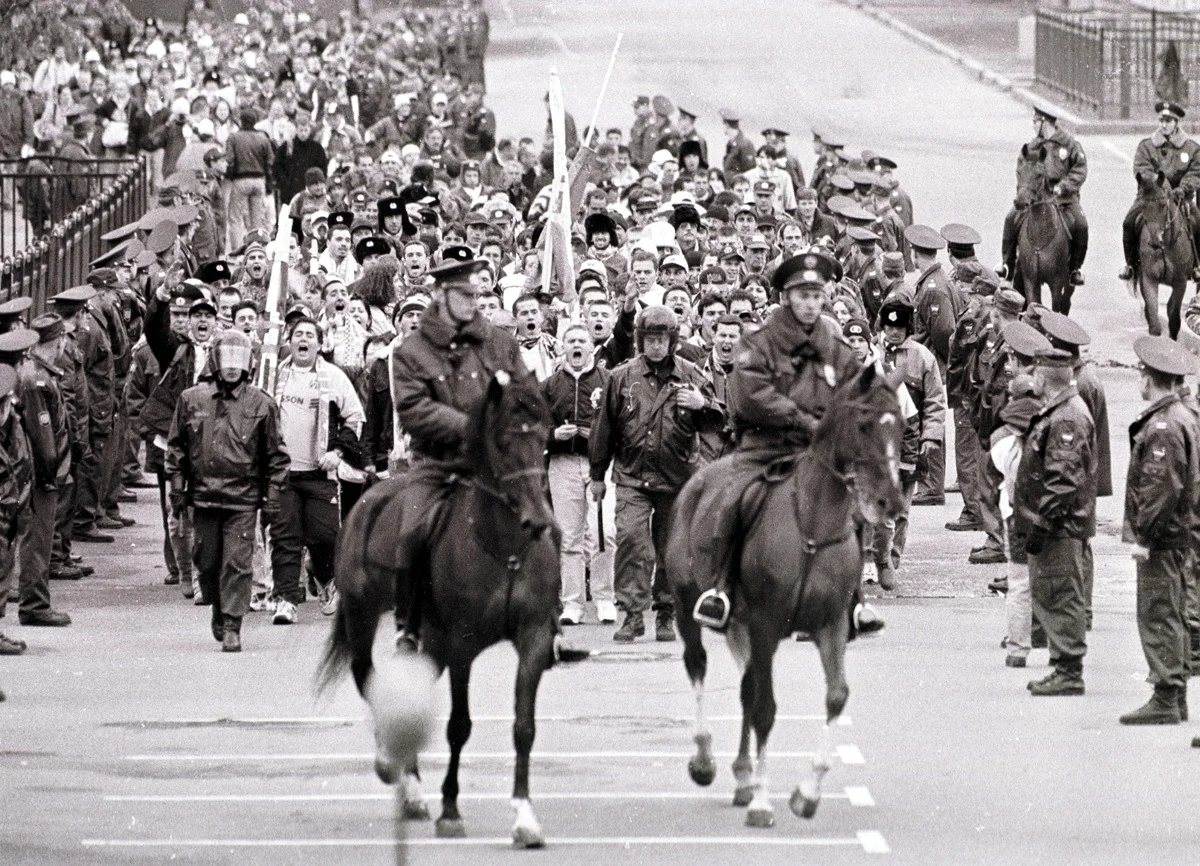
The record has not been broken by the number of police officers (then still police officers) who ensured order in Luzhniki and on the outskirts of them. About 10 thousand comrades in the form followed that day the adventures of foreign fans and their native public. Moreover, with all the guys with clubs and in helmets, the generals conducted a great briefing, explaining that when celebrating the goal of the tiffozi, no one should score to death (who went to the games of the Russian championship in the 90s, they probably remember that riot police worked with those who did not behave like in the theater). However, just in case, Yuri Luzhkov warned foreign guesters that in case of poor behavior in the city, all hooligans would receive tightly in the ears. But the ears eventually received (according to official figures) only 65 people. From among the Muscovites who have crossed the joys with alcohol ...
Separate visiting journalists went through. True, no one arrested them. In total, 644 representatives of the press worked at the match:
116 photojournalists,
134 television and radio workers,
374 writers comrade.
And they complained, in fact, at two points: cold weather (the thermometer stopped at +6 mark) and on too loud music, which was turned on at the stadium before the game, which is why many commentators did not hear the directors of their broadcasts ...
By the way, the final on which our side spent 20 million rubles was broadcast to 140 countries, and for the first time in the history of Russian TV, 25 cameras were used for its show.
The football itself, what a sin to hide, was exciting and stubborn. The Marcelian fans that had put on the earflaps, the Marseille fans were more active and inventive than their favorites, which was then led by Rolan Kurbis (in 2004, he will lead the Vladikavkaz Alania). The leaders of the blue and white-Robert Pires and Florian Maurice-harshly grabbed Fabio Cannavaro, Lilian Tyuram and Nestor Sensini. And the young Dzhanluji Buffon was only a piercing wind for an hour and a half - he almost did not have to jump behind round “shells” after the French attacks. And by the 55th minute the Provencal themselves have already missed three “banks” (the account was opened by Ernan Kryu, and finally “Marseille” finished off Enrico Keza). By the way, the second ball to the net of the gate was sent by Paolo Vanoli, who reached the Spartak two years ago before the victory in the Russian Cup ...
And exactly at midnight at the Parmesan residents specially built in the center of the softened field, commemorative medals and a silver cup were presented. Well, then Russian fans did not let Alberto Malezani's wards for a long time at a closed party. Dino Bajo, Juan-Sebastian Veron and, of course, Bufffon at the same time distributed autographs and took pictures. They did not refuse anyone. As, however, the sad residents of Marseille.
And the mayor of Moscow and the President of the RFU glowed with joy. Vyacheslav Ivanovich even took a chance to offer the European authorities to hold the Champions League final in the capital for next year, and in Russia-Euro 2008. And impudent ventures, albeit not immediately, but they were a success. In 2008, “Mu” fought for a cool eared cup with Cristiano Ronaldo and Chelsea with John Terry. And after two five -year planes in Luzhniki, the French and Croats fought for the Jules Cup.
It is a pity that Yuri Luzhkov has not seen this anymore ...