
Translated material
More, more da Winchi
Another ambiguous exhibition was held in the Hermitage, which aroused interest among visitors, and specialists - bewilderment
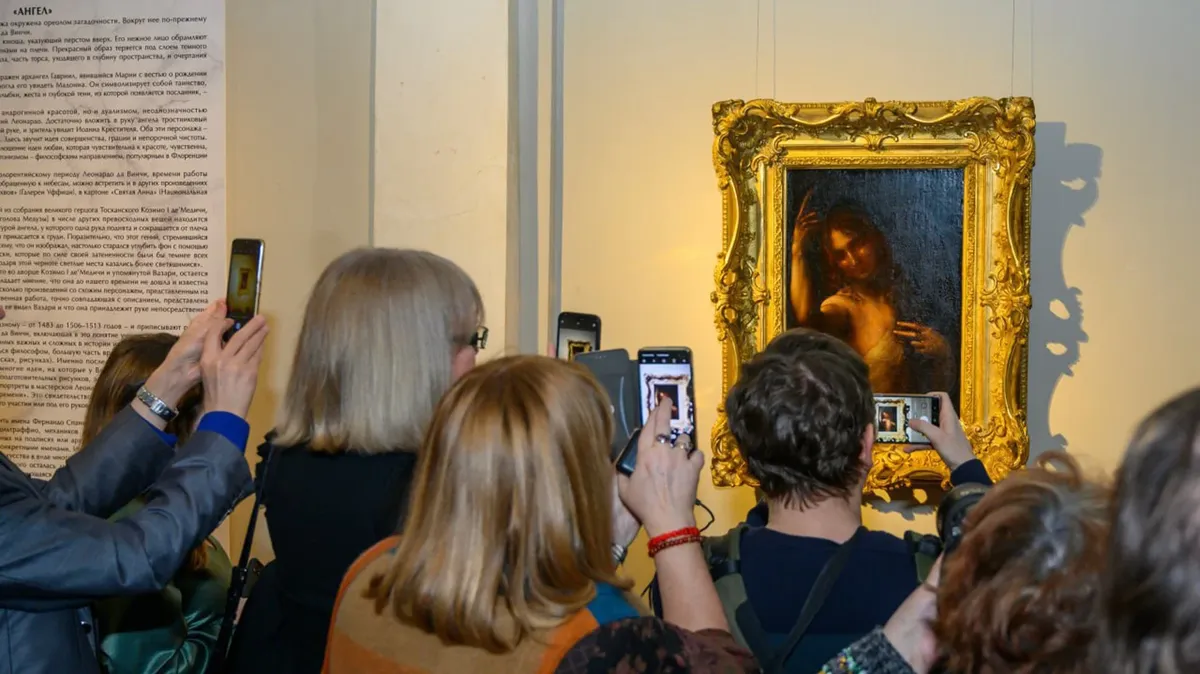
Photo: Dmitry Yesakov
The joint project of the Hermitage and the Museum of Christian Culture “New Riddles of the paintings by Leonardo da Vinci”, held in the picket hall of the Winter Palace from the end of February this year and recently ended, left behind a strange aftertaste. It seems that his main mission was the task of sowing in the minds of the audience the confidence that it was only worth looking for, and the new work of the great Leonardo will appear at any time and in any quantity.
Even the official press release of the Hermitage indicates the possibility of such a turn of events. He is full of hints of “unresolved issues of attribution and picturesque manner” of da Vinci. And even open promises using the latest technologies to find "Leonardo where they had not seen him before." And to help the Hermitage “to study Leonardo da Vinci” is called precisely the museum of Christian culture, which organized all this “feast of spirit”: two works were presented from his meeting in the Hermitage - “Battle of Angiari” and “Madonna in the rocks”. Which, as the owners and authors of the exposition hint, and can be the very "mysterious masterpieces of Leonardo." And in confirmation of this version, an “angel” from the Hermitage collection and created by specialists in multimedia technologies were added to them, the virtual figure of Da Vinci, looming on one of the walls of the picket hall.
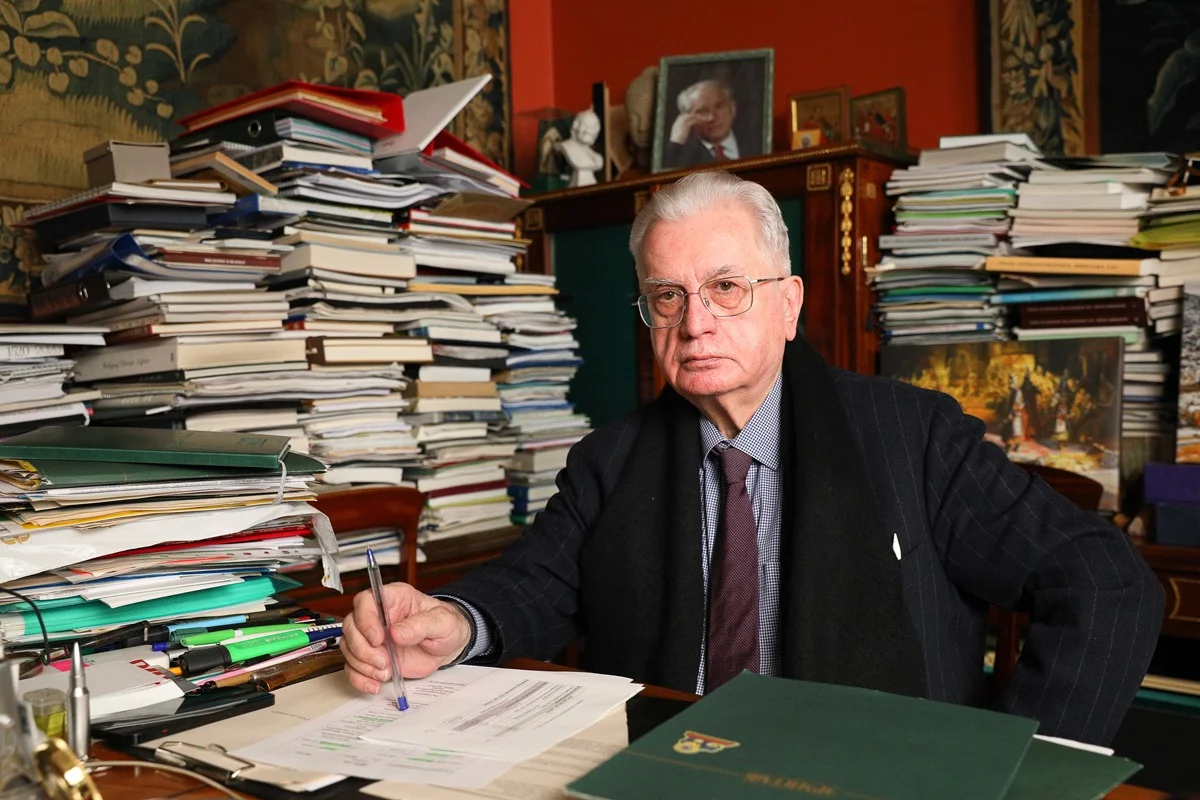
And in order to add fire to a quietly flourished project that aroused interest even in the Petersburg press only at the time of the opening of the exhibition, Mikhail Piotrovsky said at the closing ceremony:
“... She was a success and caused a rather large world scandal. This was required, because everything related to the name of Leonardo is important. "
Important, and how! Therefore, it is worthwhile to figure out more details: what was it in the Hermitage? And it seems that you need to start with the owner of the collection of the Museum of Christian Culture.
From relics to Leonardo
The Museum of Christian Culture opened in the Admiralty district of St. Petersburg in May 2021 Konstantin Goloshchapov, who is called the "masseur of Putin." The museum was opened on the territory of the multifunctional center at the Konstantino-Elenin convent. The monastery itself is located in the village of Leninskoye, Vyborg district of the Leningrad region, and its compound in St. Petersburg, and it was also built by Goloshchapov.
Goloshchapov is known not only as a “Putin massage therapist”, he has other names and nicknames: Kostya-Moshevoz and Kostya-Padra. He not only engaged in judo in his youth and met on tatami with the future president of the Russian Federation. He is known as one of the organizers of the Athos society, formally - purely religious, in fact - a closed club for the political elite, Russian and foreign.
Religion Konstantin Goloshchapov has long been passionate, and one of his most significant church projects is the transportation of relics. First of all, the relics of Nicholas the Wonderworker, revered in Russia. Part of these relics was transported to Russia and handed over to the Constantine-Elenin convent.
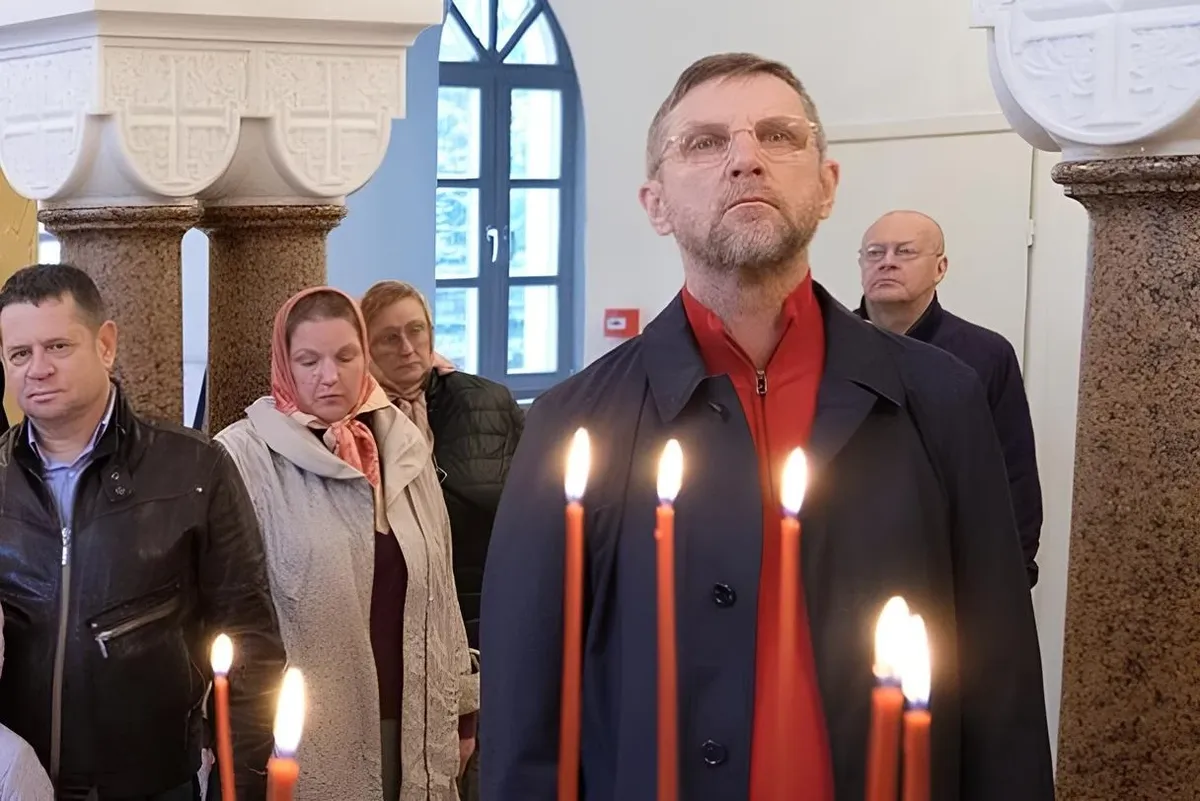
Thanks to the transportation of the relics, he established strong personal connections with Italy, according to media reports that were not previously refuted, can have a branched business there, including a network of houses built on the principle of pilgrimage hotels. The relics of Nikolai are now in one of the cathedrals of the Italian city of Bari (where they were from the world, the motherland of the saint, the Italian merchants once brought). By the way, in the same place, in Bari, Goloshchapov has his own real estate.
His wife Irai Gilmutdinova is a successful business woman: she built sports complexes and kindergartens, exported garbage, was a co-founder of pharmaceutical companies and was a member of the board of directors of large banks. Gilmutdinova and Goloshchapova six children, for which in 2011 they received from the then President Dmitry Medvedev the Order of Parental Glory.
In 2022, Goloshchapov and his family urgently left Russia in connection with searches in the case of fraud with contracts in Nostrum, Vodokanal. His wife and children are still abroad, but Konstantin himself appeared in St. Petersburg again in the spring of 2023. Like a big admirer Leonardo da Vinci ...
A copy of a copy of copies ...
... What was confirmed by the exhibition in the Hermitage, which the leadership of the museum supported widely and in a grand scale.
But just saying the need to “study Leonardo”, Mikhail Piotrovsky seems to have forgotten about the main thing: it is still better to study on the originals and original, and not on copies. And even more so on copies of copies. According to many experts, the work presented in the Hermitage by the Museum of Christian Culture is by which.
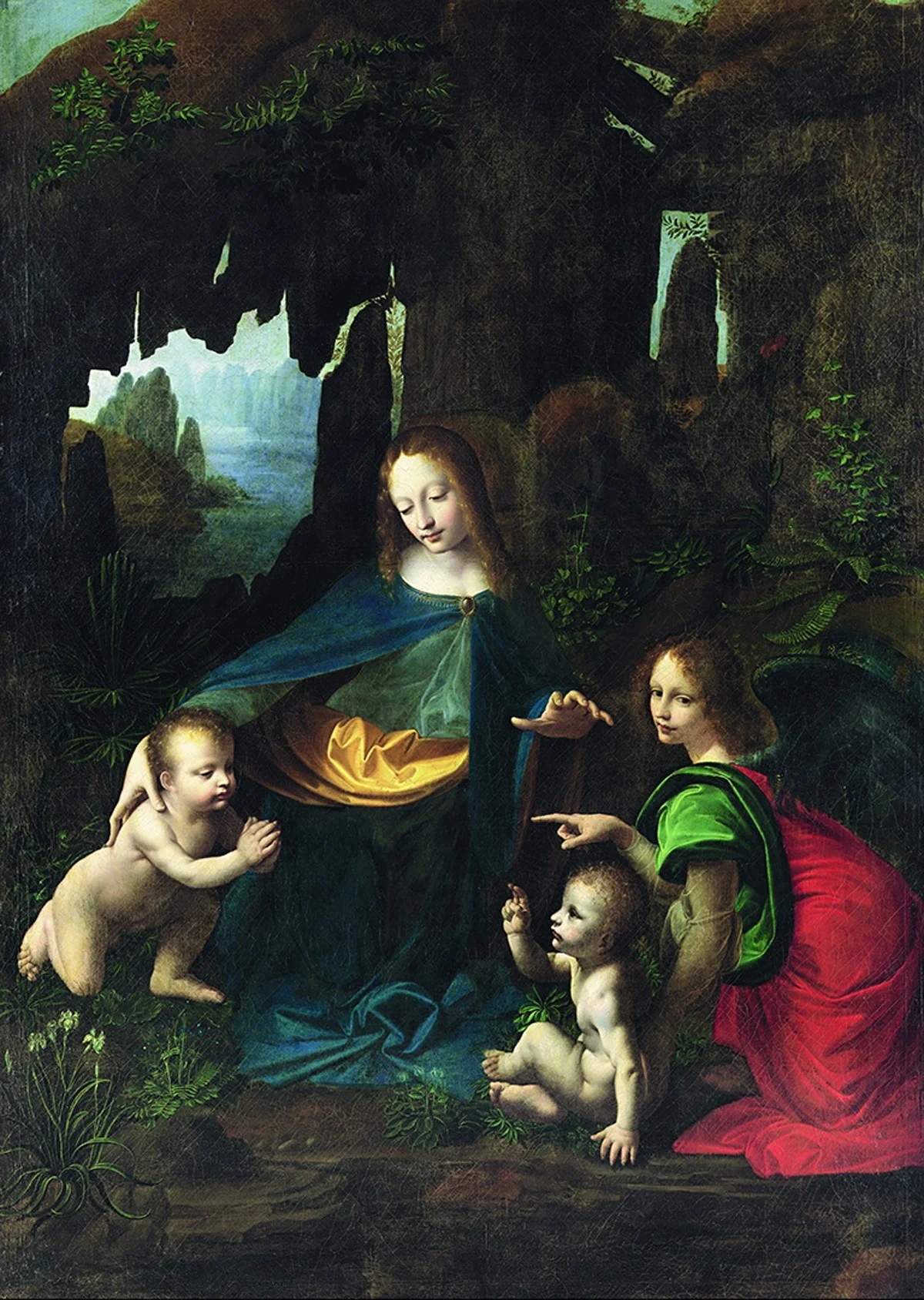
Two versions of his painting “Madonna in the grotto” are known to specialists in the work of Leonardo da Vinci. One, created in 1483-1486, is located in the Louvre, the other, 1499-1506, in the London National Gallery. The plot is based on an apocrypha from the text of “John in Serapion” about Christ's childhood and his possible first meeting with John the Baptist in a certain cave. Both paintings have minor differences that allow specialists to distinguish, a copy from what option were made by masters of other centuries: from London or Parisian. The owners of the Assembly of the Museum of Christian Culture claim that their work is copied from the London picture, hinting that it can be genuine.
Konstantin Akinsha, art critic, curator, researcher of the history of fakes:
- There is a legend about the third “Madonna in the grotto”, which can be a repetition of the one that hangs in London. But work from the Assembly of the Museum of Christian Culture, according to all experts who saw it, is a copy of the Louvre, not London.
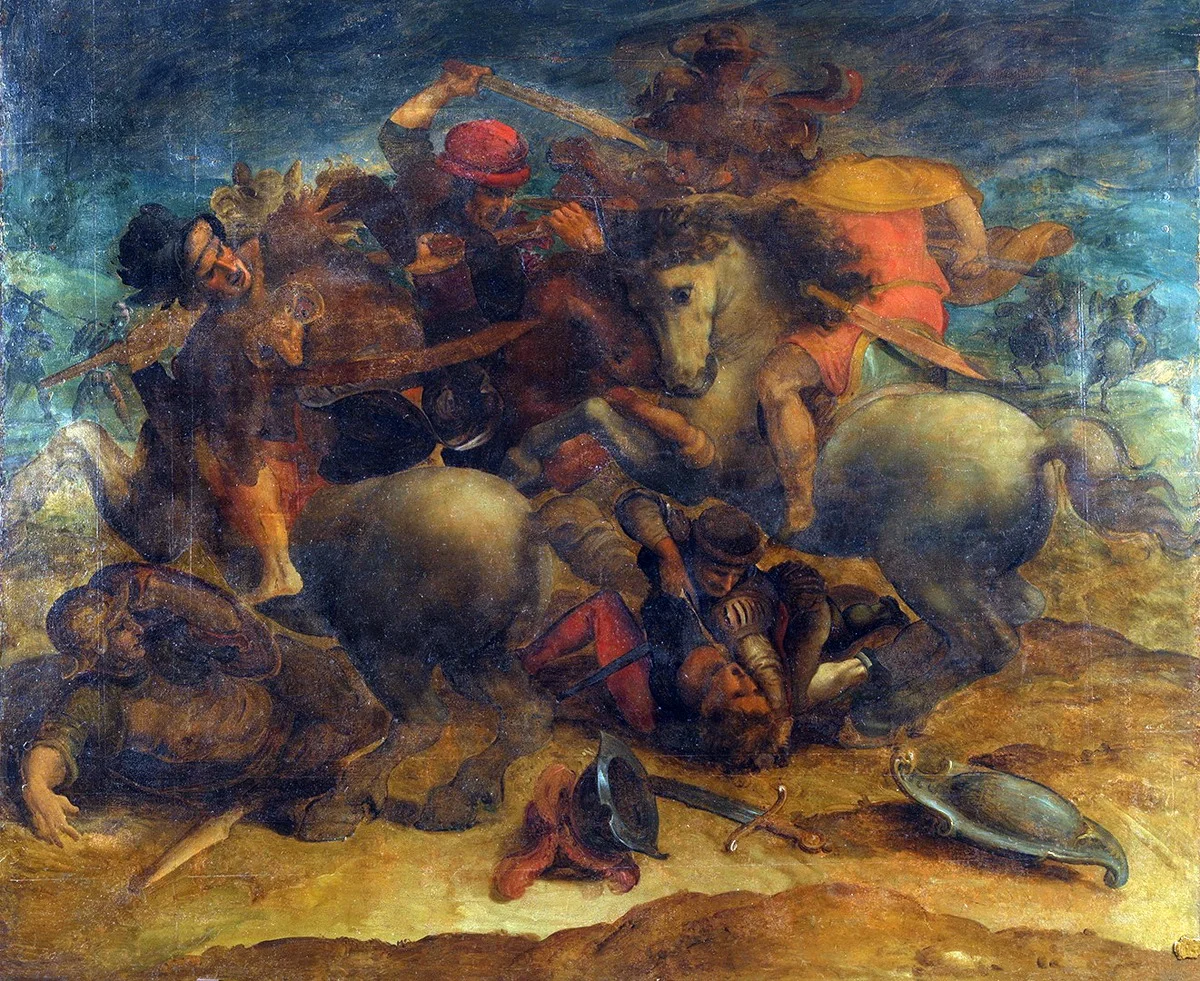
The second work from the collection of the Museum of Christian Culture is the Battle of Angiari. At the exhibition in the Hermitage, she was represented as “Leonardo da Vinci and the follower”, as the “preserved picturesque composition”, but its real story is much more complicated and not as simple as the owners would like. The plot of the battle of Angiari has been known since the beginning of the 16th century - it was then that Leonardo da Vinci made the building of the Bolshoi Council of Florence. In the middle of the 16th century, these frescoes were completely painted over. The original has not been preserved, but drawn copies of the composition are known. The most famous is the Rubens drawing, made approximately in 1612–1615, it is in the Louvre. But Rubens, as experts are sure, made this drawing not from the destroyed original, but from the engravings of Lorenzo Zakkia in 1558, known for the unique print in the Albertin Museum in Vienna. However, the original Leonardo was painted back in 1555, so that Zakkia could not make his engraving from the original, but from the sketches that have survived at that time.
You need to know the materiel
All this information is not a secret, it is publicly available to anyone who is interested in sales of art objects at European auctions. It was this work - the “Battle of Angiari”, which is now owned by the Museum of Christian Culture - has appeared twice over the past seven years at European auctions. The first time it was exposed on December 8, 2017, the auction house of Thierry de Megre called "Italian school, around 1600." The second time she appeared in May 2019 at Christie's already as “Battle of Angiari”, the middle of the 16th century, “followers of Leonardo da Vinci”. The Provens indicates that the work comes from the collection of the family of Sir Giles Priralite.
And further in the materials of the auction, the story of both Leonardo frescoes and the options for copies from its originals and sketches is told in detail. This is information for which the auction house is responsible for both its reputation and its money. Specialists who made research by Christie's admit that the preliminary pattern on the board could be made from the original of the middle of the 16th century, but this is only one of the versions, not a statement.
And none of them even closely admits that Leonardo himself participated in the work.
However, this seems to have not embarrassed anonymous buyers. The work was auctioned for only 120-180 thousand dollars. According to experts, if there were at least a weak hope that da Vinci at least painted or corrected something in it, the subject of the auction would initially cost an order of magnitude more than 120 thousand dollars. But then, in May 2019, two anonymous buyers staged a small “battle” for the work of an unknown old master and “caught up with” the amount of up to 735 thousand dollars. And a few years later, she surfaced in the Hermitage as “Leonardo da Vinci and a follower”. How easy it is to achieve the desired effect, simply rearranging two words in places!
Dr. Matthew Landrus, freelance employee of the college of Wolfson, Oxford, one of the leading European specialists in the work of Leonardo da Vinci, in correspondence with the correspondent of "New":
“I agree that these paintings belong to the followers of Leonardo. For a number of reasons, we know that Leonardo did not directly participate in the creation of any of these copies. Nevertheless, some of the most interesting recent studies about Leonardo are devoted to the work of his followers, and I think it would be very useful to place these three paintings in the context of the activities of these followers. ”
Context and subtext
The study of the work of such geniuses as Leonardo da Vinci is really the matter of the entire world community. But, unfortunately, in recent years, the Hermitage is not the first time to separate its ideas about the beautiful from global. How this happened recently with an exhibition from the Faberge Museum, owned by Alexander Ivanov. In the case of Leonardo, something similar happened.
None of the authorities recognized by the world community on the work of Leonardo participated either in examinations or the compilation of the catalog. In a press release and catalog, only the name of Luke Tomio appears, who for some reason is called "an adviser to the Minister of Culture of Italy." Luke Tomio really published several books on Da Vinci, but they are purely popularized, designed for a wide audience, and not for specialists and experts. By scientific works, Mr. Tomio also did not celebrate in the academic community, and if you go to the website of the Ministry of Culture of Italy, then you will not find his last name there.
Initially, in the press release of the Hermitage, the surname Carlo Pedreti, an Italian historian, and a specialist in Da Vinci appeared. But he died back in 2018 and could not say anything about the picture, who was supposedly “Leonardo and the follower” bought in 2019. By the way, later the surname of Pedreti was removed from the Internet version.
Another remarkable feature of this project is a detailed illustrated catalog does not contain a word in English, which the Hermitage practically does not allow any of its catalogs, especially when it comes to foreign artists.
But one gets the feeling that the creators of the “new Leonardo” were clearly tried to complicate foreign researchers with access to information about their “discoveries”.