
Translated material
Instead of snuffboxes - mangoes hidden in an airplane. Who blew up the Pakistani dictator Zia-ul-Hak: Mossad, KGB or their own officers?
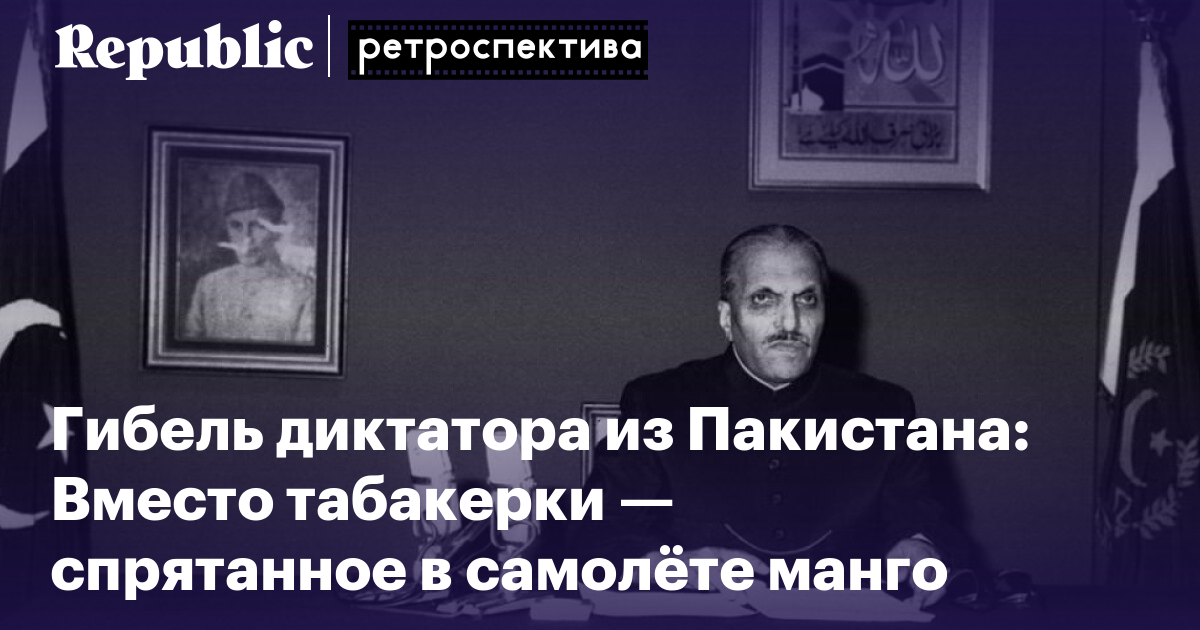
In the past month, we once again became convinced of the correctness of the Bulgakovsky Woland: a person is not just mortal, but suddenly mortal. Events similar to the collapse of the Bell helicopter on May 212, 2024 - when a whole head of state is dying - extremely rare. It is not surprising that each such case inevitably entails a train of conspiracyology.
In a series of plane crashes with the participation of large politicians, the Pakistani plane crash is a mansion on August 17, 1988. The then president of the Republic of Muhammad Ziya-ul-hack, several prominent figures of the regime, as well as the ambassador and military attache of the United States, were killed in it. It is all the more amazing that there is still no convincing official version of the incident.
The mysterious death of Zia-ul-hack seemed to obscure his life. This policy can be compared with a solid football player who ended up in Real Madrid or Manchester City and settled there on a bench. He was dictated by the flow of Cold War, when a real gala set of tyrants for every taste gathered in the world. At one time, Saddam Hussein and Augusto Pinochet, Mobutu Seke Seko and Nikolai Chausko, Enver Hodge and Rukholla Khomeini, Ferdinand Marcos and Muammar Gaddafi ruled with the Pakistani leader.
Against such a background, the modest zia-ul-hack was somewhat lost. Neither the transcendental duration, nor monstrous bloodthirstiness, nor absurd tyranny, nor a patagogical craving for acquisition were distinguished. Nevertheless, the general managed to do a lot, by planting the country on a outlandish cocktail from military dictatorship, Sharia laws and affordable drugs, holding Pakistan in the hedgehog mittens. Many could wish and contribute to the death of such a person, including their own environment.
Something unclean in a clean country
August 17, 1988. Pakistan, the surroundings of the city of Balavalpur in the eastern province of Panjab. The most important tests of American M1 Abrams tanks with the participation of foreign representatives and first persons of the country are approaching the military training ground.
The main character of the day is the 64-year-old President Muhammad Ziya-ul-hack, the sovereign owner of the country over the past eleven years. The general and politician was in high spirits, despite the 37-degree heat. He smiled a lot and joked.
Muhammad Ziya-ul-hack watches the dinner of cadets of the Military Academy, the 1980s
Photo: White Star Archives
A stranger hardly admitted that Zia-ul-hack initially did not want to go to Balavalpur. He was hardly persuaded by the commander of the armored troops, General Mahmoud Durrani: they say, Mr. President, you are not only a politician, but also the chief of staff of the ground forces. The Americans will be pleased to see you personally at the training ground. Zia, as relatives recalled, complained about an obsessive officer, but he accepted his logic at the last moment.
Consciously or not, but Durrani sent his president on his last trip in his life.
Of course, relations with the United States excited the Pakistani President. They did not always work out simply, although in the past few years the South Asian Republic has become an important regional partner for Americans. In the 1980s, Afghan Mujahideen who fought at home against the Soviet troops received military assistance through Pakistani. Their support was supervised by the head of the interdepartmental military intelligence of ISI Abdur Rahman Akhtar - by the way, and he went to Bahalpur with his boss.
The struggle against the common enemy hit the degree of the former tension between Washington and Islamabad. Previously, the authorities of the "Clean countries" often got from the overseas superpower: both for their nuclear program and for not the most democratic orders. It is enough to recall that in 1977, Zia-ul-hack came to power through a military coup, and his predecessor was executed two years later on the basis of very dubious accusations.
The “country of pure” is the literal translation of the word “Pakistan” with Urdu, the functional style of the Hindustan language, which historically served Lingua Franca for Muslims on the Indian subcontinent.
On August 19, 1988, along with the head of state in Balavalpur, several Americans watched the tests of the Abrams at once. Near the president were US Ambassador Arnold Rafel, military attache Herbert Wass and other honorary guests.
Lockheed C-130 Hercules
Photo: wikipedia / asuspine
Specifically, foreigners had the mood so -so - the M1 crew did not fall into the academic purpose. True, the outstanding good nature of Ziya-ul-Hak did not embarrass. He confirmed that he would acquire American tanks. After the tests and lunch, the guests were called aboard the Presidential Hercules S-130. At 15:46 local time, the transport took off, heading for Islamabad. He was not destined to fly to the capital.
Around 15:52 the aircraft suddenly entered the steep peak, then sharply went up, again dedicated almost vertically and, finally, crashed into the ground at an angle of 60 °. The country was left without its sovereign owner-and, analyzing the following events, it is difficult to get rid of a strange sensation: for the Pakistani elite, the catastrophe of the presidential S-130 did not at all a surprise.
Subscribe to read the whole
Make a subscription Redefine.media to read Republic
Subscribe [you can pay for a Russian or foreign card. The subscription is extended automatically. You can unsubscribe at any time.]
Where are the money subscribers going