
Translated material
Aircraft flights became more dangerous due to global warming
All is to blame the unpredictable and unprofitable "turbulence of the clear sky." How does she threaten?
The global climate change was reached civil aviation - for the first time in 27 years, the passenger’s death on board was recorded as a result of sudden turbulence, dozens of people were injured . The turbulence that the flight fell into is associated with global warming. Scientists warn that it is impossible to predict the “turbulence of the clear sky”, while the number of cases will only grow in the coming years, which will only have to revise the rules of transportation, and the aircraft will fly more slowly. The duration of standard shaking in the plane will grow three times: from the usual 10 minutes to half an hour. "Cold" tells what "turbulence of the clear sky" is and whether they are now afraid to fly now.
In order not to miss the main materials of the "cold", subscribe to our Instagram and telegram .
“The turbulence of the clear sky”, or sudden turbulence, is one of the main natural risks for the aircraft industry in the coming years. Its fundamental difference from the usual one is impossible to predict, which is why the crews simply cannot prepare passengers for shaking. This happened with a side by Singapore airlines flying from London to Singapore, on which the passenger died .
Typically, the turbulence zone coincides with the natural landscape and is quite regularly found during flights above the mountains, ocean or the equator zone. Pilots before each flight receive meteorological reports by which it is possible to determine the zones of shaking. They can decide to change the route, reduce speed or change height. In addition, the pilots are helped by modern autopilot systems that hold the board at a certain height. However, with strong turbulence, autopilot will not help .
Any turbulence occurs due to a sharp change in the velocity of winds at a height. The usual shaking is not dangerous and lasts about 10 minutes. The turbulence of a clear sky is dangerous in that at the moment, modern technologies cannot fix its offensive - the air flows at an altitude are so clean that their sudden fluctuations are not fixed by monitoring systems.
“The problem of turbulence in the clear sky is that it is just a movement of air. And the air is transparent for radio waves of ultra -high frequency used in radars, ” explains the chief meteorologist of the Pakistan meteorological department of Sardar Sarfaraz.
Any crew can face sudden turbulence anywhere in the world. For example, in May 2017, Boeing of the Russian Aeroflot fell into the zone of turbulence of the clear sky, as a result of which dozens of passengers received fractures and bruises. Only another aircraft, which has already flown over the same area earlier, can warn about sudden turbulence.
The route is rebuilt
Scientists distinguish four degrees of turbulence depending on its intensity: light, moderate, strong and extreme. With light and moderate turbulence, passengers usually feel a couple of shocks and tension of seat belts, but nothing threatens the plane. With a more intensive degree of turbulence, a sharp change in height is felt, and the pilot may lose control over aircraft.
Turbulence arises anywhere regardless of height, but there are areas where shaking is statistically more common. The most dangerous route is the flight from the Chilean Santiago to Santa Curus in Bolivia. In the flights of Europe, a great risk is to encounter turbulence with a flight from Italy to Switzerland. There are turbulent zones near Russia. In second place in terms of frequency of dangerous turbulence is a route from Kazakhstan to Kyrgyzstan. The TOP 10 in Europe also includes the flight Yerevan (Armenia)-Tbilisi (Georgia).
It is difficult to protect yourself with unpredictable turbulence. All that the passenger can do is not to unfasten the safety belt throughout the flight and not keep manually with you. In most cases, it is the non -set passengers with turbulence.
Many airlines allow children to be transported up to two years without a separate place. So babies are sitting on the knees of adults. This helps parents save, because discounts on the removal of a child can reach 90-100%, but with strong turbulence, such a seedling is dangerous for both the baby and passengers nearby.
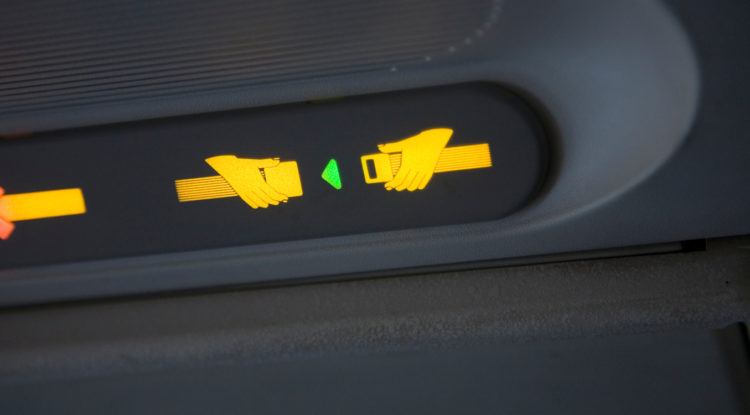
“The“ fasten the belts ”sign will be turned on much more often, unfortunately for passengers,” says Paul Williams, professor of atmospheric sciences from the University of Reading in the UK.
With any turbulence, it is the flight attendants who conduct flights on the legs that are most at risk. 79% of all injuries on board falls on the crew members: the stewards can throw it to the ceiling of the aircraft due to severe turbulence. Often, flight attendants received fractures and injuries that interfere with work for many years. The President of the Association of Betterniki and the Stewardess with 20 years of experience in Sarah Nelson recalls that one day she fell into such severe turbulence that she began to pray. According to her personal observations , the intensity of shaking intensified after a hurricane Catherine in the United States in 2005.
Half an hour shaking
In 41 years, the number of cases of the turbulence of a clear sky is a strong degree over the North Atlantic by 55%. In the coming decades, cases of strong turbulence may be more or even three times, the professor of atmospheric sciences from the University of Reading in the UK Paul Williams warns . Due to the global warming of such cases, there will be more and more. Scientists associate this with an increase in the concentration of carbon dioxide in the atmosphere, which leads to an increase in the average air temperature and provokes new cases of sudden turbulence. Aircraft industry also makes its small contribution to this growth - it accounts for about 2% of global carbon dioxide emissions.
Researchers from the British University of Reading came to the conclusion that an increase in the concentration of carbon dioxide in the atmosphere can lead to an increase in cases of light turbulence by about 59%, and moderate and strong turbulence - by 127%. An increase in temperature prevents the planes from flying up: heated air molecules expand, which is why the number of effective molecules that hold the plane in the air decrease.
Due to high temperatures, aircraft in the future may need more lifting force for take-off. To do this, the designers will have to improve, for example, wings, to increase their effectiveness, to put more powerful engines or reduce a mass of aircraft. The need to increase the lifting force can even lead to a reduction in the number of passengers and new limenes for baggage. Some airlines have to cancel flights at high temperatures. For example, on June 20, 2017, about 40 flights were canceled in Arizona due to a heat of 48 degrees-the maximum temperature for taking off small airliners.
Climate change leads to a change in stable air flows: they become more chaotic and changeable, and therefore turbulent. Sharp fluctuations in wind flows reduce the lifting force of the wing of the aircraft, which can lead to loss of height, control over the aircraft, and even its fall. This happened with the Air France in 2009 - a sharp gust of wind caused the effect of dumping the aircraft, which led to a sharp loss of height, which, coupled with icing and error of pilot management, led to the largest plane crash in France. 228 people died.
Nevertheless, Professor Paul Williams from the University of Reading in the UK assures that the planes will not begin to fall due to an increase in turbulence around the world. Modern liners are built according to very high safety standards, which provide for a strong shaking. However, the trend indicates an increase in the duration of turbulence. Now it lasts about 10 minutes, but in the future its “ordinary duration” will grow to half an hour.