
Translated material
The hero will not help anyone
We talk about Ilya Voronov’s satirical novel “My Lord's Foreign” - about where to find salvation when the Motherland declared war on God
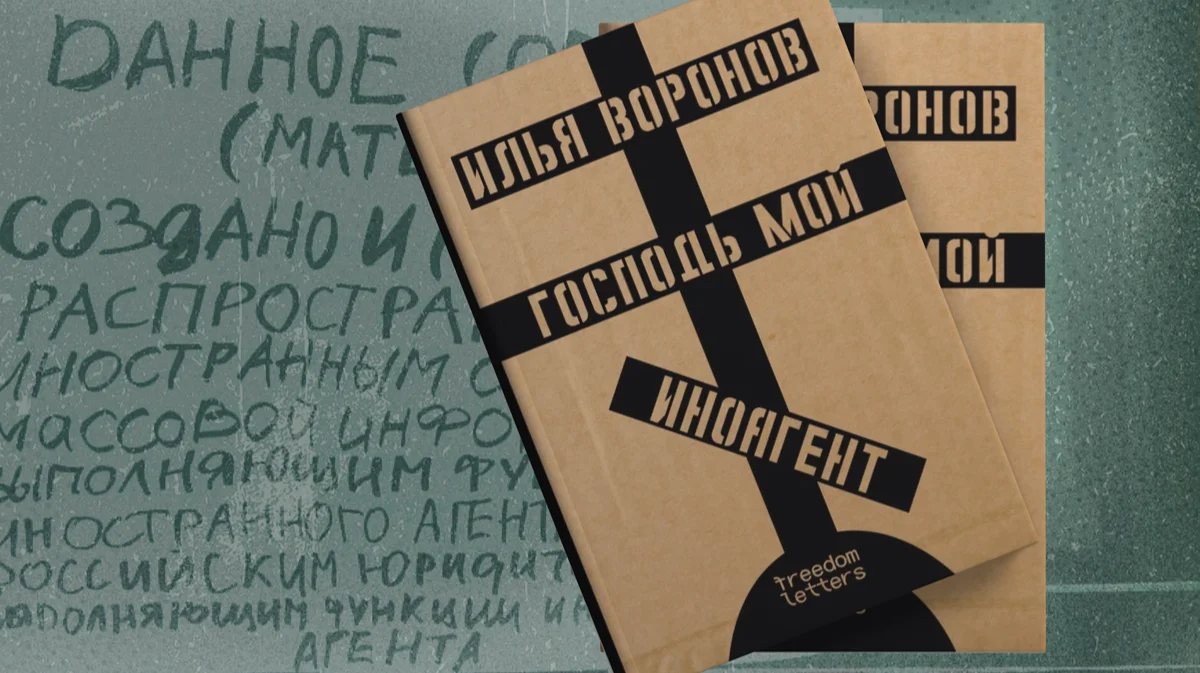
Photo: Freedom letters; AvtoZAK Live / Telegram (CC by-NC-SA 4.0)
According to the plot of the novel published by Freedom Letters, the Russian authorities decided to assign status and arrest the Most High itself. Among the characters of the phantasmagoria are the young revolutionary Til (we recall “Ulenshpigel”), “The Great Inspector” Fedor Mikhailovich, the head of the partially independent radio station Alexander Alexandrovich (Venediktov) and one of the doubles of Putin. And in the role of a lawyer in God's court, the “intertextual wanderer” arrester will act.
“My Lord's Ino -Agent” is a fatal mixture of acute satire and philosophical novel. Original and really funny parodies are combined with an attempt to rise above the “malice of the day” and look for eternal human meanings. Sorin Berm read Voronov’s bold and controversial romance (the young prose writer is in Russia, and therefore uses a pseudonym. - Approx. Ed.).
The main character, a participant in the resistance of Til performs a dangerous task and almost immediately falls into the hands of the special services. He himself, however, was ready for this: “ He did not need to explain that there are no protests under totalitarianism. If it seems that you allowed yourself something, in fact they allowed you to ... Til quickly learned: not a single protest movement has changed about anything and approximately never . ”
Til does not believe that the struggle will lead to a decline in power or at least its significant transformation. His rebellion pursues another goal. “ After all, the dissidents said: we do not do this so that the regime collapses, but to look at ourselves in the mirror nauseous. <...> The protest is a spiritual effort, and any work with the soul is outwardly absurd and impractical . ” Til is not going to save either Russia or fellow citizens. Other people do not particularly interest him at all. He fights on the front of internal resistance, the main meaning of which is the liberation of himself. And, of course, the search for God. In the finale on the bench of the defendants, they will appear with him together.
“My Lord's foreign Agent” is a very free romance. The plot does not develop progressively, but flickers - it suddenly appears, then dissolves in the stream of all kinds of inserts and retreats. For such a laconic (less than 150 pages) history, the solution is risky, although justified in its own way. On the one hand, a healthy author’s need to feel as liberated as possible. On the other hand, the “crisis novel” is much greater than integrity. Yes, and the hyperinformation modernity pushes the “relevant book” to this form. It is not so easy to keep track of the “underlying” plot development, diving into it - even more so. But interesting. Behind the bend is always an unknown. Then a fragment of the broadcast of the recognizable radio wave of Moscow, the funny code of the honor of “compromise” ( “1. Small affairs are like big, only with permission” ), then the Soviet fake under the ancient essay “On the Geopolitics of the Gods” (the philosopher turns to the ruler with the surname Put), finally, the romantic evening of the German journalist with Putin’s double, who was lost in Siberia ...
The obvious dignity of the book is humor. Political parodies are not often sparkling, but it is difficult not to laugh at the "Lord my foreign agent":
“ - I have enough, traitor! - the military university, who had to call on the air fought in hysteria.
He did not know how to turn on the microphone, so the listeners enjoyed silence, and Alexander Alexandrovich read well on his lips, and he was bored with such a reading. ”
Or here is a juicy propaganda pamphlet about Moscow, which will nostalgically respond in a relocar heart worse than a fresh track of a coin:
“We demolished the vegetable stalls and built marketplaces, we rolled up the frozen grandmothers with hot pies into the asphalt and put a bakery with face control in their place. We keep the couriers in the serfdom dependence and feed them with bread with water so that expensive Muscovites can eat and drink, drink and eat. Like mammoths on the broken ice -linen, traitors sing “Let my mother hear, let her mother come”, but the mother does not care about such children. She presses them like weak piglets, strangles, like frail kittens, and throws them out of the nest, like ugly chicks. And our dear mother, our Motherland is alive as ever and drunk with life, as an arise. And when our mother is drunk, when she is confused ... khe-khe, I am to the fact that Moscow does not believe in tears, she uses them as fertilizer. "
This parody continues the theme of compromises from the plots about Alexander Alexandrovich and the ex-opposition of Kosovsky, now voicing the update in the “tape” of foreign agents (by the way, they make kangaroo, all students of Jonya and forever alive, and therefore the jurisdiction of Tolstoy). Both the editor -in -chief of the radio and Kossovsky with all his might strive to avoid losses, whether it be a favorite business/community or lifestyle. And the authorities can only find their weaknesses. More from the "Code of Honor of Compromises":
"6. I know what I want and how to get it, but they know what I do not want and how to give it to me, taking everything that I want and managed to get. ”
The well -known propaganda move about the “useless left for anyone” hits the same goal: for “stability” will have to be paid by the game according to the rules, that is, values. So Putinism exploits the fear of death, promising to stop time and turn the “present” into “forever”. Such a war against the "backlog" of being at some point becomes the struggle against the laws of nature, and therefore, it is logical, as the creator.
This line in the novel is revealed by the second main character - the antipode (but in a sense, the twin) Tilya - Colonel Semenov. The author managed to create an image of charming evil, which is not perceived, in fact, evil. Reflections on the perception of all the native are permeated with empathy, tenderness and a sense of fragility. They have Semenov, who psychologically cannot return to his hometown, accept his changes and, thus, turns out to be a “prodigal son” in wanderings.
In the painting of the “Environmental Enterprise”, Jean-Franesois Mille (1857), where “time stopped and will not allow anyone to die or lose himself,” the future Chekist looks through the impending catastrophe of the First World War: “He [Semenov] waved his hands in front of them and could not say a sound, as if he had seen a train rushing to them. <...> These collectors lived at the end of the nineteenth century, and their children - children who are not visible in the picture, but who run with white legs around the house - will rot in the trenches, and death will gather their crop. " In the metaphorical space of the novel, special services solve the philosophical problem. They wage war with history, with a unsteady order of things, trying to stop a moment and protect it from destructive novelty.
And Russian society itself turns out to be the space of a hidden, but total fear of death, self -defense and the struggle for survival (“ you can’t trust anyone. The Russian lifestyle saves from death ”). The nihilism of the authorities is their natural continuation, an attempt to keep the “safe” place at the top of the hierarchy and with its help to protect their own (“ Where did you see him, this is the Fatherland? People are our Fatherland. Family, children ...” the great inspector handed him a photograph of a fat sad boy in a tracksuit. - that’s my fatherland ”).
The accusation of the “God” judgment is like this: “ He made us all mortals. (...) Our children, parents, friends will die. And everything that we have done by this short life will be forgotten and will not remember anyone and never . ” The antidote from the all -consuming vulnerability, pushing people to betrayal both their neighbors and himself, of course, should offer Til.
He takes the first step even during the “revolutionary” training, accepting the changeable nature of life and not capturing “attachments”. If the totalitarian regime seeks to take control and suppress the subjectivity of a citizen, then the hero has no choice but to learn how to rule himself. Yes, sometimes Til’s tests are cruel (say, arrange a perfect date, and then abruptly break off all ties with a potential partner). Yes, he does not seek to come to terms with his relatives, for whom he "died a long time ago, long before the disappearance." Finally, we recall that he does not intend to save those who can be saved, because "he deleted himself from the saints for a long time." But the Lord justifies:
“... Only for this experience of parting, for a sense of free flight, he is also a fall, only for him I am ready to look at you forever. In the sense of yet you will not die. Just kidding, you won’t die. ”
In the novel, Russia is likened to prison. The hero remains only to hold on to the meaning (this resembles the psychologist Viktor Frankl, who developed his concept based on the needs in the sense of the concept, being in a concentration camp). “ I am ready to cast light on all of you. You feel the movement of light and understand more clearly than before, everything is just like that, you are not in vain here, ” God explains. “I handed you an artifact, whispered the task and set off.” To understand what exactly was whispered is also part of the task. Closer to the final, it will become clear that the covenant consists of love, which is "undemanding and independent, like the rays of the sun, warming this cold earth." However, how exactly Til understands love and what he sees its manifestations, alas, remains unknown.
The most interesting and at the same time terrible in “My Lord's foreign Agent” is how a lonely, literally nourished by a feeling of abandonment is a book. “ Semenov often could not fall asleep and looked at the lights of the windows, behind which people lived with their warmth and care. But these people are no more, and it seemed that there was never, and no one would open the door, and no one would shelter - orphans did not give alms . ” The heroes of the book for each other are completely “black holes”. Caring, warmth, the need and significance of individual life in the space of the novel look even greater utopia than the radical “stoicism” of Tilya and the descent of God to Earth. We have to hope only on yourself, and seek protection - alone, inside and in the space of the unknown, because there is no one nearby. The creator is more needed by the protagonist than another person. This feature of the novel speaks of the country and about society more than the most accurate parody.