
Translated material
Putin’s new ultimatum for Ukraine and NATO: give up Crimea, Donetsk, Lugansk, Kherson and Zaporozhye
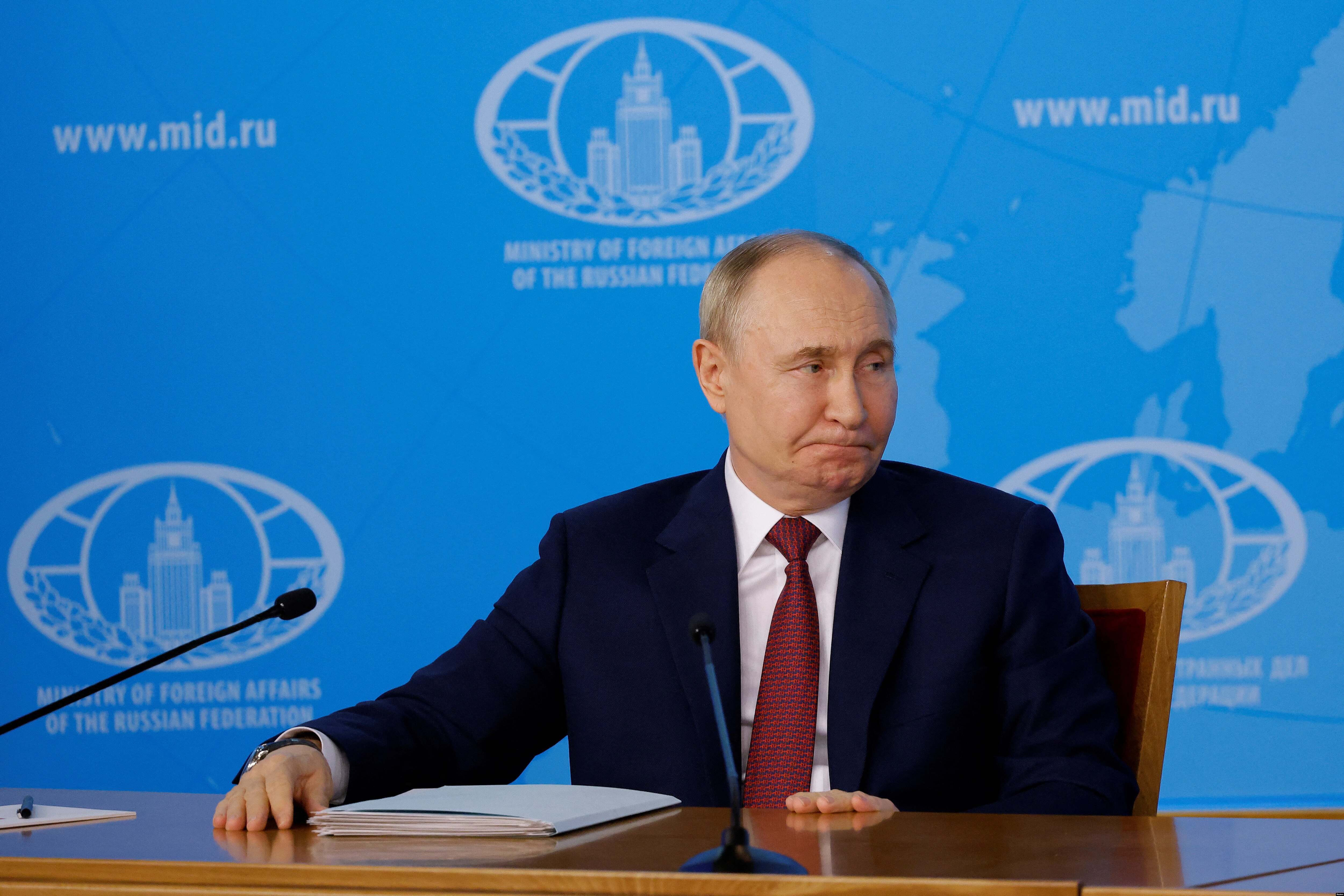
Putin curses NATO | Ultimatum to Ukraine: give up Crimea, Donetsk, Lugansk, Kherson and Zaporozhye
Vladimir Putin says that Russia will end the war “as soon as new territorial realities are recognized: the status of Crimea, Donetsk, Luhansk, Kherson and Zaporozhye regions as subjects of the Russian Federation.” During an hour of speech at the Foreign Ministry, Putin twice gave a historical lecture on Euromaidan. According to him, it was the North Atlantic Alliance that started the war between Russia and Ukraine. “NATO diplomacy is deeply flawed and fruitless,” says Putin and invites other countries to pay attention to BRICS and other associations promoted by Russia. But no one is in a hurry to form alliances with the Russian Federation. Only representatives of 18 countries out of 90 invited will come to the BRICS sports games this year. And Prime Minister of Armenia Nikol Pashinyan said that Armenia will leave the CSTO. Why is Putin's foreign policy failing? Who believes in his promises of a ceasefire? How is Russia saving its international image? We talk about this on the air “Facing the Event” with Deutsche Welle columnist Konstantin Eggert and sports commentator Alexander Shmurnov .
Today we’ll talk about where Vladimir Putin was for eight years, especially since he himself said this at a meeting with the leadership of the Russian Ministry of Foreign Affairs. Putin called the so-called special operation the “Ukrainian crisis” and “war” and for the first time announced his own peace conditions.

Putin curses NATO | Ultimatum to Ukraine: give up Crimea, Donetsk, Lugansk, Kherson and Zaporozhye
Text copiedwidth px height px
The URL has been copied to your clipboard
No media source currently available
0:00 0:01:37“Turn the page” is a familiar ending.
Let's return to Putin's peace terms. That is, the territorial integrity of Russia within the borders drawn by Putin is unshakable. The territorial integrity of Ukraine is unsteady because Putin sent troops there and held so-called referendums. The Russian army does not control Kherson and Zaporozhye, but Putin includes these cities in his conditions. And roll back your sanctions, there is nothing to discuss here at all. This is exactly the universe in which Vladimir Putin lives.
“This is a reluctance to pay for the war and not continue it in new formats,” writes Mikhail Podolyak, adviser to the Office of the President of Ukraine, on Twitter. At the G7 summit today they estimated the damage caused to Ukraine at almost half a trillion dollars. “These are not peace proposals, but proposals that imply even greater occupation,” says NATO Secretary General Jens Stoltenberg. “This is an ultimatum that cannot be trusted,” says Ukrainian President Vladimir Zelensky.
Putin began today’s little historical reference from afar: he spoke about a multipolar world, the Global South, invited NATO member countries to his BRICS, and contextually mentioned the CSTO. And he ended quite predictably: he did not attack anyone - these were all provocations and the hand of the West. Nuclear weapons again.
In Putin’s speech today there are attempts to create a split both in relation to those countries that support Ukraine and in Ukraine itself. Again, Vladimir Putin expressed doubts about the legitimacy of President Zelensky. Could this somehow affect the participants in the upcoming peace summit? Deutsche Welle political commentator Konstantin Eggert says:
It is clear that Putin does not want peace, it is clear that he believes that he can continue this war
– It can’t affect anything. One of Putin’s previously quite serious allies within the so-called Global South – South Africa – is now likely leaving Moscow’s orbit. Because there, the African National Congress, which is very beloved in Moscow, could not get a majority in parliament - they had to create a so-called government of national unity with the second largest party, the Democratic Alliance, which takes radically pro-Ukrainian positions. This is a small detail, but it means that even the Global South is not some kind of permanent bloc, it is not the Warsaw Pact, which always followed the Soviet Union where it needed to go.
That’s why Putin’s speech surprised me. It seems to be some kind of program, on the other hand, he reads it poorly, on a piece of paper with large letters, as if he himself does not know what he wants to offer Ukraine. It is obvious that he knows perfectly well what answer he will receive. Obviously, he is well aware of all the talk about Zelensky, who in his eyes looks illegitimate, but this is only because he quotes what he needs. I think this is a completely passable event. I think that even in the Global South many people have begun to understand what this is about. Putin says: give me another 26 thousand square kilometers, on which I’m not even fighting, strictly speaking, which I haven’t taken yet, just give them to me, that’s all. Therefore, it was clear how Zelensky would respond, how Stoltenberg would respond. It is clear that Putin does not want peace, it is clear that he believes that he can continue this war for quite a long time, that he expects to outlast everyone.
– Do you see any format in which negotiations could really take place?
The situation at the front does not now dictate any kind of capitulation
– No, there is no such format. There is no situation now in which President Zelensky would need to negotiate. While we see the Russian attack on Kharkov, which went nowhere further, we see the gigantic casualties that the Russian army is suffering while trying to recapture 20 square meters. In no way does the situation at the front now dictate any kind of capitulation. New sanctions against Russia are being prepared, says Konstantin Eggert.
Today Putin very significantly mentioned the Collective Security Treaty Organization as an example of a reliable partnership in spite of those very Western coalitions. Meanwhile, CSTO member Armenia recalled its ambassador from Belarus. Belarus also recalled its ambassador from Armenia. In Yerevan they are even threatening to leave the organization. Ilya Kozin looked into how the conflict between the two countries will affect the fate of the CSTO and whether it will.
Is Yerevan ready and able to go further? Because indeed, in his situation, the CSTO demonstrated rather uselessness. Does this organization, in principle, have a future? Does it aspire to be an alternative to NATO, as, by the way, it was intended? Konstantin Eggert continues:
– Pashinyan is slowly, gradually leading to a complete reorientation of Armenia towards the European Union, I think, at some point even towards NATO. He is willing to pay quite a high price for this. Because the loss of Karabakh and then the delimitation of the border, which is now being carried out between Armenia and Azerbaijan on the eve of the signing of a peace treaty, means the loss of a number of territories by Armenia, not very large, but nonetheless. Constant anti-Pashinyan demonstrations in Yerevan, saying that you are losing your land.
Armenian society is very disappointed in Russia
At the same time, these demonstrations, his opponents are not yet strong enough or Moscow’s support is not strong enough to remove Pashinyan. After the events of 2021–23, Armenian society became very disillusioned with Russia - all public opinion polls show this, and there is a rather serious reorientation towards the European Union. It seems to me that Pashinyan is gradually, but very clearly, pursuing an ever greater distance from Russia. But at the same time, look at what is happening in the European direction: there is constant talk about intensifying negotiations on a visa-free regime, at least about serious visa liberalization for Armenia. This is, let me remind you, where Georgia, Ukraine and Moldova started, today they are candidates for membership in the European Union,” says Konstantin Eggert.
Against this background, Euro 2024 and the European Football Championship begin in Munich, Germany, and the Summer Olympic Games open in Paris a month later. Teams from Russia will not participate in any of these competitions, but Putin opened his breakdancing and wushu games, the fifth BRICS Games, in Kazan instead. What kind of sports festival is this and who came to it?
Sports commentator Alexander Shmurnov about the opening BRICS games in Kazan and about Putin’s peculiar love for sports.