
Translated material
The Kremlin expected that at a new time, Erdogan would come closer to Russia. Instead, Türkiye establishes a dialogue with the West
Why have the relations of Putin and Erdogan deteriorated? In the material, Carnegie Politika explains Orientalist Ruslan Suleimanov
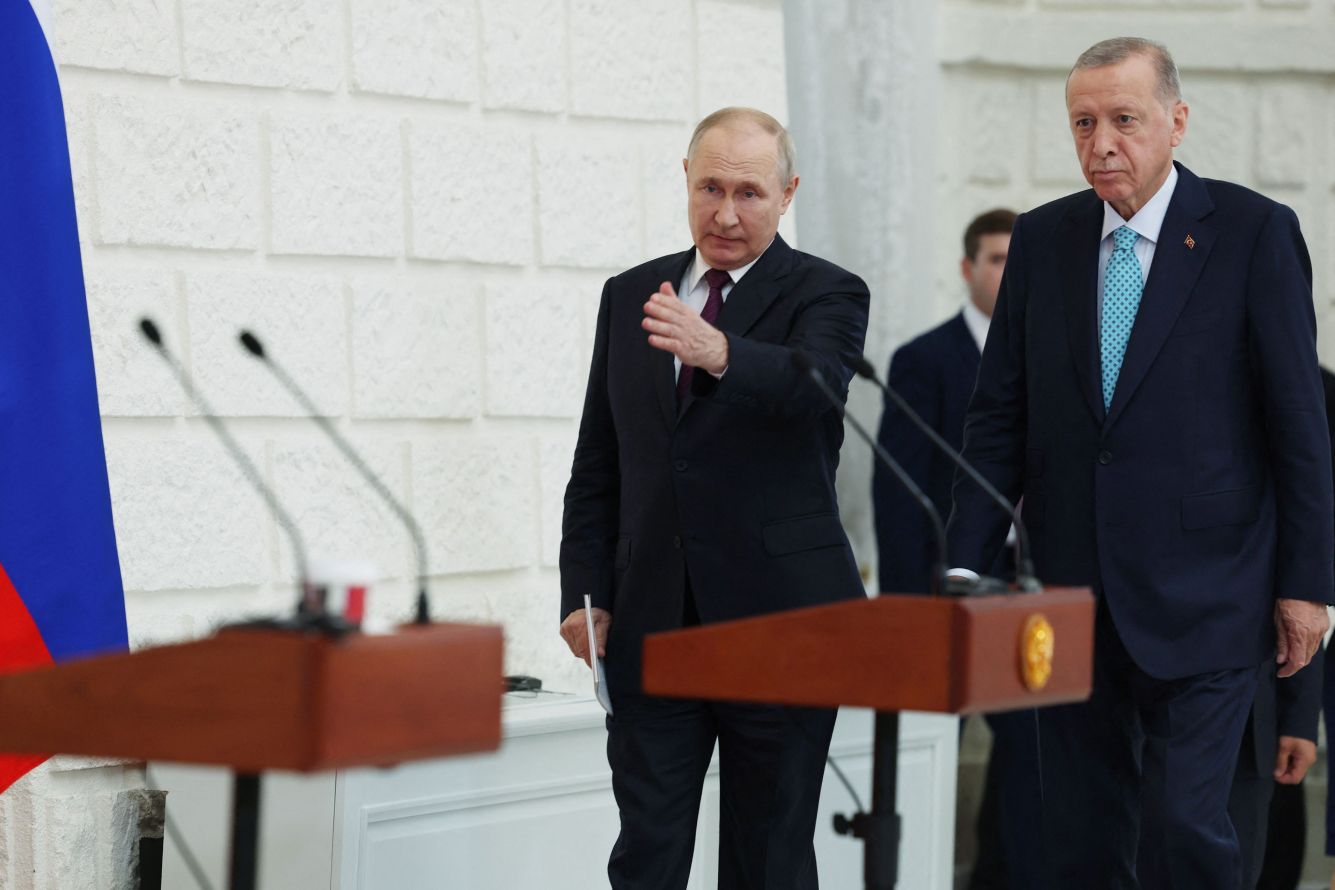
Before the Kremlin, who held in May 2023 in May 2023, made several friendly gestures against Erdogan - and explicitly hoped that after the re -election, the Turkish president would take a response step towards rapprochement. However, this did not happen: the problems in the economy rather push Ankara to the dialogue with the USA and the EU, and this is trying to use the Turkish opposition. Russia, in turn, is looking at the alternative to Erdogan forces - but so far it has not dared to actively flirt with them.
Why the Russian-Turkish contradictions, despite all the problems, will not develop into a full-scale crisis-in the material for the project Carnegie Politika explains Orientalist Ruslan Suleimanov. With the courteous resolution of the Medusa colleagues, this text publishes the whole.
The forever troubled relationship of Moscow and Ankara again balances on the verge of a new crisis, the next proof of which was the recent attacks of Vladimir Putin to Turkey and President Recep Tayyip Erdogan. In June, in the fields of PMEF, Putin reproached Ankara of military assistance to Kyiv and was indignant that the Turkish authorities are increasingly working with Western financial institutions, from which they receive investments and loans.
Officials in Ankara left this criticism unattended, but at an informal level, disputes about what made the Russian leader tighten rhetoric in relation to one of the closest partners - up to calls to refuse to refuse from Russian natural gas and wheat. If you add Putin’s constantly postponing visit here, a reduction in bilateral trade and the rapprochement of Ankara and the USA in the supply of weapons, then in relations between Russia and Turkey, cooling is increasingly emerging, which may be much deeper and longer than previous loud, but brief grinders.
What went wrong
Before the presidential and parliamentary elections in Turkey in May 2023, the Kremlin made an unambiguous bet on Erdogan, as well as on his party of justice and development (PSR). Moscow granted Ankara $ 20 billion for the construction of the Akkhu nuclear power plant, as well as a deferred payment for the natural gas delivered in 2022 (also $ 20 billion).
The Russian leadership, obviously, hoped that after re -election, Erdogan would take a response friendly steps. However, Ankara, against the backdrop of a difficult economic situation in the country, clearly headed for rapprochement with the United States and the EU. Erdogan began to call Brussels more often to the resumption of negotiations on joining the European Union. Also at the end of January, Ankara ceased to block Sweden's application to join NATO, after which the United States removed its objections to the supply of modernized F-16 fighters-in February, the American Congress gave a green light to their export to Turkey.
Thus, Ankara finally abandoned the idea of acquiring from Moscow the SU-35 and Su-57 fighters as an alternative to the F-16, although Turkish officials have repeatedly expressed the possibility of this option. Moreover, Turkey and the United States activated negotiations on the return of Ankara to the F-35 fighter production program, provided that the Turkish side will abandon the Russian anti-aircraft missile systems S-400.
New breakthrough agreements were expected from the visit of Erdogan to Washington. Initially, it was planned for May 9, but for unclear reasons was postponed indefinitely at the last moment. In the Turkish Foreign Ministry used the streamlined formulation that the “high -level dialogue” will continue to continue.
Talking about the trip of the Turkish president in the United States was conducted in parallel with how reports appeared about Putin's preparatory arrival in Turkey. At first, the visit was planned for February, then - for the period after the presidential election in the Russian Federation (March 15-17) or municipal elections in Turkey (March 31). But there is still no clarity. And the problem, obviously, is not only in the complexity of combining the schedules of two leaders.
Ukraine of discord
Almost the main stimulus for the Kremlin remains the position of Ankara in the war in Ukraine. “We will continue to make efforts to achieve a fair and constant resolution of the conflict based on independence, sovereignty and territorial integrity of Ukraine,” the Turkish Foreign Ministry on the occasion of the second anniversary of the beginning of the full -scale Russian invasion emphasized .
Such a wording of the Kremlin is probably not to the taste, but Turkey’s statements regarding the adherence of the territorial integrity of Ukraine have never caused his response (as it happened since the annexation of Crimea in 2014). But the supply of weapons to Kiev does not remain without close attention of Moscow.
In early February, it became known that the Turkish defense company Baykar began the construction of a plant in the Kyiv region, where TB2 or TB3 drones will be produced. About 500 people will work at the enterprise.
Russian officials still spoke out on this issue very carefully. However, sharp words spoken by Putin in the PMEF fields show the real degree of irritation by Ankara policies. Communicating with the leaders of leading news agencies, the Russian leader noted : “In some areas, Turkey cooperates with Ukraine,” and as a result, the pipelines for which the gas supplies Ankara are attacking Turkish drones. “I don’t wind anything here, I do not invent anything, so it is. Just inform, please, our friend President Erdogan about what is happening, ”Putin said irritably to the editor -in -chief of the Turkish agency Anadolu.
This irritation has been accumulating for a long time. The results of a visit to Istanbul of the President of Ukraine Vladimir Zelensky in Istanbul in Istanbul in Istanbul in Istanbul were indicative. The demonstrative issuance of five Azov commanders and public support by the Turkish leader of the idea of joining Kyiv to NATO could be perceived as probing the red lines of Putin, weakened by rebellion Prigozhin. And it turned out that in Russia they could not do anything with this - except that a little to turn off at a not -the -highest level.
Türkiye demonstrated its special position on the Ukrainian “Summit of the World” in Switzerland on June 15-16. Not only did the head of the Turkish Foreign Foreign Affairs took part in the event, which the Kremlin called only “absurd gathering”. Ankara ended up among the signatures of the final declaration of the summit - unlike, for example, from India, South Africa or the UAE.
Against this background, Putin, obviously, does not consider it possible for himself to go to Turkey on an official visit. If Erdogan himself does not go to Russia (as he did in September 2023), the maximum that the Kremlin is ready for is a meeting on a neutral territory. For example, in Astana, on the fields of the Shanghai Cooperation Organization, planned on July 3-4.
From politics to economics
If a thorough meeting will nevertheless take place, two leaders will have to discuss not only Ukraine. The second question that Putin drew attention to the same meeting in the framework of the PMEF is an increasingly active cooperation of the Turkish authorities with Western financial institutions.
Since January 1, Turkish banks have ceased to carry out money transfers from Russia due to the threat of American sanctions. This happened after US President Joe Biden issued a decree according to which foreign banks may lose access to the US financial system if they conduct business with the Russian defense industry. Despite the periodic assurances of Ankara and Moscow that the problem is being solved, no changes have yet occurred.
As a result, the volumes of Russian-Turkish trade are steadily reduced. So, in February, Turkish exports to Russia fell by 33% compared to the same month of 2023, and in April, China overtook the Russian Federation as a key supplier of goods and services to the Turkish market.
By the way, last year, Russian exports to Turkey decreased from $ 58.8 billion to 45.5 billion (by 23%), although Turkish to Russia grew from $ 9.3 billion to 10.9 billion (by 17%) .
Obviously, in Moscow they expect more from Ankara on the construction of a gas hub-megaproekt, which is needed to redirect the export of Russian gas due to loss of direct access to most of the European market. The Turkish authorities do not get tired of certifying that plans will soon be implemented, but so far they still remain only on paper.
Not an Erdogan one
Joint large-scale projects such as the construction of Akkui NPP still do not allow the multiplying Russian-Turkish contradictions to develop into a full-scale crisis. The voltage is also restrained by the fact that for the Kremlin, support from Turkey in the international arena and the availability of general approaches to many pressing issues is extremely important - for example, a war in the gas sector.
Recently, Moscow ardently welcomed Ankara's desire to join Brix. And the participation of the head of the Turkish Foreign Ministry of Khakan Fidan in the Nizhny Novgorod meeting of foreign ministers of the countries - participants in this association became an extra argument for the Kremlin in the dispute about whether Russia is in isolation. For Ankara, this was another opportunity to point out her unique role in the framework of NATO.
Meanwhile, Moscow made conclusions from the insufficient, from its point of view, Erdogan’s gratitude for support in his re -election, and from the success of the Turkish opposition in the March municipal elections. On March 31, the party of justice and development suffered the first defeat in 22 years, which showed: the positions of the current Turkish leadership are no longer as strong as before. Four years later, according to the results of the general elections, Recep Tayyip Erdogan and his party may well lose power.
So far, the Kremlin is carefully looking at Erdogan opponents and are not ready to actively bring together with the Turkish opposition. Meanwhile, the two news regarding the plans of the opposition republican people's party (RNP) that won at the municipal level show that the situation is changing. Firstly, the leader of the RNP Ozgur Ozel announced a fast visit to Moscow for consultations with the leadership of the Russian Federation. Secondly, the PNP is preparing to open its representative office in the Russian capital. The party says that in the Russian elite there is a great interest in dialogue with a landscape and other prominent leaders of the party, for example, with the Imamoglu ecrem, re -elected by the mayor of Istanbul.
Under the former chairman of the RNP, Kemale Kylychdaroglu was difficult to imagine - just a year ago, on the contrary, he accused Russia of interfering in the Turkish elections. There are certain shifts in the position of Moscow in relation to the Turkish opposition. In mid -May, a meeting of the Russian ambassador to Ankara Alexei Yerhov with a landscape took place . So it’s too early to bury Russian-Turkish relations, but a special personal partnership between Putin and Erdogan definitely works worse.
Read also on Carnegie Politika:
From father to son. That relations with North Korea are talking about Russia
Kim volost. How the leaders of Russia and North Korea have changed roles
Feudalism is involuntarily. How Putin's personnel conservatism forms new regional clans
Ruslan Suleimanov