
Translated material
Leave the change to yourself
Novyevropa tells how the exam has changed over more than two years of war
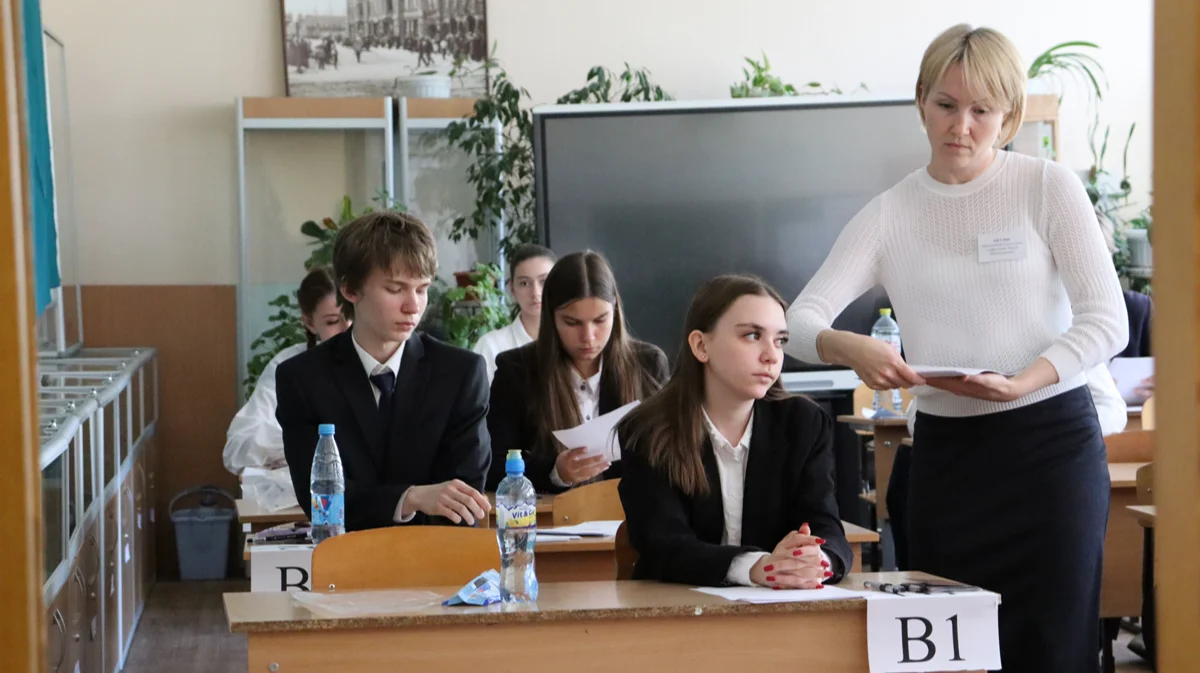
Photo: mon.tatarstan.ru
Since 2023, in the USE in the Russian language, literature, history and social studies, tasks began to appear that reflect the main event of modern Russia - the invasion of Ukraine. We tell how the examination program has changed under the influence of war.
Historical personalities
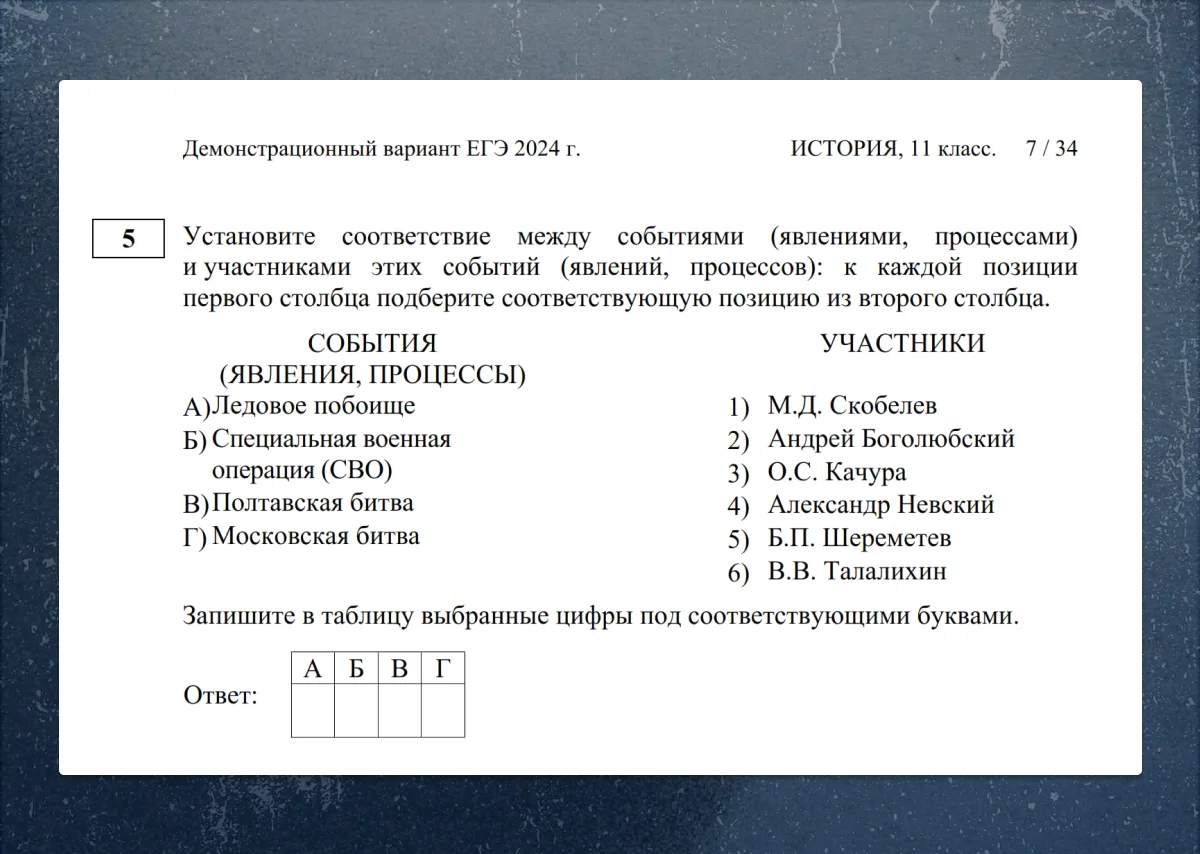
In 2024, in the materials to prepare for the exam on history, schoolchildren came across the following question: they were invited to remember the name of the person who went over to the side of the separatists in 2014, took the post of commander of the reactive artillery division and joined the People’s Police of the DPR. The name “Hero of Svo” is Olga Kachura, better known under the call sign “Cors”. In Ukraine, in December 2021, by the decision of the Shevchenkovsky District Court of Kiev, Kachura was sentenced in absentia to 12 years in prison "for participating in a terrorist group or terrorist organization." According to UNIAN, her division shot from Grads at the cities of Donbass - Ilovaisk, Debaltseve, Uglegorsk, Marinovka and Avdeevka. Kachura died on August 3, 2022 in Gorlovka, falling under fire.
Now she stands on a par with Prince Andrei Bogolyubsky, commander Alexander Nevsky and diplomat of the Petrine era Boris Petrovich Sheremetev. In this task, it is proposed to establish a correspondence between historical personalities and the events in which they took part. The task looks like this:
Boris (the name changed at the request of the interlocutor) passed the exam on the story of June 18 and encountered a similar task.
“There is a task in the exam where it is necessary to correlate historical personalities with events, very often people who participated in the war come across,” says the graduate. - To highlight people with the surname of Islam, Zhoga or Kachura is quite simple from the Kutuzovs, Frunze, and so on. Probably, the idea of this assignment is that the graduates “know their heroes”, while it is clear that in order to fulfill it, you don’t need to know much about “Svo”. In general, the exam in history could be much more ideologically filled, but before that, apparently, until they reached their hands, limited themselves to names.
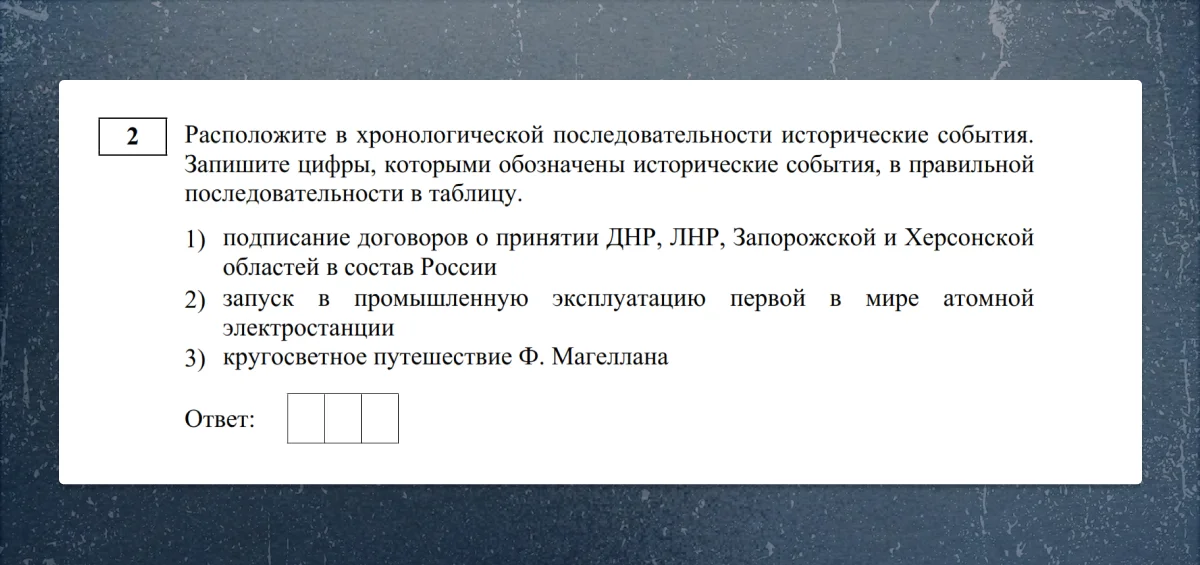
The fantasy of the compilers does not end there: in the demonstration version there is a task where it is necessary to establish the correct sequence of historical events. The points are as follows:
Civil society and the legal state - no need
These innovations became known in August 2023, when the first demonstration versions of the new USE were released . Then it became known about the changes that affected social science: such sections as “democracy, its main values and signs”, “civil society and legal state”, “international law” and the most relevant - “military duty, alternative civil service” were disappeared from the codifier (collection of those that can fall into the exam). This is how the teacher of social studies Angelica Yakovlev commented on these changes to the Publishing House "Mira":
“We need to lay the foundations of democracy in the minds of schoolchildren, especially if we are talking about adolescents who graduate from school and prepare for adulthood. I do not support the exclusion of the topic of civil society. If we talk about international law, then this topic in the framework of the codifier, the textbook was very crumpled. The information is outdated and irrelevant. Regarding the military duty: it is necessary to explain to adolescents that he was going to the army not because he did not pass the exams and did not enter the university, but because this is their duty.
Excluding this topic, we contradict ourselves. Everyone wants the population to be patriotic, and do not want to explain why this is needed. "
Pushkin, Lermontov and Ino -Agents
Also last summer, changes and examination examinations were also affected : then questions about Pushkin, Lermontov, Gogol, Griboedov, Zhukovsky, Derzhavin and Fonvizin were removed from the list. So this "innovation" was explained by Rosobrnadzor:
“In grades 5–9, the emphasis is on the study of classical literature, written until the middle of the 19th century, where the works of Pushkin, Fonvizin, Griboedov, Lermontov, Gogol and other classic writers are studied. In grades 10-11, literature of the second half of the XIX - early XXI centuries is studied. This separation is reflected in the OGE and the exam, where only the authors and works, first studied at the appropriate level, are called in the list of checked elements of the content. The educational program for literature covered all significant eras and authors of the works that have made a significant contribution to Russian literature. ”
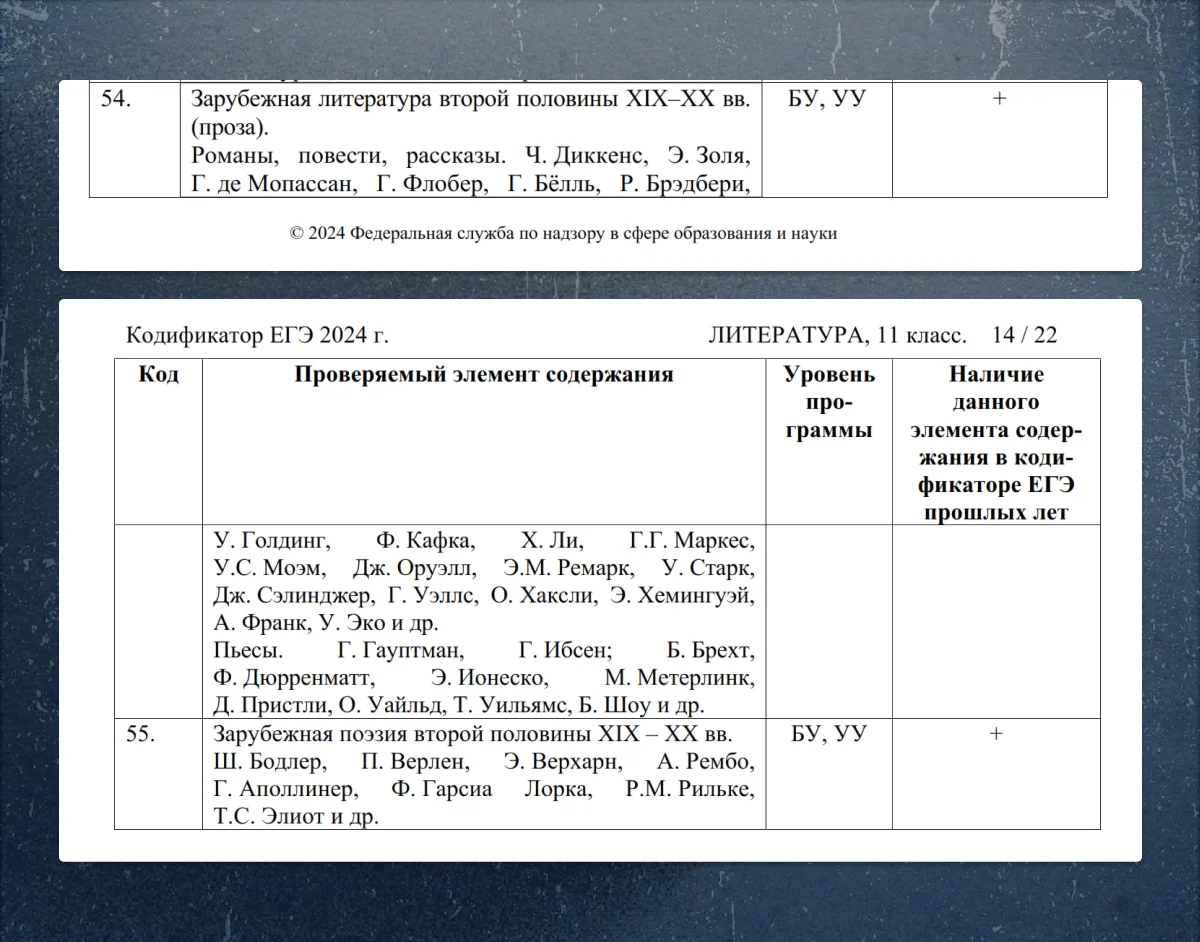
However, something new appeared, quite amazing. Foreign writers, even anti -war, - for example, Ernest Hemingway and Erich Maria Remarck, as well as a direct ideological opponent of modern Russia - George Orwell, were in the exam in literature. So in the exam this year there were no questions about Eugene Onegin and the Hero of our time, but there were questions about 1984.
“In the USE in the Russian language, I asked all my students not to give examples related to what they call“ Svo ”in Russia, that is, with the war,” says the tutor in the Russian language and literature of Veronica (the name was changed at the request of the interlocutor). - With everything related to today's positioning of Russia, from any side - neither with laudatory or negative, that is, not to give assessments at all, to leave this as much as possible, because when checking everything will depend on the inspector. There is no such criterion that says that if you scolding someone, you will be reduced for this. However, in the essay of the exam in the Russian language there is such a point as “compliance with ethical norms”. That is, how ethically you spoke out, whether you showed, as they call it, speech aggression: I can imagine what can be taken away if that, if anything.
Since 2022, Veronica recommends that his students not mention the names of unwanted organizations and foreign agents in the works - just in case.
“This year was just a story with a boy who loves the“ porn films ”group very much,” says the tutor. - He stubbornly mentioned them in the essay for the OGE. And we agreed with him. I told him: “I really respect your choice, but let's not you and I will give an example, please, the“ porn films ”group, because, well ... the human factor, you understand.”
In the realities of modern Russia, tutors explain to children what “Heroes of Swy” can fall into the exam: for example, such a post is on Yandex.Zen.
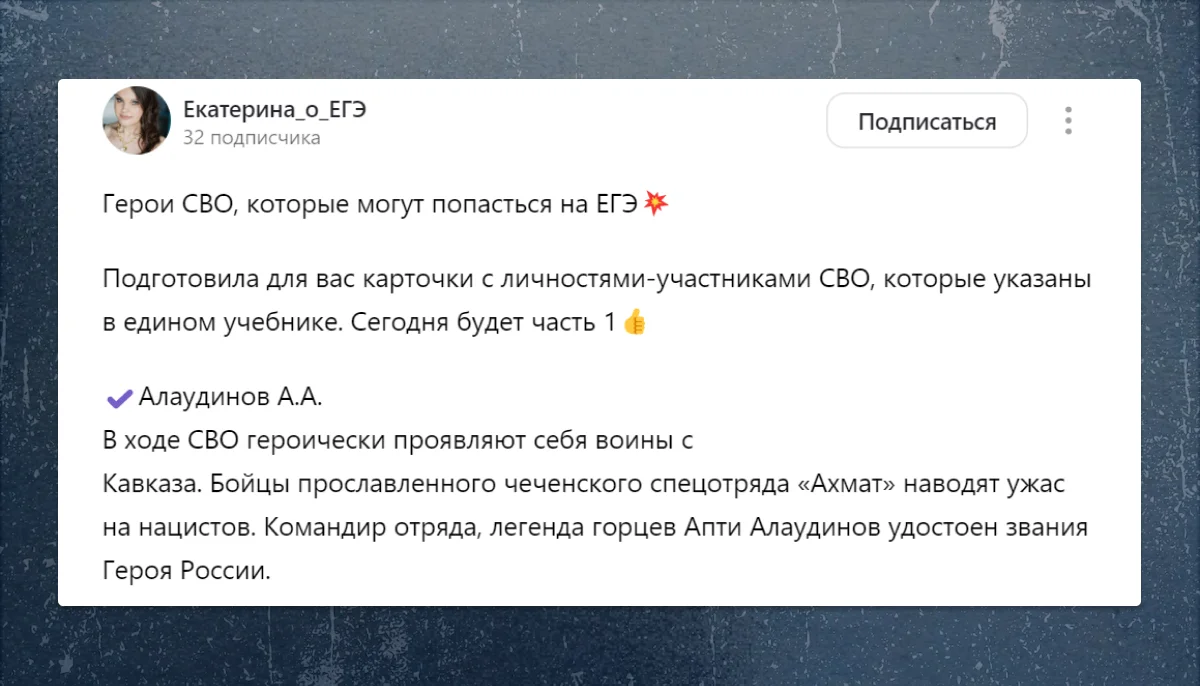
Autti Alaudinov, as the New Gazeta previously wrote , could have been involved in the extrajudicial execution of dozens of people in the territory of the special forces regiment named after A. Kadyrov on the night of January 26, 2017.
Meanwhile, the head of Rosobrnadzor Anzor Musaev, commenting on tasks with the “Heroes of Svo” in the USE, promised : “In the future, the number of such tasks will expand.”