
Translated material
The demons of war wake up
Israel and Lebanon - on the verge of a full -scale military conflict, despite public statements
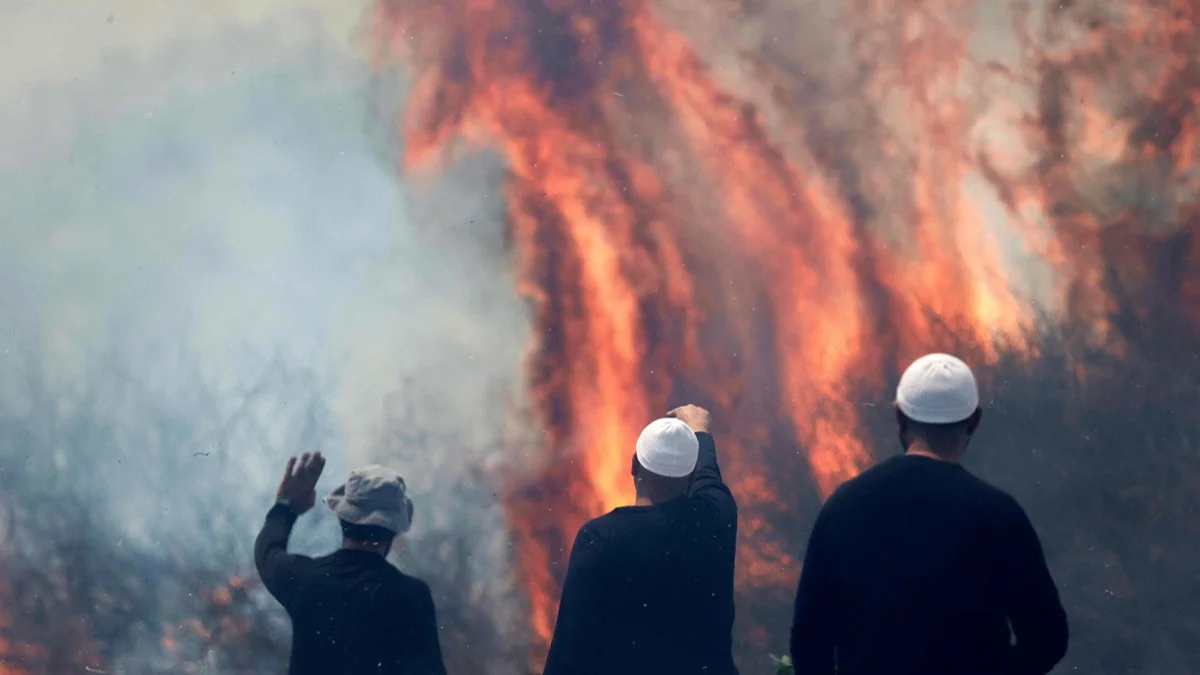
Photo: Jalaa Marey / AFP / East News
From the Middle East, rattle of weapons and threats are heard. This is wake up by demons of war. Apparently, the region is on the verge of a full -scale war, into which other states will be drawn. Including the United States.
The European intelligence services believe that the countdown has already gone, and a few days remain before the war. CIA estimates are more conservative: if Israel and Hamas will not be able to agree on hostages soon, this will affect the situation on the Livo-Israeli border, and the war will begin there in the coming weeks. Meanwhile, foreign embassies in Beirut have already studied the coast and ports, preparing for the imminent evacuation of their citizens. A number of countries published a warning, urging the fellow citizens not to visit Lebanon in the near future and leave him until the situation calm down. Last week, the Israeli army officially approved the operational plans of the war in Lebanon. To the border, the transfer of units began. And the general secretary of the Hezbolla group, Sheikh Hassan Nasell, made a warlike speech in which he stated that "it would not be safe in Israel." According to him, Hezbollah will fight without rules and without restrictions. "
The war has already begun
In fact, the war of Lebanon and Israel is already the ninth month, and it only gains pace. The Hyesbollah of the pro -Gishboll group attacked Israel on October 8 - the day after the bloody attack of Hamas militants. The group promised to show where the attack was being prepared from, and began to shell Israel as a sign of solidarity with the Palestinians.
Since then, attacks have occurred almost every day, with the exception of a weekly break at the end of November, when a ceasefire was announced in Gaza to conduct the exchange of hostages to Palestinian prisoners from Israeli prisons.
In Hezbollah, attacks with the position in the gas sector are directly linked, emphasizing that the border provocations will stop at the moment when the war ends in gas.
These attacks are gradually gaining strength and scale, Hezbollah expands the geography of shelling and launches more and more Kamikadze drones towards Israel. If in February the militants launched only four drones, then in March - already 24, in April - 42, in May - 80. There are no statistics on June yet, but it is obvious that these attacks reached a peak in the first half of the month. As for missile shelling, May became the most difficult month since the beginning of the war on the Lebanese-Israeli border. Hezbollah attacked the territory of Israel 305 times (compared with 237 in April).
As a result, since autumn, the population of many settlements in the north of Israel was evacuated because living in them became impossible. At least 61 thousand northerners filled the empty 240 hotels throughout the country - the state pays for their accommodation. The still unknown number of Israelis is huddled by friends-related people or left the country for a while.

Even in autumn, Hezbollah began to methodically demolish Israeli villages by the border, destroying the house behind the house in them. Ali Murtada, the correspondent of the Al-Mayadin television channel, which is associated with the group, in December removed the mocking report, showing the destroyed houses in the kibbutz Menar and accompanying it with caustic comments.
The Israelites do not remain in debt. The FINANCIAL Times published its own investigation, which showed that in the south of Lebanon there was no less distressing situation than in the north of Israel. The population of the border areas almost completely left them, because it became impossible to live there.
Israeli attacks completely destroyed or significantly damaged buildings and infrastructure, agricultural land and forests, and, of course, the Hezbollae military facilities. The main destruction was carried out in the border zone up to five kilometers north of the so -called blue line, recognized by the UN by the border between Lebanon and Israel. In fact, this has become a buffer zone.
According to the UN, more than 95 thousand people were forcibly evicted from Southern Lebanon. According to official Lebanese data, more than 90 peaceful citizens and three hundred Shiite militants have died in the country of cedars from the beginning of the conflict.
Three hundred - this is more than Hezbollah lost in the second Lebanese in 2006 (both numbers are artificially underestimated). For comparison, the attacks of the Hezbollah in Israel led to the death of about 25 military personnel and civilian.
According to Financial Times, 1,500 buildings in the southern Lebanon are completely or partially destroyed. According to Lebanese estimates, there are more than three thousand such buildings, and there are another 12 thousand houses that have caused more moderate damage.
With the onset of hot weather, both sides began to resort to another weapon - fire. The IDF purposefully causes fires on the Lebanese territory with the help of artillery shelling, setting fire to dry grass and shrub. The goal is to detect the Hezbollah infrastructure, disguised and hidden objects and tunnels, as well as stripping the territory to deprive the militants of natural shelter, if they decide to attack and begin to approach the border fence.
Why does a large -scale war seem to be inevitable?
The diplomatic efforts of the United States, France and Qatar are the only factor that allowed to win the time and delay the beginning of a full -scale war. But given that Hezbollah is not ready to retreat from the border areas, and even more so to disarm, there is no agreement even on the horizon.
The stumbling block in negotiations through the mediation of the United States was the issue of the withdrawal of the Hezbollah militants, including the elite special forces of the Radwan Forces, from the border. The group refuses this, saying that this is impossible, since the southern Lebanon is a place of compact living Shiites and the support base of the organization.

Israel is not ready for an agreement on this matter. According to a survey of the Tel-Hai College, 13% of the evacuated residents of the north of Israel said that they would definitely not return to their apartments and houses, because they were afraid of the Hezbollah attacks according to the same scenario, as Hamas acted on October 7. While its militants are in a matter of kilometers from the border, the residents of the northern regions of Israel do not have to wait.
Nothing strengthens the Israelis in their opinion that the grouping must be moved as far as possible from the border, like Shiite militants who, from RPG, hit the residential buildings in border villages from RPGs.
It should be noted that according to the resolution of 1701 of the UN Security Council of 2006, which put an end to the Second Lebanese War, Hezbollah was supposed to take its forces over the Litani River, that is, about 20 kilometers from the border. But the group immediately began to violate this resolution, accusing Israel of its violation.
And if there is no war?
There is a possibility that with the withdrawal of the forces for the IDF and the end of the war in the Hezbollah sector can synchronously stop its provocations. But here is one nuance.
Even if the IDF announces the end of the war in the sector and the elimination of Hamas power, the forces from there will not have been withdrawn for a long time. Because Hamas will immediately begin to try to restore his control in the sector. Such attempts are being made now. This deprives the point of all the work done by the Israeli army. Thus, for at least a year, or even more, the Israeli military administration with continuing point stripping will remain in gas.
Therefore, Hezbollah will not stop. But the third Lebanese is also unlikely to help save Lebanon from this group. Therefore, Israel will have to again, as in the 1980s, create a security zone in the south of Lebanon. The area created then lasted until 2000, that is, almost two decades.
Who will attack whom?
The probability that Hezbollah will make a ground attack on Israel is quite low. Such an attack can be effective only when it is not expected. As an attack by Hamas on October 7. However, now in the area of the Lebanese border the DSAL units are deployed, and gradually new forces arrive from the south. It would be stupid to try to attack them on the ground.
The massive missile attack of the Shiite militants in Israel is able to cause significant damage, but in this case Hezbollah will definitely become an aggressor. Although in fact it is already it, but from the point of view of public opinion around the world, this will become an indisputable fact. Therefore, Hezbollah prefers to throw this hot potato into Israel's hands.
The main weapons of Hezbollah are missiles and drones, that is, it does not imply a land invasion of Israel, although individual sabotage of the “Radvan forces”, special for the group of groups, are also possible.
In the current situation, Hezbollah is more profitable to lure the IDV in Lebanon, where the Shiites for 18 years were preparing for the Third Lebanese. It is to such a war - in the Lebanese territory. There, in a mountainous area, an extensive network of underground tunnels and fortifications was deployed, warehouses, observation points and missile systems are hidden in the rock. Houses and roads are mined in preparations for the arrival of the Israeli military.
In the villages in the border areas, according to Israeli intelligence, at least every third building is used by Shiite militants for military purpose. This means that the border settlements in South Lebanon are waiting for the fate of the northern part of the gas sector - total devastation.
This will look like the third Lebanese. The intensive missile shelling of Israel and the response massive bombing of Lebanon, especially its south, the desire to break through the Israeli missile defense, large -scale destruction on both sides, attempts to lure Israeli military into a trap to kill and/or kidnap them.
The IDF understands what Hezbollah is achieving. Therefore, “in the event of a large-scale terrestrial operation in Lebanon, Israel will have to make a very strong first move,” the UPDIDED STANDED MILITA noted in an interview with the 12th Channel of Israeli TV.
In the Israeli army for a long time there is no doubt that there is no other way out: the path to security for residents of the North lies only through a large -scale war.