
Translated material
Lost decade
For the first time since 2014, the World Bank took Russia to countries with high income of the population. Is it true?
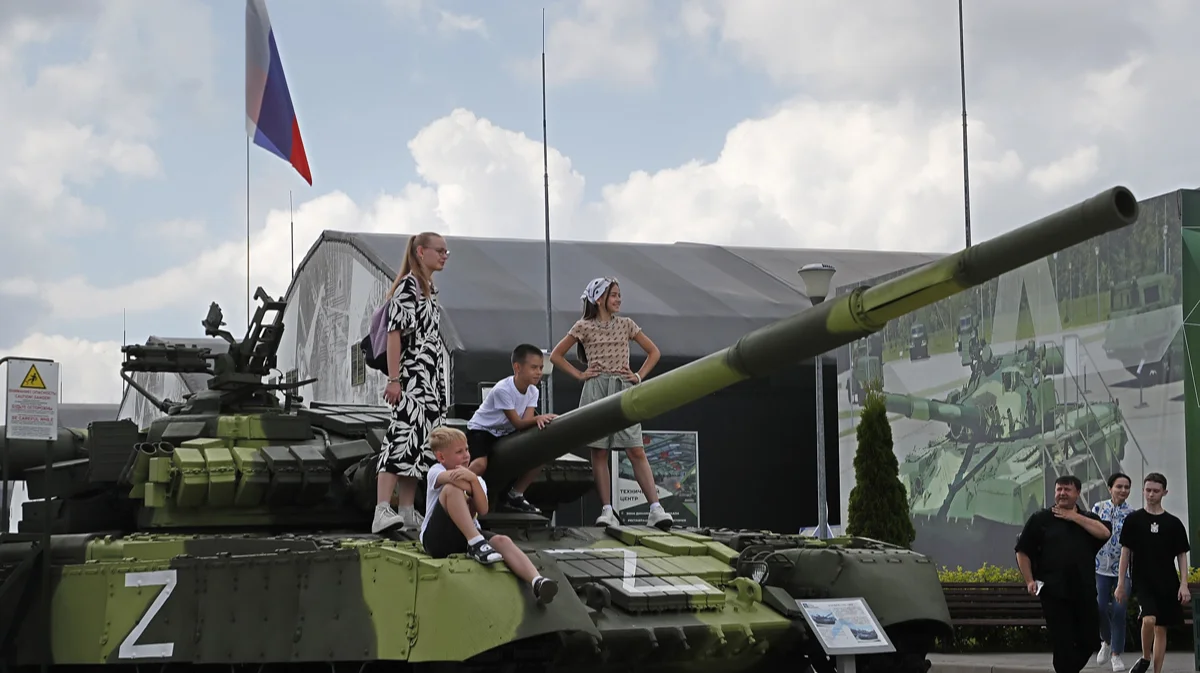
Visitors to Patriot Park during the celebration of the paratrooper day in Kubinka, Moscow Region, Russia, August 2, 2023. Photo: Maxim Shipenkov / EPA-EFE
The World Bank transferred Russia to the category of high income countries. It was already included in this list from 2012 to the annexation of Crimea in 2014-it took a decade to again join the club of “rich countries” according to the VB version.
Is Russia really called a country with a rich population, does this mean that the country has recovered from shocks caused by a war in Ukraine, and what disadvantages do the method used by the World Bank have? Novyevropa is dealing with economists.
What's happened?
The World Bank assigned Russia to the category of high income countries. According to the organization’s estimates, the level of gross national income (GNI) per capita in the country in 2023 amounted to $ 14,250.
The Methodology of the World Bank
The World Bank attributes the world economy to four income groups: low, lower than average, higher and high. Classifications are updated every year on July 1, based on GNI per capita for the previous calendar year. GNI indicators are expressed in US dollars using recalculation coefficients obtained in accordance with the atlas method.According to this method, gross national income (GNI) is the cost of all goods and services produced in the country (gross domestic product - GDP), as well as the cost of income received by Russians in other countries. Revenues taken from the country by foreigners are deducted from this indicator.
There are other ways to determine the level of income of the country, explains economist Grigory Bazhenov in his telegram channel: for example, a method for comparing the national currency with the average annual US dollar. In order to level the excessive volatility of the currency course, the Economists of the WB use the atlas method, since in this case the average course in three years is adjusted for the difference in internal and international inflation, Bazhenov adds.
This year, three countries - Bulgaria, Palau (where, as the World Bank believes, the restoration of the economy continued after the Pandemia of the Coronavirus) and Russia - crossed from the category of countries above average to the category of high income countries.
Why did the World Bank transfer Russia to the category of high income countries?
An increase in the gross national income per capita in Russia (+11.2%) in the World Bank was associated with a significant increase in military spending, the restoration of trade (+6.8%), the financial sector (+8.7%) and construction (+6.6%). These factors led to an increase in both real (3.6%) and nominal (10.9%) GDP.
In 2022, in Russia, gross national income was at $ 12,830. Then the country was in the category of countries with GNT above average.
What countries, according to WB, have also increased their income?
This year, Algeria, Iran, Mongolia and Ukraine moved from the category of countries with income below the average to the category of countries with income above average. The rating of Ukraine increased due to the resumption of economic growth in 2023 (real GDP grew by 5.3% after a fall by 28.8% in 2022) along with the ongoing reduction in the population (-15% after the start of Russia's invasion). These factors were additionally strengthened by increasing prices for goods and services of domestic production. GDP growth in 2023 was due to income in the construction sector (24.6%) and an increase in investment costs (52.9%).
As the Novyevropa wrote , in the third year of the war, the Kremlin increased budget expenditures by 5 trillion rubles. This huge amount is approximately a fifth of the annual expenses of the federal treasury for the last two peaceful years, in 2020 and 2021. It is impossible to restore the exact figure of federal budget expenditures for a war with Ukraine: money for these purposes is also coming from closed articles.
However, not only an increase in the military expenses of Russia played an important role in increasing the country's income level, the economist notes in a conversation with the New European ( he chose to remain anonymous for security consideration. - Ed. ).
- In Russia, both retail trade and wholesale trade are growing. Revenues in the manufacturing industry are growing, not only in military sectors, but also in the production of dual -use goods. In the civilian sector, growth is also observed. However, all this is somehow connected with military spending or sanctions, and
- The state inflating money into the military sphere, of course, significantly increased the growth rate of GDP,
He says.
According to Rosstat, in 2023, the average military income of Russians (the indicator is calculated by dividing the total amount of cash income by the average annual population) amounted to 53.1 thousand rubles, and the mediate average per capita income (that is, income that divides the population into two equal parts: 50% have income above this value, and 50% lower) amounted to 40.1 thousand rubles. The average salary in Russia in March amounted to 87,740 rubles, and over the year it increased by almost 22% compared to March 2023. As the Russian BBC service explains , this is nominal growth, and it does not take into account inflation that remains high and “eats” part of this growth.
Is it possible to name the VB assessment of objective and what needs to be taken into account when speaking about the economic condition of Russia?
Olga Shamina, the BBC economic observer, believes that, based on the figures of the World Bank, it is not worth concluding that Russia has become a country with a rich population. Firstly, the country is high in the country, and secondly, a “bubble” is inflated in the country's economy due to huge infusions into the military sector.
However, according to the interlocutor of Novo-Europe, the assessment of the World Bank as a whole can be called objective, despite the shortcomings of the method used.
- It should be understood that economic indicators do not take into account a lot of things. Obviously, now in Russia in relation to, for example, security, the situation has become worse. Many goods were inaccessible, the field of tourism and the car market sank. Something, obviously, became worse, but something has become better: for example, the Internet has become faster, the comfort of trains became higher. Therefore, it remains, just shrugging our shoulders, to say: “Well, there are indicators, they do not take into account a lot of things, but in general they reflect the overall situation in the world,” the economist summed up.
At the same time, he notes that the Atlas method was first used in calculations in 1989, taking into account global inflation. Then the indicators indexed, but the income level of some countries grew faster than indexation.
As a result, it turned out that in the absolute expression of rich countries in the world there was more: if in the 1980s about a quarter of them were part of the high income group, now it is already 40%.
Russia is now located on the lower border of the “elite club” of wealthy states, however, inside this club there is high heterogeneity, economist Grigory Bazhenov draws attention : GNI per capita in the Russian Federation is two times lower than the median value in the club, almost three times lower than average and seven times less maximum.
Russia has recovered from the shocks of 2014 and 2022?
In the period from 2012 to 2014, Russia was already a country with a high level of income, however, after the annexation of Crimea and the sanctions that followed this, the outflow of capital, the fall of the national currency and oil prices, it passed into a group of countries above the average. It took ten years to recover from the shocks that covered the Russian economy after 2014, an anonymous economist said in a conversation with Novo-European.
- Since then, Russia has increased the geopolitical stability of its economy. The losses were significant, and now we can say that Russia simply returned to what was. Therefore, the previous decade can be called lost: from what they left, they came to that, ”the expert says.
In his opinion, a full -scale invasion of Ukraine, which happened already in February 2022, had a slight impact on the stability of the Russian economy: Russia adapted to new realities by increasing the cost of war. However, this negatively affects the real incomes of the population, the interlocutor of the Novo-Europe summed up.
The state of the Russian economy cannot be called satisfactory anyway: as the economist Dmitry Nekrasov said , the new-European, growth does not occur due to civil consumption and well-being of the population, but due to murders and destruction.
- From this GDP no one lives better. This is a “bad” GDP, some of which will inevitably be reduced after the war, ”he said.