
Translated material
Unified State Exam 2024: entering the budget will be more difficult due to beneficiaries
Unified State Exam 2024: slightly better results, fewer budget places, more beneficiaries
Editorial “Layout” July 03, 2024 |The Unified State Exam 2024 results are better than in previous years, but it will be more difficult to enroll on the budget

Rosobrnadzor spoke about the preliminary results of the Unified State Exam in 2024. According to his data, the academic performance of graduates is comparable to previous years, and in some subjects the proportion of high-scoring students has even increased. But this year it will become even more difficult for them to get into budget places due to the increase in the number of different beneficiaries. “Layout” tells what is known about the results of the Unified State Examination, passing scores for universities and competition for budget places.
In order not to miss new texts from “Layout”, subscribe to our telegram channel
Unified State Exam results in 2024
Rosobrnadzor, which is responsible for conducting the Unified State Exam, on June 25 announced the preliminary results of the Unified State Exam in 2024. According to the head of the department, Anzor Muzaev, this year the performance of graduates in exams in all subjects is comparable to the results of previous years. “Nothing took off and nothing collapsed,” he said.
In the Russian language, 99% of students scored the minimum 24 points to obtain a school certificate, about 60% scored above 60 points. In literature, the average scores, according to Muzaev, are “comparable” with last year’s 64 points. In geography, the average score has “increased slightly” from last year’s 54.6. More than a third of exam participants showed results above 61 points
The head of Rosobrnadzor noted that results in subjects chosen for admission to engineering specialties have improved. In specialized mathematics, the share of those who did not score the minimum 27 points for a certificate decreased from 9% to 6.5%. The number of people passing the exam with more than 60 points increased by 10%.
In physics, the failure rate dropped from 5.85% to 1.96%. The share of participants who scored more than 60 points increased by 30%, the share of high-scorers who received 81 – 100 points increased by 1.8 times. In chemistry, the average result, according to Muzaev, is “comparable” with last year. Then it was 56 points.
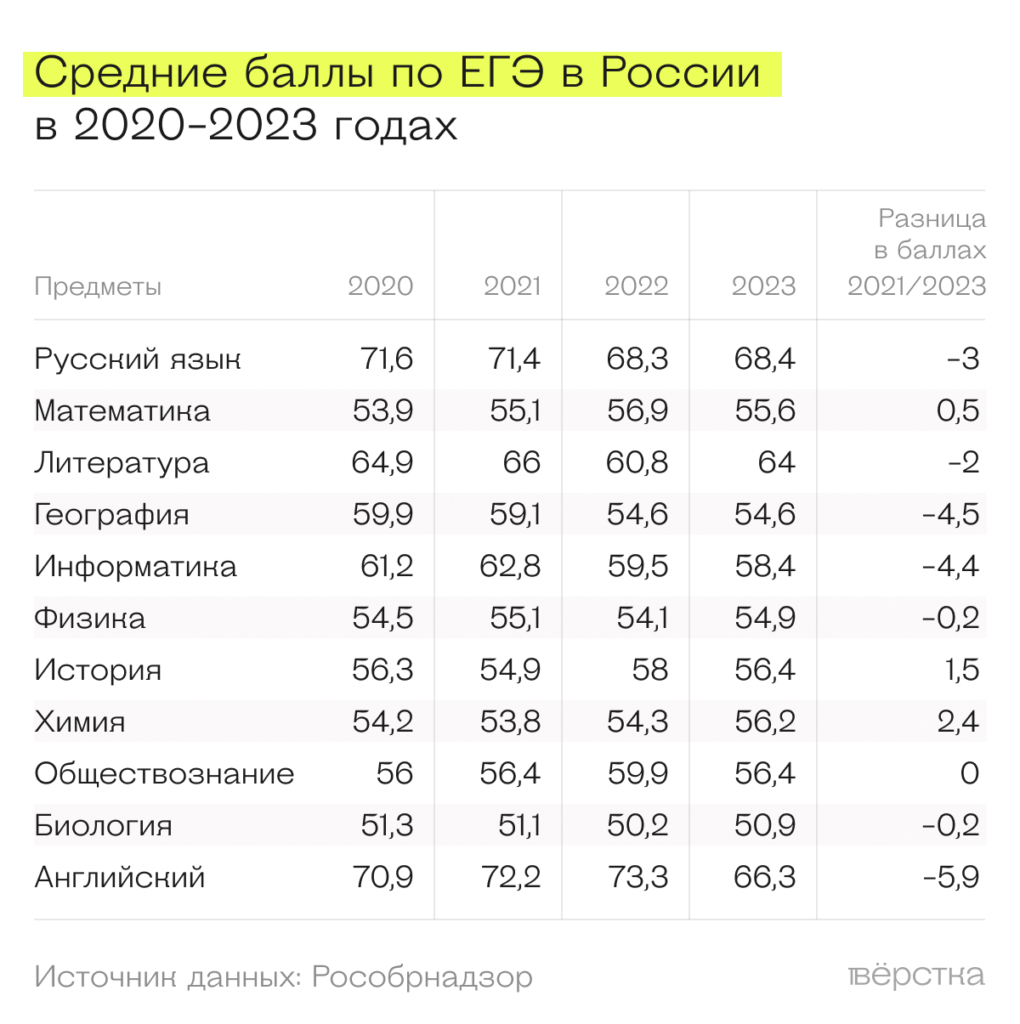
Rosobrnadzor has not yet announced exact data on the average Unified State Exam scores obtained by graduates in 2024. In 2023, with which the head of the department compares the results of this year’s Unified State Exam, the average scores were low - lower than in the pre-war years. For example, in 2023 compared to 2021, average scores fell in seven out of 11 core subjects. In Russian, the results fell by three points to 68.4. The result in English deteriorated the most - by 5.9 points, to 66.3. In mathematics, the result during this time improved by half a point to 55.6. The largest increase in the average result was in chemistry - by 2.4 points, to 56.2. The remaining numbers are in the table below.
What data on the results of the Unified State Examination does Rosobrnadzor publish and what does not?
Expand ↓Every year the department publishes only slides with average results for Russia. Rosobrnadzor does not publish detailed statistics, for example, by region, school, or the success of completing individual tasks. This data can be found on the websites of educational organizations in some regions, for example, on the website of the Center for Monitoring the Quality of Education of the Samara Region. There is the same organization in the Belgorod region, but it has not updated statistics on the Unified State Exam on its website since 2021. At the same time, basic data for the entire Belgorod region for 2022 can be found in the school report from Stary Oskol.
In order not to miss new texts from “Layout”, subscribe to our telegram channel
Minimum Unified State Exam scores
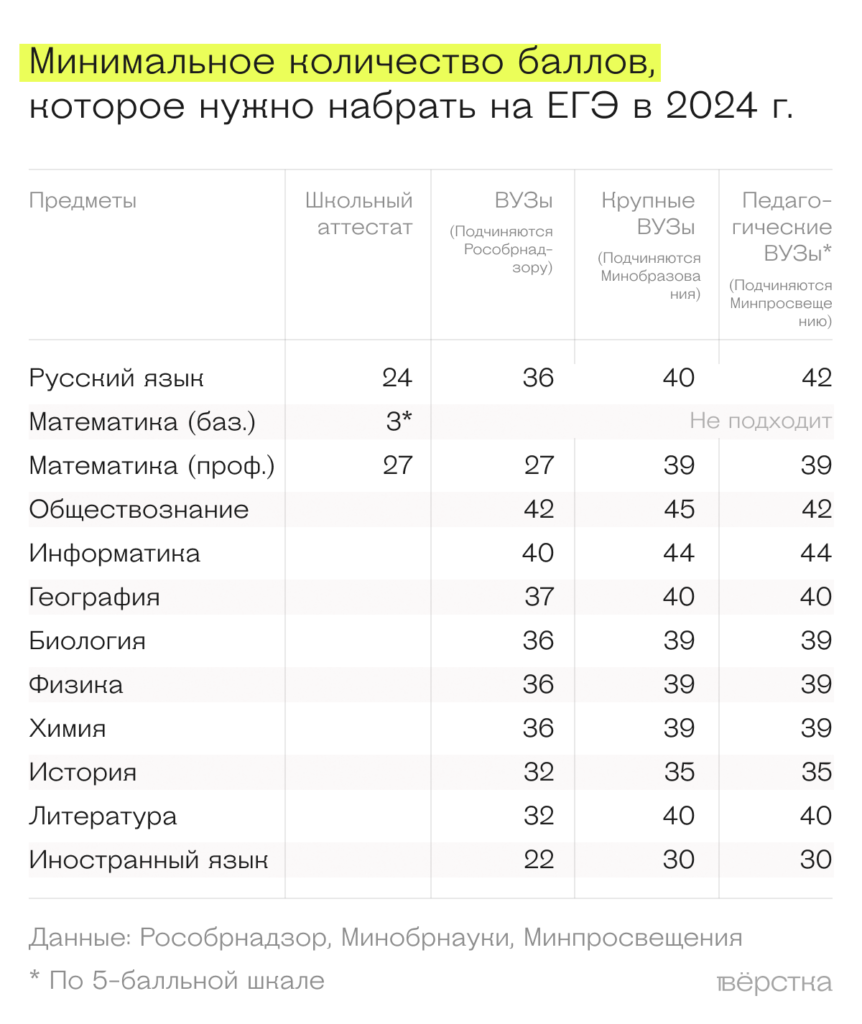
To obtain a school certificate, you must pass the Unified State Exam in two compulsory subjects. In the Russian language you need to score at least 24 points on a 100-point scale. The mathematics exam can be taken in one of two options: basic and specialized. Results on the basic exam are assessed on a 5-point scale. According to it, the minimum bar for obtaining a certificate is a three. In specialized mathematics, you need to score at least 27 points for a certificate.
The minimum scores for admission to universities are higher. There are three different sets of minimum scores, which are set for subordinate universities by Rosobrnadzor, the Ministry of Education and Science, and the Ministry of Education. The latter has jurisdiction over 38 pedagogical universities, which are listed on the ministry’s website . The Ministry of Education and Science sets minimum scores for 219 universities; their list is listed on the website . Among them are mainly large universities, but not all, for example, there is no RANEPA. For other universities, minimum scores are set by Rosobrnadzor, which has lower requirements for all subjects. In the Russian language, Rosobrnadzor has a minimum bar of 36 points, the Ministry of Education and Science - 40, and the Ministry of Education - 42. For admission to programs that take into account the Unified State Examination in specialized mathematics, Rosobrnadzor has set the bar at 27 points, the Ministry of Education and Science and the Ministry of Education - 39 points. In social studies, the Ministry of Education requires 45 points - three more than the Ministry of Education. Otherwise, the requirements of the two organizations are the same. A complete list of all subjects is in the table below.
Passing points for university 2024
For admission to universities, passing scores are important, which are added up annually during a competition between applicants. The average score of those admitted to government-funded places in 2023 was 70.38, said Deputy Head of the Russian Ministry of Education and Science Dmitry Afanasyev. In 2022, it was slightly higher at 71.1. The Higher School of Economics (HSE) estimated this indicator lower in 2022 - at 70.3 points. The average score for the paid department in 2022 was 65.5. The HSE has not yet published data on monitoring the quality of admissions for 2023.
In 2022, the average passing score for the budget in Russian universities, according to the Higher School of Economics, ranged from 41 points to 99. In 13 universities, the average score was 90. In first place was Tatarstan Innopolis with 99 points, followed by universities from Moscow and St. Petersburg. Among them were HSE, MIPT, MGIMO, St. Petersburg State University, ITMO. At MSU the average score was 88.9. In 16 universities the average score was below 50. Of these, nine were agricultural educational institutions, three were railway ones. The lowest average score was in the branch of the Baikal State University in Ust-Ilimsk, Irkutsk region - 41.6.
More and more government-funded places in universities are occupied by beneficiaries
It is becoming increasingly difficult for high-scoring students to enroll on a budget due to various types of benefit recipients. In 2024, targeted admission quotas were increased by 6% to 145 thousand. This is 23% of the total number of budget places. At the same time, in 2024 the number of budget places decreased by six thousand to 620.5 thousand compared to 2023. Earlier, in 2022, the number of budget funds was increased by 41.5 thousand.
For individual bachelor's degrees, the share of target enrollment varies from 5% to 50%. For example, shipbuilding and theater directing - 50%, aircraft manufacturing and housing and communal services - 40%, information security - 35%, nursing - 10%, nanotechnology - 5%. In 2020, “Important Stories” and “Transparency Russia” published an investigation that the children of officials are often “targeted”.
Another 10% of budget places are allocated to participants in the invasion of Ukraine and their children. Although last year in many universities they used only a small share of the allocated quotas. State Duma deputies explained this by the fact that many of these children’s current level of education does not allow them to study at universities, and some children are not yet old enough or did not know about this opportunity.
Regions in which applicants can apply to universities without the Unified State Exam
Due to the war in Ukraine, some applicants may apply to universities without the Unified State Exam.
At least until the academic year 2025-2026, students from territories annexed in 2022 do not have to take the Unified State Exam. They can receive a school certificate through intermediate certification - calculating average grades. They can enter universities using separate internal exams. According to the portal of the Ministry of Education and Science, about 2.5 thousand students still took part in the Unified State Exam. 210 eleventh graders are from the Zaporozhye region, the rest are from the DPR and LPR. There are none in the Kherson region.
The same relaxations were in effect in 2024 for schools in the Belgorod, Kursk and Bryansk regions. These border regions are suffering from shelling. In the Belgorod region, these rules apply in 284 schools - half of the total, in 40 schools (10%) in the Bryansk region and in all 434 schools in the Kursk region. According to the governor of the Belgorod region, Vyacheslav Gladkov, 70% of students from border areas decided to take the Unified State Exam.
Performance in final exams after the outbreak of war in the Belgorod region changed in different directions. In 2022, compared to the previous year, the average result on the Unified State Examination in the Russian language fell by one point to 70.6. In mathematics, the average score increased from 54.6 to 60.8.
Let us recall that earlier “Verstka” told us that bachelor’s degrees are being abolished in Russia and what this means for future graduates, as well as how the war has changed Russian schools : unified educational programs for everyone, textbooks with a chapter on “special operations”, the war with Ukraine in exams and active involvement in the “new pioneer” - this is only an incomplete list of innovations that Russian schools have faced, like public and private last year. We also wrote about the movement of “ Academicists ”: nationalist students who are now trying to gain political influence.
Cover: Dmitry Osinnikov
You can support “Layout” from any country in the world - it is still safe and very important. We really need your support now. How to help us →