
Translated material
Why read the dog?
How animals expand library experience
Joint reading with animal companies is a practice originated in American libraries and quickly spread around the world. However, in Russia, bibliotexicists are still perceived as a curiosity, and such classes are unsystematic. About why the attitude towards them should be reviewed, says Kanisterapev. Alexander Polev.Starting from February 24, 2022, we were all in the face of the advancing barbarism, violence and lies. In this situation, it is extremely important to preserve at least the remnants of culture and support the values of humanism - including for the sake of the future of Russia. Therefore, the editorial office of Gorky will continue to talk about books, reminding our readers that the world remains in the world and fiction.
Have you ever read a dog? Or a cat? Or maybe they heard about library dogs? No, not about those that like a cat of Dewey from the book of the same name were saved and extended by employees, but about those who themselves officially work in libraries.
Most likely, you will answer both questions (or at least one of them). So, this material, telling why it is worth reading to dogs and how animals help children develop this skill and instill in them love for books will be at least interesting for you.
I first learned about readings with dogs in libraries a few years ago. How exactly, I don’t remember anymore. But I was immediately interested in this project, since he combined two of my big loves - books and animals.
What is reading with dogs? Oddly enough, this is literally when the dog comes to the library and the child reads her book out loud. This is if it is very common. Then begins the “free program”, depending on who holds the event, in which library and the country.
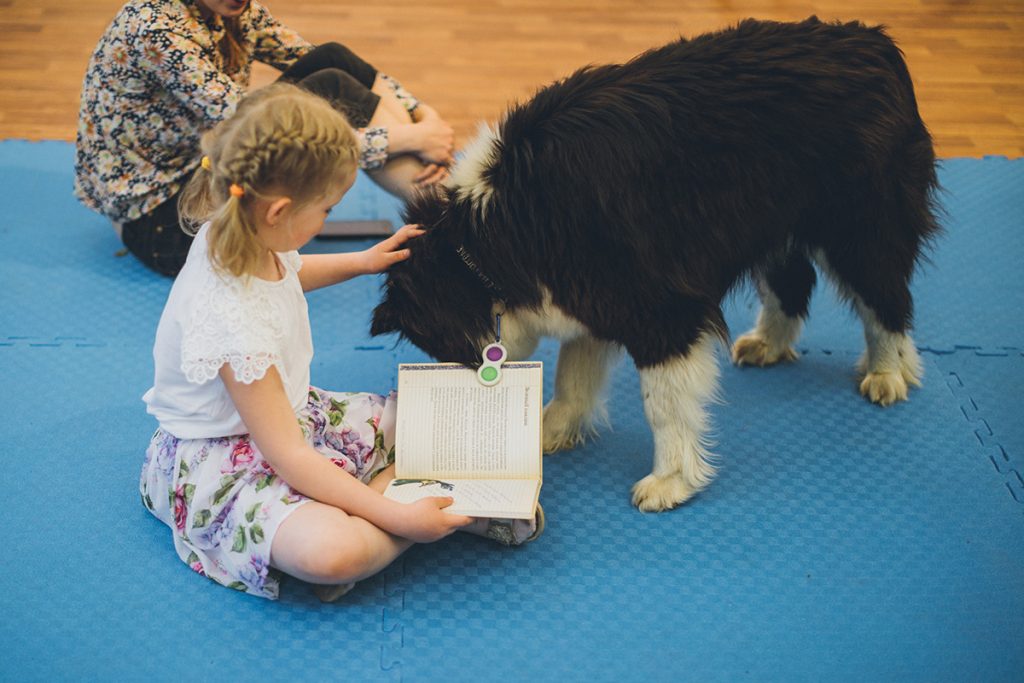 Photo: Olga Filonova
Dog readings were born at the end of the twentieth century in the United States, when a group of volunteers came up with the idea to bring pets to the library so that they play the role of listeners for small visitors. The idea turned out to be so successful that it soon spread throughout the States, and then completely went beyond their borders, going to conquer the world.
In Russia today, there is also a similar practice, and you can meet library dogs everywhere - from Kaliningrad to Magadan. Only now these are spontaneous stories initiated by volunteers and not always withstanding the test of time, as well as those who do not have any system or methodology.
And even despite such “wild” and randomly arising here and there, there are activities with dogs, they still work. How does this happen? And why?
In search of an answer to this question (however, not only to him) I learned to be a canister, I myself began to ride readings with pets, and now I get the second higher in the field of neurobiology. And after all my textbooks and practices, some idea of how it actually works, I began to take shape.
To begin with, what is reading in principle. Now, reading these lines, you probably do it easily and at ease, almost on the machine, without even thinking about how much effort and energy the brain spends in order to perceive the image of each letter, put them into words, and the words into sentences, deduct some meaning from their aggregate, keep in your memory that you have just run through your eyes ... in general, it is a very complicated cognitive process.
And now let's try to remember or, more precisely, to imagine (because it is unlikely that we will be able to remember), as we usually learn to read. If you went to school without owning a letter, then most likely you experienced additional stress in the form of ridicule of classmates and comments of teachers, or maybe parents. To the already difficult matter-to read something-criticism, disorder, distracting factors are added ... Where does the pleasure of reading and love for books come from? In addition, today they expect from children that, coming to school, they already know how to “write different letters”, and woe to someone who reads by syllables or does not know how to do it. As a result, reading becomes a real duties (if not punishment), which can not even occur to which he could not even come to mind.
Dogs are fundamentally changing the matter.
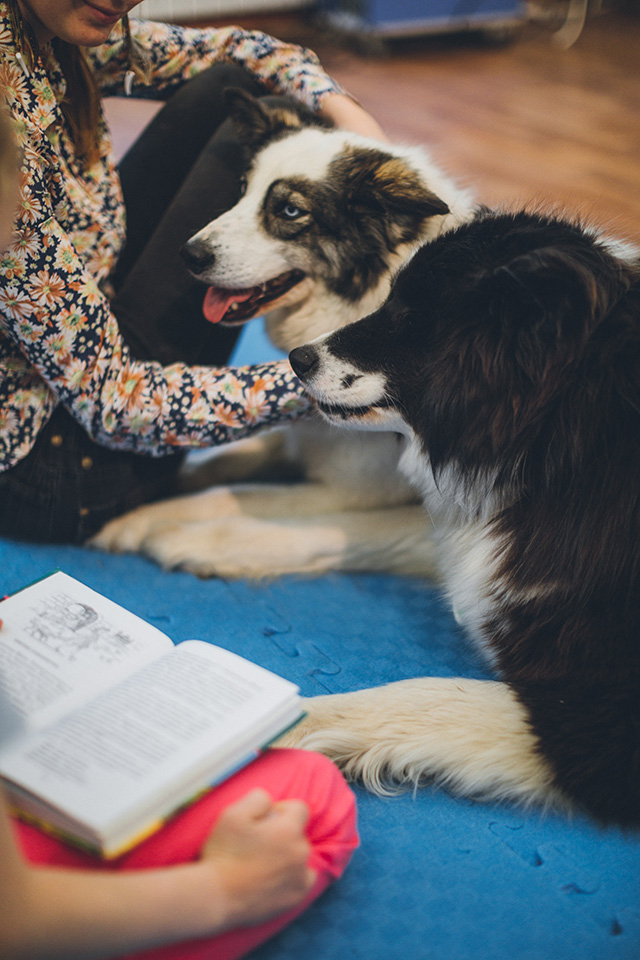 Photo: Olga Filonova
Firstly (for children, this is probably the main thing), reading the dog is cool, interesting and fun. In principle, she can not be read, but in general to do anything with her. And it will still be great. But if adults want you to read the dog, then what to do, you can spend time so. Moreover, this works even when the child has his own dog at home (stranger is still more interesting). Slightly expanding this item, it is worth noting that the child reads in an unusual atmosphere, not at school and not at home, which means that the previous (sad) experience of reading over him does not seem to do not finish. Or if it dominates, then it is slightly. That is, children no longer perceive it as a lesson or duty, but simply “a little strange” spend time with a dog. Although, as practice shows, it may look “strange” to us adults. Children usually do not ask the question, but why read the dog. They just take and do what adults told them.
Secondly, emotions and, of course, positive. They relax, liberate the child. But at the same time they do not turn him into anything not interested in a lazy person, but, on the contrary, contribute to training, increase the motivation and the desire to continue to do what brings pleasure. True, for this you usually have to “remove” other adults from the room (except, of course, a volunteer who has come with a dog and monitoring the safety of both an animal and a child). Because, again, as practice shows, almost every parent no, no, and will not restrain himself from correcting his child, telling him something, making a comment. And to eliminate such distracting and stressful factors, this activity is directed. The comments are upset and removed from mental balance, and parental control, which is still felt by the child by default, is somewhat in oppressing and does not allow to completely relax. The dog, on the contrary, acts as a relaxant and an incentive to continue reading.
With relaxation, a decrease in stress and positive emotions, they figured out. What else? Positive reinforcement. Dogs always only reward: they support the child and rejoice at successes with him. They listen, do not interrupt, do not scold, and at the end of the reading session is not averse to playing five to ten minutes. And this time, many volunteers who conduct such meetings with dogs are also laid for each child as part of classes. In parallel, in addition to working out reading skills, children learn how to communicate with pets and how to care for them. In fact, individual “kindness lessons” are obtained, which are sometimes carried out in schools.
What is still important is additional sensory stimulation. Rarely when such meetings take place without touching dogs, without treating them with treats. Moreover, often, when the child reads and nervous, he begins to (unconsciously) to stroke the dog, tug in her wool, wind it on the finger. This gives not just psychological support, but also tactile stimulation, which activates additional areas of the brain and gives a pleasant sensation. And again, reading from boring and severe duty turns into a process that brings joy.
 Photo: Olga Filonova
What dogs are suitable for this? First of all, of course, safe. Moreover, this applies to both aggression as a whole and fear - dogs in front of children. Because stress from communicating with a child can, firstly, make the behavior of the animal unpredictable if it suddenly sees a threat to a small person for itself, and secondly, it will harm him. Fortunately, the project to read dogs in libraries basically contains Win-Win strategy, when all participants in the process get pleasure and benefit, so no violence against the animal or special hold (dogs are usually in the room without a leash) is allowed. As for the character of the pet, I myself saw examples of how beautiful library dogs became both large phlegmatic dogs and small active dogs. Therefore, in this case, a lot depends on how the volunteer uses the features of his four -part partner and builds the interaction between the participants in the process.
Most often participate in such events, but there are exceptions. So, for example, in 2023, the Charity Fund for helping homeless animals “Good Together” decided to swing the idea of dog readings, and his wards began to go to the libraries.
Such meetings not only enable dogs to change the aviaries of shelters to rooms with books and chat with children, but also increase the chance to find a house in comparison with exhibitions-updates, where many animals are present at once, they are in stress, and potential owners run out of their eyes and choose one lucky one. And the animal participating in the readings has an unusual story that makes it instead of “one of many homeless” unique, “scientist”, library.
Can adults read their dogs? Of course! And although we, by default, perceive the letters surrounding us, putting them in words and sentences and extracting meanings from them, this does not mean that reading aloud the dog will not bring any benefit. Such a pastime will help to relax no worse than various relaxing practices. And your dog will probably be satisfied with such an interaction with the owner.
And a few more words about literature in the context of dog readings. In 2021, the Polyandria publishing house published the translated book “Maidelin Finn and the Library Dog”. And although it is intended for children, the role of such animals in changing the child’s self -awareness and gaining self -confidence is quite well shown in it when he begins to read better. Thanks to the dog.