
Translated material
Counting for the destroyed lives
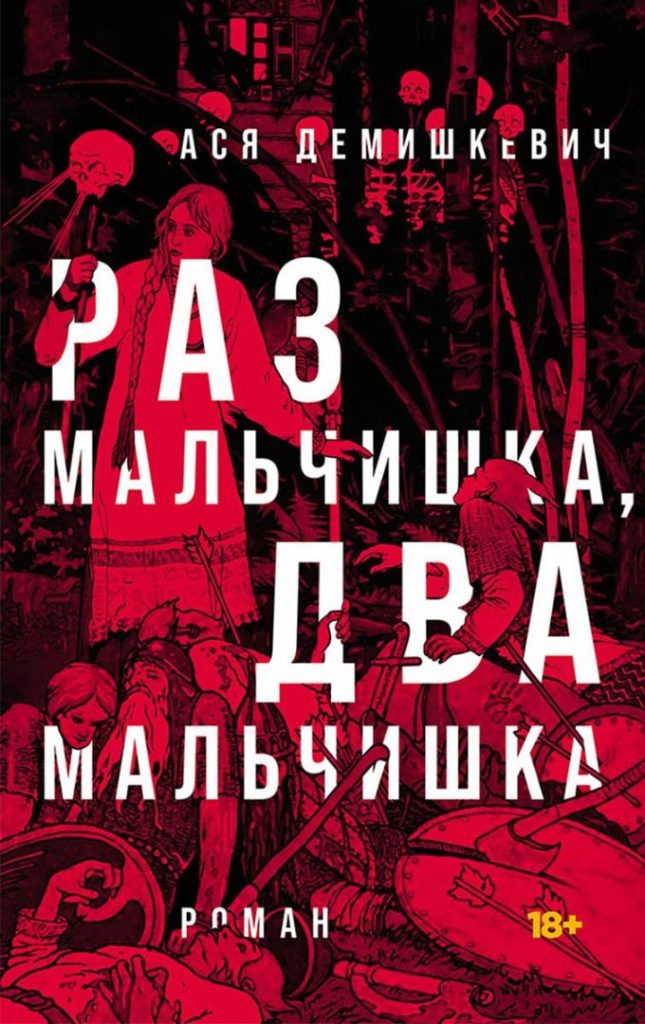
About the novel by Asi Demishkevich "Once a boy, two boys"
Roman Asi Demishkevich “times a boy, two boys” balances between a fairy tale and a folk-chorror, but in fact it is an relevant and bitter statement about the reality in which we all found ourselves after February 2022. Read about him in the material of Sergei Syzantsev.Starting from February 24, 2022, we were all in the face of the advancing barbarism, violence and lies. In this situation, it is extremely important to preserve at least the remnants of culture and support the values of humanism - including for the sake of the future of Russia. Therefore, the editorial office of Gorky will continue to talk about books, reminding our readers that the world remains in the world and fiction.
Asya Demishkevich. Since a boy, two boys. M.: Alpina Non-Fikshn, 2024
 Modern Russian -speaking authors only learn to talk about reality after February 24, 2022, but now you can notice genre diversity. Books where war is directly or indirectly mentioned can conditionally be scattered in the range from action -packed realism to anti -utopias.
The action of Triller Shamil Idiatullin "until February" takes place in 2021. The heroes need to hand over a new number of the reviving literary magazine “Flame” until February next year - this period is a refrain through the entire book. And although Roman Idiatullin does not affect the actual reality, the winter deadline set in the name of the book acquires an alarming sound in the reader's mind. The feeling of irreversibility of trouble and rock intensifies when the heroes in the final meet the 2022th with joyful expectations and familiar hopes, they say, the next year will be better.
Asi Volodina’s novel “Cicadas”, based on the script for the series of the same name “KinoPoisk”, touches on 2023. Volodina carefully circumvents the signs of time: her heroes are yearning for large foreign clothing brands, and a feeling of an impending end of the world is captured between the lines. This worldview looks organically among the heroes of old-ledges-the Zumers who are growing up with irremovable power and on the threshold of the Apocalypse, which was expected in 2012, and it came only now. Moreover, the phrase of Anton from Cicadas, when he speaks of his peers: “generation without a sequel” - that is, a generation without a future.
Finally, probably the most representative novel about reality after February 24 can be called the anti -utopia of Alexei Polyarinov “Kadavra” . In the book, the author represents an alternative to Russia of the future: in the fall of 2000 in several regions there are cadaurus - statues of dead children with salt deposits. After a short bustle, local residents are slowly getting used to the cades and continue to live a calm life: they say, well, these dead children stand and stand, do not bother anyone. Decades later, scientists have been created by the Institute of Mortal Anomalies, where they study cadavres, but soon their activity begins to interfere with the authorities - the institute is declared an “unwanted organization”, and everyone who worked there is “foreign agents”. In the unexpected appearance of the cadaurus and what happened next, the picture of the world is guessed after 2022. Polyarinov also does not speak openly about the war, but he hints at her in every possible way, so his “cadavers” are not so much anti -utopia in the usual sense of the word as the running line of relevant reality with the familiar words: “undesirable organization”, “foreign”, “special natural phenomenon”.
The novel of last year's finalist of the Lyceum Prize, Asi Demishkevich, “times a boy, two boys”, occupies a profitable middle here: on the one hand, folklore motives and following the principles of building a fairy tale give Roman Demishkevich obvious fairy tale, on the other, not a fabulous representativeness, where, it would seem, an abstract war, to which a ghostly ghost The command is preparing a soldier, reads as a very specific one, and fairy tales told by heroes - as a bitter reflection of reality. Demishkevich performs here like a storyteller who appeared at the beginning of Soviet fairy -tale films - it seems to speak directly about the war, but with some folklore wisdom.
Thirteen -year -old Andrei recently lost his mother. At school, he did not tell anyone about this, therefore, when his classmates will recognize the truth, they stigge him with the “son of Zombies”. The cruel stepmother decides to get rid of a problem stepson and sends him to the army. So Andrei turns out to be along with other conscripts on a field with bare beds. Nearby is a terrible forest, which, as it seems to Andrei, is approaching the camp every day, and an elderly nurse, similar to a woman-yaga, lives on the edge of it. There are no clear attitudes from unknown commanders, so the soldiers mainly do the camp work: they cook food, talk, think what will happen next, and look at the forest with apprehension.
Every evening, the distant command, using the body of one guy as a walkie -talkie, for a while, having taken his consciousness for a while, orders the soldiers to tell them fairy tales about the war, love for the homeland and traditional values. After that, the commanders will choose the best story and the worst. The winner is waiting for honor and praise, and the loser is a night in the forest, where, according to rumors, Strigac wanders - a forest monster, which abducts the boys and cuts them down, thus depriving them of memory and identity.
Like any fairy tale, Roman Demishkevich is relatively small and very simplified. In the main character, Andrew, from the first pages, a familiar fairy -tale combo gathers: the death of a loving mother, a hasty second marriage of his father, a cruel stepmother who does not allow a stepson to live calmly and invents an insidious plan to get rid of the boy. Andrei also has a secret, combined with mental torment, which will appear at the right time, and a certain artifact, from which everything begins: at the beginning of the book, Andrei pierces his ear, inserts the silver earring of his mother into it and thus starts a certain spring that sends him as a journey. The whole Roman Demishkevich fits into the hero’s usual path - with a call to adventures, allies, mentors, trials and a fight with the main villain.
The mechanism of a fairy tale helps Roman Demishkevich confidently to go along the road laid out by folklore motifs, so the subsequent plot simplifications do not seem to be the result of the author’s leftism. We willingly believe that in reality Andrei is taken into the army from the age of thirteen; that the commanders can take possession of the consciousness of one soldier at a distance in order to give orders through him; That a couple of living dead were flooded among the conscripts ("We then fell to death and were buried for a long time, but the agenda, she will find and will raise the dead, you know). A wide field with bunks and the infernal forest are also perceived as an important part of the setting, and here we have some semblance of a lim, in which the heroes are ill in a closed circle - from one fairy tale to another.
“Once a boy, two boy” can be called fairy tales in a fairy tale. Soldiers tell stories based on their own experience, so behind each fairy tale lies someone's fate, in which it is easy to recognize the cynical and cruel picture of reality. This effect intensifies, because each time fairy tales become darker and tougher. So Vova told the story of a boy who found out that he was born after his mother was raped at the front. Ivan told a fairy tale about a boy who loved his homeland so much that when he grew up, he killed everyone in a row, who did not share his patriotic feelings. Pashka, the only one in the detachment who showed sympathy and understanding towards Andrei, told the story of the unloved son, whom his father sent to the front; He returned already in the coffin, but somehow, before he died finally, he saw a white “Lada” and his father proud of his house in front of his house.
By default, the main villain in the novel by Demishkevich is a stagach whose image really inspires horror. However, soon we understand that the real evil lies in the guys themselves who are ready to comply with any order - even if it hurts a comrade. And they cannot disobey this order - they are afraid of the authorities, whom they did not even see. However, if you get up, you can feel sympathy for these soldiers, if only because they are confused young guys, and not marshmallows, who are ready to go on their heads to fulfill the “combat mission”. The guys can still try to fix, reason, dissuade - Andrei does not always succeed, but you always need to try, the author believes.
The novel “Once Boy, Two Boys” Asi Demishkevich is easy to blame for the straightforwardness and some unnaturalness of the protagonist. For example, compared with the remarks of the other characters, Andrei’s phrases look highly, and somewhere even pathetic (“I peered at her until I saw pain in her eyes and as if guilt”-this is exactly the teenager?). Minor details also raise questions: on one day, the command sends the soldiers an inappropriate and meaningless snowy toilet in the field, which in the future does not play any role. Finally, in the final, Demishkevich meets to the parable, reducing all the plot lines into complete uncertainty, which can be unraveled only at the level of associations.
Here, if you wish, you can recall the “Monster's Voice” by Patrick Ness, only if Conor is in friendly relations with the monster and thanks to him is reconciled with personal grief, then in the novel Demishkevich Andrei confronts the strigach, and the local pain and shame of the boy associated with the disease and death of his mother will be transformed into more-into collective guilt that can be applied to every Soldian character. For submission to the blind authorities. For the inability to recognize the essence of their terrible orders. For the readiness and calmness with which they are ready to betray their own comrades.
However, the foggy finale “times boys, two boys” can hardly be called a drawback. Considering the looseness of the present and doubts in the future, it would be unfair and reckless to demand the explanation from Demishkevich, especially since she had already written a very terrible, bitter and topical novel. “Once a boy, two boys” is not only a way to understand the present with the help of a fairy tale and a folk chorror, but also a bold anti-war statement. It all starts and ends with a counting, which seems to count the number of lives and destroyed fates. Who will she stop at the next time?